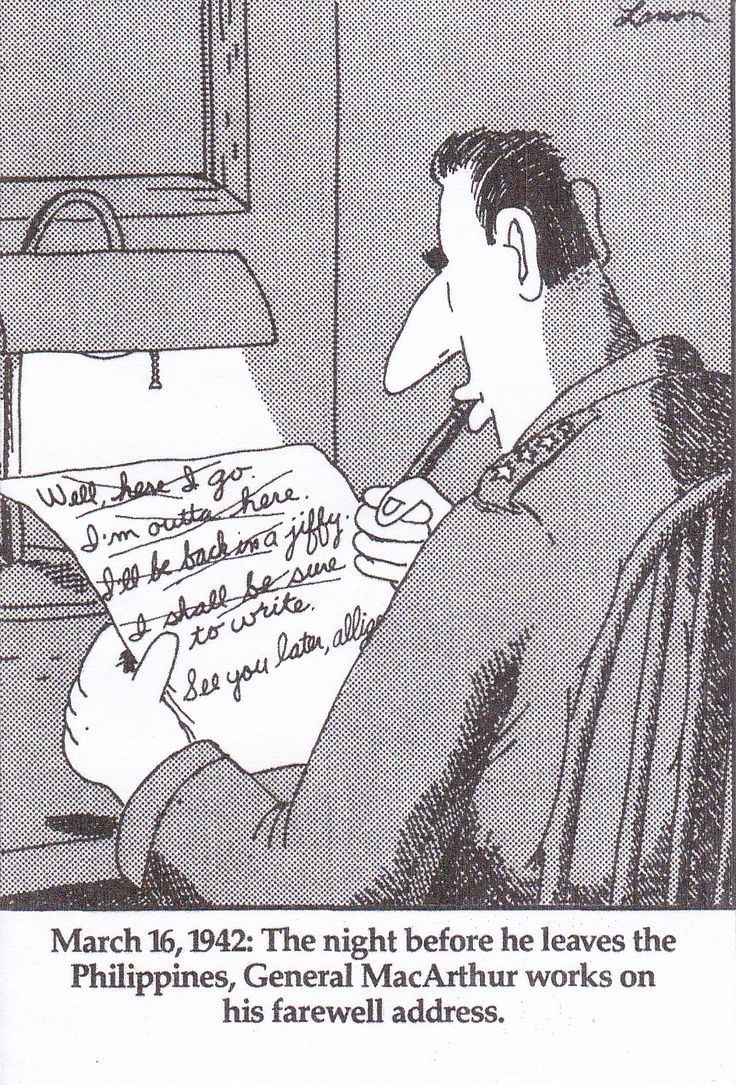
Done but for all the grading

Scattered throughout this semester, I’ve been discussing my EcoDevo course, Biol 4182, Ecological Development. It’s done now, so I’m just going to make note of a few things that I’d do differently next time around.

  • Fix the squishiness. I envisioned this as more like a graduate level course — a 15 week conversation on ecological development, with a textbook that kept us centered. Assessment was largely subjective, based on students demonstrating their understanding in discussion. I had an oral exam, for instance, where we just talked one on one. I think that went well, but in the end, I’ve only got a few specific metrics to use to assign a grade, and much of it will be built around how well they engaged with the material.

    I don’t mind that, but students are a bit bewildered by the absence of hard grades throughout the term. I’ll have to incorporate more detailed assignments next time around, something where they go home with a number that they can work on improving, artificial as all that is.

  • Personally, I greatly enjoyed the student presentations, and I want to do more to have students bring their interests to the course. I might include a student poster session next time — a different medium, and if in a public place, bringing in new perspectives.

    The oral exam was also valuable in getting to know where their interests were. I think I’d schedule it earlier in the term, when I do it again.

  • No way will I ever offer this course at 8am again. It was stuff that required interaction and attentiveness, and somedays it was tough to wake everyone up. These were really smart students, too, so the fault isn’t in them, but in timing.

    Maybe I’d do it at 8am if the college provided a big pot of coffee with donuts every day for the students in compensation. Hah, right.

  • One of the most dramatic effects on student participation was making it mandatory that they ask at least one question a day. Late in the course I added that requirement, and it worked surprisingly well — I could tell they were paying attention to try and find something to pursue further. They also asked good questions, so it wasn’t just pro forma noise. I’ll do that from day one in the future.

    It would be nice if that provided one of those non-squishy metrics I need to add, but it worked too well — they all met that minimal requirement easily. Guess I’ll just have to give them all As.

  • I was bad. I got summoned to Washington DC for important grant-related meetings twice during the semester, which rather gutted two weeks out of 15. That was unavoidable, but while I managed to cover the material in my syllabus, my hope that we could go a bit further and get into the evolution and development side of the textbook was thwarted. But then I never get as deeply into the subjects of any of my courses as I’d like.

    Next time, if I have planned absences, I’ll try to bring in colleagues from ecology or environmental science to cover for me, and keep the momentum going. I was really reluctant to do that this term because…8 goddamn am. I wasn’t going to ask that of anyone.

What I really got out of the course was getting to go in twice a week, even at an ungodly hour, and getting to think about more than just basic, familiar stuff. The core courses I teach in cell biology and genetics are fine, but fairly routine — I know those subjects inside and out, and the challenge is in improving the pedagogy, not in getting exposed to new science. +1, would do again.

Also, one of the best things about small upper-level classes like this is that I can get to know the students a little better, and they reaffirm my faith in humanity because they actually are smart and thoughtful and likeable (I can say that now, I’m not sucking up, because they’ve already done the course evaluation and turned it into the office). Maybe I should just give everyone an A+, with gold stars and smiley face stickers.

May the Fourth

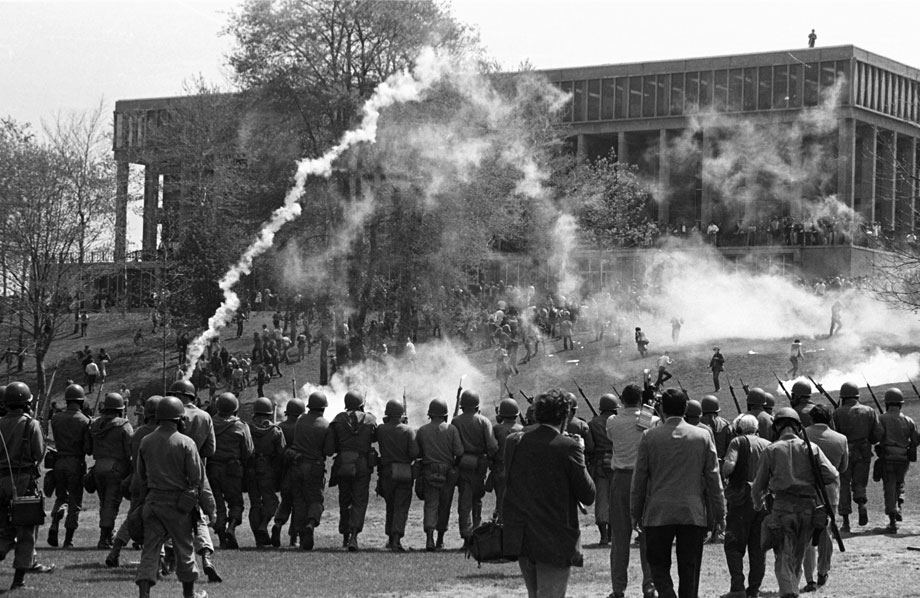
Y’all remember the true meaning of this date, right?

The National Guard fire tear gas to disperse the crowd of students gathered on the commons, May 4, 1970.

Slate

Don’t let the Star Wars jokes distract you from the fact that this is a day to remember the horrors of the police state.

Also note that the guardsmen who murdered four students got away with it. No surprise there.

You British and your fondness for understatement

Prince Philip, Duke of Edinburgh, has announced his retirement at the age of 95. I don’t quite see the point of retiring from a job as a figurehead, but I guess even Walmart greeters can expect to see some time off, so good for him. The BBC did report on it, and made this statement that made me laugh:

He is famed for off-the-cuff remarks he has made at royal engagements around the world over the years.

Yes, I suppose you could say that.

One down. So when are y’all getting rid of the rest of the royal family?

Today is the last day of teaching until August for me

I ought to sit back, laugh, and drink champagne, except, unfortunately, that tomorrow the deluge of term papers and lab reports washes up to my door and inundates my office with work. Then there’s the small matter of a final exam next week.

I’m thinking I may actually be done done next Wednesday.

But I’ll still find time to see the new Guardians of the Galaxy movie tomorrow!

The horrible two-headed rat

I’m not impressed with this recent exercise in microsurgical technique to allow researchers to transplant the head of one rat to another rat’s body. In all honesty, I don’t see the point.

I’m going to put the discussion of this paper below the fold because it seems more an exercise in animal cruelty than anything else; I’ve included one figure illustrating the surgery, but it will be at thumbnail size and you’ll have to click on it to see it in all its gory vulgarity.

[Read more…]

The Prestigious Robes of Science!

Don’t you just love it when people like @FerranSuay wrap themselves in the Prestigious Robes of Science and Evolution, and then make a series of statements that show they understand neither, and fail at logic to boot? A professor of psychobiology has written an essay in which he equates a refusal to make natural selection omnipotent with creationism. It’s a familiar and wrong tirade. I should have been keeping track of how often I get accused of being a creationist because I find evolutionary psychology poorly founded and full of sloppy research, because if I had, I’d have a really big number.

In academic environments it is very difficult to find someone who will openly and explicitly deny the principles of evolutionary theory. Professors and researchers from any scientific discipline will endorse, more or less accurately, the principles of natural selection, and everyone has a rough idea about what genes, chromosomes, and DNA are. Certainly, nobody will deny that we walk on two legs or have a hand with an opposable thumb because evolutionary pressures have shaped our anatomy in this way. And very few academics refuse to acknowledge that human brains underwent a unique frontal development, which clearly distinguishes them from those of other primates, and even those of our closest relatives, the great apes. This is accepted as an obvious consequence of the evolutionary process that has shaped life on Earth today.

But the situation is very different when we apply the same principles to the study of human behaviour. In this area, there are scientists prepared to deny any genetic influence whatsoever. Some will say instead that behaviour is wholly the product of social and environmental variables. Others will try to consistently minimize the explanatory power of genetics. But how can a species rid itself of the laws that govern the rest of life on the planet?

See the highlighted sentence? Name them. Go ahead. You should be specific in your claims if you’re in those science robes, you know. I don’t know anyone who fits that description, unless he’s thinking of some fringe New Age wackaloon like David Avocado Wolfe.

Only a few minutes of thought reveals all this to be extraordinarily unscientific.

Yes, I agree, that essay is extraordinarily unscientific. It’s not going to get better.

Are we to believe that evolutionary pressures, which have configured the anatomy of the body and the brain, cannot also be used to explain and understand the whys and wherefores of human behaviour? Everyone agrees that we have opposable thumbs because those of our ancestors born with this mutation possessed certain reproductive advantages and left more living descendants on Earth. As this trait continued to provide benefits to subsequent generations, it became so dominant it is now the norm for the vast majority of humans. The same can be applied to the standing position, and to the size and the particular anatomical configuration of the human brain. This is all uncontroversial.

We can credit all kinds of things to evolution, but this fellow has three major problems: 1) he thinks all of evolution is explained by natural selection, 2) he assumes that every single feature of the human form is adaptive, and 3) he has this overly simplistic notion that opposable thumbs are a product of a “mutation”. Every one of those points is false.

Do we need to go on after he reveals that all of his premises are wrong? Of course we do, for the spectacle of someone digging themselves a very deep hole.

Why should the same logic not apply to human behaviour? Let’s take physical aggression, for example—the tendency to impose on others through coercion. Didn’t aggressive individuals enjoy (some) reproductive advantages? Didn’t the most aggressive males climb the hierarchy of social groups thereby enhancing their ability to attract resources and mates? Didn’t that privilege the transmission of aggressive genes to the next generation? The statistics on violent crime reveal a very clear over-representation of the male sex. Without needing to study the numbers, anyone with eyes in their head can conclude that human males are generally considerably more physically aggressive than females.

That explains nothing. It’s a lazy, sloppy attempt to justify a patriarchal status quo without looking for any evidence.

The logic is wrong. If physical aggression is an advantage for men, why not also for women? Wouldn’t aggressive women enjoy some reproductive advantages? Don’t women experience hierarchical social groups? Why is this being framed as a male thing with arguments that should apply to all sexes?

And if you want to argue that submissive behavior is advantageous for women (somehow I suspect he would), wouldn’t it also be the case that submissive behavior would be advantageous for men? He has trapped himself in an argument that can work in any direction you want.

Let’s look at reality, too. Does this professor expect to climb the rungs of the hierarchy at the University of València with physical aggression? That would be truly remarkable. Universities are not purely intellectual meritocracies, but still — using violent crime to work your way up the ranks probably wouldn’t work. Social skills are far more important. Attempting to coerce one’s colleagues with a good punch-up or skillful use of a club will not get you far.

It’s nice of him to announce that you don’t need numbers, since he doesn’t have any.

However, unlike the shape of our hands, the standing position, or the anatomy of the brain, this trait is not a universally accepted product of evolution. Instead, it is a response to social conditioning, such as patriarchal education, the nefarious influence of the media, or the excessive availability of violent video games. In this scenario, miraculously, evolutionary pressures have no part to play, and the socio-environmental, psychosocial, or psycho-socio-environmental variables (we can keep on juxtaposing terms until we find a sufficiently abstruse formulation) are the sole determinants of behaviour.

There he goes again.

Look. This shouldn’t be so difficult to understand. You did not evolve to be well-adapted to your academic niche. Evolution gave us a plastic brain capable of learning and adapting — in an immediate, developmental sense, not an evolutionary sense — to diverse and complex circumstances. You are capable of both bashing in a competitor’s skull with a rock, or publishing papers to demonstrate your cognitive superiority (this guy ain’t doin’ so well on that front). We can simultaneously see that human minds have a genetic predisposition to process, understand, and use symbols, and a learned ability to speak Spanish, English, or Russian.

These are not hard concepts to reconcile. A genetic/biological substrate that has many predispositions and capabilities, plus a general ability to learn and modify behavior on the basis of experience is the obvious, universal, scientific understanding of the human mind. It is simply perverse to throw away the last part of that description and believe in strict genetic determinism of behavior.

But when psychologists deal with one of the most complex phenomena we know about, human behaviour, they must discard the methods that have proved useful, and the knowledge derived from them, and embrace a new faith; one that says that the cause of behaviour are to be found only in social and environmental variables. This is unscientific and intellectually dishonest—it is creationism by another name. Only it is “hidden,” because its advocates will not openly resile from evolutionist positions and, instead, drape their irrational beliefs in the prestigious robes of science.

Since genetics is relatively inflexible, it is only reasonable to assume that the cause of variation in behavior may be a product of learned experience. That there may also be some genetic biases between individuals is not off the table, but dang, guy, you’ve got to do a heck of a lot of work to show that.

Because science expects you to drop the pretentious Robes of Science and buckle down to work.

Speaking of place…

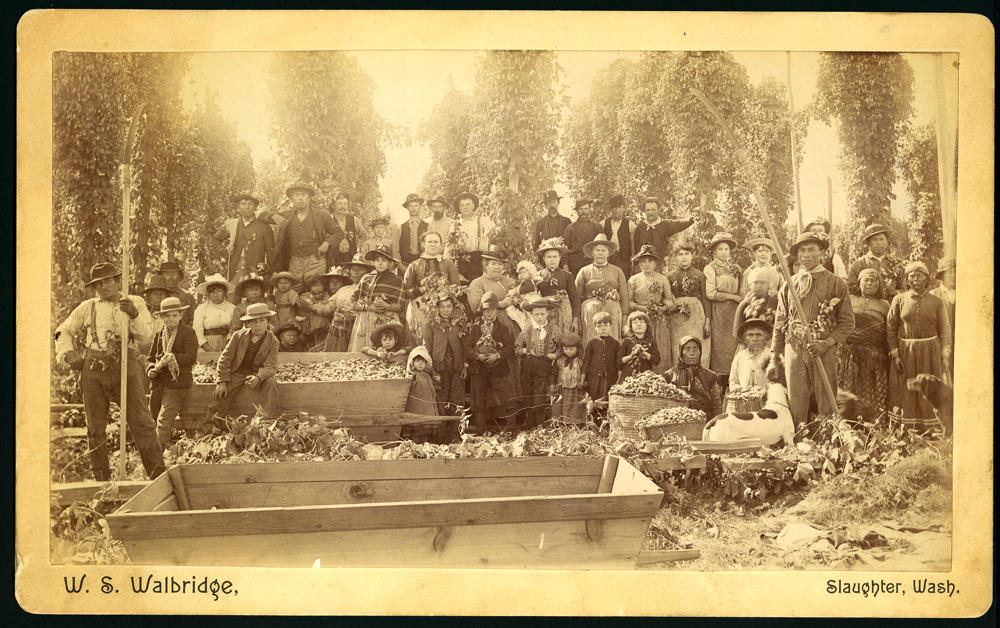
I grew up in Kent, Washington (so did my wife). That was long after this photo, though:

It was named for the region in England where hops were grown because, again before I was born, hops were the primary agricultural product around there. What I find fascinating, though, are the vestiges. The article names some of the early pioneers in that area — Ezra Meeker, Everett Titus — and I lived on Titus street, and the central business district was on Meeker. And that practice left a mark on the economy of the town.

The legacy of hops continues today, even though the Kent Valley is no longer farmland. When produce and dairy farming went away, existing railroad networks and flat farmland helped Kent scale up as a center of manufacturing and warehousing.

“We really built an infrastructure that even after hops left has become fertile ground for industry, for manufacturing, for warehousing,” Garfield said.

Yeah. I detested Kent when I was growing up. Warehouses. I lived through a transition, when the city was taking everything that was lovely and green and pleasant about the place, covering it with asphalt, and putting up warehouses all along the river, with the bonus of tearing down businesses to build more gas stations for the commuter population. Kent was a desert for human beings for a long, long time. I hear it has improved since then, but it couldn’t help bet get better.

I watched American Gods, and I liked it!

But then, I also liked the novel, which is not to everyone’s taste. It was refreshingly pagan, with a plethora of gods, and not much difference between a leprechaun and the king of the gods — they’re all manifestations of human belief, and since they merely reflect humanity, they tend not to be very nice. The show has an element of the surreal to it, too.

If you’ve read the book, you know that one of its featured elements is the Upper Midwest. In an interview with Neil Gaiman, the author makes that explicit.

“I couldn’t have written it without living in Wisconsin, and Minneapolis and St. Paul being the nearest big cities,” said Gaiman, chatting last week from a Los Angeles hotel where he was preparing for the world premiere of Starz’s TV adaptation of the book. “It just wouldn’t have worked.”

Gaiman, so thoughtful in responding to questions that you sometimes worry the phone line has gone dead, wasn’t referring so much to specific landmarks, such as the House on the Rock or the wintry landscape, both of which play pivotal roles in his 2001 book. He’s talking about the region’s general weirdness.

“There’s that tiny off-kilter nature in the Midwest that’s in the details,” said Gaiman, 56, who moved from England to Menomonie, Wis., in 1992. “I would enjoy stopping at a little restaurant somewhere and half the place would be selling peculiar stuff like … warrior princess dolls. That’s weird.”

As someone who has lived in the Pacific Northwest, the Desert Southwest, the East Coast, and now, Minnesota, I can confidently say that everywhere is a tiny bit off-kilter from everywhere else. The Midwest is not weirder than any other part of the country, but it does have a different flavor, and as someone who grew up in a place with mountains and evergreen trees and the ocean and temperate weather, long-term residence makes it feel like home-but-not-home, if you know what I mean. You live in it, but you’re not of it, and that small element of disconnectedness makes it uncomfortably interesting.

And now for something truly controversial

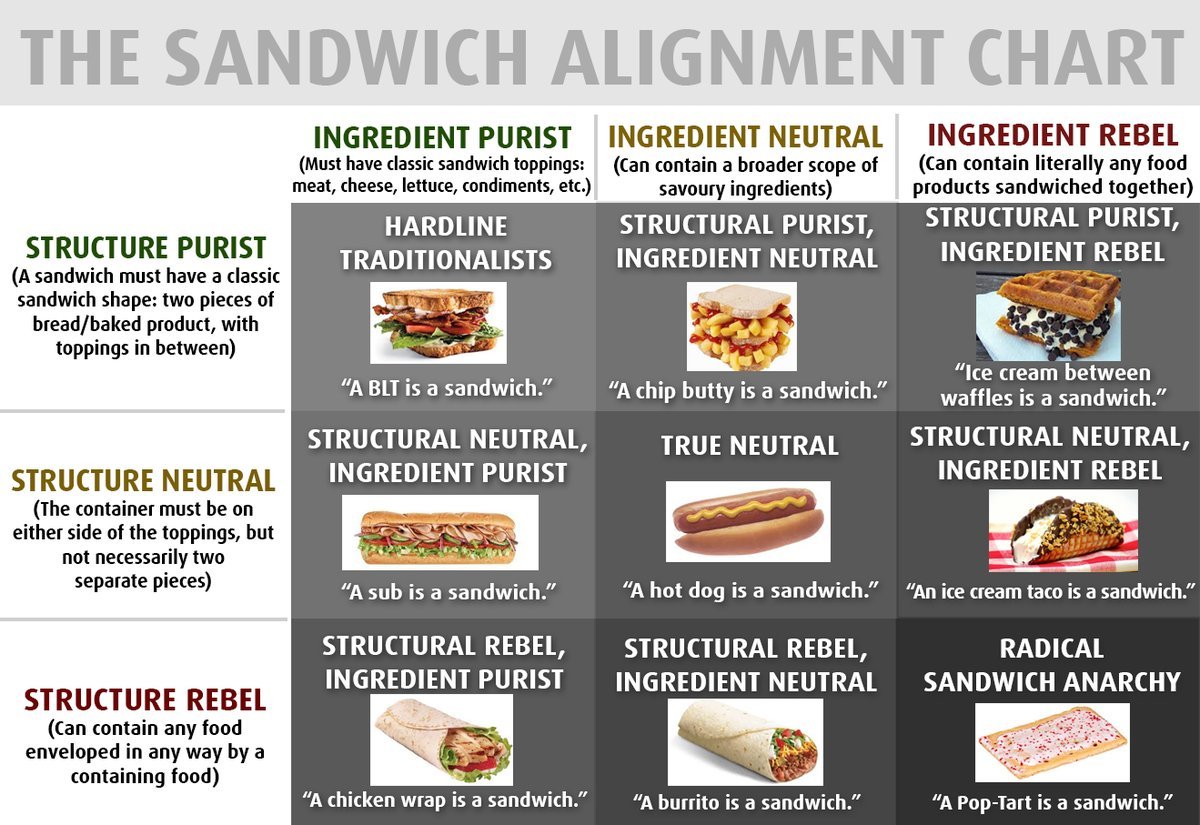
I’m not as open-minded as I thought. I was fine with everything on this chart, but my mind rebelled at “A Pop-Tart is a sandwich”.

My working definition is that a sandwich is some kind of filling wrapped in a bread so that you can hold it in your hand, which should accommodate a Pop-Tart…but it is making me question my understanding.

Persuade me, yes or no.