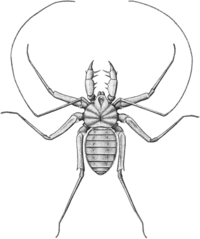
Sacrifices made in the name of lust

Some spiders have a serious problem: runaway evolution sometimes produces maladaptive conditions. Here’s a spider, Tidarren sisyphoides, that exhibits extreme sexual dimorphism — males have about 1% of the mass of the females.

Male and female T. sisyphoides in copula. The minute male (indicated by the arrow) on the female’s ventrum is ≈1% of the female’s mass. (The scale bar represents 1 mm.)

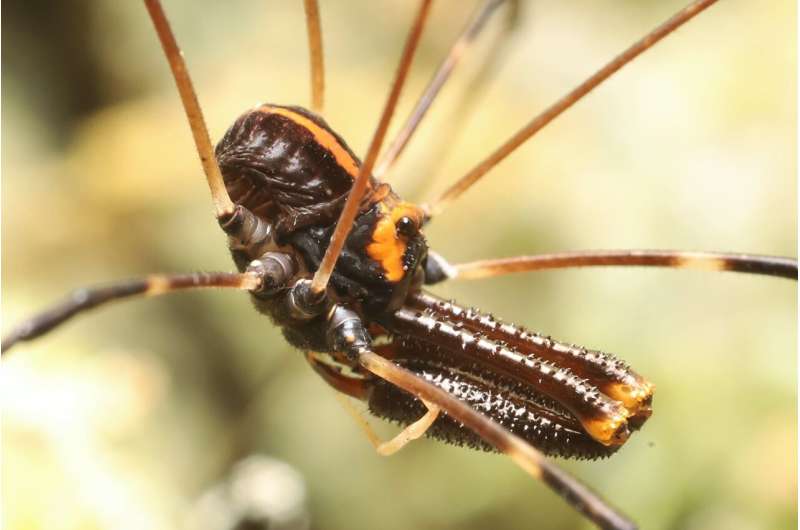
That’s not the problem, though. The problem is that the males maintain a massive pair of palps. Really gigantic. They probably clang when they walk. Look at these two big boys, and the monster intromittent organs dangling from the front of their faces.

You may notice that the top spider has the normal two palps, which are so large that they’re interfering with each other. The bottom spider has only one palp. The surprise is that this is a product of self-mutilation.

During copulation, males generally use both pedipalps in an alternating fashion to inseminate the paired spermathecae in the female. In Tidarren, however, one pedipalp is removed (either left or right pedipalp, seemingly at random) before sexual maturation which has also been described for another spider of similar size and closely related to Tidarren (Echinotheridion). Just after molting to the penultimate instar, the male secures one of its pedipalps to a silk scaffold and then twists it off by turning in circles and pushing the bulb with the third and fourth pairs of legs.

Ouch. There’s a reason for their partial emasculation, though.

We found that, for male Tidarren sisyphoides, maximum speed increased (44%) significantly and endurance increased (63%) significantly after pedipalp removal. Furthermore, spiders with one pedipalp moved approximately 300% greater distances before exhaustion and had a higher survival after exertion than those with two pedipalps. Removal of the pedipalp may have evolved in male Tidarren because of enhanced abilities to search for females (higher endurance and survival after exertion) and to out-compete rival males on the female’s web (higher maximum speed). Our data also highlight how the evolution of conflicts can result in the evolution of a novel behavior.

Not recommended for humans, unless your testicles are the size of basketballs.


Ramos M, Irschick DJ, Christenson TE (2004) Overcoming an evolutionary conflict: removal of a reproductive organ greatly increases locomotor performance. Proc Natl Acad Sci U S A 101(14):4883-7.

Summer research presentation time!

My students talked about their work today — this picture was taken before the crowds put them to work.

Violet took full advantage of the medium, a big screen connected to a laptop, and instead of a static display, the ‘poster’ rotated through a big collection of images. They had the prettiest poster of the group, as long as spiders are considered to belong to the category “pretty”.

MORE SPIDERS

I saw the mommy spider spin the egg sac on 21 August, and this morning, the 6th of September, they finally emerged. These are Parasteatoda tepidariorum — note the leopard pattern on the abdomen. That’ll turn into a more complex mottling as they get older. Also see how the legs are mostly pale, but with distinct bands.

Steatoda triangulosa has a longer incubation time of 30 days, and the spiderlings emerge with pale abdomens and black, hairy legs.

The important thing about this is that we can nail down how long the incubation period for both species is under our specific culturing conditions. Now we wait for the Steatoda borealis egg sac to hatch out so we know its incubation period. Then…comparative embryology!

By the way, the lab was hectic this morning, with 150 tiny baby spiders, each about 3/4 of a millimeter long, emerging all at once and immediately trying to disperse. There was a cloud of barely visible dots all radiating out instantly from the locus of their home vial, while I was frantically trying to gather up individuals and put them in separate containers. Some, I’m sure, escaped.

Hmmm, is it ever a good thing when a scientist says that?

Since I avoid posting spiders here, you’ll have to go to Patreon or Instagram to see the baby picture.

Shoes allow me to better serve my ravenous masters

I am pleased to report that for the first time in almost a month I am wearing shoes and socks, and have stuffed the ugly ol’ immobilizing boot in a closet. It feels like real progress at last. Next, I’m going to gingerly walk over to the lab and set up some class stuff and tend to my little beasties.

I know that this is the least exciting news you’ve ever heard — some guy is wearing shoes and socks! NY Times, get a reporter on that! — so here’s something that’s almost as newsworthy: false widow spiders kill and eat mammals larger than themselves.

The video shows a noble false widow’s web, located outside a bedroom window of the house in Chichester, with a small mammal ensnared in the silk. Later analysis of the mammal’s remains helped researchers identify it as a pygmy shrew.

The shrew was still alive in the web, the researchers report, although it was only seen making a few slight movements near the beginning of its ordeal. That’s probably due to the spider’s powerful neurotoxic venom, which is known to cause rapid neuromuscular paralysis.

The spider was seen moving back and forth between the shrew and the rafters above the window, using silk to hoist the shrew upward about 25 centimeters, the researchers report.

After 20 minutes, the spider had lifted its prey into the rafters, partially out of view. It wrapped the shrew in silk, fed on it for three days, and then dropped what was left out of its web.

According to the researchers, “the remains of the shrew were nothing but fur, bones, and skin”.

Now you know why, despite my recent travails, I still made the effort to guarantee the few hundred false widows in my lab a twice-weekly feeding. I don’t feed them rodents, but they do love big juicy mealworms that are at least fifty times their mass. They got fed yesterday, and today Igor…I mean, me…must extract the drained corpses. Next feeding on Tuesday.

Perfect sheet webs

We’re having a little unpleasant weather — high temperatures and sky-high humidity, to the point where this morning we were socked in with a gray mist. The good thing about that, though, is that it highlights all the grass spider webs in our lawn. These are perfect and beautiful.

Yes, we have a few weeds in our lawn. It’s a yard for diverse invertebrates, so that’s OK.

Leaves? The leaves have started to fall? It’s that time, I guess.

New acquisitions

I’m home from the exotic pet fair. I acquired a Chromatopelma cyaneopubescens! And a Northern Black Widow! They’re young juveniles, now I just have to fatten them up.

Photos will follow once I have them set up.

Update: I don’t think they were lesbian spiders

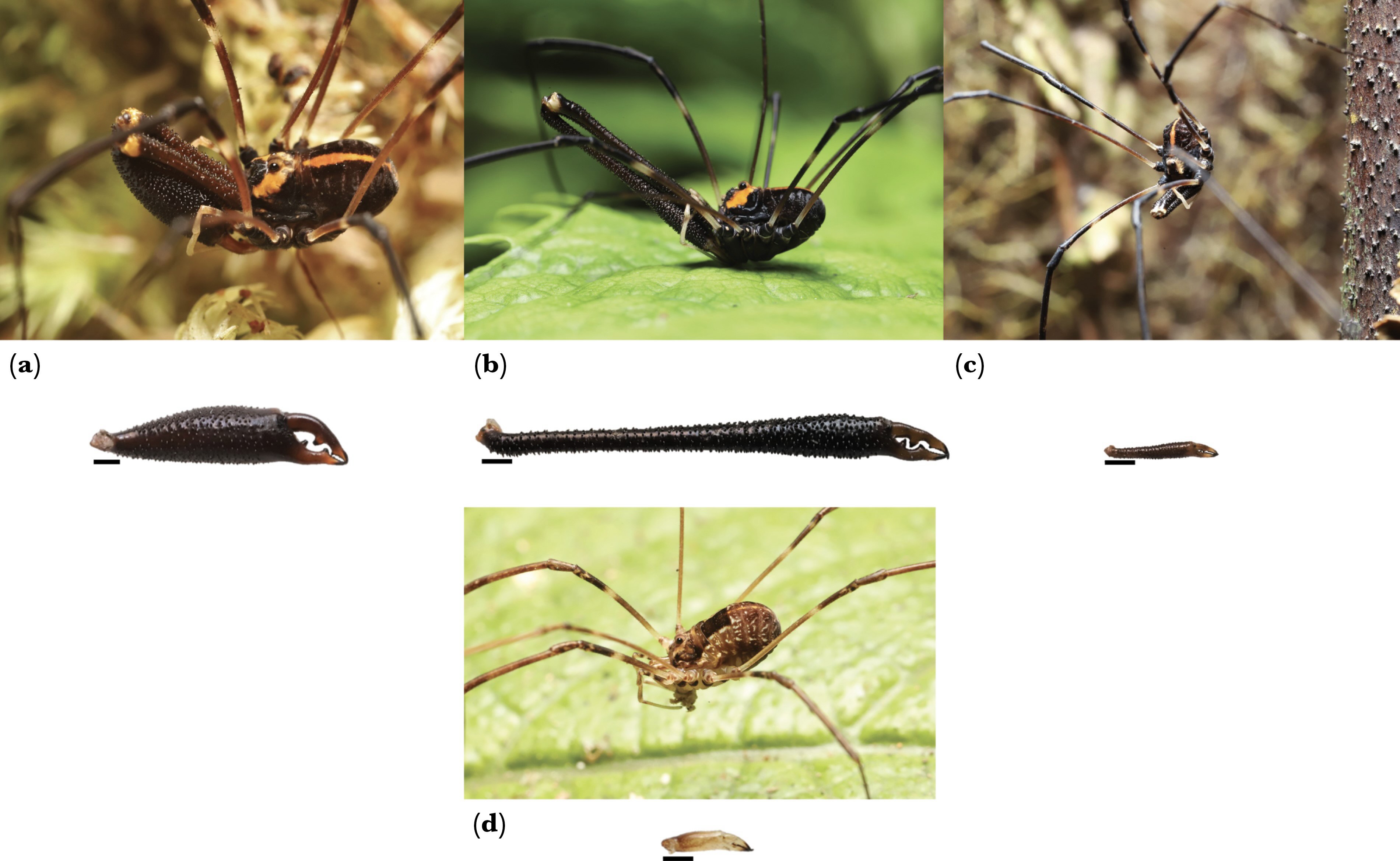
I’m sorry to disappoint, but looking at my Steatoda borealis population, I think what I’ve got are dimorphic males: some with huge spiky palps, some with slender pencil-shaped palps. I have no idea if these are distinct subtypes, or just developmental differences.

I have the full story on Patreon, and posted some photos on Instagram.

Lesbian spiders would have been cool, though, unlikely as that was.

Lesbian spiders? Dimorphic males? Precocious adolescents?

Yesterday, I set up a cage for Steatoda borealis. I haven’t successfully raised them in the lab, probably because I haven’t fine-tuned their environment, but I thought I’d give it another try. I caught these individuals living in a communal environment (my compost bin), so I made a substrate of moss, for burrowing in, and added 5 females, all in the same confined space.

I came in today, and what do I find? They’ve built a communal web and they’re all perched on it, spaced about 2cm apart. This is already interesting.

Something to know about S. borealis: the adult males are distinctive, they have palps that look like massive medieval instruments of war, while the females have slender palps. I was pretty confident I’d segregated them by sex accurately, on the basis of casual inspection.

So I added a male this morning. All the spiders seemed somewhat agitated, there was much scurrying and tapping and exploratory sensory behavior, as I would expect. The male was courting the biggest, plumpest female in the cage.
Then, to my immense surprise, two of the females (I think) paired off, and one of them was aggressively thrusting its skinny little palps at the others genitals. Whoa, what? Did I misgender them, or was this some kind of social behavior?
Then I get dragged away to attend some fucking meeting, and couldn’t inspect them more carefully. This was extremely annoying, as you might guess.

Now I’m intensely curious. I’ve searched the literature, there is no mention of male dimorphism in this species, but it’s an interesting possibility that warrants further investigation. The other possibility is female:female sexual behavior — these spiders are somewhat social compared to others I’m working with, so it could be some kind of bonding behavior? Another possibility is that I’m fooled by juvenile males that exhibit typical sexual behavior but just haven’t completed their final molt to acquire their gloriously developed sexual organs.

I’ll be putting them under the microscope tomorrow to find out.

I’m getting outta here!

Classes start in one week (there are also way too many meetings this week), and I’ve been housebound far too long, so this weekend is my last chance to escape for a bit before the crunch hits. And then I discover there’s an Exotic Pet Fair in Eau Claire this weekend. Perfect! It’s a twofer — I get to visit my granddaughter, and take her with us to go spider shopping. I’m in the market for a nice show tarantula for the lab, and maybe a black widow or two.

It’s not all spiders. They also have birds, reptiles, bunnies, guinea pigs, etc., so even a kid who isn’t that much into spiders should be entertained. I’ll also be glad to just get out for a day.

(Don’t worry — I’ll consult with experts, and won’t be getting any endangered species. If we get Latrodectus,I think I can keep them reliably confined. I don’t want to go do down in history as the guy who populated the basement with black widows, like the former professor who let cockroaches loose in the building.)