It’s a bad day for the MIT Media Lab. Hot off the resignation of their corrupt leader, Business Insider breaks a bizarre story that sounds a bit like the Theranos story: a non-functional technology turns out to have been pumped up with fake data and even faker promises. It’s something called The Personal Food Computer, which was going to revolutionize agriculture. Or maybe just urban agriculture. Or maybe just impress city-boys (excuse me: “nerdfarmers”. That’s what they actually call them) who have never seen a farm.
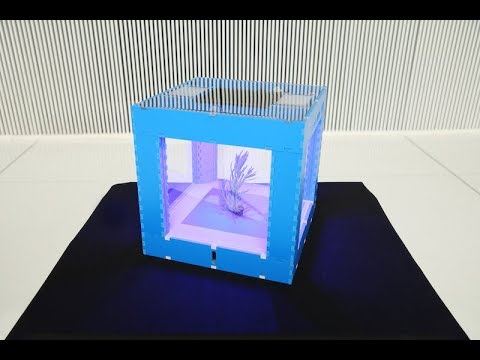
It’s a plastic box with some widgets under control of a computer that watch temperature and pH and lighting and spritz a plant inside it with water and nutrients. Just think, no dirt, and a computer will make sure it gets watered if you forget, and at the end of a few weeks or months, you find food inside the box, maybe a sprig of basil or a tomato! This box, and your hypothetical tomato, will only cost you about $500 to build and take up a desktop in your apartment.
(I literally groaned at Harper’s naive babbling about genetics, I’m afraid.)
Am I alone in thinking this idea, even if it worked, was ridiculously stupid? I’m living in the Midwest, in the midst of farm country. When I drive to the big city of Minneapolis, I pass through about 150 miles where all I see on either side of me is corn and soybeans, each individual plant of negligible value, growing with negligible individual care (in aggregate, it’s expensive in time and labor), without computers tweaking each plant along. It’s what plants do. Farmers don’t have the time or money to nurse each 1m2 of cropland along with personal attention and a dedicated computer. I don’t understand the point of this gadget at all. My wife planted a little circular garden in our backyard, maybe 5 meters in diameter, and right now I’m buried in somewhere around 50kg of tomatoes.
This box is the most useless over-hyped technology ever. I wonder how much Jeffrey Epstein invested in it?
That’s assuming it worked. Surprise! It doesn’t!
The “personal food computer,” a device that MIT Media Lab senior researcher Caleb Harper presented as helping thousands of people across the globe grow custom, local food, simply doesn’t work, according to two employees and multiple internal documents that Business Insider viewed. One person asked not to be identified for fear of retaliation.
They had to salt their demos with plants bought elsewhere. Even the one use I could imagine for them, as educational tools in schools, flopped.
In the Spring of 2017, Cerqueira was part of a pilot program that delivered three of Harper’s devices to local schools in the Boston area. Initially, the idea was for the students to put the devices together themselves. But Cerqueira said that didn’t work — the devices were too complex for the students to construct on their own.
“They weren’t able to build them,” Cerqueira said.
In response, Cirque’s team sent three MIT Media Lab staff to set up the computers for them. Of the three devices the staff members tried to setup, only one was able to grow plants, she said. That one stopped working after a few days, however.
When Cerqueira and her coworkers would visit the school, students would joke that the plants they were growing in plastic cups were growing better than the ones in the personal food computers, she said. The pilot ended shortly thereafter.
On another occasion, her team sent two dozen of the devices to classrooms across greater Boston as part of a curriculum being designed by one of MIT Media Lab’s education partners.
“It’s fair to say that of the 30-ish food computers we sent out, at most two grew a plant,” Cerqueira said.
I like that there plastic cup with dirt technology. I’ve done that. It works. Cheap, too. Maybe “nerdfarmers” should try investing in that.
MIT isn’t exactly basking in glory lately. It’s a shame.