Spider identification agonies. Species are lies.

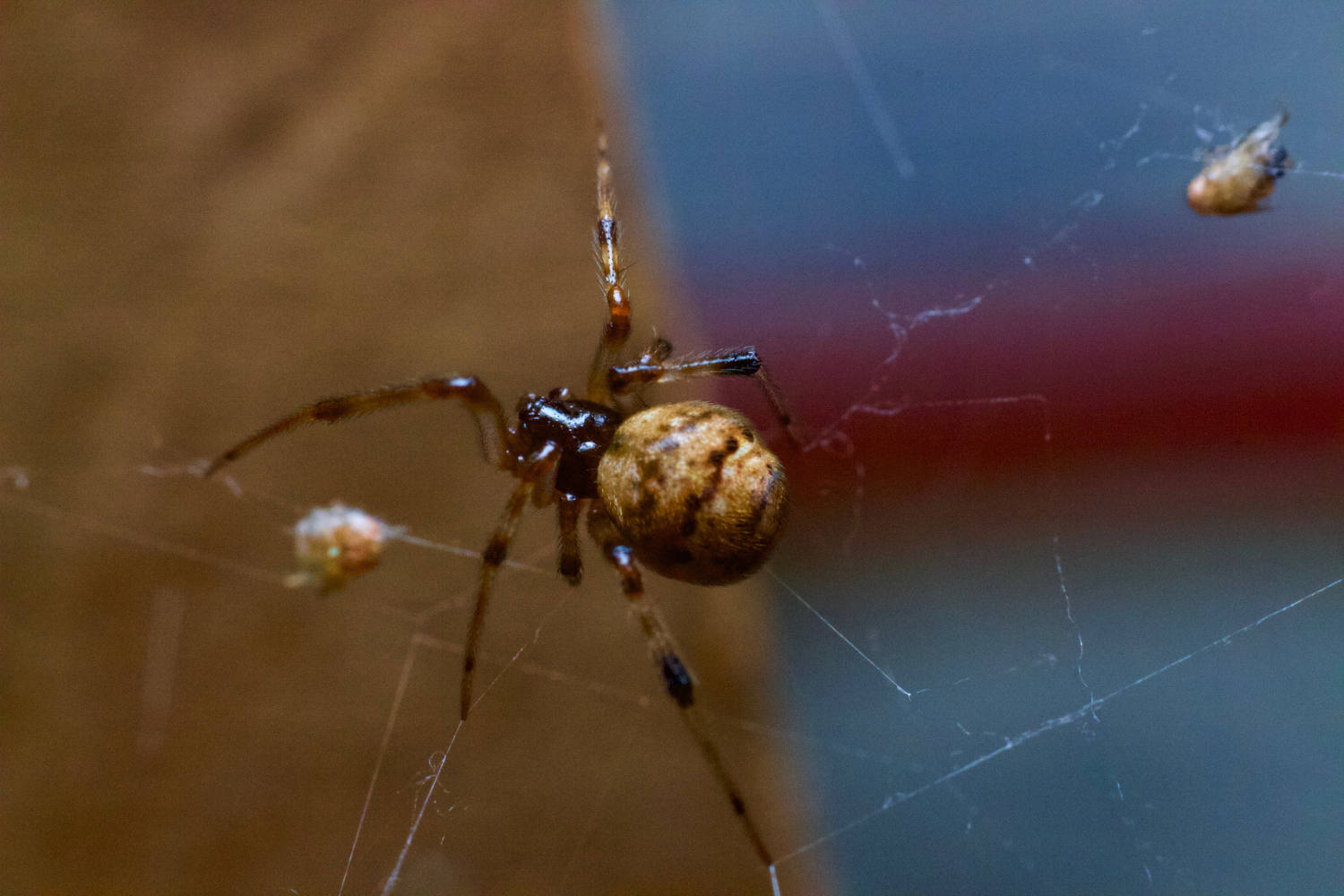
Spider taxonomy drives me cross-eyed. Today I was working on sorting egg sacs, tearing them away from their mommies, who don’t like that one bit — they’re very protective. I’m learning to tell the different species apart without a microscope. For instance, Steatoda triangulosa has a distinctive zig-zag of pigment on their abdomen that looks like a row of triangles from above, and they also have nearly spherical egg sacs that are white, have a fluffy surface, and are often semi-transparent. Parasteatoda, on the other hand, has an irregular mottling that sometimes looks roughly stripey, and their egg sacs are football-shaped, beige, and have an opaque leathery/papery surface (there are two species of Parasteatoda around here, P. tepidariorum and P. tabulata, which I haven’t learned to distinguish — it requires careful scrutiny of their genitalia — and my live spiders refuse to sit still long enough to poke around their private parts). Those are my rules, they’re what helps me figure out who is what.

So today I’m parting Lyanna from her egg sac…here’s Lyanna:

[Read more…]

Disgusting

The Mirror has an article on a man who claims to have been so severely bitten by spiders that he can’t work. You probably don’t want to read it: it’s mainly lots of close-up, full-color photos of oozing, infected wounds full of pus, and it’s going to horrify and sicken most people. There is one photo of a large false widow, but there is no connection between it and the person’s injuries, and I have to suspect something else is going on here.

The man and his son have multiple lesions all over their legs…how? These are solitary spiders, mostly, and they have no interest in biting people. One bite, I could believe; if you rolled over in bed on one, crushing it, it might bite in self-defense. But numerous bites? This makes no sense. Ticks, bedbugs, that sort of nasty beastie that actually feeds on humans, I could see, especially since those kinds of bites are recurrent and prone to infection.

This is not the first time I’ve seen the UK tabloids freaking out about spider invasions. What’s going on over there? Is this a symptom of rising xenophobia? Can I expect US tabloids to start inventing lurid stories of evil spiders killing people in their beds?

Gilly’s breakfast

I know what you’re all saying: I haven’t been posting as many spider photos lately. Guilty as charged. In my defense, classes have started up, and I’m busier, and I’ve already got grading to do, and I’ve got all these students, and…

OK, you don’t want to hear about it. So this morning I fed a few of the spiders and tried to get some action shots.

[Read more…]

We can all do something

Yesterday was Morris’s Prairie Pioneer Days parade, one of those small town events where local people cruise slowly down main street to praise small town virtues, like, you know, royalty.

Or local businesses.

(The restaurant Mi Mexico had the best float, I think: gorgeous costumes, people dancing, great music. Mostly what we had was some guy in a pickup truck with a sign glued to the side.)

UMM was represented.

I had joined with some of our students who were marching to advertise a climate action event. This was their float.

I know, it was a little green wagon that they pulled down the street. We were surrounded by the local Chevy dealership, our regional Republican assholes (Jeff Backer and Torrey Westrom) and these guys:

It was kind of creepy, actually, that while we were waiting in the pre-parade lineup, these guys were sitting in their truck, staring at us, looking like they wanted to teach us a lesson or two. We ignored them, and just had a grand time going down the street handing out candy to kids and giving them flyers about our plans.

And what where those plans? I think a lot of young people are inspired by Greta Thunberg, who has said “Our house is on fire – let’s act like it.” They’re planning a Global Climate Strike, with our own implementation here, with a West Central MN Climate Strike. They want us to go on a general strike, just shutting down all that we can (especially classes) on 19-20 September.

I can do that. I will do that. Will you?

Do it for the youth.

Prophets of Doom vs. Scientists with a Plan

Jonathan Franzen is wildly incoherent. He’s written this terrible mess of a piece that veers between “We’re doomed, climate change is unstoppable, trying will bankrupt us” to “gosh, won’t it be great when civilization collapses and the survivors are living on love and peace?”, and it’s infuriatingly bad. All you need to know is that he explains his method for scrying the future.

As a non-scientist, I do my own kind of modelling. I run various future scenarios through my brain, apply the constraints of human psychology and political reality, take note of the relentless rise in global energy consumption (thus far, the carbon savings provided by renewable energy have been more than offset by consumer demand), and count the scenarios in which collective action averts catastrophe.

The editors at the New Yorker should have read that and realized, by his own admission, Franzen is a crank, and that publishing this crap would be an embarrassment, and they should have pulled the plug. Franzen, though, is a Famous Author, a fact that impresses the New Yorker unduly and leads to a failure of judgment.

I think I’ll get my information from real scientists who actually use data to arrive at their conclusions, like Michael Mann, who published this article, Doomsday scenarios are as harmful as climate change denial, two years ago.

The evidence that climate change is a serious challenge that we must tackle now is very clear. There is no need to overstate it, particularly when it feeds a paralyzing narrative of doom and hopelessness. Some seem to think that people need to be shocked and frightened to get them to engage with climate change. But research shows that the most motivating emotions are worry, interest and hope. Importantly, fear does not motivate, and appealing to it is often counter-productive as it tends to distance people from the problem, leading them to disengage, doubt and even dismiss it.

It is important to communicate both the threat and the opportunity in the climate challenge. Those paying attention are worried, and should be, but there are also reasons for hope. The active engagement of many cities, states and corporations, and the commitments of virtually every nation (minus one) is a very hopeful sign. The rapid movement in the global energy market towards cleaner options is another. Experts are laying out pathways to avoid disastrous levels of climate change and clearly expressing the urgency of action. There is still time to avoid the worst outcomes, if we act boldly now, not out of fear, but out of confidence that the future is largely in our hands.

There is a huge difference between “This is a huge problem, resign yourself to defeat” and “This is a huge problem, we’re going to have to work very hard to overcome it.” Who are you going to listen to, a competent and credentialed scientist in an appropriate field, or a crankypants author with weird ideas about underwear?

You know, the biggest change you can implement right now is to throw the science denialists out of political office. Get to work on that, then we can start implementing changes that would help.

Them goofy city-folk and their weird ideas

It’s a bad day for the MIT Media Lab. Hot off the resignation of their corrupt leader, Business Insider breaks a bizarre story that sounds a bit like the Theranos story: a non-functional technology turns out to have been pumped up with fake data and even faker promises. It’s something called The Personal Food Computer, which was going to revolutionize agriculture. Or maybe just urban agriculture. Or maybe just impress city-boys (excuse me: “nerdfarmers”. That’s what they actually call them) who have never seen a farm.

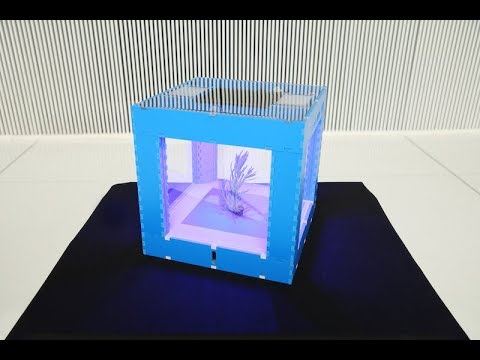
It’s a plastic box with some widgets under control of a computer that watch temperature and pH and lighting and spritz a plant inside it with water and nutrients. Just think, no dirt, and a computer will make sure it gets watered if you forget, and at the end of a few weeks or months, you find food inside the box, maybe a sprig of basil or a tomato! This box, and your hypothetical tomato, will only cost you about $500 to build and take up a desktop in your apartment.

(I literally groaned at Harper’s naive babbling about genetics, I’m afraid.)

Am I alone in thinking this idea, even if it worked, was ridiculously stupid? I’m living in the Midwest, in the midst of farm country. When I drive to the big city of Minneapolis, I pass through about 150 miles where all I see on either side of me is corn and soybeans, each individual plant of negligible value, growing with negligible individual care (in aggregate, it’s expensive in time and labor), without computers tweaking each plant along. It’s what plants do. Farmers don’t have the time or money to nurse each 1m2 of cropland along with personal attention and a dedicated computer. I don’t understand the point of this gadget at all. My wife planted a little circular garden in our backyard, maybe 5 meters in diameter, and right now I’m buried in somewhere around 50kg of tomatoes.

This box is the most useless over-hyped technology ever. I wonder how much Jeffrey Epstein invested in it?

That’s assuming it worked. Surprise! It doesn’t!

The “personal food computer,” a device that MIT Media Lab senior researcher Caleb Harper presented as helping thousands of people across the globe grow custom, local food, simply doesn’t work, according to two employees and multiple internal documents that Business Insider viewed. One person asked not to be identified for fear of retaliation.

They had to salt their demos with plants bought elsewhere. Even the one use I could imagine for them, as educational tools in schools, flopped.

In the Spring of 2017, Cerqueira was part of a pilot program that delivered three of Harper’s devices to local schools in the Boston area. Initially, the idea was for the students to put the devices together themselves. But Cerqueira said that didn’t work — the devices were too complex for the students to construct on their own.

“They weren’t able to build them,” Cerqueira said.

In response, Cirque’s team sent three MIT Media Lab staff to set up the computers for them. Of the three devices the staff members tried to setup, only one was able to grow plants, she said. That one stopped working after a few days, however.

When Cerqueira and her coworkers would visit the school, students would joke that the plants they were growing in plastic cups were growing better than the ones in the personal food computers, she said. The pilot ended shortly thereafter.

On another occasion, her team sent two dozen of the devices to classrooms across greater Boston as part of a curriculum being designed by one of MIT Media Lab’s education partners.

“It’s fair to say that of the 30-ish food computers we sent out, at most two grew a plant,” Cerqueira said.

I like that there plastic cup with dirt technology. I’ve done that. It works. Cheap, too. Maybe “nerdfarmers” should try investing in that.

MIT isn’t exactly basking in glory lately. It’s a shame.

Friday Spider

I knew who I was cheering for — my spiders are combfoots, too, and the behavior I see in this video is exactly what I see in my colony. The careful guarding of egg sacs, the swift wrapping of prey, that disabling bite once the target was helpless is exactly what I was watching in the lab this morning. Very cool.

We also got several new egg sacs this morning. I’m feeling a bit overwhelmed, paternally. Anyone want pet spiders around here?

(The answer is no. Well, I’m just going to have to drop them off in their forever homes without the knowledge of their new parents.)

Plant trees!

I think this article hits the nail on the head: Stop Building a Spaceship to Mars and Just Plant Some Damn Trees. Basically, if you want a machine that will suck carbon dioxide out of air and lock it up so it doesn’t contribute to climate change, we’ve already got one. It’s called a tree. They’re cheap and easy and they build themselves, and further, they look good. There’s no NIMBY phenomenon here!

All we have to do is plant a heck of a lot of trees, and they can sequester 200 gigatonnes of carbon out of the atmosphere. All this is from a paper in Science that calculated about how much land area is available for planting trees, and suggests that we should work fast to use that area.

The restoration of trees remains among the most effective strategies for climate change mitigation. We mapped the global potential tree coverage to show that 4.4 billion hectares of canopy cover could exist under the current climate. Excluding existing trees and agricultural and urban areas, we found that there is room for an extra 0.9 billion hectares of canopy cover, which could store 205 gigatonnes of carbon in areas that would naturally support woodlands and forests. This highlights global tree restoration as our most effective climate change solution to date. However, climate change will alter this potential tree coverage. We estimate that if we cannot deviate from the current trajectory, the global potential canopy cover may shrink by ~223 million hectares by 2050, with the vast majority of losses occurring in the tropics. Our results highlight the opportunity of climate change mitigation through global tree restoration but also the urgent need for action.

There’s a catch, though. A lot of this land is owned and/or inefficiently used. The authors try to take that into account.

In total, 4.4 billion ha of canopy cover can be supported on land under existing climate conditions. This value is 1.6 billion ha more than the 2.8 billion ha existing on land today. Of course, much of the land that could potentially support trees across the globe is currently used for human development and agriculture, which are necessary for supporting an ever-growing human population. On the basis of both the European Space Agency’s global land cover model and on Fritz and colleagues cropland layer, we estimate that 0.9 billion hectares are found outside cropland and urban regions and may represent regions for potential restoration. More than 50% of the tree restoration potential can be found in only six countries (in million hectares: Russia, +151; United States, +103; Canada, +78.4; Australia, +58; Brazil, +49.7; and China, +40.2), stressing the important responsibility of some of the world’s leading economies.

Great! Let’s plant trees on the over 100 million hectares available in the US! Except…here’s land use in this country.

Wow. Look at all the land used for raising cows, and for feeding cows. Do you think the cattlemen’s association will let us shut down their wasteful use of the land? There’s profit in cows! Not so much in setting aside land for trees. There’s also the little problem of convincing consumers that going vegetarian would help cool down the planet. It’s unlikely that we can do what’s good for us; Brazil right now is making a dedicated effort to burn down their forests.

Don’t let the capitalists stop you, though. Do you have a space where you can plant a tree? Do it! Cut back on the meat-eating. When you eat fewer cows, it’s like kicking Ammon Bundy in the balls, dries up the profit motive for setting aside vast tracts of treeless land to feed herds of selfish cattle who are eating your salads. Maybe you can’t go full-on vegan yet, but that’s fine — cut back to eating meat once a week, you’re making a difference.

One other thing: I’ve already seen people complaining about the title of the Mother Jones article. Why can’t we do both? We can plant trees and explore Mars, but I think it’s a dig at the billionaires who are aspiring to escape Earth’s problems and build imaginary colonies on Mars. That’s not going to work, and it’s an excuse to shirk responsibilities to this planet.


Bastin JF, Finegold Y, Garcia C, Mollicone D, Rezende M, Routh D, Zohner CM, Crowther TW (2019) The global tree restoration potential. Science 365(6448):76-79.

Science, why you gotta do me like this?

“It would be cool to map the appearance of a pigment pattern,” I said. “Just photograph spider abdomens over development,” I said. “It’ll be easy,” I said. “Just do it!” I said.

So I took these Steatoda triangulosa embryos that emerged from their egg sac yesterday, and I sat down at my microscope and configured my camera to a useful and consistent setting (with a little tinkering, I found I could get decent photos at f/4, 1/80th of a second, ISO 3200 (!), at 64x on my Wild dissecting scope), lined up the containers with the spiderlings next to me, and thought I’d just march through and snap photos of the dorsal surface of the abdomen. Then I’d repeat this procedure every couple of days, and at the end of it all I’d have photographic series of pigmentation changes over time in a developing set of spiders. Simple! Except…reality intrudes.

[Read more…]

Steatoda triangulosa!

I said I was going to tend to my shiny newborn Steatoda triangulosa today. It didn’t take as long as I expected. Here’s the vial of my freshly emerged spiderlings; the egg sac is the foamy looking bubble at the bottom, attached to the yellow plug on the vial, and the little dots are the babies.

There were only nine spiderlings from that egg sac. It was a bit of a surprise, since when a Parasteatoda egg sac pops, I easily get over a hundred spiderlings. It makes me wonder how well S. triangulosa does in the wild — I can tell you from our summer survey that they were the rarest of the false widows we found, with even S. borealis far more numerous, and they were a distant second to Parasteatoda. Now I’m curious about what niche they fill in the local spider ecosystem.

[Read more…]