What will I do if a virus closes my classes?

Yikes. I just read this comment about the coronavirus shut down in Poland — 22 cases in the whole country, so all university classes are suspended for the next month. That’s taking the issue seriously and taking major steps to slow the spread of the disease.

At my university, it’s only provosts and deans and chancellors and department heads talking about contingency plans, with no imminent threat of a shut down. But it could happen! With the number of cases doubling every week, I might come back from Spring Break to find my students have been ordered to stay away. I’ve scribbled up a quick contingency plan for my genetics course, just in case.

Contingency plan for Genetics (Biol 4312)

Genetics is an unusual lab course in that it already doesn’t fit the mold of the weekly intensive lab session. We’re working with Drosophila, and are at the mercy of their 9 day reproductive cycle, so we have to be more flexible. Typically, we meet for a half hour to an hour at the scheduled lab time, during which I explain the steps that the students need to take that week. The students need to come in frequently during the course of that week to maintain their flies, set up crosses when they’re ready, and count phenotypes. Some weeks this is a light load, coming once or twice on their own time to check on flies; other weeks they may have to come in 3 or 4 times a day to collect flies for a cross; and on several occasions they have to come in for long sessions of fly screening. The variability and flexibility suggest one fairly non-disruptive way to protect students.

Staggered, scheduled lab times. To minimize exposure, I could set up specific, individual lab times for each student. Right now, it’s a free-for-all with students doing their work whenever they can, but we could switch to exclusive lab sessions for each. So far this semester we have completed one whole experiment involving 3 different crosses, so students are familiar with the details of the methods, and they are experienced enough to not need direct instruction from me; I could manage with an explicit set of detailed instructions on Canvas for the steps in the next experiment.

They would still be using a shared lab facility, so we’d couple this scheduling with instructions on using sanitizers and sterilizing lab benches with alcohol between students.

In a worst case scenario, in which the university is shut down, another alternative is:

Drosophila genetics kits. I could assemble a kit with two fly stocks, a half dozen fly bottles, a small supply of medium, some anesthetic, and a hand lens for each student or pair of students. They could then carry out the whole experiment at home, again with detailed week-by-week instructions on Canvas. Data would be shared between students online.

Potential problems: Lack of an incubator would mean developmental rates might vary significantly. A hand lens is going to make it harder for students to score phenotypes. Currently, if one student’s cross fails, they can share specimens with other students and complete the experiment; in isolation, if one cross fails, they’ll be unable to finish. The final assays are somewhat labor intensive, alleviated by the fact that a group can share the load of counting thousands of flies.

Please note that these alternatives are only feasible because the students have completed an experiment with multiple crosses in the first half of the semester, with direct instruction and demonstration from me on how to set up a cross, how to maintain flies, and how to analyze phenotypes. The second half of the semester is repeating these same methods with a very different kind of cross and different mutant phenotypes. These stop-gap procedures would not be applicable to teaching a full semester lab course in fly genetics.

Setting up staggered lab times looks like wishful thinking now, if entire countries are locking out universities in the face of the threat. I might have to spend my spring break boxing up flies and media for distribution.

Aw, jeez. South Dakota has COVID-19?

It’s cutting close to home now. South Dakota has reported FIVE putative cases of COVID-19 with one death scattered across the state, among people who had no contact with each other.

It’s entirely possible that this is a case of paranoia and misdiagnosis, since adequate testing kits have not been available, despite the fact that Trump officials keep saying it is contained. We can’t know. That’s a big part of the problem, that when science denialists are running the government they interfere with getting good information and allowing us to manage a disease effectively.

Here’s Richard Lenski’s take on the situation.

The news just came out that South Dakota — South Dakota! — has 5 presumptive cases of SARS-CoV-2 infections, including 1 death. South Dakota has lovely people and places, but it’s not exactly the center of the universe, or even of the midwest. It has ~885,000 people in total … roughly 0.3% of the US population. So a simple extrapolation to ~330 million people would imply something like 1,800 infections over the entire USA.

There’s good news and bad news. Good news: there weren’t 5 cases reported in North Dakota, which has an even lower proportion of the US population.

All the rest is bad news. We’re assuming all potential infections have been tested and discovered. We’re also looking in the rear-view mirror, time-wise. In most cases, it takes a few weeks for an infection to lead to death (when it does, which fortunately is not usually the case). Maybe a week or so to develop symptoms that would lead to someone being tested. So let’s call it a week. Well, this virus typically doubles in a week or so. So 1,800 infections a week ago (ones that have become symptomatic today) implies ~3,600 infections at present in the USA as a whole.

It’s personally worrisome, because Morris, where I live, is way out on the western edge of Minnesota, physically closer to South Dakota than we are to Minneapolis. Isolated rural communities aren’t supposed to be hotspots for pandemics, don’t you know — we leave that to the big city folks. Yet here we are, where we might have to deal with this at home.

We’ve received some concerned messages from the university administration, too. We’re supposed to develop a plan for how we’d complete lab courses if we go on lockdown, which isn’t exactly reassuring. I’ve been thinking about it, and have some less-than-satisfactory ideas about how I could wrap up the genetics course, and we’re supposed to have a meeting to discuss biology’s response tomorrow.

Our goal has to be to slow the spread of the disease to prevent medical services from being overwhelmed. Nobody is panicking — I’m already seeing conservatives mocking any response as panic — but taking necessary steps so that we don’t reach a situation that is unmanageable.

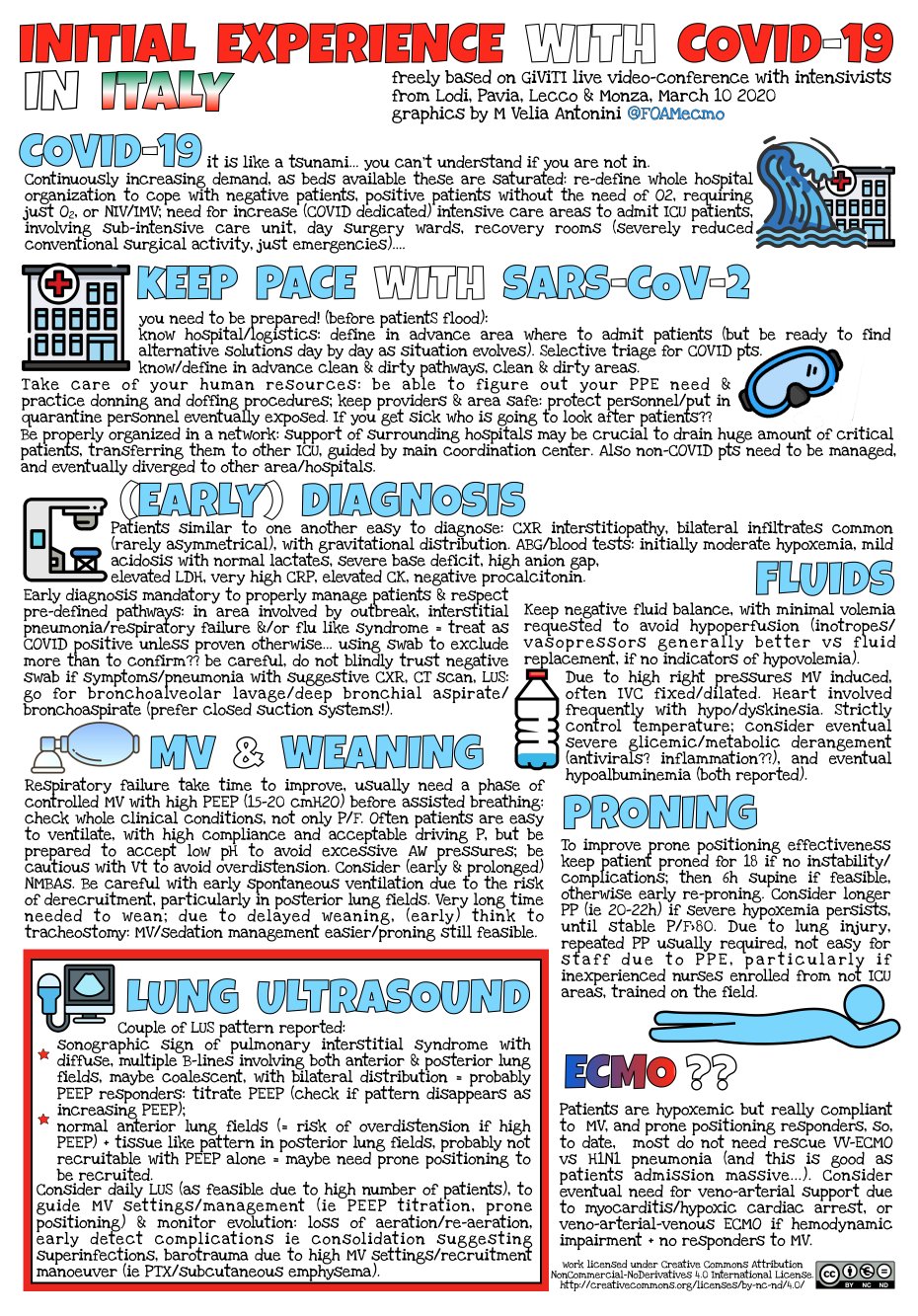
We already have examples we should be learning from, in China, in South Korea, in Italy. This rather cluttered infographic summarizes the lessons from Italy. It’s like a tsunami.

There’s a lot of medical jargon in that — I hope my local clinic is paying attention.

A simple genetics problem I could never put on an exam

My genetics students are learning a bit about sex linkage and modes of inheritance, so I’ve got them thinking about an entirely hypothetic problem outside of class. I’ll be interested to hear their explanations, but this is the kind of problem that would drive me nuts to try and grade. Let’s see how you all do with it.

In Guardians of the Galaxy, the assassin Gamora is bright green. Her sister Nebula is blue. 


a. Invent a genetics of skin color in her species, the Zehoberei, that explains their differences in color, using an autosomal gene and modeling it after human patterns of inheritance, and use it to predict the skin color of their parents. (Note: Thanos is purple, but he’s a different species and is their adoptive father.)


b. Now assume the trait is X-linked. Does it change your prediction for their parents? What color(s) would a hypothetical brother be?


c. A new twist: in Zehobereians, females are the heterogametic sex. What does this do to your model?

The fun part is (a), which could have all kinds of possible explanations (that’s why I couldn’t put it on an exam, the range of possibilities is huge), with the one constraint being that it has to be autosomal. I want to see some dueling discussions about how it would work, brought down to earth by the need to make a prediction about the parents.

Then (b) changes the assumptions, and forces their model to change, and (c) flips it around some more. I don’t want to grade this kind of question, I just want to see how their brains logic their way around it. It should be fun. I hope.

I also had some ideas about the inheritance of color in Minecraft sheep, but decided that was just too weird. Blending inheritance + acquired characters? Heretical. Not very instructive about Earthly rules of genetics.

Of course, it may all be moot because attendance in all of my classes is declining this semester — only half the students showed up today! I don’t know if it’s pandemic fears (no diagnosed cases in Morris), the imminence of Spring Break, or that I’m just horribly boring.

Spiders gettin’ fat

I put some more spider photos on my Patreon account — last time I neglected to mention that I also post some on Instagram, where they are free and you don’t even need an instagram account to see them.

I fed everyone big ol’ waxworms yesterday, and today they’ve been turned into big ol’ spider bellies. The ones I photographed are all new additions, spiders that were born here in my lab as tiny little spiderlings, and have now been successfully raised to pulchritudinous maturity.

Common sense about spiders

Hey, this is the same thing I tell everyone: spiders are mostly harmless, and they’re there whether you like them or not.

Spiders are not out to get you and actually prefer to avoid humans; we are much more dangerous to them than vice versa. Bites from spiders are extremely rare. Although there are a few medically important species like widow spiders and recluses, even their bites are uncommon and rarely cause serious issues.

If you truly can’t stand that spider in your house, apartment, garage, or wherever, instead of smashing it, try to capture it and release it outside. It’ll find somewhere else to go, and both parties will be happier with the outcome.

But if you can stomach it, it’s OK to have spiders in your home. In fact, it’s normal. And frankly, even if you don’t see them, they’ll still be there. So consider a live-and-let-live approach to the next spider you encounter.

The author of that article is also one of the authors of a paper I’m citing in something I’m working on now, in which he and colleagues did a thorough, room by room search for all arthropods in houses in a North Carolina region. One of their observations is that 100% of the homes had Theridiidae (common house spiders, like the Parasteatoda I’m studying) living in them. They’re kind of unavoidable. In my own much more limited survey (we only examined garages and sheds, and only arachnids, here in the harsher environment of Minnesota), we saw some similar results: almost all garages housed spiders. The one exception was eerily meticulous, everything stored away in tidy boxes, and no cobwebs or even dust. There are people who dust their garages! Unless you are that thorough, though, they’re there. And even if you are, they’ll sneak in — later that summer, we did find a few spiders in a shed on that same property. They looked terrified. Don’t worry, I didn’t rat out that they were there.

(Note: we were pretty strict about confidentiality, all locations are encoded in a file separate from the data on spider populations. You’d have to go through two sets of paper records matching addresses with spider counts to pin an identity on the houses with the most, or least, spiders.)

By the way, I have in mind proposing a workshop to Skepticon this year, an effort to counter arachnophobia. What I was thinking is a series of staged tables, where the beginning is something like 1) coloring pages of spider drawings, with explanations of anatomy; 2) a table of photos (maybe in trading card format?) of real spiders; 3) some small, caged spiders where we could observe feeding and courtship; and 4) a few harmless spiders, like Pholcidae, where people could actually let them clamber around their hands. Participants could ease in gradually and stop where ever they feel comfortable, and see people actually interact harmlessly with spiders.

What do you think? Would you actually participate in such a thing, if you had the opportunity? What number would you stop at?

NEE NED ZB 6TNN DEIBEDH SIEFI EBEEE SSIEI ESEE SEEE!!

Wired tries to defend SETI and UFOlogy. They argue that there are 3 branches of inquiry — exobiology, the search for extraterrestrial intelligence, and the study of UFOs — and each has their place in our battery of methods.

Aliens—hypothetical beings from outer space—fall into roughly three categories. They could be far-away microbes or other creatures that don’t use technology humans can detect; they could be far-away creatures that use technology earthlings can identify; or they could be creatures that have used technology to come to Earth.

Each of these categories has a different branch of research dedicated to it, and each one is probably less likely than the last to actually find something: Astrobiologists use telescopes to seek biochemical evidence of microbes on other planets. SETI scientists, on the other hand, use telescopes to look for hints of intelligent beings’ technological signatures as they beam through the cosmos. Investigating the idea that aliens have traveled here and have skimmed the air with spaceships, meanwhile, is the province of pseudoscientists. Or so the narrative goes.

The issue, the article argues, is that the boundaries of legitimate research have shifted over time and are culturally determined, not objective at all. There’s a continuum of legitimacy, and it’s entirely arbitrary that we place UFOs in pseudoscience, and don’t fund SETI, and think exobiology is valid and interesting. That is a good point, except that I think there is a solid criterion that is rooted in how we do science.

Here’s the deal: early in our training, we’re taught to keep an open mind — you use hypotheses to guide a line of research, but we must be prepared to find unexpected results and alternative explanations. We’re adapted to thinking, “My experiment to test my hypothesis should find X, but if it finds Y we’ll have to modify the hypothesis, and if the answer is Z, well, back to the drawing board, but gosh, that would be exciting.” Experiments are designed that give interesting results, and whether the results are compatible with our hypothesis or reject it are equally useful.

Exobiology fits the paradigm. We’re looking at other worlds with they hypothesis that life produces chemical signatures we can detect, and even if we don’t see them, we learn something about that alien planet. We gather data looking for biology, and if we don’t see it, we still have data on extraterrestrial chemistry. That’s the safe bet funding agencies look for, that we’ll learn something even if our preliminary hypothesis fails.

SETI doesn’t work that way. SETI is looking for specific patterns in extraterrestrial signals; they have a pre-set goal, rather than an open inquiry. Not finding a signal they are looking for is a literal failure that tells us nothing. That star isn’t transmitting anything useful? Abandon it, move on, look somewhere else. Over and over again. It also doesn’t help that all their hypotheses look like ad hoc dreck contrived to convince people that there might be someone out there, with infinitely bendable variables.

UFOlogy, on the other hand, is an extreme example of that latter phenomenon. We don’t see what we’re looking for — no little green men, no crashed spaceships — so they invent elaborate and often contradictory rationalizations. The evidence isn’t there, but they are determined to pretend that it is. It’s a kind of anti-empiricism where the accumulated data is irrelevant to the conclusion.

It’s as simple as asking, “What will we learn from doing the observation/experiment?” SETI’s answer is nothing, unless we find a one in a trillion possibility, then it’s the jackpot. UFOlogy’s answer is that they already know little green men exist, so we just have to photograph thrown pie plates until we’ve persuaded the establishment. Neither is good science.

Both SETI and UFOlogy are strongly susceptible to apophenia as well. They are trying to fit complex data to a prior expectation, so there’s a tendency to impose patterns on noise. Here’s a classic example: NASA has observed complex sand dune formations on Mars.

Cool. What causes it? These are windblown rills shaped by topography and prevailing, but changeable, winds that formed under more or less chaotic pressures, producing lines and bumps and branches.

But, if you’re looking for it, it could be a signal. Perhaps, if we ignore the physical mechanisms that made them, these dunes could be Martian handwriting. Or better yet, a Martian code.

Right. So someone, probably as a bit of lark, tried to interpret them as dots and dashes, and then translated them into Morse code (why ancient Martians would have used a code devised by a 19th century American is left as an exercise for the reader). The Martian dunes therefore announce to the universe these immortal words:

NEE NED ZB 6TNN DEIBEDH SIEFI EBEEE SSIEI ESEE SEEE !!

I’m sure that means something profound in the original Martian. Either that, or it’s a compressed recipe for cored cow rectums.

That’s the problem with SETI, though. The universe produces patterns all the time, and human brains strain to impose interpretable derivations on them — SETI will milk that for all the news and attention they can get, even if it is ultimately meaningless.

Meanwhile, UFOlogists already know that the aliens are living on Mars, and have trained Bigfoots raking the dunes to send secret messages to the fleet hovering invisibly in our atmosphere, and you ignore it at your peril, you fools.