On top of pandemic woes, emerging technologies force me to revise my courses!

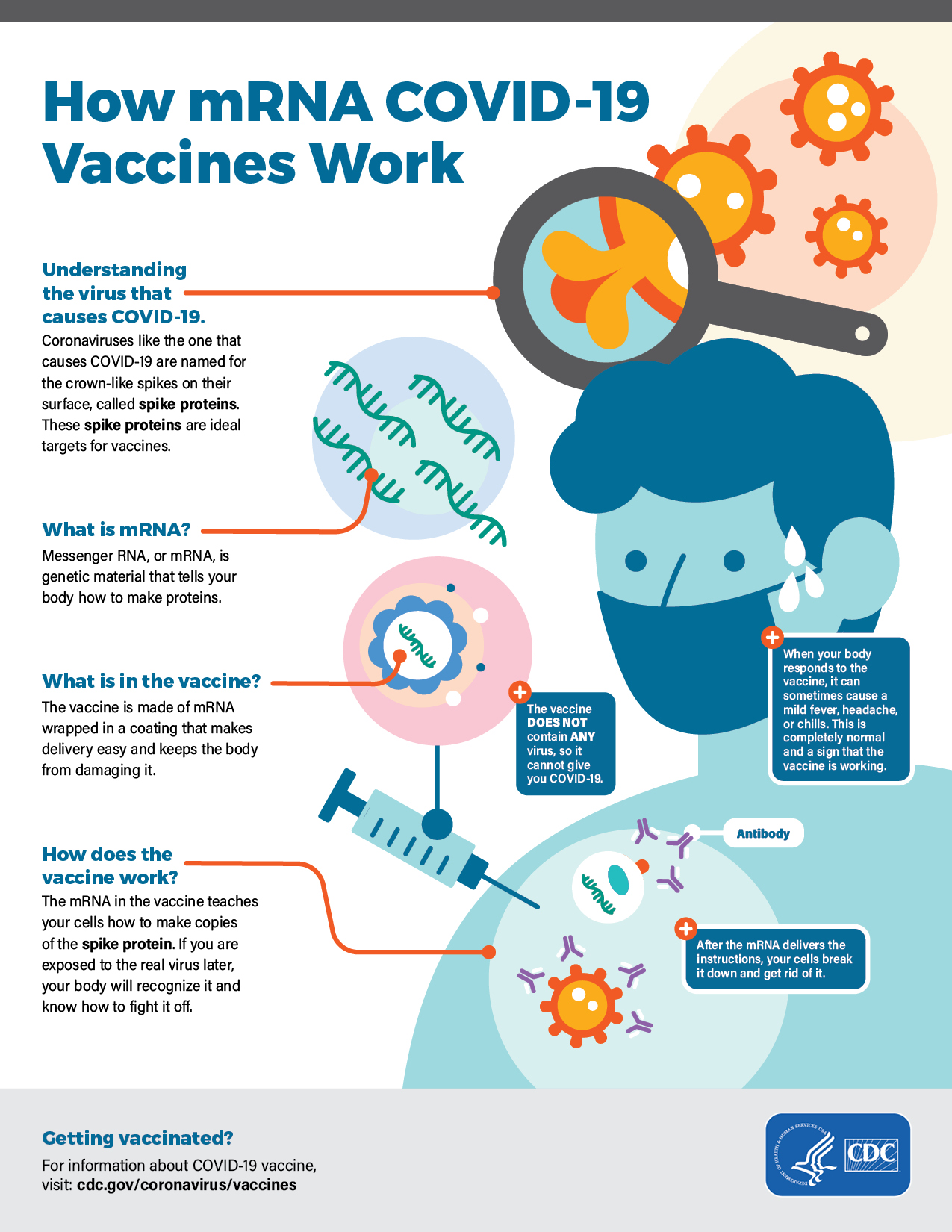
I am not an immunologist by any stretch, but I do teach a bit of basic immunology in my cell biology course every year — you know, just the basic concepts of immunological memory and core proteins and the innate and adaptive immune system, that kind of thing. I’d heard about the idea of mRNA vaccines, but if you’d asked me last year, I would have said that’s far too speculative for a course that was just an overview, I can’t possibly wedge such a tenuous proposal into the class, and why should I? It has no real world utility yet. Well, next year I’ll have to start wedging. Here’s an article that describes the importance of mRNA vaccines.

…mRNA’s story likely will not end with COVID-19: Its potential stretches far beyond this pandemic. This year, a team at Yale patented a similar RNA-based technology to vaccinate against malaria, perhaps the world’s most devastating disease. Because mRNA is so easy to edit, Pfizer says that it is planning to use it against seasonal flu, which mutates constantly and kills hundreds of thousands of people around the world every year. The company that partnered with Pfizer last year, BioNTech, is developing individualized therapies that would create on-demand proteins associated with specific tumors to teach the body to fight off advanced cancer. In mouse trials, synthetic-mRNA therapies have been shown to slow and reverse the effects of multiple sclerosis. “I’m fully convinced now even more than before that mRNA can be broadly transformational,” Özlem Türeci, BioNTech’s chief medical officer, told me. “In principle, everything you can do with protein can be substituted by mRNA.”

In principle is the billion-dollar asterisk. mRNA’s promise ranges from the expensive-yet-experimental to the glorious-yet-speculative. But the past year was a reminder that scientific progress may happen suddenly, after long periods of gestation. “This has been a coming-out party for mRNA, for sure,” says John Mascola, the director of the Vaccine Research Center at the National Institute of Allergy and Infectious Diseases. “In the world of science, RNA technology could be the biggest story of the year. We didn’t know if it worked. And now we do.”

At least the article does a lot of the work for me, organizing the history of the technology and explaining its strengths and weaknesses. Maybe I can just assign it as reading in the class, because I just checked the latest edition of our textbook, which seems to come out with a new edition every year, and there isn’t a whisper of a hint of a suggestion of this use for mRNA. That’s how fast this technology has emerged.

The last time this happened was when CRISPR/Cas appeared on the scene — 3 or 4 years ago I had to start including a segment on that in my course, because it was starting to appear in students’ senior seminars, and had such obvious research applications. But there was negligible clinical use, and none of my students had used or been the subject of CRISPR/Cas. Now this fall I expect every single one of my students to show up having been injected with an mRNA vaccine, so I’d better get it into the curriculum.

I do appreciate that the article also comes right out and explains that mRNA vaccines aren’t a miracle cure for everything.

“This is not a magic bullet, and it’s not perfect for everything,” Pfizer’s Dormitzer told me. His partners at BioNTech concurred. “I do not claim that mRNA is the holy grail for everything,” Türeci said. “We are going to find that there are diseases where mRNA is surprisingly successful and diseases where it’s not. We have to prove it for each and every infectious disease, one by one.”

It also makes it clear that this isn’t the product of a single genius making a breakthrough.

The triumph of mRNA, from backwater research to breakthrough technology, is not a hero’s journey, but a heroes’ journey. Without Katalin Karikó’s grueling efforts to make mRNA technology work, the world would have no Moderna or BioNTech. Without government funding and philanthropy, both companies might have gone bankrupt before their 2020 vaccines. Without the failures in HIV-vaccine research forcing scientists to trailblaze in strange new fields, we might still be in the dark about how to make the technology work. Without an international team of scientists unlocking the secrets of the coronavirus’s spike protein several years ago, we might not have known enough about this pathogen to design a vaccine to defeat it last year. mRNA technology was born of many seeds.

The one thing it’s missing is the growing awareness that the missing ingredient here isn’t technological, it’s sociological. The absurd opposition to vaccines in some quarters isn’t based on evidence or reason, it’s a phenomenon of irrational brains. I’ll resist the temptation to wedge a whole course on sociology or psychology into my biology class — that’s why I’m at a liberal arts college, because the students should be studying that with real experts in a different building on campus.

I’ve been in grading hell all day

But I finally finished the exam for introductory biology. There were two huge problems.

  1. Never again will I give a take-home multiple choice exam. I thought I was being generous: 16 multiple choice questions, one multi-part essay question, and I even gave them a form to fill in. Somehow, many of them didn’t follow the instructions. A form with a space to put in A, B, C, or D for the answer? Nope. Many wrote out answers. What I thought would be an easy grading exercise turned into a nightmare. If I were to do it again, I’d be extremely obvious and specific in how to answer.
  2. Scores were abysmal, but that’s on me. I didn’t spend enough time going over the problems…so now I have to backtrack and cover the material again and give them some more exercises to try out.

Now I have to collapse in a soggy heap. Tomorrow it begins again with an exam from my second course.

Playing with my camera

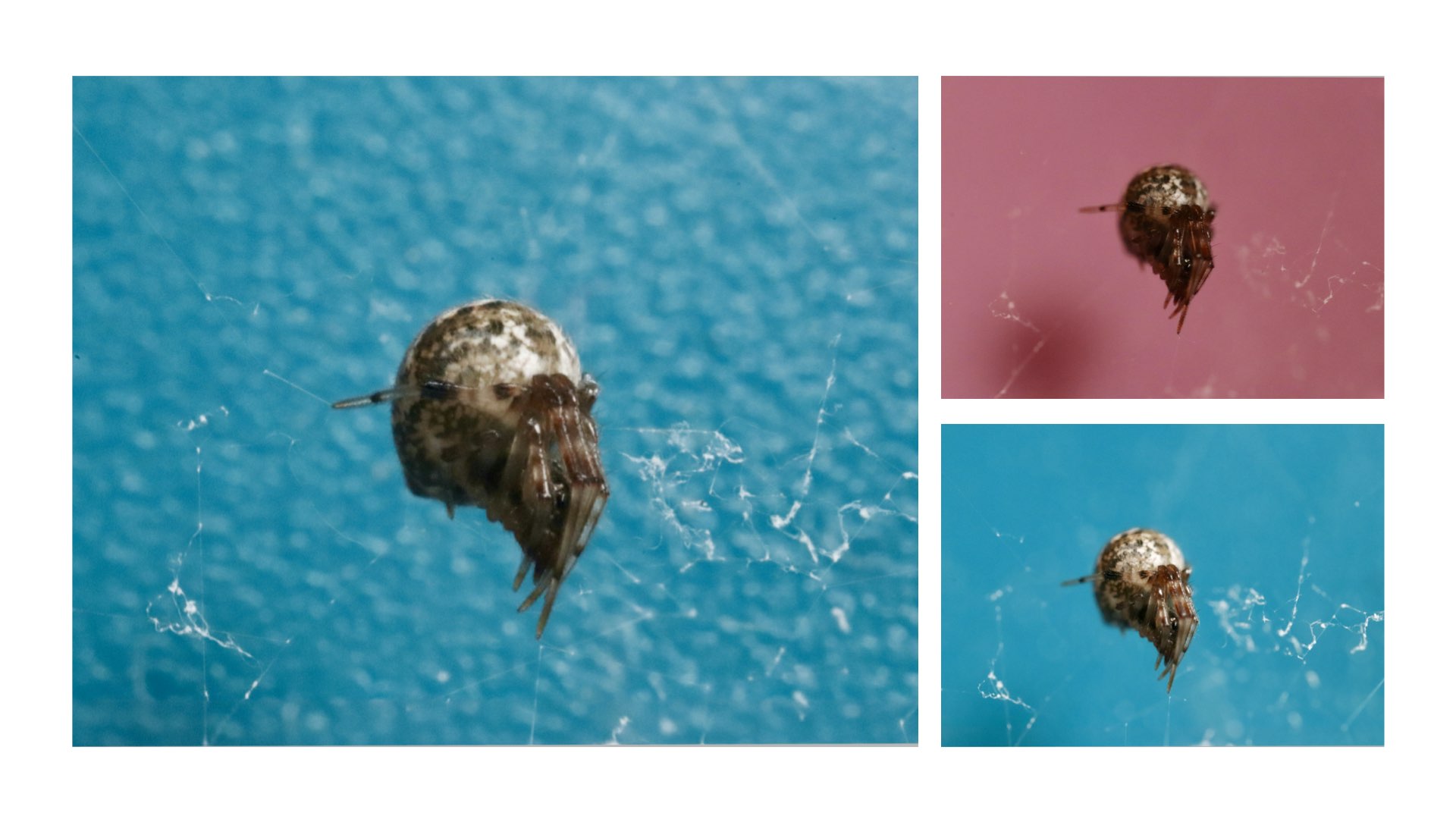
Today’s spider time was a bit abbreviated, because my day is jam-packed with stuff scheduled on top of stuff, so I only had a brief moment in the lab. I decided to tinker a bit with a camera lens I’ve been neglecting, the Laowa 25mm f2.8 Ultra Macro 2.5-5.0x. This is a strange little lens with a lot of potential, but I have struggled with it before. It’s just so different from my other lenses, with different properties, and I think I’ll have to invest some serious effort to master. Today was not that effort. I shot a few quick photos before I had to refocus on today’s classes.

Spiders are the ideal models for macrophotography, because the ones I have are so calm and stable. This little lady was practically immobile for the entire half hour I spent playing with lights and backgrounds and moving in close for pictures.

One thing I discovered is that the Laowa is surprisingly good at collecting light. My first photos were at f/2.8, an exposure of 1/500, and they were all washed out. I kept reducing the exposure and closing off the aperture, and still got usable photos. So it’s got that going for it. On the other hand, the depth of focus is still pretty shallow and I had to stick the lens right in the spider’s face to get it in view, and one thing I like in a lens is a forgiving working distance. Fortunately, this spider was imperturbable.

Anyway, I played for a bit. The one on the left is shot at f/16, the other two at f/2.8. I’m not straining for light in any of them, which is nice. All are at 2.5x, I’ll have to try the 5x option next and see how that goes.

I have a mostly free day tomorrow! I’ll have to practice some more, and maybe do some comparisons with the Tokina Macro 100 F2.8 D, which is currently my favorite lens for field work. I don’t think the Laowa can replace it, but might make a good choice for the lab.

Now…on to classes and grading!

Lab time, and a whatsis

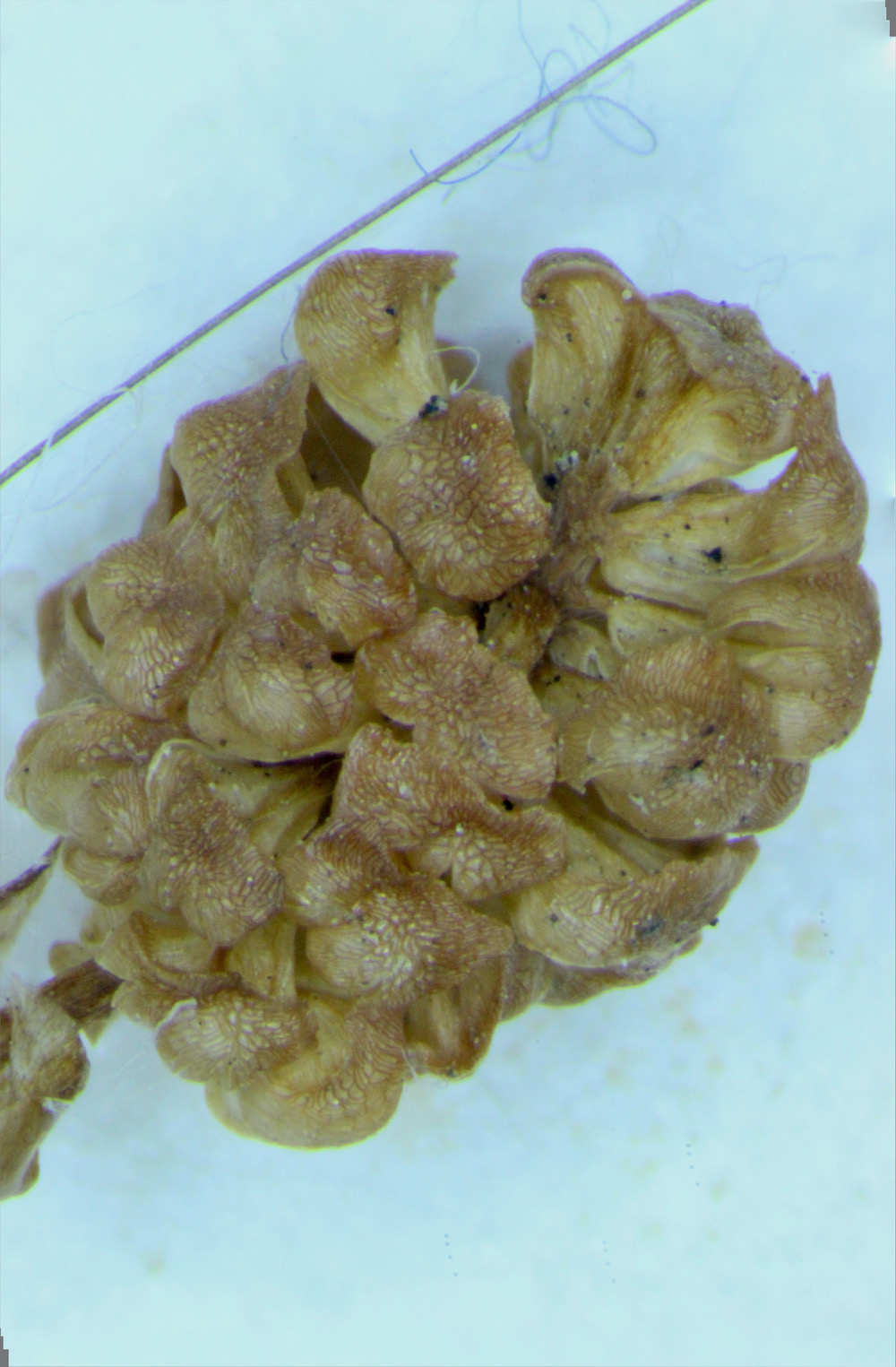
Yesterday, Mary startled a jumping spider which had been hiding under a mysterious small object. That object was also attached to the wall of our house by strands of spider silk. Is it an egg sac? I put it under the microscope, and no, it is not.

It is something tiny, about 2mm long, and botanical. I know nothing of botany. It is not a spider thing, which is enough for me.

While I was in the lab anyway, I tended to the spiders, who are all doing fine. Here’s one just relaxing in a spider-like way.

[Read more…]

Good news, everybody! Beelzebub has come to town!

Mary kicked me out of the house this afternoon — she told me to get some exercise, I’ve been moping around the house too much, she said, or at least, implied — so I went for a walk with my camera. I discovered…

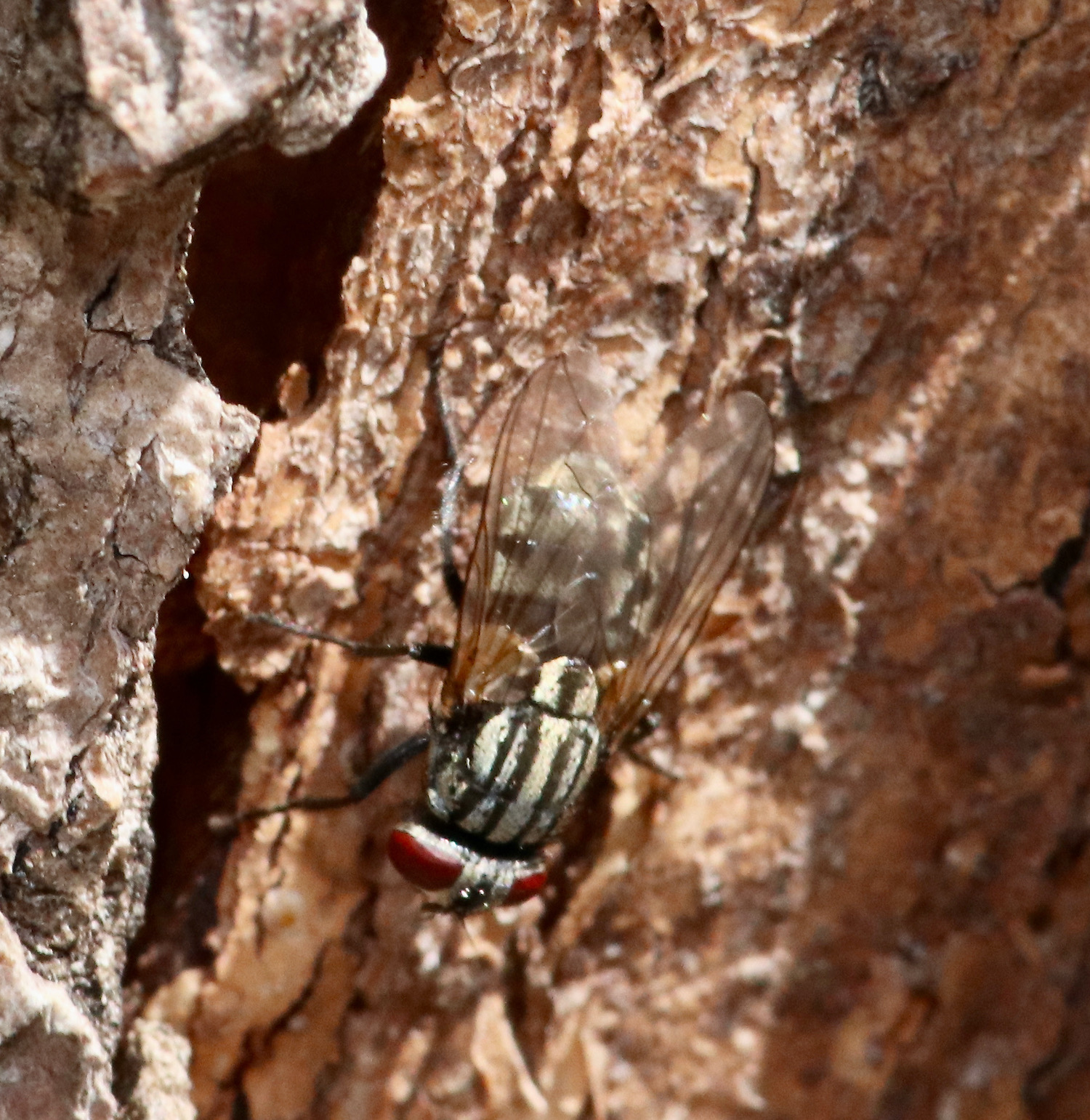
Yay! Lots of flies on the ground, on the trees on the walls (not so much flying, though, it’s pretty windy today). Beelzebub has arrived! And you know what that means, boys and girls?

The Lord’s holy angels, his minions of righteousness, the noble spiders, will be arriving soon to smite them! Praise the Arachnida! Can I get an “AMEN!”?

Tekporn, and a spider

Something for everyone! In the last spider zen thread, I showed off my collection of junk optics, and someone mentioned Tektronix oscilloscopes. I have those, too! Two of them!

These are relics of my old days, when I spent my day punching teeny-tiny electrodes into teeny-tiny neurons. I wasn’t a hard core electrophysiologist, I was mainly interested in delicately poking in without killing the cells so I could fill them up with interesting probes that glowed all kinds of garish colors. I brought them here with me with the idea of using them in neuroscience classes, but it turns out that you need all kinds of other infrastructure to do neurobiology of that sort right, which a small liberal arts college lacks (unless you’ve got a core of several faculty who were interested in building that infrastructure, which we didn’t have — I was alone.)

Anyway, these almost certainly don’t work anymore. They were old and finicky when I was using them, and they’ve been neglected for 20 years.

But who cares? Here’s a spider.

[Read more…]

The prodigal spider returns, and my cabinet of optical curiosities

I reported yesterday that the tiniest of my juvenile spiders had vanished, and I feared that she had escaped. I was wrong! She was still there, tucked away under a crossbar of the frame, being shy and quiet. Either that, or she had just taken off for a day to fight crime. She was famished and immediately chowed down on a fly this morning, so that is a possibility.

I also mentioned that in my ongoing lab clean-up efforts, I had unearthed another assortment of microscopical oddments that I tucked away in my cabinet dedicated to antique optics, and threatened to show you some of it. I now make good on that threat.

My predecessors at this university in cell biology, Drs. Abbott and Gooch, collected a few gadgets and were clearly imaging people. Some of it was just lying around in boxes, and when I find it, I fish it out and toss it onto a shelf. It’s really just junk at this point, and I have no use for any of it, but once upon a time these things cost a lot of money and I have a fondness for old technology, so as long as I’ve got the space, I’ll hang onto it.

Here’s the whole cabinet. It’s just a hodge-podge, not organized at all.

Look at this — a real treasure. That’s a Konica (now Konica-Minolta) Hexanon camera lens! Those, once upon a time, were high-end optics — now though, they don’t fit any camera I’ve got, and you can’t even get adapters to make them work with DSLRs, since the focal length is too short. I’ve thought a few times about collecting old lenses to play with photographically, when I get rich, but this one…nah, sadly, not something I could use, unless I were to also collect old camera bodies. Nope.

There are also a few cheap video lenses in view, and I’ve got a few CCTV cameras that seem to work, if ever I wanted to image stuff with RS-170 again. Ooh, 525 lines of fuzzy resolution. Also lenses from Cosmicar (a division of Pentax) and Computar (which is still around, making lenses), and several C-mount adapters for various microscopes.

I have a couple of Zeiss lamp housings and this tube for a fluorescence microscope. Someone was doing some nifty stuff in the 1970s, I suspect. There are also a couple of massive illuminator bases with interesting clamps — part of an optical bench setup?

These were some other curiosities very neatly packaged in solid boxes with faded velvet padding: something called an optibeam, a name I associate with antennas, but this has a couple of lenses, so I have no idea what it’s for. There’s also a massive syringe of metal and glass, very impressive, I might have to use it to terrify the grandchildren.

Not shown: I also have some mystery boxes of my own, with DECtape reels and Zip drives, which were all the rage in the 1990s. They seem quaint now — 100mb on a clunky plastic drive when I’m carrying around a terabyte in my pocket, on little thumbnail sized chips? Nah, they’re about as obsolete as all the junk on my shelf.

If you see something in those photos that get you excited, though, I can probably make arrangements with the university bureaucracy to ship them out. Otherwise, I predict that my successor someday will just sweep them all into a box and send them off to a landfill.

Spider Zen: a loss, and a discovery!

I had another morning therapy session in the lab. First, the bad news: I think there was an escapee. Sound the alarms! Head for the hills! Panic! Run in circles, scream and shout!

Actually, the problem is that I’ve moved some of the juveniles to my larger cages, and the one that seems to have gotten away was tiny, and I think she may have found a crack in the lid and scurried off to even wider vistas. In the future, I’m going to have to grow the babies to a larger size before moving to the bigger cages. Oh well. I hope she prospers out there!

The fun news, though, is that while I was tidying up I found a Mystery Box in one forgotten corner. It was full of antique microscopy gear! I think much of it might have come from my predecessors, Dr Gooch, who retired just a few years ago, or Dr Abbott, who retired a few years before I was hired here. This box contained an oddball assortment of video adapters — nothing that fits my current microscopes, and they’re all fitted with the old C-mount style threaded fittings for, like, CCTV cameras. I’ve been collecting these odds and ends for years, and I’ll add them to my mini-museum shelf. I’ll sort them out tomorrow, and maybe post a few photos here — I should probably catalog them at some point, because while they aren’t actually useful to me, except as curiosities, maybe someone out there could find a purpose for some fragment of a Zeiss scope from the 1980s.