Stop it. It wasn’t a lab leak

I’m getting a little tired here, gang, of all the “lab leak” nonsense. It’s pure, distilled, refined conspiracy theory stuff. Did the Trump presidency so exhaust us with conspiracy theories that we no longer have the ability to recognize them?

None of the scientists I know are giving any consideration to the lab leak bullshit. Here’s Larry Moran with a couple of videos of qualified scientists discussing it (I don’t consider myself a particularly well qualified scientist — I’m not a virologist, microbiologist, or epidemiologist. But I recognize the skills you need to have to do virology, microbiology, or epidemiology.)

The WHO scientists want to emphasize three things: (1) it is extremely unlikely that SARS-CoV-2 was being studied at WIV so it couldn’t have escaped from there; (2) there is no evidence to support the lab leak conspiracy theory but if any evidence shows up they are perfectly willing to investigate; (3) it’s very likely that SARS-CoV-2 originated naturally in the wild and all efforts should be focused on the most likely scenario and not on an extremely unlikely scenario.

After the interview is over, the three hosts talk about the lab leak conspiracy theory. You should hear what they have to say about Nicholas Wade and his failure to understand the furin cleavage site (1:10 minutes)! And they have lots to say about everything else in the Wade article. Everyone needs to watch that discussion if you are really interested in science and not half-baked conspriacy theories.

Even if it were accidentally released from a lab, it’s not a bioengineered virus, but something that had been collected in the wild during extensive sampling of, for instance, bat caves. It would have originated there, not in a lab. I agree that it’s important to study where these viruses arise, because there are more out there, lurking in the complexity of the natural world, but thinking the only danger can come from intentional manipulation in a lab is going to mislead you into underestimating the risk.

Also, you can never trust anything that comes out of Nicholas Wade. He’s not competent and he’s got strong biases.

How animals feel pain

On Saturday, I wrote this bit about whether animals feel pain, and I said then I’d follow up that day or the next. I didn’t! I’ve been doped up on painkillers and my brain is all soft around the edges. I finally decided to give up on them this morning when I woke up, had breakfast, and then fell asleep for a couple of hours. Enough already. Now I have to recover from some potent drugs as well as my back pain.

Anyway, where were we? Oh, right, we had taken down William Lane Craig’s argument that humans (and maybe some other primates) are the only creatures on the planet that actually feel pain, that other animals are mere meat robots who act out a superficial script that looks like they are in pain, but really, they have no consciousness to experience the pain.

I don’t think he is making this argument to warrant or excuse animal torture, but rather he’s trying to justify human exceptionalism. See, humans have this special god-granted ability to perceive suffering and pain, which is why we have souls and animals don’t, and why we have to worry about that Final Judgment, since we can sense and appreciate the harm we do to others. At least, that’s my charitable assessment.

Curiously, in order to make this argument, Craig feels a need for some scientific backing, some recognizable neuroanatomical feature that shows humans are special. I don’t get it. He already believes in something invisible and intangible, the soul, so why not just say humans posess an invisible magical flimflam that the scientists can’t see or experiment on, neener neener, therefore humans are unique in having a conscience or ghost or pneuma that gives them the abilty to really truly deeply feel pain and suffering?

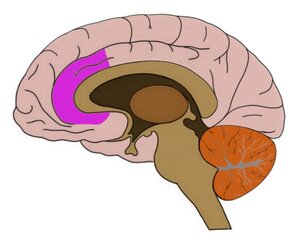
Often the physical substrate for feeling pain is determined in a backwards sort of way: we find some feature of the human brain that is only found in us, or is more pronounced in us, and we decide that, aha, that must be where this higher ability resides. Some of the common culprits are our enlarged pre-frontal cortex (PFC) or more narrowly, the anterior cingulate cortex (ACC). The ACC was a favorite of Francis Crick, for instance, who thought that not only was it the seat of awareness, but also of free will (I think free will is a non-existent phenomenon that makes no sense, but I’ll defer on discussing that to another time).

I don’t think the hypothesis is far out of line — there is evidence that lesions in this area do cause sensations of dissociation, and it is entangled in a lot of higher brain functions. But on the other hand, other animals have these structures, so how do you use this phenomenon to make humans exceptional? You can’t.

This leads me to an article in a journal called Philosophical Psychology, Against Neo-Cartesianism: Neurofunctional Resilience and Animal Pain by Halper et al.. Mixing philosophy with psychology and throwing in a lot of ethology and neuroscience sounds like a potent way to address the issue, don’t you think? Especially with a feisty abstract like this one:

ABSTRACT: Several influential philosophers and scientists have advanced a framework, often called Neo-Cartesianism (NC), according to which animal suffering is merely apparent. Drawing upon contemporary neuroscience and philosophy of mind, NeoCartesians challenge the mainstream position we shall call Evolutionary Continuity (EC), the view that humans are on a non-hierarchical continuum with other species and are thus not likely to be unique in consciously experiencing negative pain affect. We argue that some Neo-Cartesians have misconstrued the underlying science or tendentiously appropriated controversial views in the philosophy of mind. We discuss recent evidence that undermines the simple neuroanatomical structure-function correlation thesis that undergirds many Neo-Cartesian arguments, has an important bearing on the recent controversy over pain in fish, and puts the underlying epistemology framing the debate between NC and EC in a new light that strengthens the EC position.

In one corner, the Neo-Cartesians like William Lane Craig (there are also secular philosophers who like this idea).

In the other corner, the Evolutionary Continuity camp, which I would happily attach myself to, which argues for “a non-hierarchical continuum with other species and are thus not likely to be unique”. Yay Team EC!

The paper quickly dispatches part of the argument. All mammals have a prefrontal cortex, although the human PFC is relatively larger. So now you’re going to have to argue, if you think the PFC is the seat of awareness, that a quantitative difference leads to a qualitative change, and you’re also going to have the problem of a continuum of PFC sizes. Where do you draw the line?

Well, maybe it’s the anterior cingulate cortex, rather than the whole PFC, that matters. They have a case study that refutes that. Patient R is a man whose brain was devastated by herpes simplex encephalitis, yet survived with normal intelligence and anterograde amnesia (loss of the ability to form new memories). Most importantly to this point, he has retained full self-awareness.

Patient R, aka Roger (Philippi et al. 2012), provides us with a novel angle for assessing certain versions of the NC hypothesis. Roger has extensive damage to his PFC as well as his ACC and insula, bilaterally. He has been probed for self-awareness (SA) in numerous ways, some standard, some novel with positive results for all probes. The authors of the 2012 study concluded that SA is likely a function of the interaction of multiple brain regions, with some redundancy, rather than dependent upon one particular region.8 Roger’s case, like others described in the literature (Damasio et al. 2013), seems to demonstrate fairly conclusively that the PFC, the ACC, and the insula are not needed for SA, including SA of a fairly sophisticated sort, a sort we need not presume animals to have to make our case here.

Patient R also has a normal physical and emotional response to pain — if anything, he now reacts more strongly.

So now if you want to argue for a discrete localization of self-awareness in the brain, you’re either going to have to pick a different brain region or claim that Patient R is a p-zombie. Or, perhaps, that the brain has a lot more flexibility than was thought. I like this last idea, but then, that makes the pursuit of a feature unique to humans futile.

Further, these cases suggest an alternative to the rigid structure-function correlation thesis. Resilience of function following brain damage suggests the existence of degrees of freedom in the relationships between certain functions and neuroanatomical structures (Rudrauf, 2014). Anatomical regions and networks normally supporting central psychological functions (like the emotional appraisal of pain) may simply be the usual defaults. In patients such as Roger, functional resilience after such extensive and irreversible anatomical damage cannot be explained by structural plasticity, in the sense of anatomical restoration or large-scale “rewiring” (e.g., dendritic sprouting and axon regeneration) to restore structural connectivity. Large-scale functional networks supporting key psychological functions, however, can be maintained or restored even when the integrity of normal anatomical networks is massively and irremediably compromised.

This suggests that a different concept of flexibility is more apt, namely what Rudrauf (2014) has called “neurofunctional resilience”. This concept is based on the phenomenon of preserved function in spite of large-scale architectural changes, is not limited to one specific class of mechanisms or levels of observation, and indicates a relative openness in implementation at various levels of a functional hierarchy. The neurofunctional resilience framework, while in need of elaboration and refinement, makes more sense of lesion cases like Roger’s, observed variation in structure-function relationships in imaging studies, interspecific structure-function variations, the relative unimportance of lesion locales versus lesion size vis-à-vis functional deficits in the developing brain (Pascual, 2017, 5; Battro, 2000), and better fits general theoretical considerations about multiple realizability drawn from computational neuroscience. In realizing that a crude, “phrenological” localizationist structure-function paradigm (even one incorporating plasticity) is unable to account for these observable phenomena, one need not, of course, embrace the old holistic, “equipotentiality” theories of brain function (see Finger, 1994, ch., p. 4). A new, subtler approach is needed.

My first thought would have been that Patient R is an amazing example of neuronal plasticity, but the author is right: this is something more impressive. Big chunks of the brain are just gone; minor self-repair mechanisms, like neurons regrowing around a damaged pathway, are not sufficient. This is as if your car had the electronic engine timing system blown off, so the wires were rerouted to make use of circuits in your car radio instead. Be impressed! Brains seem to have a biological imperative to assemble themselves into some kind of cognitively functional structure, in spite of massive damage.

But never mind human brains — they’re too complicated, and you can’t do experiments on them. What about fish brains? Do they feel pain? And what about cephalopods?

As Godfrey-Smith (2016, 94 f.) notes, flexible behaviors and preference changes related to pain avoidance and analgesia-seeking (observed in both fish and chickens) in entirely evolutionarily novel situations and perhaps certain grooming and protecting behaviors associated with bodily damage are arguably best explained in terms of the presence of consciously experienced negative pain affect. And when one considers the overall behavioral, affective, and cognitive repertoire of, for example, cephalopods, as Godfrey-Smith does at length, the notion that such an animal, whose nervous system is so different from ours, does what it does in the absence of consciousness begins to look implausible and continued commitment to it perversely skeptical.

It seems more reasonable to follow the approach of Segner (2012, p. 78) who, in considering fish pain, looks at seven relevant properties: (1) nociceptors, (2) pain related brain structures homologous or analogous to those found in humans, (3) pathways connecting peripheral nociceptors to higher brain regions, (4) endogenous opioids and opioid receptors in the CNS, (5) analgesic-mediated reduction of response to noxious stimuli, (6) complex forms of learning, including avoidance learning of noxious stimuli, and (7) suspension of normal behavior in response to noxious stimuli. Humans and fish, Segner concludes, unequivocally share all but item (2), which is partially shared: we share subcortical structures with fish but not the neocortical structures. However, given the evidence reviewed in this section, it is clear that the neocortical structures commonly thought to be necessary for pain affect are not required in any case (cf., Merker, 2007; Ginsburg & Jablonka, 2019) Surely the other similarities are sufficient to make reasonable the inference to the presence of consciously felt fish pain (cf., Tye, 2017, 91ff.). For mammals, as we have seen, all of these similarities are in place.

That “phrenological” approach doesn’t work well for fish, and even less well for cephalopods which have virtually no homology with our brains. Those seven criteria are a useful rubric for figuring out if a given brain can be aware or feel pain, and like the authors say fish meet all of the criteria except #2, having homologous pain-related brain structures. But we also just saw that Patient R fails to have homologous pain related structures. It would be strange to then assert that an organism that has the other six features would have failed, in its evolutionary history, to have incorporated them into an integrated pain awareness system.

Segner codifies the basic analogy argument for the presence of negative affect in animals that goes beyond the one we all spontaneously draw from our admittedly fallible raw intuitions. On our view, this basic analogy argument coupled with the considerations about neurofunctional resilience (and evolutionary analogies) we have adduced yield a reasonably high probability for the claim that negative pain affect is present in mammals, avians, fish, and cephalopods. Even if we are mistaken about the latter three, however, these considerations make the claim that it is present in mammals so probable that the more ambitious NC thesis of M. Murray and W.L. Craig is cast into nearly insurmountable doubt.

The paper goes on to discuss in detail the specific question of whether fish feel pain (short answer: yes), cetaceans, the issue of blindsight, and much more briefly, consciousness, which would require a stack of books to consider. I’ll stop here, though, disappointed that nowhere does the paper discuss spider pain, or any invertebrates other than cephalopods. Invertebrates are so alien and distantly removed from us that it is nearly impossible to discern a pain affect in them, but they also meet 6 of the 7 Segner criteria. The pain pathways in vertebrate and invertebrate systems also show homology at the molecular level, and it’s possible to see similarites across many phyla.

Maybe that’s for a different day. I’ve been having a fun time lately diving into an area I’ve neglected for a while, developmental neuroscience, and maybe I’ll be motivated to tell you all why you should be kind to bugs, because they have feelings, too, and maybe even experience suffering.

The NY Times doing what it does best: waffling

The NY Times sent me an explainer for the lab-leak theory of the origin of COVID-19. It’s long. It’s very careful to present Both Sides at length. It’s what I’ve come to expect from the NY Times, a diligent, earnest explanation that gives equal weight to every position that requires some technical expertise to see through the bullshit to recognize that A) we’re in a realm of uncertainty, and B) that doesn’t mean every explanation is equally valid, and C) they’re giving disproportionate attention to a theory that has no supporting evidence. We don’t know every single intermediate step in the evolution of COVID-19, and can never know the full details of its origin, but that doesn’t imply that a claim that an intelligent Chinese designer intentionally constructed the virus in a lab.

So they cite a letter to Science signed by 18 people that says, “Theories of accidental release from a lab and zoonotic spillover both remain viable.” The letter doesn’t include any evidence. It doesn’t explain why we should consider the lab-leak hypothesis reasonable, while citing a WHO report that considers a lab accident to be “extremely unlikely”, only to dismiss it.

They cite an article in the Wall Street Journal as evidence that the lab leak hypothesis is “plausible”. Did they read the same article I did? Because that article starts with a group of Chinese miners who came down with a serious respiratory illness after collecting bat guano in an abandoned copper mine. Unless you think the Wuhan biological warfare scientists store their samples in bat shit in old caves, that only tells us that bats harbor all kinds of interesting and potentially horrible viruses, not that the viruses are intentionally created. The WSJ and the NYT do share a similar disease, though, bothsideritis. Notice the one-two punch in this short quote: first they tell us that lab origin is extremely unlikely, and then swivel to say the question divides the scientific community.

“If the world wants to shut down work that was not gain-of-function because of a conspiracy theory, that’s a huge mistake,” Dr. Daszak said earlier this year. ”This virus, it’s extremely unlikely that it came from a lab. If we focus on the lab issue and ignore what really happened, we do so at our ultimate peril.”

One question now dividing the scientific community is whether such experiments could have created SARS-CoV-2, either accidentally or as part of a deliberate effort to see which viruses could evolve into ones dangerous to humans.

I don’t think the scientific community is divided. There are a few scientists who think the lab leak hypothesis is possible and should be investigated more (but they lack any evidence), while the majority are saying “Wha…? But we already know viruses evolve rapidly, and that there are vast numbers of unknown viruses lurking in natural reservoirs, so why are you asking us to waste time on the least likely explanation?” And so it will go, round and round, with major news organizations feeding the conspiracy theories and paranoia.

Meanwhile, the strongest piece of evidence the conspiracy theorists can muster is the claim that the Chinese have been dodgy about allowing investigators in. This is nonsense. The head of the Wuhan labs, Zheng-Li Shi, explains.

Wuhan Institute of Virology (WIV), Chinese Academy of Sciences, has engaged in a long-term study on natural reservoirs of SARS-CoV[16–18] and is among the first institutions that identified the SARS-CoV-2 after the COVID-19 outbreak.[2,19] In addition, WIV discovered a virus sequence (RaTG13) that shows a 96.2% genomic sequence identity match with the SARS-CoV-2 genome, in its archived bat samples collected in 2013.[2] These results lay a foundation for understanding the origin of SARS-CoV-2, development of diagnostic methods, antiviral drug screening, and vaccine development; the findings also provide an important clue pertaining to the natural origin of SARS-CoV-2. Sadly, WIV was at the center of the misleading speculations regarding the origin of the virus, which were not fully clarified until a recent joint study was performed by an international expert team led by the World Health Organization (WHO) and Chinese experts.

The joint expert team has been working in three groups, the epidemiology, molecular research, and animal and environment groups.[20] The experts have been working together through video conferences, onsite interviews and visits, and extensive discussions. Over the course of 4 weeks, the joint team studied massive volumes of epidemic-related data and visited some facilities, including the Wuhan Jinyintan Hospital, the Wuhan Center for Disease Prevention and Control, and the Wuhan National Biosafety Laboratory (Wuhan P4 laboratory) run by WIV; in addition, they also visited the Huanan seafood market. The team interviewed local medical workers, laboratory researchers, scientists, market managers, residents, and recovered COVID-19 patients.

The joint team visited the Wuhan P4 laboratory, a facility which is the most widely speculated place of origin of the SARS-CoV-2. The Wuhan P4 laboratory is the first of such facilities to be constructed in China and runs high-level biosafety checks. The laboratory is a state-of-the-art design by French experts, jointly constructed by French and Chinese engineers and accredited by the China National Accreditation Service for Conformity Assessment (CNAS). It was designed to be a laboratory studying highly classified pathogens and an international collaboration research center on emerging infectious diseases. All activities in this laboratory on specific viruses were qualified by the China National Health Commission (CNHC). All administration and management have been strictly regulated and regularly examined and reviewed by these two Chinese authorities. It has been examined by CNAS and CNHC four and three times, respectively, since its opening at the end of 2017. Currently, this laboratory is approved to study the Nipah virus, Ebola virus, Xinjiang hemorrhagic fever virus, and SARS-CoV-2. This laboratory has played a pivotal role in fighting the COVID-19 pandemic by way of animal model studies and inactivated vaccine development, drug screenings and tests, and basic research for understanding SARS-CoV-2.

The WHO joint team has had extensive exchanges with the laboratory manager, scientists, and staff and has highly appraised the cooperation, transparency, and openness of the WIV leadership and staff. The team concluded, “They upheld a very stringent and high-quality management system. Also proceeding from the current evidence, we regard the lab leak hypothesis as extremely unlikely” in a statement released to the media on February 9, 2021, Wuhan.[5]

Shi summarizes their goals.

In the past several decades, more than 70% of emerging or reemerging infectious diseases are zoonoses and were transmitted to humans from their animal reservoirs through intermediate hosts. A huge number of unknown viruses exist in their natural reservoirs and continue to evolve, which results in the generation of new strains. Many of these viruses may have intrinsic characteristics that enable them to cross species barriers and infect humans. The rapid global economic development, including urbanization, land usage, animal domestication, and intensive agriculture, increases the chances of contact between humans and wildlife, thereby increases the risk of interspecies transmission of viruses carried by wild animals. To prevent future zoonosis, the best strategy is long-term and extensive surveillance based on science. We need to learn about unknown viruses, assess the potential risks of interspecies transmission, pinpoint the hotspots of animal-human interfaces, and eventually prepare diagnosis methods and use them for monitoring high-risk animal and human populations. With this prophylactic strategy, we can rapidly identify and limit the rapid spread of emerging pathogens at the very early stage and prevent the next epidemic. To this end, it is necessary to unify experts from different disciplines, including microbiologists, epidemiologists, veterinarians, clinical specialists, ecologists, sociologists, and policymakers, to work together on the basis of science.

Exactly. The Chinese labs are right there at the forefront of studying how zoonotic diseases emerge from animal reservoirs. It doesn’t help if, when a population is infected with a disease of natural origin, they grab the torches and pitchforks and descend in a mob on the laboratories that are trying to control the disease. Yeah, the Wuhan Institute of Virology is studying coronaviruses, because they knew these were a potential source of human pandemics; do you want to shut them down? Do you really think that an institution that was studying viruses is therefore the source of a virus?

The New York Times earned my contempt over a decade ago with their he said/she said approach to Intelligent Design creationism. They presented then their notion of balance, with long articles that highlighted creationism with equal weight to scientific studies of evolution. It drove me crazy then, and this is exactly the same thing here. The idea that the COVID-19 virus was the product of intentional design can be dismissed with a simple statement: we have no need of that hypothesis. Instead, the NY Times will quote Matt Yglesias and Tom Cotton insisting that we do, and conclude with this:

So what’s the truth?
We don’t know. Both animal-to-human transmission and the lab leak appear plausible. And the obfuscation by Chinese officials means we may never know the truth.

Let’s pretend they’re equally plausible, and then find an excuse to blame China. That’s what this was really about.

Hbomberguy is back

After a very long hiatus, Hbomberguy has come out with a new video, about vaccines and the anti-vax movement. And it’s…ONE HOUR AND 44 MINUTES LONG???!?

Oh well, I’m currently doped to the gills and melting over my chair, so I guess I’ll watch it. At least, have it in the background while I stare vacantly into space.

I’m not gonna believe what isn’t there

This is cute. What’s the difference between politicians and scientists?

There are at least two ways to look at that, though. My first assumption was that gosh, politicians are simply innumerate. But another perspective would be that politicians have an agenda and interpret data to fit a desired conclusion.

And then I read all the nonsense about attempts to pin the pandemic on an intentional conspiracy. The latest news is that workers at Wuhan labs were coming down sick before the pandemic hit.

A State Department fact sheet released by the Trump administration in January said that the researchers had gotten sick in autumn 2019 but did not go as far as to say they had been hospitalized. China reported to the World Health Organization that the first patient with Covid-like symptoms was recorded in Wuhan on December 8, 2019.
The Wall Street Journal first reported on the intelligence surrounding the earlier hospitalizations.
Importantly, the intelligence community still does not know what the researchers were actually sick with, said the people briefed, and continues to have low confidence in its assessments of the virus’ precise origins beyond the fact that it came from China. “At the end of the day, there is still nothing definitive,” said one of the people who has seen the intelligence.

That last paragraph is the important one. I can believe that people were sloppy, that the labs may have been poorly managed, or that they were secure, but employed human beings who could get sick for reasons that had nothing to do with their work. But I have yet to see any evidence that the disease was engineered. There is no evidence that the workers had COVID-19. There is no reason to think this virus was the consequence of anything other than chance variation.

But that wouldn’t fit the teleological imperative!

Uh-oh — I don’t think the metaphor works

This cartoon does sort of accurately illustrate how Muller’s Ratchet works, but like any metaphor, it drags in a lot of baggage.

Here’s what I don’t like: every step involves intent. In the metaphor, every change has a purpose and brings in a functional element in addition to the random noise and degradation, and the recombination step is portrayed as combining specific, useful parts. Intelligent design creationists will love this cartoon, which is too bad.

I guess my primary objection is that last panel that says “…if you have an image editor that lets you spice together parts of two images, you can make a new version with the best parts of both“. Recombination doesn’t discriminate what parts are best. It’s random.

The pandemic is not over, stop acting like it is

I’m seeing a lot of slack in my little town: I’m vaccinated, but I still wear a mask in public and shy away from getting within 2 meters of anyone, but apparently a lot of the locals think the pandemic is over and have stopped bothering. It doesn’t help that we have idiots everywhere who claim without evidence that masks and vaccines are bad things that violate their rights.

So look at this ninny virtue-signaling to his fellow ignorati.

Just wear the mask, guy.

And then there’s the new conspiracy theory going around: getting vaccinated turns you into a plague rat.

A conspiracy ripping through the anti-vax world may finally drive some anti-maskers to do the unthinkable: wear a mask and keep their distance.

The conspiracy—which comes in several shapes and sizes—more or less says the vaccinated will “shed” certain proteins onto the unvaccinated who will then suffer adverse effects. The main worry is the “shedding” will cause irregular menstruation, infertility, and miscarriages. The entirely baseless idea is a key cog in a larger conspiracy that COVID-19 was a ploy to depopulate the world, and the vaccine is what will cull the masses.

Experts say the conspiracy is born from a fundamental misunderstanding of how vaccines work.

There has to be a limit to the absurdity, doesn’t there? First they bumble about claiming that a disease that has killed a half million people in the US doesn’t exist, and now they’re claiming that a disease that doesn’t exist and can’t exist is going to make everyone sterile. And they’re led by pseudo-intellectuals who have figured out that anything that causes fear will make them rich and famous.

There’s this guy named Jay Bhattacharya, whose claim to fame is that he is one of the authors of the Great Barrington Declaration, that infantile libertarian whine that we ought to ignore all of epidemiology so that people will start spending money at businesses again. Back in January, he wrote this:

This is rather like Elon Musk claiming we’d have “zero new cases” by April…of 2020. Why does anyone listen to these wankers?

Do read this great debunking of Bhattacharya, but I think this is the most appropriate dismissal of his (and Musk’s) claims:

Twenty-five million cases and a quarter million dead is a pretty strong argument that you should just ignore these evil people…or arrest them.

Fundraising, stories, and a new video

It’s true, we’re still digging out from under our legal debt and begging for donations. Check out our Fundraising page! There’s new stuff there!

Also, very importantly, Kris Wager is matching donations, up to a thousand dollars total. This is the perfect time to kick in a little bit to our our paypal account.

My contribution this time is a video about a science paper — a case study of an XY woman who gave birth to a child.

You can read the original paper right here, or a transcript of my remarks below the fold.

[Read more…]

That reminds me…

I’m home alone, and in addition to taking care of the evil cat, I have a mealworm colony in the dining room. Mary set it up and usually feeds them — it’s not a big deal, just throw a slice of apple in there every once in a while — and I just scoop up a handful every few weeks to feed the spiders.

We do not have 10,000 mealworms. I’d have to be raising a thousand spiders for that to make sense. But I can dream!

(We do not have guests over for dining now…pandemic, you know. If we did, we might move the colony to another room, even though they are quite quiet and well-behaved.)

Who is Max Hodak?

And why does he say such stupid things?

To answer the first question: he’s a guy with a bachelor’s degree in engineering who developed some software to help colleges find “identify the next generation of high performers” which got bought up by some bigger company, making him relatively rich. Then he hooked up with Elon Musk (Warning! Danger!) to move to Silicon Valley and run Neuralink, despite having no qualifications in biology or neuroscience. He’s a wealthy techbro who has been promoted way above what his competence and experience should allow.

Wait, I think I just answered my second question, too.

New question: why does anyone pay any attention to him? Like me right now for instance?

Because he’s one of the new generation of hucksters whose sole claim to fame is grossly exaggerated promises, and also it helps that he’s associated himself with the crown prince of hucksterdom, Elon Musk. That gets him write-ups in the press, and then we all have to rebut his nonsense, which makes him more of a sensation, which leads to more press, where he gets to spew more nonsense. I don’t know how to get out of this cycle.

I don’t think Twitter helps, either. It enables these bozos to make quick blipverts to promote their idiocy even more. Hodak’s latest was to make this claim:

The co-founder of Elon Musk’s company Neuralink tweeted on Saturday that the startup has the technological advances and savvy to create its own “Jurassic Park.”

“We could probably build Jurassic Park if we wanted to,” Max Hodak tweeted Saturday. “Wouldn’t be genetically authentic dinosaurs but [shrugging emoji]. maybe 15 years of breeding + engineering to get super exotic novel species.”

Pure clickbaity bullshit. No they couldn’t, nor would anyone want them to. Hodak doesn’t even have the expertise to make such a claim, but that’s not going to stop a huckster!

We’re not even close to achieving such a thing, and Musk’s or Hodak’s company doesn’t have the tools to even start. It’s complete, arrogant hype.

Let’s break it down into a simpler problem. Let’s say tigers go extinct (unfortunately, it could happen in our lifetime). Super-rich uber-capitalist gets the fever and decides he’s going to reconstruct the species using “breeding + engineering” to modify house cats, and he gives himself 15 years to do it before his attention span flits off to something equally silly. Can they do it?

No. Maybe someday, but not in 15 years, and that’s a case where we have complete genomic information. Just to mention one obstacle, tigers have a generation time of 8 years. Even assuming the first couple of generations have breeding times of a year, like a housecat, that gives you virtually no time to work out the bugs in your production model. But worse, we don’t have any idea what all the genes that differentiate a housecat from a tiger are! We’re going to need a few decades of work to figure that out, which admittedly, would be an interesting research program, but doing it with the goal of making a tiger would be unproductive, especially given that we don’t seem to be able to keep the existing tiger population alive.

And that’s the easy problem, compared to resurrecting dinosaurs. The only templates we have for the dinosaur genome have been extensively modified by over 70 million years of drift and selection, and we don’t know what genes were lost or gained, or what their role in the complex outcome of “dinosaur” might be. It would be lovely to find out, but it’s not the accomplished fact Hodak thinks it is.

Also, “Jurassic Park” is fiction, based on a bad novel written by a hack writer of thrillers. I read it when it first came out, as an undergrad who was waffling between an oceanography and biology major, and it’s one of the first novels I recall ripping up and throwing in the trash because the science was so bad. It’s kind of a shame that it got rescued by CGI and movies.

As for the Neuralink connection, which I’ve written about a couple of times, that’s also bad science. The plan is to build a brain-machine interface, so you can just think at a computer and have your brilliance manifest in code, or control a fighter plane even faster. Here, though, is their great accomplishment:

Launched in 2017, Neuralink works on creating brain-computer interfaces with the hopes to one day help those afflicted with Alzheimer’s disease, dementia, paralysis and spinal cord injuries, among others.

In August 2020, Musk debuted Gertrude, a pig that Neuralink had implanted a small computer chip in its brain. The chip was planted near the part of the brain that controls its snout, so as Gertrude ate, a computer showed waves and spikes being emitted from the chip, monitoring Gertrude’s neural response.

Uh, right. My first year in grad school we repeated a classic experiment, placing hook electrodes on a cricket’s cercal nerve, and recording the pattern of “waves and spikes” as the insect processed sensory information. It was cool — you could see differences when you touched or moved the cerci, or with blowing on them from different directions, and this is just more of the same, only they’ve got it on a chip rather than the boxy little pre-amps and clumsy oscilloscopes we used. Congratulations. They’re catching up with JZ Young, who was doing recordings of neural activity 70 years ago.

One other difference: Young and that generation of neurophysiologists were working on organisms acutely — the animals were dead after the experiment was over. Are you willing to have a chip inserted in your motor cortex so you can play video games better?

The most biting sentence in the article is this one.

Hodak didn’t further explain what technology Neuralink could use to engineer the long-extinct dinosaurs.

Exactly. Hodak is talking out of ignorance, nothing more. Don’t listen to him.