More boat than fish

How is it, living in the Anthropocene?

Sea levels will likely rise a few feet by the year 2100. Current fish wet biomass is about 2 billion tons, so removing them won’t make a dent either. (Marine fish biomass dropped by 80% over the last century, which—taking into consideration the growth rate of the world’s shipping fleet—leads to an odd conclusion: Sometime in the last few years, we reached a point where there are, by weight, more ships in the ocean than fish.)

The current world shipping fleet has a displacement of about 2.15 billion tons (most of which is oil and ore), so yeah, we humans are now bulking out more volume in the oceans than the fish do (we’ve got a long ways to go before we overtake invertebrates and bacteria, I suspect).

The other depressing point in the article is that global warming is adding more water to the oceans every second, and that every 16 hours we’re adding more than that 2 billion tons of water to the ocean.

Roberts on Revkin on Keystone

I like reading David Roberts’ stuff on Grist, especially when I disagree with him. Sadly, there’s not a thing I disagree with in this piece rebutting Andrew Revkin on opposition to Keystone. (Perhaps excepting his characterization of Matt Nisbet as a “professional wanker,” which I find overly generous given that I have always found Nisbet sorely lacking in professionalism.)

This weekend, close to 50,000 people gathered for the biggest rally ever against climate change, a threat Revkin acknowledges is enormous, difficult, and urgent. Revkin and his council of wonks took to Twitter to argue that the rally and the campaign behind it are misdirected, absolutist, confused, and bereft of long-term strategy. They had this familiar conversation as the rally was unfolding.

As a result, Revkin suffered the grievous injury of a frustrated tweet from Wen Stephenson, a journalist who has crossed over to activism. This gave the wounded Revkin the opportunity to write yet another lament on the slings and arrows that face the Reasonable Man. He faced down the scourge of single-minded “my way or the highway environmentalism,” y’all, but don’t worry, he’s got a thick skin. He lived to tell the tale.

This is all for the benefit of an elite audience, mind you, for whom getting yelled at by activists is the sine qua non of seriousness. The only thing that boosts VSP cred more is getting yelled at by activists on Both Sides.

Nice line, that last one. Useful in SO many contexts.

Roberts’ casual slam against the Frameinator comes in response to this tweet, in which Nisbet chides 350.org types for not hewing to his own special brand of 13-dimensional chess:

What struck me about the thread that tweet came in was the overwhelming criticism of Keystone pipeline opponents for not having an overarching strategy that extends past stopping the Keystone pipeline as they mobilize people to oppose the Keystone pipeline. That criticism isn’t quite true: 350.org, for instance, is full of local student groups putting pressure on their colleges to divest from fossil fuel companies, in much the same fashion as the anti-apartheid divestment movement that hit U.S. campuses in the 1980s.

But there’s also an uncanny similarity between the objections voiced in that thread to Keystone opponents’ lack of a formal program, and objections we heard to the Occupy Wall Street folks way back in 2011. We heard back then that because OWS didn’t have, say, a 13-point program to adjust the schedule of lunches at quarterly SEC hearings, that they weren’t Very Serious People.

Which, of course, essentially translates to “your genuine groundswell of concern and subsequent activism threatens to undermine our position as experts.”

I used to get lots of letters and emails when I worked at Earth Island Institute from helpful people who thought somebody ought to start a campaign to do something. That something varied: take on the issue of overpopulation, plant redwood trees along the shore of San Francisco Bay, teach inner city children about marmots, whatever. The problem was that very few of these missives were phrased in the first person: “I would like to do this work.” It was almost always “…you should do this thing I think is important.”

I roundfiled those letters, but they kept coming.

Which all raises two questions for me:

  1. What is it with people declaring that movements like the opposition to the Keystone pipeline ought to do things a certain specific way, while notably refraining from offering to do any of the hard work of implementation with the group they’re criticizing?
  2. How the hell does Matthew Nisbet still have a job?

Jacquelyn Gill has a good question

From Jacquelyn’s fine blog The Contemplative Mammoth, a bit of context:

You’re enjoying your morning tea, browsing through the daily digest of your main society’s list-serv. Let’s say you’re an ecologist, like me, and so that society is the Ecological Society of America*, and the list-serv is Ecolog-l. Let’s also say that, like me, you’re an early career scientist, a recent graduate student, and your eye is caught by a discussion about advice for graduate students. And then you read this:

too many young, especially, female, applicants don’t bring much to the table that others don’t already know or that cannot be readily duplicated or that is mostly generalist-oriented.

I’m not interested in unpacking that statement beyond saying that “don’t bring much to the table that others don’t already know” is basically a really sexist way of saying that they female applicants “are on par with or even slightly exceed others.” There is abundant evidence that perception, not ability, influences gender inequality in the sciences– it’s even been tested empirically.

What I am interested in is why other people in my community don’t think those kinds of comments are harmful and aren’t willing to say something about it if they do.

And then the question:

After the sexist comments were made, some did in fact call them out. This was immediately followed up with various responses that fell into two camps: 1) “Saying female graduate students are inferior isn’t sexist” (this has later morphed into “she was really just pointing out poor mentoring!”), and 2) “Calling someone out for a sexist statement on a list-serv is inappropriate.” Some have called for “tolerance” on Ecolog-l; arguably, more real estate in this discussion has gone into chastising the people who called out Jones’ comments. These people are almost universally male. To those people, I ask:

Why is it more wrong to call someone out for saying something sexist than it was to have said the sexist thing in the first place? 

That is a really good question.

[Updated to add:] Apologies to Jacquelyn for misspelling her name at first. Need moar coffee.

Show your work, @JoseCanseco!

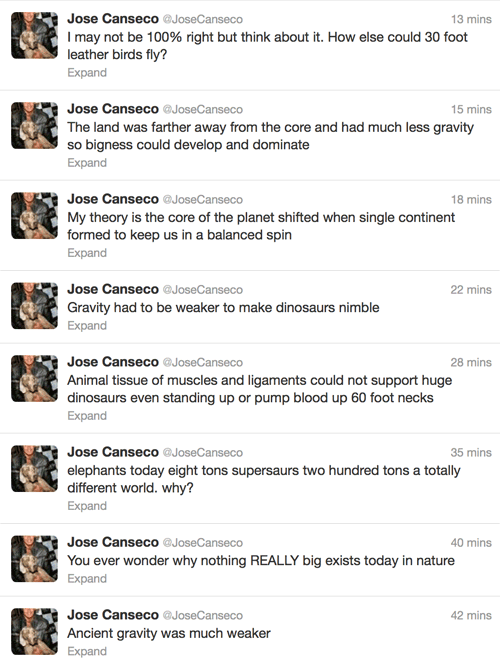
The baseball player Jose Canseco made a remarkable series of tweets yesterday.

canseco

I may not be 100% right but think about it. How else could 30 foot leather birds fly?
The land was farther away from the core and had much less gravity so bigness could develop and dominate
My theory is the core of the planet shifted when single continent formed to keep us in a balanced spin
Gravity had to be weaker to make dinosaurs nimble
Animal tissue of muscles and ligaments could not support huge dinosaurs even standing up or pump blood up 60 foot necks
elephants today eight tons supersaurs two hundred tons a totally different world. why?
You ever wonder why nothing REALLY big exists today in nature
Ancient gravity was much weaker

Deja vu, man, deja vu. Any old regulars from the talk.origins usenet group will remember this one: Ted Holden and his endless arguments for Velikovskian catastrophism. Holden also claimed that earth’s gravity had to have been much lower for dinosaurs to stand up.

Ted Holden has been repeatedly posting the claim that sauropod dinosaurs were too large to have existed in 1g acceleration. His argument is based on simple square-cube scaling of human weightlifter performance (in particular, the performance of Bill Kazmaier). His conclusion is that nothing larger than an elephant is possible in 1g. His proposed solution is a “reduction in the felt effect of gravity” (by which he seems to mean the effective acceleration), due to a variant of Velikovskian Catastrophism, often called Saturnism. Ted’s materials in their current form can be found on his web pages dealing with catastrophism.

For those not familiar with Velikovsky, he was a pseudoscientist whose claim to fame was that he so nimbly straddled two disciplines and befuddled people on either side. He was a classical scholar who used his interpretations of ancient texts to claim there was evidence of astronomical catastrophes in Biblical times (his scholarship there impressed astronomers and left the real classical scholars laughing), while also peddling an astronomical model that had planets whizzing out of their orbits and zooming by Earth in near-collisions that caused the disasters in the Bible and other ancient civilizations (his physics dazzled the classical scholars but had physicists gawping in astonishment at their absurdity).

Holden at least tried to do the math; he just flopped and did it wrong. Canseco hasn’t even done that much. Vague and uninformed impressions are not justifications for rejecting science. Here are some quick arguments against this nonsense of dinosaurs living in reduced gravity.

  • Dinosaurs exhibit the adaptations required for their mass: limbs are thicker in proportion to their length, bones show large muscle insertions, bones are thick and dense, etc. The biology clearly obeys the scaling laws we can see in extant animals.

  • Holden’s mechanism for reducing gravity is ridiculous: he postulates, for instance, that Mars hovered above the Earth and that its gravitational pull countered part of the Earth’s pull. It would have to be very close to have that effect, and while it’s true that could reduce the ‘felt effect of gravity’, it would only do so briefly before the two planets collided and destroyed all life, and also, you wouldn’t be alive to experience that brief easing of the gravitational load — you’d have been killed in the destructive chaos during the approach, and your body’s behavior would probably be dominated by atmospheric and geological upheavals anyway.

  • Canseco’s mechanism is pathetic. We already have gravitational variations on the planet, with primary differences between the equator and the poles. These amount to a roughly 0.5% difference in weight — so a 200 pound person weighs 199 pounds at the equator, and 201 pounds at the North Pole. So, most optimistically, if all the gravitational anomalies happened to be piled up on one side of the planet, let’s assume that the Mesozoic variation was greater, all the way up to 1% less on the supercontinent. So that 200 ton supersaur Canseco is concerned about would instead weigh…198 tons. Oooh. That’s enough to make his objections disappear?

At least Canseco is not as delusional as Holden. But if he starts tweeting about giant teratorns carrying Neandertals on their backs, who then fly to Mars and build giant monuments in Cydonia, get him some help, OK?

What I taught today: induction in worms, early development in flies

Today was the due date for the take-home exam, which meant everything started a bit late — apparently there was a flurry of last-minute printing and so students straggled in. But we at last had a quorum and I threw worms and maggots at them.

The lab today involves starting some nematode cultures so I gave them a bit of background on that. They’re small, transparent hermaphrodites that can reproduce prolifically and will be squirming about on their plates this week. They’re models for the genetic control of cell lineage and also for inductive interactions: I gave them the specific example of the development of the vulva, in which a subset of cells in close proximity to a cell called the anchor cell develop into the primary fate of forming the walls of the vulva, cells slightly further away follow a secondary fate, forming supporting cells, and cells yet further away form the hypodermis or skin of the worm. I had them make suggestions for how we could test that the anchor cell was the source of an inductive signal, and yay, they were awake enough at 8am to propose some good simple experiments like ablation (should lead to failure of the vulva to form) or translocation (should induce a vulva in a different location). I also brought up genetic experiments to make mutants in the signal gene, in the receptors, and deeper cell transduction pathways.

All those experiments work in the predicted ways, and I was able to show them an epistasis map of the pathways. Two lessons I wanted to get across were that we can genetically dissect these pathways in model organisms, and that when we do so, we often find that toolkit Sean Carrol talks about exposed. For instance, in the signal transduction pathway for the worm vulva, there are some familiar friends in there — ras and raf, kinases that we’ll see again in cancers. And of course there are big differences: mutations in ras/raf in us can lead to cancer rather than eruptions of multiple worm vulvas all over our bodies, because genes downstream differ in their specific roles.

Then we started on a little basic fly embryology: the formation of a syncytial blastoderm, experiments with ligation and pole plasm manipulation in Euscelis that led to the recognition of likely gradients of morphogens that patterned the embryos. From there, we jumped to the studies of Nusslein-Volhard and Wieschaus that plucked out the genes involved in those interactions and allowed whole new levels of genetic manipulation. As the hour was wrapping up, I gave them an overview of the five early classes of patterning genes: the maternal genes that set up the polarity of the embryo; the gap genes that read the maternal gene gradient and are expressed in wide bands; the pair-rule genes that respond to boundaries in gap gene expression and form alternating stripes; the segment polarity genes that have domains of expression within each stripe; and the selector genes that then specify unique properties on spatial collections of segments.

And that’s what we’ll be discussing in more detail over the next few weeks.

Slides used in this talk

Awesome cool scary horrible frightening!

A meteor exploded over Russia, injuring hundreds of people. At last report, no one had been killed, fortunately. Most of the injuries were caused by flying debris from the shock wave, but official police reports are describing the impact site and showing small fragments — it really went kablooiee.

There are also lots of videos of this event, because apparently everyone in Russia drives with a dashboard cam.

Russian drivers are probably scarier than rocks from space (usually), but it’s still got to give you pause— the universe really doesn’t care about us at all, and there is scary stuff whizzing about overhead.

What I taught today: Nuffin’!

Nothing at all! I gave the students an exam instead! While I got a plane and left ice-bound Morris to fly to Fort Lauderdale, Florida! Bwahahahahahaha!

Sometimes it is so good to be the professor. And if ever you wonder why my students hate me with a seething hot anger, it’s because I’m such an evil bastard.

Here’s what they have to answer.

Developmental Biology Exam #1

This is a take-home exam. You are free and even encouraged to discuss these questions with your fellow students, but please write your answers independently — I want to hear your voice in your essays. Also note that you are UMM students, and so I have the highest expectations for the quality of your writing, and I will be grading you on grammar and spelling and clarity of expression as well as the content of your essays and your understanding of the concepts.

Answer two of the following three questions, 500-1000 words each. Do not retype the questions into your essay; if I can’t tell which one you’re answering from the story you’re telling, you’re doing it wrong. Include a word count in the top right corner of each of the two essays, and your name in the top left corner of each page. This assignment is due in class on Monday, and there will be a penalty for late submissions.

Question 1: We’ve discussed a few significant terms so far: preformation, mosaicism, regulation, epigenesis. Explain what they mean and how they differ from each other. Can we say that any one of those terms completely explains the phenomenon of development, or is even a “best” answer? Use specific examples to support your argument.

Question 2: Tell me about the lac repressor in E. coli and Pax6 in Drosophila. One of those is called a “master gene” — what does that mean? Is that a useful concept in developmental genetics, and is there anything unique to a gene in a multicellular animal vs. a single-celled bacterium that justifies applying a special concept to one but not the other?

Question 3: Every cell in your body (with a few exceptions) carries exactly the same genetic sequence, yet those cells express very diverse phenotypes, from neurons to nephrons. The easy question: explain some general mechanisms for how development does that. The hard part: answer it as you would to a smart twelve year old, so no jargon or technical terms allowed, but you must also avoid the peril of being condescending.

Wait…I’m going to have to fly back to Morris on Sunday, and then I’m going to have to read and grade all those essays! Aargh — they’re going to get their revenge!

What I taught yesterday: master genes and maps

On Wednesdays, I try to break away from the lecture format and prompt the students to talk about the science of development. We’re working our way through Sean Carroll’s Endless Forms Most Beautiful, and yesterday we talked about chapters 3 and 4.

Chapter 3 has an overview of basic molecular biology — transcription and translation, that sort of thing — and since these are junior and senior students who’ve already heard that a few times, we skipped right over it and they explained to me what master genes are, with specific examples of homeobox-containing genes like the Hox genes and Pax6. They caught on fast that what we call master genes are actually just transcription factors located high up in a regulatory hierarchy.

I think we also got across a less-than-naive idea of the evolution of Hox genes. There is a recognizable, conserved motif in each of these genes, but the proteins are far more than just their homeodomains, and can exhibit considerable variation — necessary functional variation, because the expression of different Hox genes are going to have distinct morphological consequences.

Chapter 4 has a general theme of maps and geography — what does it mean for a cell to be in a particular position and to have a particular fate? We also get into details. This is a very fly-centric chapter, and we get a picture of early development in the fly and the specific patterning and positional organization in the early embryo of that organism, with an introduction to many genes we’ll be hearing much more about during the course of the term. We also got enough information on vertebrate development that I could ask them to play the compare and contrast game: what’s different and what’s the same in fly and mouse development? I’m trying hard to be the Reese’s Peanut Butter Cup of development in this class: it’s so easy to say, “they’re the same!” and focus on common molecular mechanisms, or to say “they’re different!” and talk about the numerous quite radical innovations between them (especially in the fly, which is a weird, highly fine-tuned machine for rapid robust development). I’m trying to get across that both statements are absolutely true, and they really taste great together.

Friday is their first exam. Next Monday, class will be an overview of nematode development, to prime them for the lab exercises for the next two weeks which will be all about photomicrography of worm development and behavior, and also more details about early fly embryology to get them prepared for a couple of weeks of nothin’ but flies. I also warned them that next Wednesday we’ll be discussing chapter 5 in Carroll, just chapter 5, because I’ve found in the past that that’s usually the brain-clogger chapter, with all its talk of boolean logic and gates and circuits.