Reddit: working hard to bury their reputation ever deeper in the slime

A new tasteless meme is spreading across Reddit: good girl college liberal. As usual, I think you can guess what makes someone a “good” girl: it’s the willingness to do anything the guy with a copy of photoshop wants her to do. And what makes her a “college liberal”?

She’s topless.

I’ve never known that to be a common characteristic of women in college, liberal or otherwise, but as we all know, reality never interferes with a misogynist’s fantasies about how women should behave.

I’ve included an example below the fold. Breasts are blurred out, but you might still want to be careful about flashing the picture around the workspace.

[Read more…]

John Logsdon hits the big time

Last night at #nwc36 we were talking about evodevo, and one of the topics that came up was the importance of Drosophila reasearch in providing the foundation for comparative genetic analysis…which led to Sarah Palin. Remember Palin’s ignorant mockery of fruit fly research? This is what we get from the Republican party.

Now Michelle Malkin’s blog chimes in with a similar complaint. John Logsdon got an NSF award to study reproduction in snails. WASTE OF MONEY! CUT THE DEFICIT! HOW DARE THEY SPEND MONEY ON SOMETHING SO STUPID!

Malkin’s blogger, Doug Powers, and the majority of the commenters there are embarrassingly ignorant. They quote the award announcement with some annotations.

The study, first funded in 2011 and continuing until 2015, will study the New Zealand snails to see if it is better that they reproduce sexually or asexually – the snail can do both – hoping to gain insight on why so many organisms practice sexual reproduction.

“Sexual reproduction is more costly than asexual reproduction [just paying for the drinks can end up running into the thousands of dollars over a lifetime – DP] [fucking moron – PZM], yet nearly all organisms reproduce sexually at least some of the time. Why is sexual reproduction so common despite its costs,” the study’s abstract asks.

And then doubles down on the cluelessness.

“Why is sexual reproduction so common despite its costs”? Seriously?

Yes. Seriously. That’s an important question in biology. Selfish stupid libertarian/republican idiots ought to understand this clearly.

Look at it this way, Doug. When you go to reproduce, you — perfect, powerful, independent, self-serving you — need to go to a mere woman and in order to produce offspring, you only pass on half your genes, and they are mingled with half the genes from your partner. That’s what we mean by the cost of sexual reproduction. You don’t get to produce a literal self-made man: you need to cooperate with a partner, and your genome will be diluted with that of some other person. That other person is using YOU as well, parasitizing off the perfect efficiency of your genes to propagate her patently inferior genes.

Any good conservative Republican ought to be outraged at this state of affairs. Think about it: your God, President Ronald Reagan, instead of cloning himself, had to randomize his genes with some other person and produced a son, Ron Reagan, who is a politically liberal atheist. You ought to be throwing far more money at this problem!

Snails are an interesting choice to study this problem because, unlike humans, they have options to either reproduce in that familiar sexual way, or to do it asexually and essentially clone themselves. The question is why any individual would elect to throw away half their genes each time they reproduce.

If Doug Powers can explain that, he could get published in some big name science journal instead of the blog of an ignorant political hack.

Hey, we should study that choice, too, except we haven’t yet found any molluscs stupid enough to have to decide whether they want to be published on Michelle Malkin’s site or not.

What I taught today: O Cruel Taskmaster!

I’m out of town! Class is canceled today! But still, my cold grip extends across the Cascades, over the Palouse, the Rockies, the Dakota badlands, the old homeland of the American bison, the the great farms of the midwestern heartland, to a small town in western Minnesota, where I crack the whip over a tiny group of hardworking students. They’ve been mastering the basics of timelapse video microscopy in the lab this week, I hope, and will be showing me the fruits of their labors on Monday. I’m also inflicting yet another exam on them over the weekend. Here are the questions they are expected to address.

Developmental Biology Exam #2

This is a take-home exam. You are free and even encouraged to discuss these questions with your fellow students, but please write your answers independently — I want to hear your voice in your essays. Also note that you are UMM students, and so I have the highest expectations for the quality of your writing, and I will be grading you on grammar and spelling and clarity of expression as well as the content of your essays and your understanding of the concepts.

Answer two of the following three questions, 500-1000 words each. Do not retype the questions into your essay; if I can’t tell which one you’re answering from the story you’re telling, you’re doing it wrong. Include a word count in the top right corner of each of the two essays, and your name in the top left corner of each page. This assignment is due in class on Monday, and there will be a penalty for late submissions.

Question 1: One of the claims of evo devo is that mutations in the regulatory regions of genes are more important in the evolution of form in multicellular organisms than mutations in the coding regions of genes. We’ve discussed examples of both kinds of mutations, but that’s a quantitative claim that won’t be settled by dueling anecdotes. Pretend you’ve been given a huge budget by NSF to test the idea, and design an evodevo research program that would resolve the issue for some specific set of species.

Question 2: Every generation seems to describe the role of genes with a metaphor comparing it to some other technology: it’s a factory for making proteins, or it’s a blueprint, or it’s a recipe. Carroll’s book, Endless Forms Most Beautiful, describes the toolbox genes in terms of “genetic circuitry”, “boolean logic”, “switches and logic gates” — he’s clearly using modern computer technology as his metaphor of choice. Summarize how the genome works using this metaphor, as he does. However, also be aware that it is a metaphor, and no metaphor is perfect: tell me how it might mislead us, too.

Question 3: We went over the experiment to test the role of enhancers of the Prx1 locus which showed their role in regulating limb length in bats and mice. Explain it again, going over the details of the experiment, the results, and the interpretation…but without using any scientific jargon. If you do use any jargon (like “locus”, “regulation”, “enhancer”), you must also define it in simple English. Make the story comprehensible to a non-biologist!

Yeah, you don’t have to tell me. I’m evil.

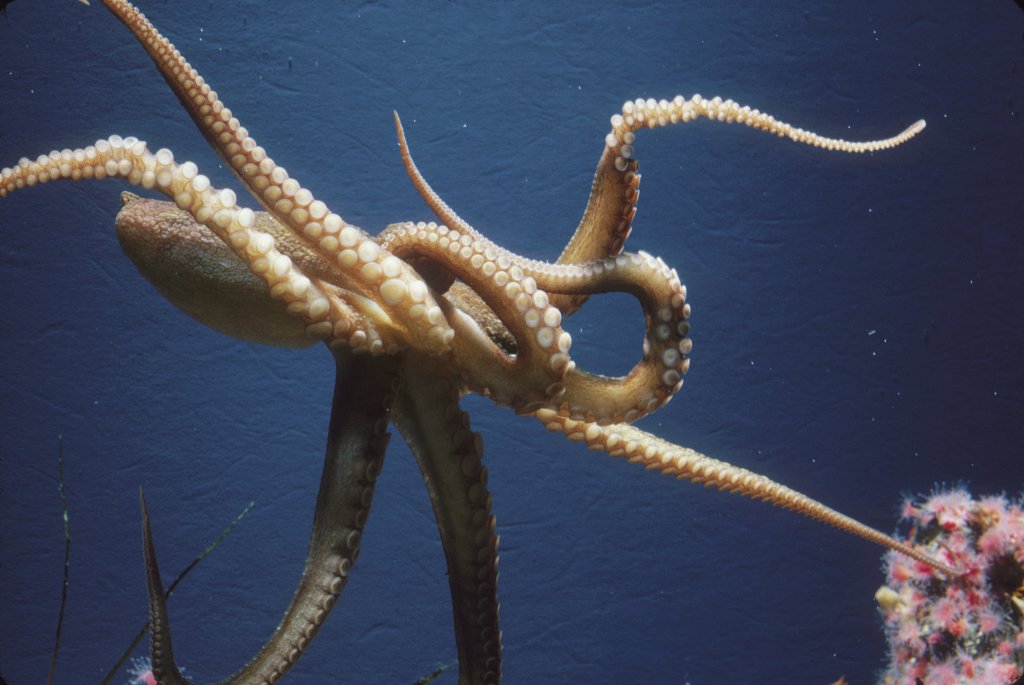
Friday Cephalopod: Our cunning plan exposed

pinksquid

This pretty pink photo that accompanied the article has nothing at all to do with the contents; this can’t be the species involved. But that’s appropriate to the devious nature of the story.

A squid was caught in China that had swallowed a three pound bomb — a live explosive that was later detonated by the local bomb squad.

Just keep that in mind next time you order calamari. If you hear a loud boom from the kitchen, you’ll know the suicide squid have struck again.

Here I Stand; I Can Do No Other

I weigh in on Google Glass at KCET.

The gist:

Some of us come out to the desert to escape the Panopticon that life in the city already is, increasingly. In Los Angeles, Google Glass might be just one more increment of invasion in a landscape already thoroughly colonized by surveillance cameras, red light cameras, random private webcams, smart phone videographers and other such prying eyes. But there are places out here that don’t even have 4G yet. In fact — and you might want to sit down here and swallow that mouthful of coffee — there are some places out here where even the 3G coverage is spotty. We are in the back of beyond here in much of Eastern California.

And we like it that way, mostly.

So by all means, come on out and visit the desert. Bring your recording equipment, whether it’s a shoulder-mounted Steadicam or this latest bit of geek lust from Google sitting on your face. Document your hike. Record that coyote begging for sandwiches. Take video of that gorgeous desert bloom backlit by sunrise. The desert needs all the documentation it can get.

But if you’re talking to me, take that Google Glass off and put it away. If I’m speaking in public — which I do from time to time, offering lectures and poetry readings and such — and see you’re in my audience wearing Google Glass and you haven’t cleared it with me first, I will stop what I’m doing and ask you to put it away or leave. If you’re at an adjacent cafe table facing me and recording in my direction, I will write something derogatory in Sharpie on a sheet of paper and hold it up. I may escalate from there. And I’m not alone.

Read the whole thing.

[Read more…]

The argument from eyelid development

This is a new one for me. Earlier today I was summoned on Twitter to address an assertion by a creationist, @jarrydtrokis. I was slightly boggled.

He was baffled by eyelid development. It seems he thinks it requires…intelligent design!.

… Here’s one for you to ponder :) Eye lids in the womb… How are they formed? #IntelligentDesign?

Wait, what? What’s mystifying about eyelid formation?

The section of skin in the middle dies… How does it know to do that? And in a perfectly straight line???

Oh. It forms a straight line. Whoa. And he claims to have done research to get the answer.

The research I’ve done shows the scientists are at a loss for an explanation….

Gosh. I can do research, too. It’s easy to explain, with pictures even.

The eyelids separate in a straight seam because of how they got that way. The eyelids form by expansion of two epithelial sheets from above and below that meet in the middle. When you see how the eyelids develop, it’s easy to see how they separate in a straight line later. This is a series of images over the course of about a day in mouse development. In the first, you can see the eye sans eyelid, but ringed by epithelia. In the second, you can see that epithelium growing, expanding in a sheet over the eye. In the third, the sheet is beginning to close in a line over the middle, and in the fourth it has completely closed, but leaving a seam or scar in a straight line across it.

mouse_eyelid_sem

Wait, you say inquisitively, I’d like a closer look at that seam. Can you show me what is going on postnatally, as the eyelids separate? Sure can.

mouse_eyelid_tem

The first panel is 5 days postnatal in the mouse; the eyelids are still fused. But you can see a difference in the histology of the junctional region (J), and a depression at the arrowhead (you can also see the layers of keratin there). There’s something different in this area.

In the second panel, 10 days postnatally, the depression at the junctional region is deepening and you can see a stratum granulosum (SG) at the seam, while you can also see hair follicles (HF) forming in the adjacent portions of the lid.

The third and fourth panels are at 12 days, and now the keratin layers have extended into the depression from both the inside and outside, completing the separation of the two lids.

Now @jarrydtrokis might be tempted to say that Jesus did the separating, but that’s only true if Jesus is a polypeptide called epidermal growth factor, or EGF. EGF is a molecule that triggers growth and differentiation of keratinocytes, and it turns out that if you treat baby mice with EGF it accelerates the rate of eyelid separation.

I’m sorry, @jarrydtrokis, but your argument from ignorance wasn’t very persuasive, and your talents at ‘research’ are rather pathetic, since the paper describing all that was trivial to find. But then, isn’t this always the case with creationists? There are none so blind as those who will not see.


Findlater GS, McDougall RD, Kaufman MH (1993) Eyelid development, fusion and subsequent reopening in the mouse. J Anat. 183(1):121-9.

Gizmodo fails again

There’s a whole lot wrong with this Gizmodo piece on the proposed Palen Solar Electric Generating System. In fact, the fuckup per sentence ratio is higher than in any piece I’ve seen this month outside of Mercola.com. The Solar Energy Zone “Initiative” wasn’t “signed into law” by Obama — it was a record of decision issued by the Interior Department on an agency program as the culmination of an environmental assessment, rather than a bill passed by Congress and sent to the President’s desk. (Which means Obama didn’t sign it and it’s not a law.) Palen will very likely not start construction this year: the California Energy Commission is casting a sober eye at contractor BrightSource’s technology on its proposed Hidden Hills project, which is much closer to approval. The towers at Hidden Hills will be just as tall as those at Palen, if either plant ever gets built, and Hidden Hills will likely go up first, meaning that the Gizmodo headline is wrong.

Like I said: many, many errors. But this one’s the worst, and it’s the very first paragraph:

The US government holds vast tracts of public lands—more than a 654 million acres, in fact—for public use such as national parks as well as for military use like test ranges and proving grounds. But most of the time, much of that land is left to rot when it could be producing clean solar energy for our ever-increasing power needs.

“Left to rot.”

By way of comparison

“Left to rot.”

ashford

“Left to rot.”

marching

What is it with some of these tech writers? Any landscape that doesn’t look like fucking Trantor is useless to them, sounds like.