The most precious jewelry in the world

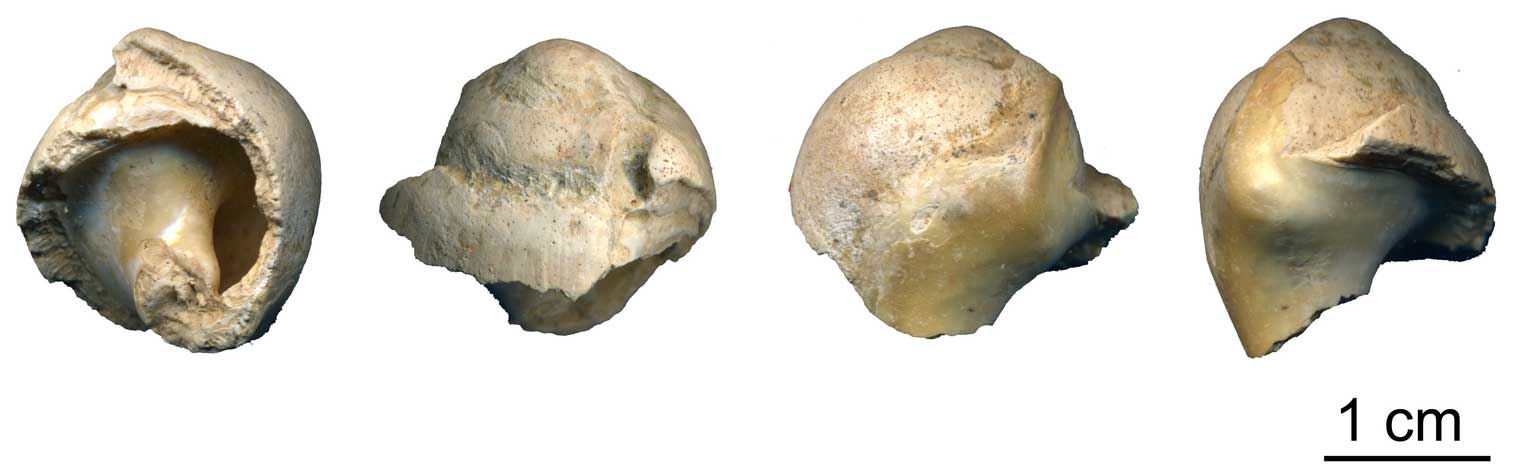
It’s not the Koh-I-Noor or the Empress Eugenie Brooch or whatever my wife is wearing right now, it’s this:

neandertal_shell

It’s a small, broken fossil shell, collected from a fossil outcrop and transported 110 kilometers to a hole in the ground in Italy. Close inspection reveals that before it was broken, there was a pattern of abrasion in one spot that suggests a hole had been drilled in it and a loop of sinew threaded through it. Although most of it has been worn away by time, bits of material in microscopic pits on its surface reveal that once, this shell had been painted with red ochre.

It doesn’t sound like much. But then, what makes it precious is the burden of antiquity it carries: it’s about 47,000 years old, and it was made by Neandertals.

A few Lower and Middle Paleolithic sites preserve exotic objects with no obvious functional role and striking visual appearance such as quartz crystals, fossils, shells, and natural objects mimicking human or animal shapes. These are interpreted as the first evidence for the ability to distinguish ordinary from exotic items, to create conscious cultural taxonomies, and/or to detect iconicity in the natural world. Some argue these sporadic finds would have prompted the mental bridge between referent and referrer thus igniting the creation of symbolic material cultures. Although this possibility cannot be discarded, three reasons may favor the interpretation of the Aspa marginata from Fumane as a pendant, i.e. an object conceived to be suspended for visual display body through threading or stringing. The attention put to uniformly cover the outer shell surface with good quality red pigment suggests that this action may have been performed to make the object suitable for visual display. The wear detected on the inner lip, made of overlapping groups of striations oriented perpendicular to the shell main axis, is consistent with a sustained friction produced by a cord rich in abrasive particles, such as sinew. The absence of pigment on the shell fracture is most consistent with this item being used as a pendant.

It’s art. Very, very old art, made by a people who are completely extinct today, from a culture of which we have almost no knowledge, just these lost scraps with all context lost. That also adds great value to the object, that it is such a tiny fragment of knowledge, that it reminds us of how little we actually know about these long-gone people. Tens of thousands of years from now, if anyone is going through our decayed rubbish heaps, they aren’t going to find the Mona Lisa, a well-preserved space shuttle, or sheet music from a Beethoven symphony — they’re going to find a broken plastic toy from a McDonald’s Happy Meal, or a nicely symmetrical fragment of a concrete traffic bollard, and I suspect it will be regarded as a great and rare treasure then, too.

I also just find it wonderful to contemplate — that over 40,000 years ago, our relatives found enough stability and security in their communities that they had time to express themselves, and that they naturally exercised their minds and hands to create art, and that they worked to adorn themselves.


Peresani M, Vanhaeren M, Quaggiotto E, Queffelec A, d’Errico F (2013) An Ochered Fossil Marine Shell From the Mousterian of Fumane Cave, Italy. PLoS ONE 8(7): e68572. doi:10.1371/journal.pone.0068572

Differential Interference Contrast Microscopy, or the question I’m never asked

Thirty, almost forty, years ago when zebrafish were an up and coming model system and very few labs were working on them, we were used to going to conferences and reciting the zebrafish litany, a list of attributes that justified us working on such an oddball animal: we’d explain, for instance, that it was prolific, fast developing, and optically transparent, so we could see right into the nervous system in the living embryo. And you know, not once have I ever been asked the really simple and obvious question: if it’s transparent, then how do we see anything inside it?

I know. It takes a moment to step outside the assumptions (we say we see stuff, after all) and think about what transparency actually means. Of course, I always have an answer prepared: “With differential interference contrast microscopy, Nomarski optics specifically.” A polysyllabic phrase is always an effective way to shut down the rubes, isn’t it?

But I can also explain it in simple English, especially if I can flail about on a chalkboard at the same time. So let’s try.

[Read more…]

What? Indulgences are still a thing?

Everytime I get a peek into the weird world of Catholicism, it gets stranger and stranger. I had heard before that the Vatican was still offering “indulgences”, token recognition of piety that give you time off in purgatory, but I had no idea that they were going to make it technology driven — a medieval idea given a 21st century facade. But here they go, the Vatican has a new way to get time off in purgatory: follow the Pope on twitter!

All you have to do is follow the Pope’s 140 character tweets as he presides over Catholic World Youth Day in Rio de Janeiro, and presto, indulgences! No word on the exchange rate — is it like one tweet is worth one day off, or 140 seconds, or something? Does retweeting give you a special bonus?

If you thought Catholicism couldn’t possibly get more trivial or silly, I think they’ve just about hit rock bottom.

Oh, wait…

"What really counts is that the tweets the Pope sends from Brazil or the photos of the Catholic World Youth Day that go up on Pinterest produce authentic spiritual fruit in the hearts of everyone," said Celli.

Pinterest, too?

Could we also get spiritual credit if we set up a Pope porn tumblr?

Embryos at last!

Oh, look: The first embryos from our new and improved fish system!

babyfishies

We only got a handful today, but you can see why. Those are about 3½ hours old, so we collected too late and the little babies’ mommies and daddies had spent the previous few hours assiduously poking around in the marbles sheltering the eggs, and had sucked up their little brothers and sisters in a cannibal feast, as they like to do. We’ll be adjusting our schedules, as developmental biologists often have to do, to do much earlier collections starting tomorrow.

The parents look happy and comfortable, perhaps a little plump after their breakfast of caviar and shrimp, so we expect more tomorrow. Right now we’re raising these little guys at a couple of different temperatures to calibrate our staging adjustments.

Short, sharp summary

Larry Moran has a simple list of the 5 basics you need to understand about junk DNA. It’s short and sweet; I’d like to see a creationist, who are often weirdly antagonistic to the whole idea of junk DNA, deal with these basic facts before they start ranting against the observations and conclusions.

  1. Genetic Load

    Every newborn human baby has about 100 mutations not found in either parent. If most of our genome contained functional sequence information, then this would be an intolerable genetic load. Only a small percentage of our genome can contain important sequence information suggesting strongly that most of our genome is junk.

  2. C-Value Paradox

    A comparison of genomes from closely related species shows that genome size can vary by a factor of ten or more. The only reasonable explanation is that most of the DNA in the larger genomes is junk.

  3. Modern Evolutionary Theory

    Nothing in biology makes sense except in the light of population genetics. The modern understanding of evolution is perfectly consistent with the presence of large amounts of junk DNA in a genome.

  4. Pseudogenes and broken genes are junk

    More than half of our genomes consists of pseudogenes, including broken transposons and bits and pieces of transposons. A few may have secondarily acquired a function but, to a first approximation, broken genes are junk.

  5. Most of the genome is not conserved

    Most of the DNA sequences in large genomes is not conserved. These sequences diverge at a rate consistent with fixation of neutral alleles by random genetic drift. This strongly suggests that it does not have a function although one can’t rule out some unknown function that doesn’t depend on sequence.

I’m also relieved to see that the anti-junk fanatics tend to gravitate towards Larry’s blog and leave the rest of us mostly alone.

Disappointment

I got up early this morning and rushed over to the lab to suck on tanks — danios lay demersal eggs that sink to the bottom of the tank, and you can just siphon them up — and…nothing but fish poop. I have a sad face. It was probably overly optimistic since we only have a few adults yet and they’ve just been plunked into the system, but I had hopes. They look so happy! (Zebrafish visibly respond to stress by going pale, and as soon as these guys hit the tanks their little stripes were vividly dark blue).

Water quality is good, but now I’m channelling my grandmother and starting to fuss over their diet. They need to eat and get fat and good rich fatty food is just the ticket. We’ve got the brine shrimp hatchery bubbling and those should be ready tomorrow, and I’m going to be giving them a range of tropical fish foods. We will plump these little creatures up so they can give me more than just feces to look at in the morning.

We’ve also ordered a couple of defined wild type lines — at $20/pair, so we expect thoroughbreds — so the colony population should climb soon, which will help. Then, observations and experiments and breeding and colony expansion.

You asked, I deliver the fish porn

Since everyone insisted, here’s a photo of our incipient zebrafish system, built by my student Josh.

tankphoto

What it is is a set of ordinary plastic shelving with some custom built plastic trays to catch water overflow, and then an array of simple 2-3 liter tanks (the smallest size Kritter Keepers, if you must know — you can get them for about $2 each). There is a 110 liter reservoir tank down below, with an immersible pump that can generate a flow of about 1900 gallons/hour, currently greatly throttled down since we only have a few tanks in place. Water is pumped out of the reservoir to two places: 1) towards the ceiling, where the PVC plumbing splits — with valves, we can select to have the water pumped right out to the sink nearby, or to a bypass line that just has the water going up and back down, or in normal operation, to a line that has a big hunk of 3″ PVC pipe packed with bioballs and charcoal for filtering, and 2) to a big bucket of sand for additional filtration. Water is just flowing all over the place here.

Most importantly, the main outflow line is tapped in 3 spots to some irrigation hose leading to six of these nifty little widgets that provide a trickle of water out nine smaller drip lines, which lead to the fish tanks. It’s amazing what you can find in hydroponics gear. If ever Minnesota legalizes marijuana, I could also cycle fish water (mmm, rich & tasty fish poop) into racks of plants and pay for all this stuff.

Here’s a quick and dirty diagram if that explanation doesn’t help. Not that the cartoon will necessarily help, either. Blue circles are valves. Arrows indicate the direction of water flow.

tanksystem

It’s been running for a couple of weeks solid with no problems (I wish I could say the same for the backup system we set up yesterday, which blew gaskets all over the place and made a mess overnight), so we’ve actually put a few fish in there. With any luck, we’ll have embryos this week!