Jonathan Wells is dead

Wells was one of the worst liars at the Discovery Institute, which is saying a lot. His pals out there in Seattle are writing his praises, of course; you won’t be surprised that they don’t understand why Wells’ books were loathed. Here’s Casey Luskin, who inevitably gets everything wrong.

A lot of people hated Jonathan, not because he was a hateworthy person, but because of the bad news he delivered about their scientific arguments. His ideas threatened their paradigm, and he wasn’t afraid to say so. But he didn’t hate back. He was a kind and caring person who used his gifts to make an immense impact, helping to reform junk science that had bloated evolution education worldwide. For all these reasons, Dr. Jonathan Wells will not be forgotten anytime soon. By his many friends, readers, and others who have benefited from his research, and of course by his loving family, he will be greatly missed.

He did not deliver bad news about scientific arguments; he didn’t understand, or pretended not to understand, the science he was criticizing. Everything he wrote was a misrepresentation. He didn’t reform junk science, he vomited up books that were nothing but junk science. I am confident that he wasn’t just ignorant, but that he intentionally, willfully, and maliciously lied about the science.

He was an intelligent man who got a Ph.D. in religious studies from Yale, and then got a second Ph.D. in cellular and developmental biology from the University of California Berkeley. There’s rarely ever a good reason to get a second Ph.D., and Wells had the worst reason ever: he had become a Moonie, and he got the second degree at the behest of his church so that he would be better equipped to destroy Darwinism.

Father’s [Rev. Moon’s] words, my studies, and my prayers convinced me that I should devote my life to destroying Darwinism, just as many of my fellow Unificationists had already devoted their lives to destroying Marxism. When Father chose me (along with about a dozen other seminary graduates) to enter a Ph.D. program in 1978, I welcomed the opportunity to prepare myself for battle.

Yeah, he was one of those misguided people who went through a research program not to learn anything, but to get a few letters after his name so he could pretend to be an authority. He also dishonored Berkeley with a badge of shame; it is appalling that someone so dishonest and so committed to distorting the science could fool the research scientists at that prestigious university.

He distorted every idea he touched. Larry Moran thoroughly debunked his treatment of junk DNA, for my part, I wrote about how he constantly botched and misinformed people about developmental biology. Here’s an example of one of my posts in which I wasted my time dissecting the glurge of garbage pouring out of his Moonie brain.

The next person–apparently a professor of developmental biology–objected that the film ignored facts showing the unity of life, especially the universality of the genetic code, the remarkable similarity of about 500 housekeeping genes in all living things, the role of HOX genes in building animal body plans, and the similarity of HOX genes in all animal phyla, including sponges. 1Steve began by pointing out that the genetic code is not universal, but the questioner loudly complained that 2he was not answering her questions. I stepped up and pointed out that housekeeping genes are similar in all living things because without them life is not possible. I acknowledged that HOX gene mutations can be quite dramatic (causing a fly to sprout legs from its head in place of antennae, for example), but 3HOX genes become active midway through development, 4long after the body plan is already established. 5They are also remarkably non-specific; for example, if a fly lacks a particular HOX gene and a comparable mouse HOX gene is inserted in its place, the fly develops normal fly parts, not mouse parts. Furthermore, 6the similarity of HOX genes in so many animal phyla is actually a problem for neo-Darwinism: 7If evolutionary changes in body plans are due to changes in genes, and flies have HOX genes similar to those in a horse, why is a fly not a horse? Finally, 8the presence of HOX genes in sponges (which, everyone agrees, appeared in the pre-Cambrian) still leaves unanswered the question of how such complex specified genes evolved in the first place.

The questioner became agitated and shouted out something to the effect that HOX gene duplication explained the increase in information needed for the diversification of animal body plans. 9I replied that duplicating a gene doesn’t increase information content any more than photocopying a paper increases its information content. She obviously wanted to continue the argument, but the moderator took the microphone to someone else.

It blows my mind, man, it blows my freakin’ mind. How can this guy really be this stupid? He has a Ph.D. from UC Berkeley in developmental biology, and he either really doesn’t understand basic ideas in the field, or he’s maliciously misrepresenting them…he’s lying to the audience. He’s describing how he so adroitly fielded questions from the audience, including this one from a professor of developmental biology, who was no doubt agitated by the fact that Wells was feeding the audience steaming balls of rancid horseshit. I can’t blame her. That was an awesomely dishonest/ignorant performance, and Wells is proud of himself. People should be angry at that fraud.

I’ve just pulled out this small, two-paragraph fragment from his longer post, because it’s about all I can bear. I’ve flagged a few things that I’ll explain — the Meyer/Wells tag team really is a pair of smug incompetents.

1The genetic code is universal, and is one of the pieces of evidence for common descent. There are a few variants in the natural world, but they are the exceptions that prove the rule: they are slightly modified versions of the original code that are derived by evolutionary processes. For instance, we can find examples of stop codons in mitochondria that have acquired an amino acid translation. You can read more about natural variation in the genetic code here.

2That’s right, he wasn’t answering her questions. Meyer was apparently bidding for time until the big fat liar next to him could get up a good head of steam.

3This implication that Hox gene expression is irrelevant because it is “late” was a staple of Wells’ book, Icons of Evolution and the Politically Incorrect Guide to Darwinism and Intelligent Design. It’s a sham. The phylotypic stage, when the Hox genes are exhibiting their standard patterns of expression, of humans is at 4-5 weeks (out of 40 weeks), and in zebrafish it’s at 18-24 hours. These are relatively early events. The major landmarks before this period are gastrulation, when major tissue layers are established, and neurulation, when the neural tube forms. Embryos are like elongate slugs with the beginnings of a few tissues before this time.

4What? Patterned Hox gene expression is associated with the establishment of the body plan. Prior to this time, all the embryonic chordate has of a body plan is a couple of specified axes, a notochord, and a dorsal nerve tube. The pharyngula stage/phylotypic stage is the time when Hox gene expression is ordered and active, when organogenesis is ongoing, and when the hallmarks of chordate embryology, like segmental myotomes, a tailbud, and branchial arches are forming.

5Hox genes are not non-specific. They have very specific patterning roles; you can’t substitute abdominal-B for labial, for instance. They can be artificially swapped between individuals of different phyla and still function, which ought, to a rational person, be regarded as evidence of common origin, but they definitely do instigate the assembly of different structures in different species, which is not at all surprising. When you put a mouse gene in a fly, you are transplanting one gene out of the many hundreds of developmental genes needed to build an eye; the eye that is assembled is built of 99% fly genes and 1% (and a very early, general 1%) mouse genes. If it did build a mouse eye in a fly, we’d have to throw out a lot of our understanding of molecular genetics and become Intelligent Design creationists.

Hox genes are initiators or selectors; they are not the embryonic structure itself. Think of it this way: the Hox genes just mark a region of the embryo and tell other genes to get to work. It’s as if you are contracting out the building of a house, and you stand before your subcontractors and tell them to build a wall at some particular place. If you’ve got a team of carpenters, they’ll build one kind of wall; masons will build a different kind.

6No, the similarity of Hox genes is not a problem. It’s an indicator of common descent. It’s evidence for evolution.

7Good god.

Why is a fly not a horse? Because Hox genes are not the blueprint, they are not the totality of developmental events that lead to the development of an organism. You might as well complain that the people building a tarpaper shack down by the railroad tracks are using hammers and nails, while the people building a MacMansion on the lakefront are also using hammers and nails, so shouldn’t their buildings come out the same? Somebody who said that would be universally regarded as a clueless moron. Ditto for a supposed developmental biologist who thinks horses and flies should come out the same because they both have Hox genes.

8You can find homeobox-containing genes in plants. All that sequence is is a common motif that has the property of binding DNA at particular nucleotide sequences. What makes for a Hox gene, specifically, is its organization into a regulated cluster. How such genes and gene clusters could arise is simply trivial in principle, although working out the specific historical details of how it happened is more complex and interesting.

The case of sponges is enlightening, because they show us an early step in the formation of the Hox cluster. Current thinking is that sponges don’t actually have a Hox cluster (the first true Hox genes evolved in cnidarians), they have a Hox-like cluster of what are called NK genes. Apparently, grouping a set of transcription factors into a complex isn’t that uncommon in evolution.

9If you photocopy a paper, the paper doesn’t acquire more information. But if you’ve got two identical twins, A who is holding one copy of the paper, and B who is holding two copies of the same paper, B has somewhat more information. Wells’ analogy is a patent red herring.

The ancestral cnidarian proto-Hox cluster is thought to have contained four Hox genes. Humans have 39 Hox genes organized into four clusters. Which taxon contains more information in its Hox clusters? This is a trick question for Wells; people with normal intelligence, like most of you readers, would have no problem recognizing that 39 is a bigger number than 4. Jonathan Wells seems to have missed that day in his first grade arithmetic class.

It still infuriates me that a guy with a Ph.D. in developmental biology from Berkely would ask, if flies have HOX genes similar to those in a horse, why is a fly not a horse? Because the Hox genes only trigger the deployment of downstream genes of the animal, ya idjit.

Casey Luskin is wrong. I didn’t hate Wells personally — I never met him — but I did hate his lies, of which there were many, whole books worth of ’em. Good riddance to lying scum.

Behold, the worst teacher in the world!

If you see this face coming, kick him or spit on him or otherwise scorn him. He’s terrible.

I’m having a bad semester. I’m teaching my intro biology course, which is small and ideally sized with 10 students, and every day is a trial. I go in prepared; I’m cheerful and friendly, I think; I’m working on the shaggy Santa Claus look; I’ve got lectures with frequent pauses and breaks where I encourage discussion; I think it’s an interesting topic. I’m talking amiably, and I ask the class a question — it can be as simple as “what are the results of crossing two heterozygotes?” or more open-ended, like “what is your opinion of IVF?” and it’s always the same result: dead silence, stony faces, everyone avoiding my eyes. It’s killing me. Am I intimidating? Boring? Hideous? Should I wear a bag on my head? I keep trying to get them engaged, and all I’m getting for my troubles is flop sweat.

These are not stupid students, either. I gave them a quiz last week, the mean was somewhere in the low 80s, so I know they’re understanding the material. They just don’t want to talk to me.

I’m thinking that maybe I should try some in-class ice breakers next week, and see if I can get them more active. Anyone got any good suggestions? I’m getting desperate.

Alternatively, I pick up a fifth of vodka and numb myself before walking into the classroom, because the strain is getting to me.*

*Not actually an option. I gave up all alcohol during the pandemic.

If you’re in the neighborhood…

On Thursday, 12 September, at 2:30, I’m joining forces with another class to drag our freshman students outside, before the snow starts falling next month, to confront the reality of life on campus. I’m bringing some handlenses, my macro camera, and an endoscopic camera for poking into holes, and we’ll take a look at life in the desert of the campus lawns and shrubbery (there is some, but it’s mostly springtails, ants, and spiders). We’ll also talk about how “spider” is misleading, because there are at least 30 different species of spiders living here, alongside the human monoculture.

I’m encouraging the students to sign up for iNaturalist and to use Seek to begin their careers as natural historians. It’ll be fun! Especially since otherwise I’d be lecturing them on meiosis. You’re welcome to join in if you’re in the neighborhood of Morris, Minnesota — this is going to be casual and geared to the first year college student.

I know what I’m doing today

Busy, busy, busy. The hatching yesterday means that I’m going to spend the morning sorting spiders, on top of the regularly scheduled feeding day. I’ve got a bunch of adults who need crickets, a lot of baby Parasteatoda who need fruit flies, a few score Latrodectus I set aside in new vials yesterday who are going to get their first meal, and another score or two to be extracted this morning, and it’s time to start a new batch of Drosophila. I’m sort of dreading the possibility that another egg sac could start oozing spiderlings any day now.

There’s a limit to how many of these spiders I can maintain. I hate to say it, but I may end up throwing a lot of cute, adorable, lively little baby spiders into fixative for later microscopic examination. Unless you want some? I’m heading off to St Louis this weekend for Skepticon, and I could bring along some Latrodectus mactans spiderlings if anyone wants to give them a good home.

Speaking of Skepticon, I’m kind of on the schedule. I’m doing a workshop on Friday — but it’s not about spiders or evolution, directly. I’m going to present some exercises I’m using in a writing course I’ll be teaching this fall. If you want to learn about writing creative non-fiction (and maybe, if you really want getting your own baby black widow), that’s the place to be.

That web is not tangled at all

I was up early, watching this juvenile Cross Orbweaver shuttling about, at work building her web.

Meanwhile, the full-grown big mama spider above her had already constructed the classic spider web.

As for me, today is that trite scene, the Reading of the Will. I don’t anticipate any drama, I’m confident my mama cared for us all and just wanted to show her appreciation of everyone in the family, so all it’s going to do is make me sad.

Nobody here but us chickens

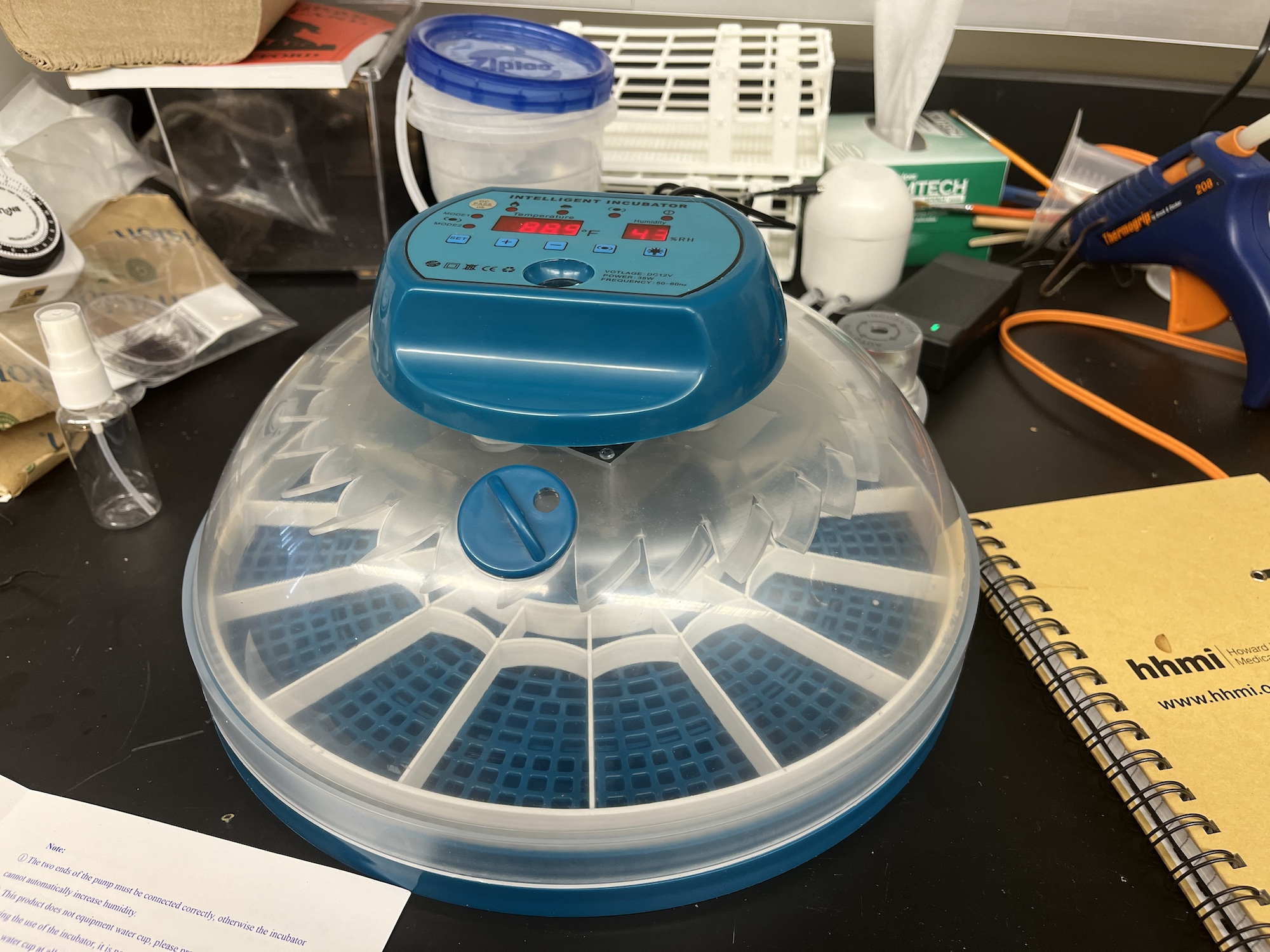
I’m still waiting for my black widow egg sacs to hatch out, and I’m getting a little concerned. My lab is still a frigid cold victim of bad environmental controls in my building — 17°C (62°F) — and although I’ve got the little guys packed up in incubators, I also have to worry about very low humidity, under 30%. I’ve been shopping for incubators with both thermal and humidity control, but it’s a terrible mistake to try looking in scientific supply catalogs. $1500? For a little 0.2L box? That’s not going to do.

So I resorted to Amazon, and searched for egg hatching stuff. Here we go — there’s a mass market demand for incubators for chicken eggs, so that’s what I got.

There we go, Egg Incubator, Intelligent Incubator for Chicken Eggs with Automatic Humidity Control and Egg Turning, Temperature control, 15 Eggs Incubator for Hatching Eggs&Quail egg with Egg Candler. $40. I just calibrated it, and am waiting for it to stabilize at 30°C and 75% humidity. I disabled the egg turning, and don’t have much use for an egg candler. I think they need to adjust their ad copy to mention Spider Eggs.

I’m still keeping my eyes open for a used scientific-grade incubator, but this will do. I also think the physical plant people need to get on the ball and get the environmental controls properly balanced — my lab is a refrigerator all summer long, while some of the offices are saunas, I hear. I complain every year, but nothing is ever done.

These monsters are all dead

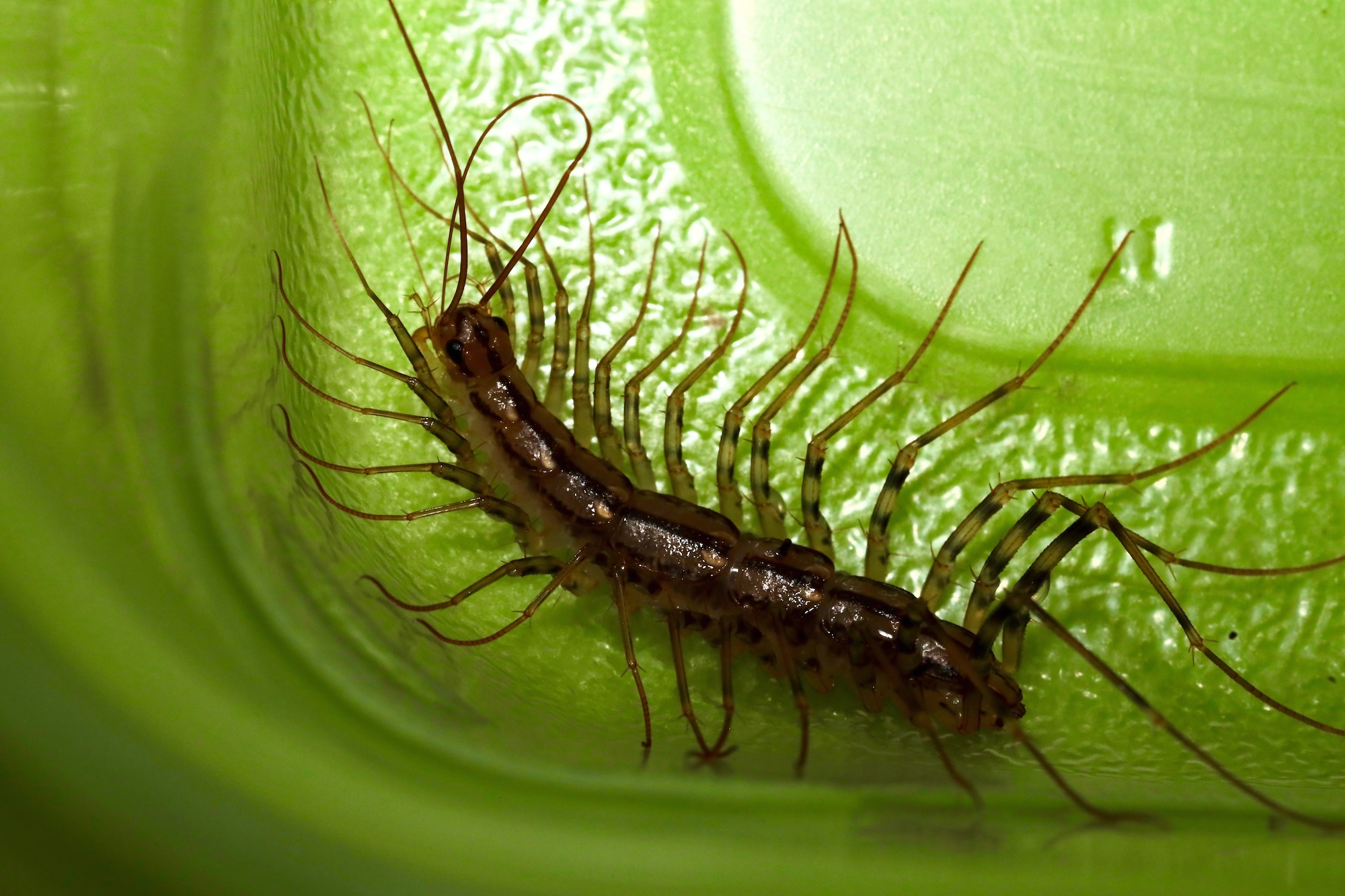
I hope you all like long tubular creatures, because that’s all I’ve got for you today. Maybe they’d be less horrifying if they had lots of legs?

Here’s a 4-meter long salamander-like beast from the Permian, named Gaiasia.

I’ve seen giant salamanders before, but not ones with big box-like skulls full of razor-sharp fangs.

Here’s another muscular tube, Vasuki indicus, only 47 million years old, but somewhere around 10-15 meters long.

The amusing thing about this beast is that everyone in the popular press treatment is making it all about how long it is — it’s a partial skeleton, there’s not enough to determine exactly how long it is. It’s either shorter than Titanoboa, the gold standard of giant ancient snakes, or bigger than Titanoboa. It’s not a competition, people! They’re separated by about 10 million years. But of course they’re in competition for starring roles in cheesy sci-fi CGI epics.

That’s why we’re seeing ridiculous comparisons like this one:

OK, the snake was longer than T. rex, but so what? It wasn’t as massive, and they were temporally distant from one another. This illustration reveals how some people are thinking:

That could be an ad for the next movie by The Asylum. These kinds of team-ups are popular to promote cheese, like Godzilla vs. Mechagodzilla or Dracula vs. Frankenstein. Learn to love Vasuki for itself, OK?

A disappointing observation

Tonight, I set up a white sheet in my yard, with a bright LED pointing at it, to see what insects would be attracted to it. It was pathetic.

After 45 minutes, 10pm to 10:45, all I found was a handful of moths, 20 or 30 tiny little flies, and about 10 mosquitoes. I’ll try again a different night with an additional UV light source, but this was mediocre. Nothing substantial enough to even feed an adult spider.

Poopology

I have read some terrible things about biology, and the worst is everything about excretion. I can’t even blame evolution — it’s all physics and thermodynamics and chemistry, in which the extraction of energy from the environment is always going to produce waste products. Even photosynthesis pumps out lots of destructive free radicals, and animals are the kings of inefficiency, making all this crap (literally) that they fling out into the environment for someone else to take care of.

I learned more than I wanted to from this article on How to Poop Correctly. It’s an art, and we’re all doing it wrong.

The stool takes time to move into the right position to come down through the anal canal, which is why you shouldn’t try to force a poop when you don’t feel the urge. Many people will try to push a poo out in the mornings before they leave for school or work.

It’s also common for people to use coffee and cigarettes, which increase the production of certain hormones and neurotransmitters that trigger bowel peristalsis (involuntary muscle movement), to encourage their body to move the poop down faster. This isn’t a great idea, as your body can become dependent on these substances to shit, and they diminish the normal movement of the bowel.

Frequently, when things aren’t moving as quickly as you’d like them to, it’s not that you’re constipated – it’s just that the stool hasn’t moved into the rectum yet. However, when you do feel the urge, you need to respond to your body’s message as soon as possible. Every time you hold it in, your stool inches a little way back up, and your rectum reabsorbs some of the water from the stool, drying it out and making it harder to push out when you finally allow yourself to go. Don’t hold it. For a lot of you, this will mean getting over your reluctance to use public restrooms. Coffee shops and high-end hotels often offer clean, safe refuge.

But that article doesn’t deal with the big problem. It only covers moving waste through your body and out to, for instance, a “high-end hotel”. Then it’s their problem. It’s not over yet, though. Here’s a study that looked at the geyser of fecal material produced by flushing.

Our study demonstrated that lid position (up or down) prior to flushing of household or public toilets of United States design seeded with MS2 bacteriophage had no significant effect on the MS2 cross contamination of household restroom surfaces. MS2 was recovered from all restroom surfaces tested, and lid closure had no impact on the results. The most effective strategies for reducing restroom cross-contamination associated with toilet flushing include the addition of a disinfectant to the toilet bowl before flushing and the use of disinfectant/detergent dispensers in the toilet tank. To reduce the risk associated with exposure to contaminated fomites in the restroom, regular disinfection of all restroom surfaces following toilet brushing, and/or use of a disinfectant that leaves residual microbicidal activity is suggested particularly when the household is occupied by an individual with an active infection with a virus, such as norovirus, causing acute gastroenteritis. Because many viral infections may be asymptomatic, this is even more important in health care facilities where immunocompromised individuals are often present.

Lid up, lid down, it doesn’t matter — you’re either going to get a plume of nastiness shooting upwards or out sideways. Coffee shops and high-end hotels are looking increasingly less attractive, because you’re just going to be wading through someone else’s fecal ejecta.

I shouldn’t read this stuff.

Also, I’m scheduling a colonoscopy for mid-August — the doctor wants me to come in the day before classes start for it. At least I’d be beginning the semester with a clean start.