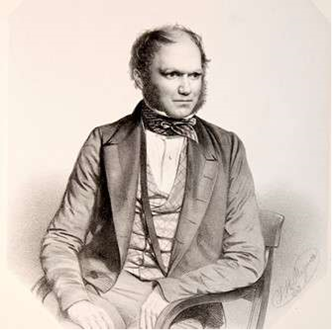
Today I’m doing a “fool’s experiment” in the classroom

Fridays are the worst, from a teacher’s perspective, and Mondays are great. Students start out the week full of enthusiasm and slowly deflate, so today I’ve only got 50% attendance…and that’s typical. I try to pack Mondays with all the deep information, while on Fridays I try to do something different.

We’ve been talking about Darwin this week. I’ve given them an in-class exercise to browse through the Darwin project and begin to put together a short essay. Here are their instructions.

In your next essay, you’re going to be a real historian: I want you to read a few samples of primary historical references from Charles Darwin, and interpret and explain what he is writing about.

The Darwin Correspondence Project (https://www.darwinproject.ac.uk/) is a massive archive of letters to and from Charles Darwin, containing about 15,000 documents that have all been indexed and made publicly available. I want you to dive into this pile of letters, pluck out a few, and read them carefully. You may have to do additional research to figure out who these long dead people were, but the Darwin Project has actually done a lot of that work for you.

Write a 750 word essay that explains the context and meaning of the letters you choose. Unlike most scientific writing, this kind of essay encourages quoting your source — but don’t use up more than 250 words in direct quotes.

You get to choose the topic of the letters. Some might contain heavy scientific arguments, others might be friendly chit-chat, some are questions about that flower you were supposed to mail to me. They’re all good and interesting! Peek into the mind of a famous scientist, and you’ll find both deep revelations and mundane conversation.

In class: before you go, summarize to the group what you intend to write about, or tell us something interesting that you found.

I’m in class, working in parallel with them, and occasionally interrupting to get an idea of what they’re focusing on. I was most interested in Darwin’s “fool experiments“. These were experiments where you figured that it would never work, or that the answer would be obvious, but you go ahead and do the experiment anyways.

‘I love fools’ experiments. I am always making them’, was one of the most interesting things the zoologist E. Ray Lankester ever heard Darwin say. ‘A great deal might be written as comment on that statement’, Lankester later recorded, but he limited himself to stating that ‘the thoughts which it suggests may be summed up by the proposition that even a wise experiment when made by a fool generally leads to a false conclusion, but that fools’ experiments conducted by a genius often prove to be leaps through the dark into great discoveries.’

That’s a really good idea. I should go do a fool’s experiment this afternoon, maybe I’ll be surprised.

My students are right now digging into Darwin’s religious beliefs, his love life, his speculations about the age of the earth, and are going to give me the details next week. This should be fun.

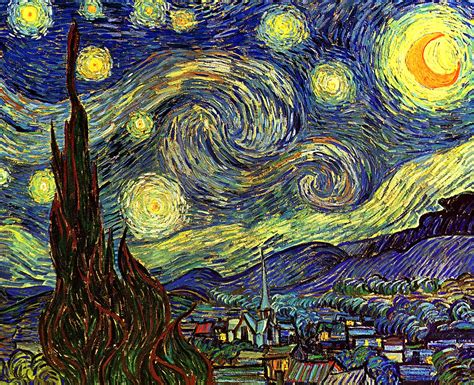
The things we get away with at a liberal arts university…poetry in a science class? Tsk.

I am struggling with student engagement in all of my classes: poor attendance, poor participation, all those horribly negligent bugaboos that make it hard to teach. So here we are, halfway through the term almost, and I’m trying to shake things up.

I’m teaching a course titled “The History of Evolutionary Thought,” which is also a writing-enriched course — I’m expected to spend half the class time, approximately, teaching writing skills. I consider that permission to get experimental at times. This past week I lectured on the history of geology, Hutton through Lyell, so today I made them sit down and do a writing exercise.

We read poetry.

Can I do that in a science building, in a science course? You betcha. I did. I made them think about a poem about James Hutton. I gave them these instructions:

The idea of Deep Time inspired many writers, and some of them are poets. Today, I want you to write a paragraph on this poem. You can
• interpret some aspect of the poem
• write about the virtue of poetry to science
• explain how it makes you feel
• express your own ideas about Deep Time
• write your own poem!

And here’s the poem!

JAMES HUTTON LEARNS TO READ THE
HIEROGLYPHICS OF THE EARTH
by Ron Butlin
 
Woken once too often by the rattle-clatter
of tumbril wheels on cobbles, the click . . . click . . .
click of distant knitting needles,
James Hutton decided never to go
to sleep again.
 
Then, by the light of several Edinburgh Council moons
(spares, in case the heavens were taken over
by the church), he tip-toed past storm-wrecked
Holyrood Abbey, went striding down
unimagined corridors,
through undreamt-of walls and doors where
Scottish Hope would one day
be cemented into place
(the bars across its parliament windows
wooden, just in case).

The Park . . . Salisbury Crags . . .
 
where several hundred million years ago,
the Earth had cracked itself wide open –
*
Detailed as a map of Man’s undiscovered self,
zigzag Time lies flat-packed,
for everyone to see . . .
 
Stacked magma, olivine, dolerite chilled to glass,
eternity crushed to lines of slowly
spelled-out hieroglyphics, and cut
in blood-red haematite.
 
. . . and Hutton sees it. He’s the first!

First to know he walks upon an ancient ocean floor
(God’s Flood, the merest puddle in all that vastness).
First to hear the stone-hard heartbeat pound-pound-
pounding out Existence.
 
Elsewhere, Revolution has taken to the streets
with an accusation and a scream,
a guillotine-swish . . .
French clocks run backwards to Year One.
 
Sunday 23rd October 4,004 BC?
All in the blink of a biblical eye! says Hutton.
*
Meanwhile, you and I continue turning
on our axis to the tick . . .
tick . . . tick of Time that never
started Once upon a . . .
And will surely never, ever –
 
Ah, these strata, these infinities glimpsed between!

I made them ponder and write for 25 minutes, and then we had a discussion. I think it went well. They were wide awake, at least!

Next week, I’m talking about pre-Darwinian ideas about biological change. Maybe I should read them one of Erasmus Darwin’s poems? Or maybe not — they’re awfully suggestive, and I don’t want to end up like Joe Gow.

Behold, the worst teacher in the world!

If you see this face coming, kick him or spit on him or otherwise scorn him. He’s terrible.

I’m having a bad semester. I’m teaching my intro biology course, which is small and ideally sized with 10 students, and every day is a trial. I go in prepared; I’m cheerful and friendly, I think; I’m working on the shaggy Santa Claus look; I’ve got lectures with frequent pauses and breaks where I encourage discussion; I think it’s an interesting topic. I’m talking amiably, and I ask the class a question — it can be as simple as “what are the results of crossing two heterozygotes?” or more open-ended, like “what is your opinion of IVF?” and it’s always the same result: dead silence, stony faces, everyone avoiding my eyes. It’s killing me. Am I intimidating? Boring? Hideous? Should I wear a bag on my head? I keep trying to get them engaged, and all I’m getting for my troubles is flop sweat.

These are not stupid students, either. I gave them a quiz last week, the mean was somewhere in the low 80s, so I know they’re understanding the material. They just don’t want to talk to me.

I’m thinking that maybe I should try some in-class ice breakers next week, and see if I can get them more active. Anyone got any good suggestions? I’m getting desperate.

Alternatively, I pick up a fifth of vodka and numb myself before walking into the classroom, because the strain is getting to me.*

*Not actually an option. I gave up all alcohol during the pandemic.

If you’re in the neighborhood…

On Thursday, 12 September, at 2:30, I’m joining forces with another class to drag our freshman students outside, before the snow starts falling next month, to confront the reality of life on campus. I’m bringing some handlenses, my macro camera, and an endoscopic camera for poking into holes, and we’ll take a look at life in the desert of the campus lawns and shrubbery (there is some, but it’s mostly springtails, ants, and spiders). We’ll also talk about how “spider” is misleading, because there are at least 30 different species of spiders living here, alongside the human monoculture.

I’m encouraging the students to sign up for iNaturalist and to use Seek to begin their careers as natural historians. It’ll be fun! Especially since otherwise I’d be lecturing them on meiosis. You’re welcome to join in if you’re in the neighborhood of Morris, Minnesota — this is going to be casual and geared to the first year college student.

They like me! They really like me!

I hit a wall yesterday. It was just one of my bad days, when I felt kind of useless, and worried about what was coming in the fall — I’ve got one week of instruction planned, out of 15 weeks in the semester, and I’m coming out of a semester in which I’d gotten all experimental and weird and tried some things that maybe the administration would not approve of, because I was tired of trying to wedge students into boxes all the time. I just wanted them to learn how to think and have a good conversation about a subject for a change, and not be fretting over points and grades!

So that’s been weighing on my mind, in addition to the usual stuff, like backaches and being tired and it’s been raining pretty much nonstop for the past week.

And then the student evaluations appeared in my mailbox. I put off opening that message, like I usually do, because I was dreading what they would say, like always. I bit the bullet this morning and opened it up, since I didn’t think anything would make me feel worse this week, anyway. Yikes…they liked the course!

I skipped over the numerical scores, because they were always useless (despite being the only thing the university will use to evaluate my work) and went straight to the comments section. Here, they’re answering the question, “What did the instructor do that most helped your learning?”

PZ structured the class such that we had a predictable workload each week, with a variety of class activities, which was useful. Lecture days on Mondays were nice and relatively easy at the start of the week, and small group discussions on Wednesdays and Fridays were always fun. The final presentation for the class was also valuable, as it gave us the opportunity to explore a topic from the class that we found particularly interesting in depth and share our discoveries with our classmates.

Had lecture on Monday’s and allowed students to help each other.

I appreciated that we did a lot of article discussions as well as chapter discussions. It was good to think over those chapters without being lectured at

Wittyness and Sarcasm were plentiful, 10/10 course

Discussion based on what we were learning

I liked the discussion questions because they went with the lectures really well

Yes! They saw what I was trying to do!

The next question was “What suggestions do you have for improving the course?”

Clearer expectations for final presentations or updates on participation grades throughout the semester would be appreciated, although PZ did assure us periodically that we were all doing well and that he had no concerns about our performance in class.

Maybe have slightly more background when discussing topics that students don’t tend to be strong in.

I wish some of the grading standards were more clear, and that there was a proper rubric for the presentations. I honestly have no clue if my presentation was even good or not because I didn’t have any guidelines to work with other than “15–20 minutes long and can be about whatever that’s relevant and also it can be whatever medium you like”

Get these college kids to talk more, they all look so nervous to have a hot take on microplastics.

It would be good if grades were updated more frequently

I like this course

Criticisms accepted. Next time I’ll try to outline my expectations more, and incorporate a few more metrics throughout the course. I may have gone too far in trying to avoid grade-chasing and point-tallying. I did appreciate the comment to “Get these college kids to talk more, they all look so nervous to have a hot take on microplastics,” because that’s exactly what I wanted, a class full of people eager to talk about eco-devo.

All right, I feel a little better today.

SCHOOL’S OUT FOR SUMMER!

Last class today; I’m not giving any finals, but I do have some term papers coming in on Monday evening. I’m wrapping this thing up in short order.

This week my eco devo course has been nothing but student presentation. I encouraged them all to be creative, and one student gave us a grand finale with a song. Here it is!

Hex here! And welcome to “hi I made another song for a school project because I can” 2 electric boogaloo.

Context for the regulars on this channel, the Ecological Development class I’m taking this semester has some rather lax requirements in that like- It has to be 15-20 minutes, but I could do music and such.

So I’m doing a presentation on allergens because I discovered I’m allergic to cats and wanted to know WHY when I’ve been around cats all my life. Sadly, my research didn’t give me any good news, and in fact I might’ve developed worse allergies from being around so many cats for a solid 18 years of my life before spending the past few years in college.

As for this song? Basically me incorporating some of my research into a song that’s basically me being like “WHY AM I ALLERGIC TO CATS WHEN I LOVE THEM SO MUCH???”

Anyways, now onto the classmates who might be watching this. Hello! These aren’t humans singing. They’re vocal synthesizers! The feminine vocal is Mai, and the masculine vocal on the harmonies is Kevin. I had no reason to pick them other than Mai is cute and then Kevin gets used for memes.

If y’all are curious about exploring my channel or commenting, just remember to avoid breeching my privacy when you do. I do not share any of my personal information like my name on this channel for safety reasons.

Two weeks to go

I made a brilliant planning decision way back at the beginning of the semester. Bless you, Fall Term PZ!

My big course this term is EcoDevo — big ol’ textbook, lots of papers from the scientific literature, all new lectures, etc. One part of the course is that the students have to do presentations on aspects of eco devo that interest them, and I scheduled that for the last two weeks of the class, which is coming up. That means I have no new lecture prep coming up! My weekends have been frantic this year: Saturday is dedicated to reading and studying, and Sunday is spent assembling those one hour lectures and putting together lists of concept questions. But not this weekend!

My second biggest class is called BioComm, and it’s a course in which I shepherd students through the exercise of writing a formal research paper, and this term by a terrible miscalculation I have 8 students. It’s too many. Never again. The problem is that I have to personally read these long papers in multiple steps of their development, and it’s a hell of a lot of grading and criticizing and revising. And here it is, the end of the semester, and there’s a pile of 20+ page papers sitting in my in-box.

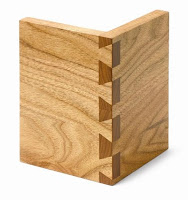
So this is where I planned brilliantly: the weekends where I don’t have to work to make content for my eco devo course, are these final weekends where I instead have to read and mark up a monstrous mountain of student writing assignments! Perfect dovetailing! Two courses meshing smoothly together to bring me to the brink of insanity, but not quite over the edge into a gibbering breakdown!

My biocomm students get another chance to address my criticisms next week, so next weekend will be similarly consumed with a returning pile of papers, but then, in two weeks…FREEDOM! Spider time! Also I get to spend the summer preparing for yet another new class in the fall, so even my relatively free months have wicked shackles holding me back.

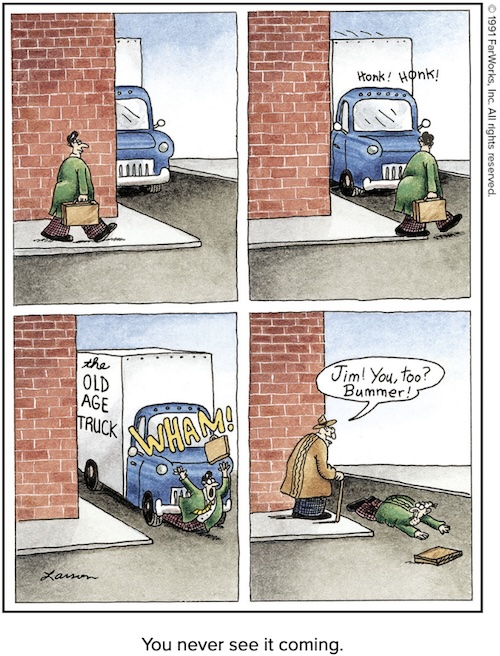
This week, we’re talking about the truck

I spend my weekends preparing the lectures for my coming week, and today the Far Side featured the perfect image for my title slide.

The subject? Aging and cancer as developmental diseases.

It is kind of awkward being a 67-year-old geezer talking to 19-21 year olds about aging. If this were a laboratory course I could just flop down on a table and let them dissect me.

The developmental origins of adult diseases

I weighed 7 pounds, 7 ounces when I was born on Saturday, 9 March 1957, at 7:07 in the morning. I know this because all the 7s were memorable, but mainly because this is what doctors and nurses do: they document everything.

You know this. Everytime we visit a doctor, they write down our weight, our height, our blood pressure, every parameter they can squeeze out of us. I can go online right now and read the doctor’s notes on every medical visit I’ve made in the last 20-some years — every prescription, every measurement, all of my complaints, every recommendation, every vaccination…it’s all there. Doctors are obsessive record keepers. There is so much medical data stored away that I sometimes wonder how anyone can extract useful information from it.

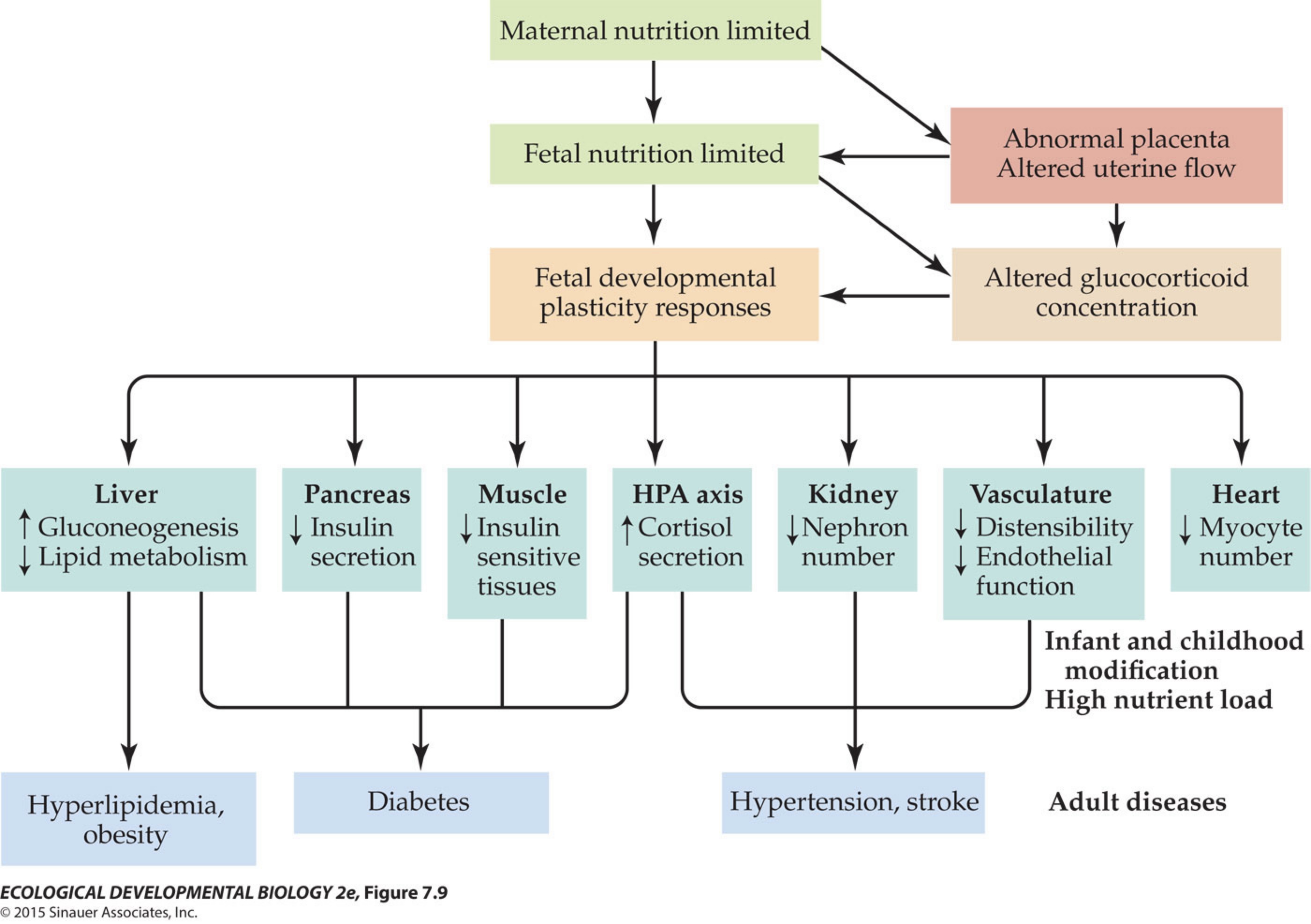
But they have! One attempt that has had significant influence was to correlate birth weight data in infants with their adult history of cardiovascular disease. Surprise, your weight on the day you were born is associated with your blood pressure, 60 years later (in a broad statistical sense, of course — this is a population-level correlation.) This led David Barker to make the specific hypothesis that “poor nutrition, health and development among girls and young women is the origin of high death rates from cardiovascular disease in the next generation.” This idea has since been broadened to form the developmental origin of adult disease hypothesis, that all kinds of medical phenomena have their origns in fetal development, and in the environmental effects that have influenced that development.

Credit where credit is due, the original exploration of the hypothesis was thanks to careful records kept by one midwife, Margaret Burnside, who assisted in the birth of over 15,000 babies in Hertfordshire between 1911 and 1930, and also the records of over 2000 births at Jessop Hospital in Sheffield between 1907 and 1924. They then compared birth records with death certificates in the 1950s-1990s to extract the first hints of associations.*

There’s a huge industry of papers being turned out now that look at correlations between birth weight and adult medical conditions. We’re also seeing more complex connections between disease and growth rate in the first year.

Some of them are very well established associations with low birth weight, like hypertension, coronary artery disease, non-insulin dependent diabetes, stroke, dislipidaemia, elevated clotting factors, and impaired neurodevelopment. Other ‘problems’ have been associated with low birth weight in a small number of studies — there really are amazing numbers of papers where researchers mine the medical data for connections, some of them possibly spurious. So small babies may be more likely to develop issues with chronic lung disease, depression, schizophrenia, and general behavioral problems. They may have reduced uterine and ovarian size and precocious pubarche. They might be more prone to breast and testicular cancer.

Surprisingly, they may also marry later, if at all, be left-handed, and have denser fingerprint whorls. You can find it all in the scientific literature.

If you are thinking that you were a plump, fat baby, so you have nothing to worry about, think again. There are correlations between large birth weight and breast cancer (everything seems to cause breast cancer,) prostate cancer, childhood leukemia, and polycystic ovary disease.

This week in my eco devo course, we talked about this hypothesis, and I also handed out a bunch of papers, a different one for each student (there are so many papers in this field!), and today we’re going to have the students assess the literature. It should be fun! The goal is to get a feel for how strong or how valid the various correlations actually are. We’ve also discussed the Dutch famine data. The Nazis starved much of Holland, including the major cities of Rotterdam, Amsterdam, and Leiden, for 7 months in 1945, until the country was liberated by the Allies.

Wasn’t that nice of Nazis to do a massive experiment on a whole nation of 9 million people for us? They let women in each trimester of their pregnancy subsist on 580 calories/day, and then went away and let us analyze the effects. Maternal malnutrition in the third trimester turns out to be bad for babies, who knew? Anyway, the subtext for this week, as it should be for every week, is that Nazis are bad***.

The bigger message is, of course, that development matters and has lifelong consequences, and good, responsible governments provide adequate nutrition to pregnant women and children.

*All these records were handwritten on pieces of paper! The effort to transcribe everything and extract the information in a computational form must have been daunting.**

**My daughter is currently involved in a research project to use natural language processing to synthesize information stored in modern medical records at UW Madison Department of Medicine. That’s useful for a lot of reasons, including drilling down through years of impenetrable treatment notes.

***I hope that overtly political message doesn’t get me in trouble with the university administration.

What are all these plastics doing to us?

In my eco devo course, we’ve been looking at increasingly subtle effects. We started out the semester examining obviously devastating agents in the environment — think thalidomide, stuff that outright kills embryos or causes gross distortions of developmental processes. Then we spent a few weeks looking at endocrine disruptors, agents that perturb developmental signaling and produce embryos with, for example, fertility problems or changes in sexual differentiation. There are a lot of ways chemistry can screw you up short of wrecking external morphology!

This past week we also looked at micro- and nanoplastics, which I personally find have the potential to be a colossal nightmare. The US is producing about 75 million tons of plastic waste each year, and that crap doesn’t go away. You can throw it in a landfill or dump it in the ocean, but it is just physically eroded down into smaller and smaller fragments, allowing it to infiltrate ever deeper into us and our world. Did you know that archaeologists are finding microplastics drifting down into soils 7 meters down, and that they’re finding them in thousand year old sites? We are filling the world with these novel stable polymers, and we have a poor idea of what they’re doing to us.

So we read a paper by Pederson et al. (2020) about the effect of nanoplastics on zebrafish embryos. Like every paper on this kind of topic, it has to tell us about the magnitude of the problem.

Plastic pollution is ubiquitous and an emerging concern in both freshwater and marine environments. Since mass production began in the 1940s, plastic manufacturing has increased rapidly, with 348 million tons produced globally in 2018. Large amounts end up in the oceans, which are now predicted to contain more than five trillion individual pieces of plastic materials (equaling 250,000 tons) in the first 20 m of the water column. Plastics have been identified virtually everywhere: from arctic sea ice to ocean sediments. In freshwater systems, plastics have been identified in large quantities in lakes, rivers, and basins, especially in areas near dense human populations. Their ubiquity has allowed for potential human exposure to plastics through the consumption of aquatic organisms and via drinking water, especially due to the inability of drinking water facilities to entirely remove anthropogenic particles sourced through freshwater environments. In 2019, the World Health Organization (WHO) called for a greater assessment of plastics in the environment after 90% of bottled water was found to contain small plastic particles (World Health Organization). In addition, anthropogenic particles, many of which are likely plastic fragments and fibers, have been detected in over 81% of tap water sources, allowing for an average of 5800 particles to be ingested annually per person.

This paper isn’t even talking about familiar microplastics — it’s all about nanoplastics, particles less than 1µm in diameter. Eventually, all plastics will be broken down to that degree, but we give these an additional boost by intentionally synthesizing these for use in toothpastes and cosmetics and cleansers, and we’ve added <1 parts per billion (ppb) to tens of thousands of ppb to freshwater and marine ecosystems. We don’t have a practical way to remove this stuff. Go ahead, take a swig of that water bottled in plastic, you’ll just absorb those exotic polymers, they’ll be circulating in your bloodstream and getting incorporated into your tissues. You’ll hardly notice.

Zebrafish embryos and larvae swimming in a solution of up to 10000 ppb nanoplastics didn’t seem to mind. There was no effect on mortality, no change in growth rate, no apparent deformities at all. Maybe we’ll all be OK after all.

Except…they do visibly accumulate the plastics in their tissues (they used plastics that fluoresce in the UV).

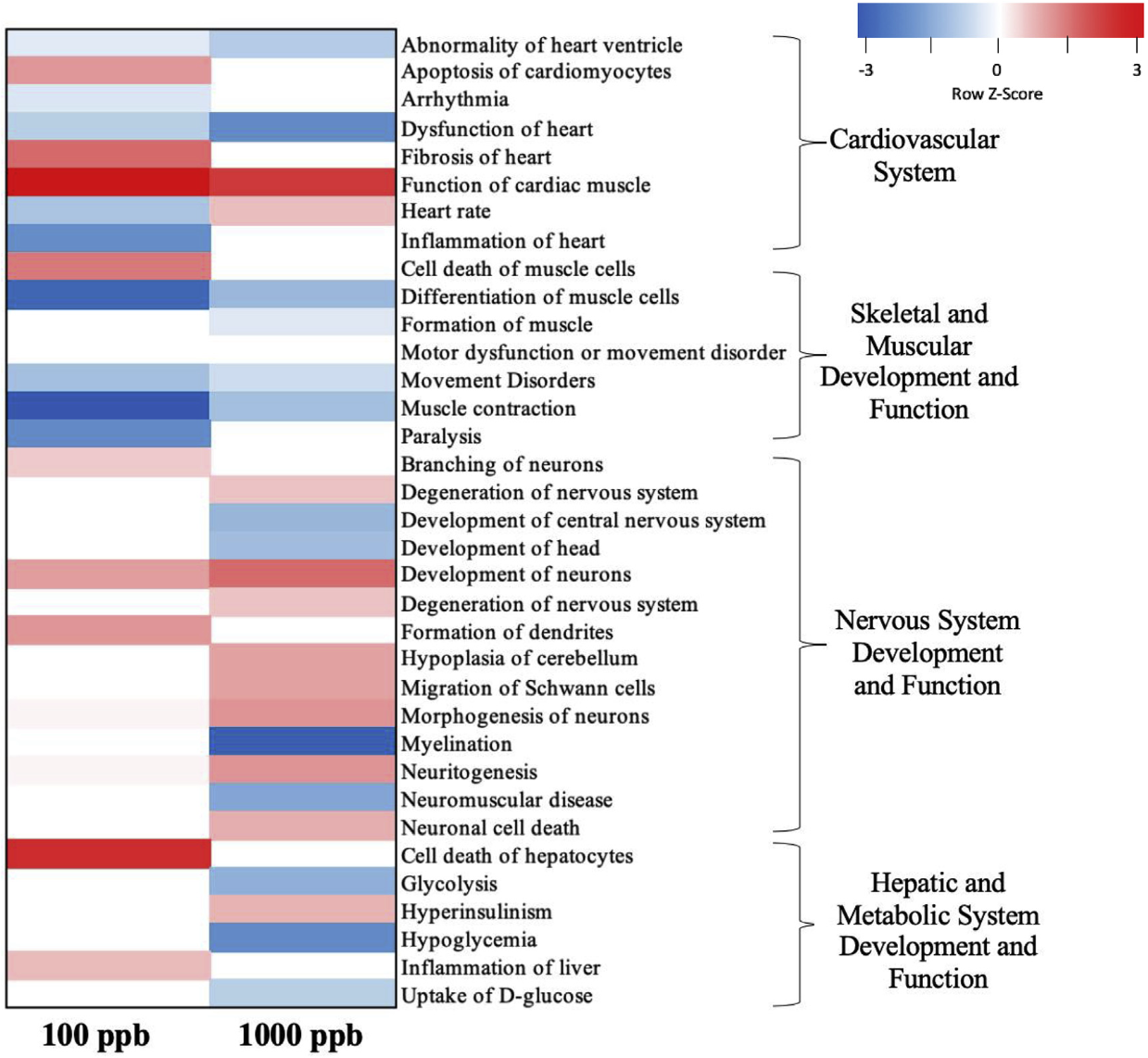
And then they looked at gene expression in various known pathways — metabolic genes, genes involved in nervous system function, the cardiovascular system — and whoa, they’re just shifted all over the place. It’s a sign of how robust development is that the organism was looking so normal to human eyes. We are all loaded with compensatory developmental mechanisms to make our construction more reliable, and it always impresses me how much damage and insult an embryo can take and still emerge fairly recognizable.

Heatmap indicating predicted upregulation or downregulation in subpathways based on z-scores. (Red is upregulated, blue is downregulated)

One disappointment in the paper is that the behavioral assays were fairly crude, but that’s not the investigators’ fault. They’re working with 5-day old larvae, which, while zebrafish are remarkable little sensory processing machines at that age, they’re still kind of stupid, with a limited behavioral repertoire. The authors looked at spontaneous motor activity, and the fish exhibited a dose-dependent increase in burst swimming. They’re twitchier. More hyperactive. Their brains are being randomly modified chemically, and we’re seeing changes that I’d expect to be more apparent with more sensitive assays.

The message I’m trying to get across to the students is that there is a wide range of phenomena that environmental factors are causing, and we don’t know most of them. It took us decades to get corporations to remove lead from our gasoline, despite the obvious ways it was perturbing our growth and behavior. Are plastics going to be the leaded gasoline of the 21st century?

There is a solution: make biodegradable plastics, ones that don’t reduce to dead stable particles, but instead are digestible by organisms and can be metabolized. Progress is being made in that direction!

An attractive solution to mitigate the environmental impact of microplastics is to develop plastics that do not generate persistent microplastics as part of their normal life cycle. Even plastics that are properly collected and recycled generate microplastics as part of the normal wear from everyday use or as a consequence of recycling or washing processes. Thus, to prevent the accumulation of microplastics, new plastic materials must be developed that are completely biodegradable so that any particles generated from these products will quickly degrade in the environment. Biodegradation is the process by which microbes break down polymers into simpler molecules that can be used as a source of carbon to produce biomass. This requires that the polymer contains chemical bonds, most notably in the polymer’s primary backbone structure, that are physically accessible to enzymes that naturally recognize these bonds as substrates, and that the underlying monomer molecules that are released through this enzymatic cleavage can be consumed by microorganisms. In natural environments, this process is typically performed by consortia of microbes, including bacteria and fungi, secreting hydrolytic enzymes, which sever the polymer to release a variety of monomers and oligomers that can then be utilized as a carbon nutrient source by the microbes. Catabolism of these polymer-derived oligomers and monomers leads to the generation of organismal biomass and CO2 via respiration.

Why would we want structural materials that inevitably break down? Well, maybe you don’t, but I think if we whisper “planned obsolescence” into the ears of corporate executives, maybe they’ll force us to accept them.


Pedersen AF, Meyer DN, Petriv A-MV, Soto AL, Shields JN, Akemann C, Baker BB, Tsou W-L,
Zhang Y, Baker TR (2020) Nanoplastics impact the zebrafish (Danio rerio) transcriptome: Associated developmental and neurobehavioral consequences. Environmental Pollution https://doi.org/10.1016/j.envpol.2020.115090.