Wilson’s Principles of Teratology

It’s another busy week of EcoDevo, and even though the campus was closed I still had to give a lecture on endocrine disruptors. I started by laying out Wilson’s Principles of Teratology…wait, what? You don’t know them? I guess I’d better explain them to the internet at large.

These principles are a bit like Koch’s Principles, only for teratology — you better know them if you want to figure out the causes of various problems at birth, and you do: about 3% of all human births express a defect serious enough for concern. Here’s the list:

  1. Susceptibility to teratogenesis depends on the genotype of the conceptus and the manner in which this interacts with adverse environmental factors.
  2. Susceptibility to teratogenesis varies with the developmental stage at the time of exposure to an adverse influence. There are critical periods of susceptibility to agents and organ systems affected by these agents.
  3. Teratogenic agents act in specific ways on developing cells and tissues to initiate sequences of abnormal developmental events.
  4. The access of adverse influences to developing tissues depends on the nature of the influence. Several factors affect the ability of a teratogen to contact a developing conceptus, such as the nature of the agent itself, route and degree of maternal exposure, rate of placental transfer and systemic absorption, and composition of the maternal and embryonic/fetal genotypes.
  5. There are four manifestations of deviant development (death, malformation, growth retardation and functional defect).
  6. Manifestations of deviant development increase in frequency and degree as dosage increases from the No Observable Adverse Effect Level (NOAEL) to a dose producing 100% lethality (LD100).

The first two tell you what is tricky about teratology. There are multiple variables that affect the response: genetic variability in the conceptus (and, I would suggest, maternal variations), and also timing is critical. A drug might do terrible things to an embryo at 4 weeks, but at 3 months the fetus shrugs it off.

Ultimately, though, the teratogen is having some specific effect (3) on a developing tissue. We just have to figure out what it is, while keeping in mind that that effect might be hiding in a maze of genetics (1) and time (2).

Another complication is that in us mammals the embryo is sheltered deep inside the mother, who has defense mechanisms. The agent has to somehow get in (4). A complication within a complication: sometimes the teratogenic agent is harmless until Mom chemically modifies it as part of her defense, and instead creates a more potent poison.

#5 is just listing the terrible outcomes of screwing with development.

#6 I do not trust. It’s saying the effect is going to follow a common sense increase with increasing dosage, but even that isn’t always true. There is a phenomenon called the inverted-U response where the effect increases with dosage, then plateaus, and then drops off at high concentrations. We’re dealing with complex regulatory phenomena with multiple molecular actors that may have unpredictable interactions. There are teratogens that do terrible things to embryos at low concentrations, but do nothing at ridiculously high concentrations — as if the high dose triggers effective defense mechanisms that the low dose sidesteps.

I had to review these principles in class yesterday, because although I’d also discussed them earlier in the semester, we are currently dealing with teratogens of monstrous subtlety, these compounds that mimic our own normal developmental signals, the same signals our bodies use to assemble critical organ systems. It’s as if some joker were placing inappropriate traffic signals along a busy highway — most would do no harm, but some may totally confuse travelers who then end up detouring up into the kidneys rather than down the genitals, as they preferred, or they end up crashing into the thyroid.

Unfortunately, in this case the responsible jokers are mainly gigantic megacorporations who are spewing these dangerous signals all over the countryside…and then we get to wait until the people swimming in them try to have children, and then the teratologists get to say “death, malformation, growth retardation and functional defect”.


In case you were wondering, Wilson didn’t come up with his list first — a 19th century scientist named Gabriel Madeleine Camille Dareste did it first. No, not first. Lots of people have been documenting these developmental problems as long as there’s been writing, like on this Chaldean tablet:

When a woman gives birth to an infant:
With the ears of a lion There will be a powerful king
That wants the right ear The days of the king will be prolonged
That wants both ears There will be mourning in the country
Whose ears are both deformed The country will perish and the enemy rejoice
That has no mouth The mistress of the house will die
Whose nostrils are absent The country will be in affliction and the house of the man will be ruined
That has no tongue The house of the man will be ruined
That has no right hand The country will be convulsed by an earthquake
That has no fingers The town will have no births
That has the heart open with no skin The country will suffer from calamities
That has no penis The master of the house shall be enriched by the harvest of his field
Whose anus is closed The country shall suffer from want of nourishment
Whose right foot is absent His house will be ruined and there will be abundance in that of the neighbor
That has no feet The canals of the country will be cut and the house ruined
If a queen gives birth to:
An infant with teeth already cut The days of the king will be prolonged
A son and a daughter at the same time The land will be enlarged
An infant with the face of a lion The king will not have a rival
An infant with 6 toes on both feet The king shall rule the enemies’ country

Nowadays we’re more interested in causes than imagined consequences, I hope.

You know, alcohol is not good for children and other growing things

A few weeks ago, I had an absolutely delicious stout at a brew pub in Alexandria. I’m going to have to remember it, because it may have been the last time I let alcohol pass these lips. Why? Because I’m slowly turning into one of those snooty teetotalers who tut-tut over every tiny sin. It started with vegetarianism, now it’s giving up alcohol, where will it end? Refusing caffeine, turning down the enticements of naked women, refusing to dance? The bluenose in me is emerging as I get older. I shall become a withered, juiceless old Puritan with no joy left in me.

It didn’t help that last week I was lecturing on alcohol teratogenesis in my eco devo course, and it was reminding me of what a pernicious, sneaky molecule it is. I’ve known a lot of this stuff for years, but there’s a kind of blindness brought on by familiarity that led me to dismiss many of the problems. You know the phenomenon: “it won’t affect me, I only drink in moderation” and other excuses. Yeah, no. There are known mechanisms for how alcohol affects you, besides the obvious ones of inebriation.

  1. It induces cell death.
  2. It affects neural crest cell migration.
  3. It downregulates sonic hedgehog, essential for midline differentiation.
  4. It downregulates Sox5 and Ngn1, genes responsible for neuron growth and maturation.
  5. It weakens L1-modulated cell adhesion.

I already knew all about those first four — I’ve done experiments in zebrafish like these done in mice.

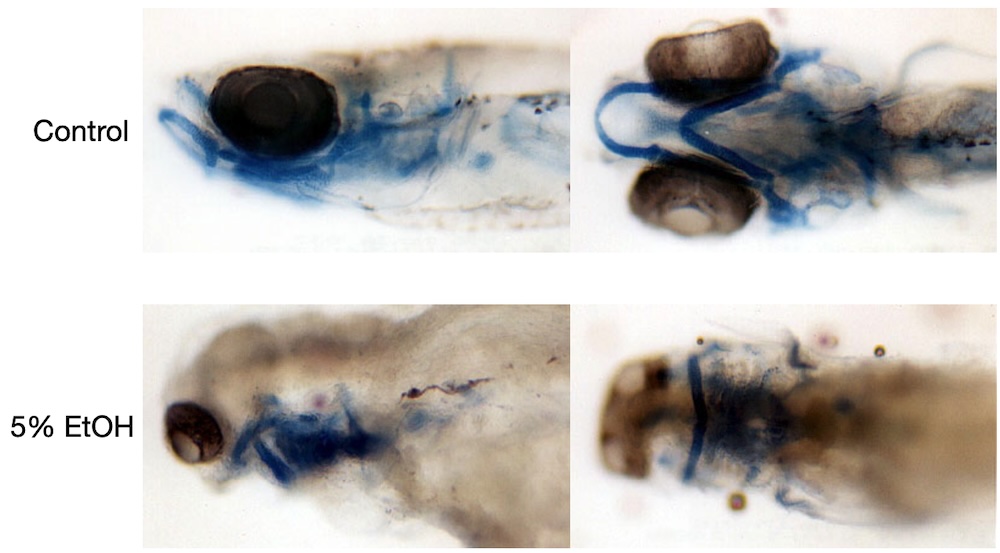
Take a normal, healthy embryo like the one in A, expose it to alcohol, and stain the brain for cell death with any of a number of indicator dyes, like Nile Blue sulfate in this example B (I’ve used acridine orange, it works the same way). That brain is speckled with dead cells, killed by alcohol. If you do it just right, you can also see selective cell death in neural crest cell populations, so you’re specifically killing cells involved in the formation of the face and the neurons that innervate it. In C, you can see the rescuing effects of superoxide dismutase, a free radical scavenger, and that tells you that one of the mechanisms behind the cell death is the cell-killing consequences of free radicals. I could get a similar reduction in the effects with megadoses of vitamin C, but that doesn’t mean a big glass of orange juice will save you from your whisky bender.

I was routinely generating one-eyed jawless fish, a consequence of the double-whammy of knocking out sonic hedgehog and cell death in the cells that make branchial arches.

You can wave away these results by pointing out those huge concentrations of alcohol we use to get those observable effects, but we only do that because we don’t have the proper sensitivity to detect subtle variations in the faces of mice or fish. So we crank up the dosage to get a big, undeniable effect.

I only just learned about the L1 effects, and that’s a case where we have a sensitive assay for alcohol’s effects. L1 is a cell surface adhesion molecule — it helps appropriate populations of cells stick together in the nervous system. It also facilitates neurite growth. It’s good for happy growing brains.

It also makes for a relatively easy and quantitative assay. Put neuronal progenitors that express L1 in a dish, and they clump together, as they should in normal development. Add a little alcohol to the medium, and they become less sticky, and the clumps disperse.

What’s troubling about this is the dosage. Adhesion is significantly reduced at concentration of 7mM, which is what the human blood alcohol level reaches after a single drink. The fetal brain may not be forming as robustly when Mom does a little social drinking that doesn’t leave her impaired at all, not even a slight buzz.

Maybe you console yourself by telling yourself a little bit does no harm, your liver soaks up most of the damage (and livers are self-repairing!), that it’s only binge drinkers who have to worry about fetal alcohol syndrome, etc., etc., etc. We have lots of excuses handy. Humans are actually surprisingly sensitive to environmental insults, we have mechanisms to compensate, but there’s no denying that we’re modifying our biochemistry and physiology in subtle ways by exposure to simple molecules.

Now maybe you also tell yourself that you’re a grown-up, I’m talking about fetal tissues, and you also don’t intend to get pregnant in the near future or ever. I’m also a great big fully adult person who is definitely not ever going to get pregnant, but development is a life-long process, and we’re all fragile creatures who nonetheless soak up all kinds of interesting and dangerous chemicals during our existence. We know alcohol will kill adult brain cells, but what else does it do? Do you want to be a guinea pig? I think that, as I age, I am becoming increasingly aware of all the bad stuff I did to myself in my heedless youth, and am starting to think that maybe I need to be a little more careful, belatedly.

Oh, you want some reassuring information? Next week we’re discussing endocrine disruptors in my class — DDT, DES, BPA, PCB, etc. — all these wonderful products of plastics and petrochemical technology. You’re soaking in them right now. They never go away. How’s your sperm count looking? Any weird glandular dysplasias? Ethanol looks pretty good compared to chlorinated and brominated biphenyls.

It’s symbiosis week!

Yesterday’s lecture began with a dilemma. The topic this week is all about symbiosis, so of course I had to talk about Lynn Margulis, a very complicated person. I have a lot of respect for her contributions to the field, but also had to mention some of her wrong ideas, like that 9/11 was a false flag operation, and that AIDS was caused by a spirochete. It was also a dilemma back in 2007, when Margulis was a guest on this blog and also on our IRC channel. Whew, that was awkward. There might be a few old timers here who remember that.

Also awkward: most of the students had never heard of Margulis until now (they also had no idea what IRC was). At least I got to expose them to a little significant scientific history, which is my job, even when Margulis expressed the opinion that “I believe at all zoologists are intrinsically poorly educated in biology and that medical people are misinformed.” Ouch. There’s a grain of truth there, but mainly my students got to learn that some famous scientists can be colossal dicks. I did tell my students that if she were alive today she’d be a popular guest on Joe Rogan’s awful show.

Anyway, duty done, I lectured on mycorrhizae and gut microbiomes and a lot on Wolbachia. The paper of the week that the students will be telling me all about on Friday is “Eco-Evo-Devo: developmental symbiosis and developmental plasticity as evolutionary agents” by Gilbert, Bosch, and Ledón-Rettig, which you can read if you want to catch up on the course.

Self-assessment time!

We’ve finished the third week of classes, I need to pause and think about my eco-devo class. You know, teachers do this: a class isn’t a set of railroad tracks taking us to a destination, and sometimes it’s worthwhile to reassess.

My goals with the course are clear. We’re studying a fairly new interdisciplinary science, we’ve got a good solid textbook, I’ve got a dozen smart students, let’s explore. I explicitly want to avoid turning it into a lecture course, where I just stand up and tell them what they need to know, so I constrained myself with some serious guardrails. I only lecture once a week, on Monday, and I don’t just tell them the answers, but give them a lot of questions that they have to answer as a group on Wednesday. I also give them a primary research paper to take apart on Friday.

Does it all work? Yes, mostly.

It wrecks my weekend, though. My Monday lectures have to cover some complex material while focusing the students on relevant questions. I can’t sink comfortably into a flurry of detail, as would be easy to do, I have to bring out the broader issues while simultaneously fleshing out examples with an appropriate amount of detail. This week we’re discussing developmental plasticity, for instance, and while the textbook sings a siren song of numerous examples that I could just recite, I have to provide context and ideas and questions that will motivate discussion on Wednesdays. I think this part of the class is going OK.

I think the students are doing the actual learning part of the course on Wednesdays. This is the day I do things like put them into groups, put stuff on the whiteboards, show that they are actually engaging with the material they’re being exposed to. It’s all on the students, and these are all smart students, so I’d really have to be bad at my job to screw this part up. I prime them with a few ideas that they get at the start of the week, and then let them go.

Fridays…I’ve got to work on my Friday class. I’ve got two problems here. One is that I appoint two students to lead the discussion of a research paper, which is fine, except that these danged ambitious students charge in to do all the work. I tell them to split it up, delegate, and put the rest of the class to work figuring out what is going on in the paper, but no, they try to do it all, and then the whole class sits quietly listening along. I may have to change how I organize those days.

The second problem is me. For instance, last week the theme was about the importance of integrating multiple perspectives to answer complex question, going beyond reductionism. And then I picked what I thought was a good paper that did exactly that, trying to identify the ecological factors behind snake evolution. It was too much. It started with a phylogenetic analysis, then applied a principal component analysis to skull morphology (uh-oh, bio students don’t get much experience with PCA here), added a bit of development/heterochrony work, and then tied all of those approaches together in a nice bit of synthesis. Cool, but too much for some undergrads to handle all at once. I am challenging them, at least, but I think I’d better take next week’s paper down a notch. While my goal was to make them read primary research, maybe I’ll have to ease them in with some review papers for a while, and give their brains a chance to release some pressure.

When I say it all mostly works, that’s entirely from my perspective. Maybe the students hate it, but because they’re all polite Midwestern people, they’re too nice to say it. I’m going to have to put together some kind of student evaluation form to hand out next week so I can find out if I’ve gone off the rails.

This is where I’m at on a Saturday morning at the end of the third week of classes, and now it’s time to immerse myself in background reading and lecture prep. One source I’m finding extremely useful for this course is Mary Jane West-Eberhard’s Developmental Plasticity and Evolution, which is a wonderfully rich source of ideas…but also would have undergraduate brains melting out their ears if I tried making this their textbook. One of my aspirations for this course is that they should be able to emerge from it at the end of the semester and be prepared to read West-Eberhard’s book without having a nervous breakdown.

That would be a fun graduate-level class to teach. Also about ten times more work than this one.

Oh no! It’s Monday!

It happened again. Monday rolled around. When will Science master the ability to predict these cataclysmic disasters? Surely there is some cause that we can treat. Vaccinations, maybe? Monday shelters, buried deep underground? Is there a pesticide that will selectively kill off all Mondays?

Once again, I’ve done it to myself: I set up all the material for my classes for the students on Monday, which effectively means my weekends are shot. This week we’re finishing up The Triple Helix with a conversation about the limitations of reductionism, Wednesday we discuss strategies for answering thorny research problems, and Friday we’re reading a paper about snake ecology, development, and evolution that takes a multidisciplinary approach. I’ve got it all queued up, almost as if I have a plan and know what I’m doing. I’m also tired, bleary-eyed, and I have a headache.

It is all my fault. The easy thing to have done would be to trundle through a series of lectures in which the students sit back with glazed eyes and absorb my wisdom, but instead I’m setting up frameworks and making the students do most of the work, at least two out of three classes. It turns out that’s far more work than just telling them what they need to know, so Mondays are going to be my days of pain.

The rest of the week, though, is cake. Mostly. Then this weekend I have to prep for next week, when we dive into the first chapter of our eco-devo textbook. Plasticity. Plasticity, plasticity, plasticity. That’ll keep us busy for a while.

Also, every day is grading day, and Tuesdays and Friday mornings are my spider days. I’ll recover tomorrow.

First round of Survivor: Morris cleared

Class went fairly well this afternoon, mainly because I’ve got a good, engaged bunch of students. The omens bode well for a good semester.

Me, lecturing

One catch: I haven’t spoken in over a month. Little bits of conversation, sure, but I haven’t used my voice in a sustained discussion in all that time, and I think it’s atrophied a bit. I made it through an hour, but at the end, it was all rough and gravelly and actually starting to hurt a bit. I’ve got to practice more.

I was also feeling a bit dehydrated. I’m going to start bringing a water bottle to work and take regular swigs throughout the day. Minnesota winters don’t help much, either: humidity bottoms out when it’s this cold, as my spiders will attest.

Evolution is the control of development by ecology

Today is my actual first day of classes. We had MLK Day off, and I have no classes on Tuesday, and today I get to meet the 12 students in my Ecological Developmental Biology course. It should be fun. I plan to present that famous aphorism by Van Valen, “Evolution is the control of development by ecology,” and then I’m done for the entire semester — once they’ve grasped that, there is nothing else left to teach, so we can just coast through February, March, April, and May.

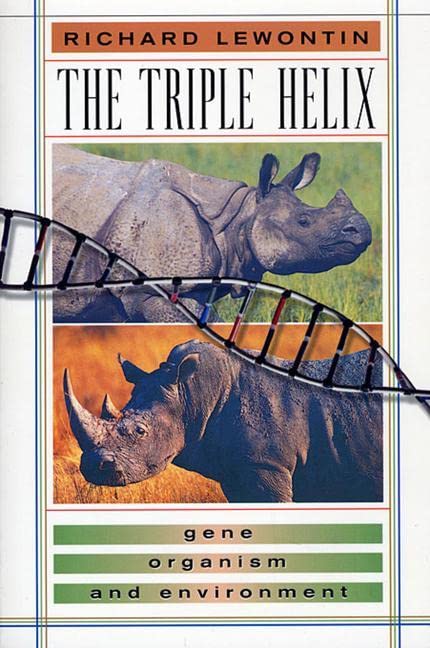
OK, so maybe we should also think about the details. We’re going to spend the first two weeks diving into Lewontin’s The Triple Helix: Gene, Organism, and Environment. It’s short but clears the stage beautifully of any vestige of genetic determinism and primes us with an introduction to some fundamental concepts. Everyone ought to read it!

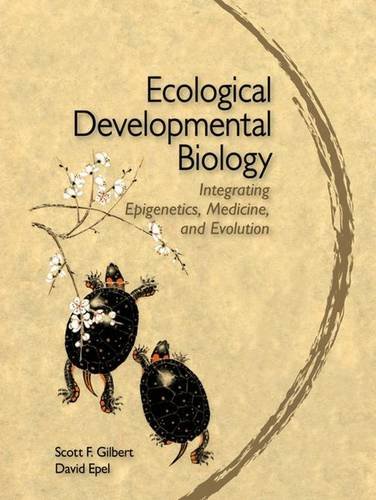
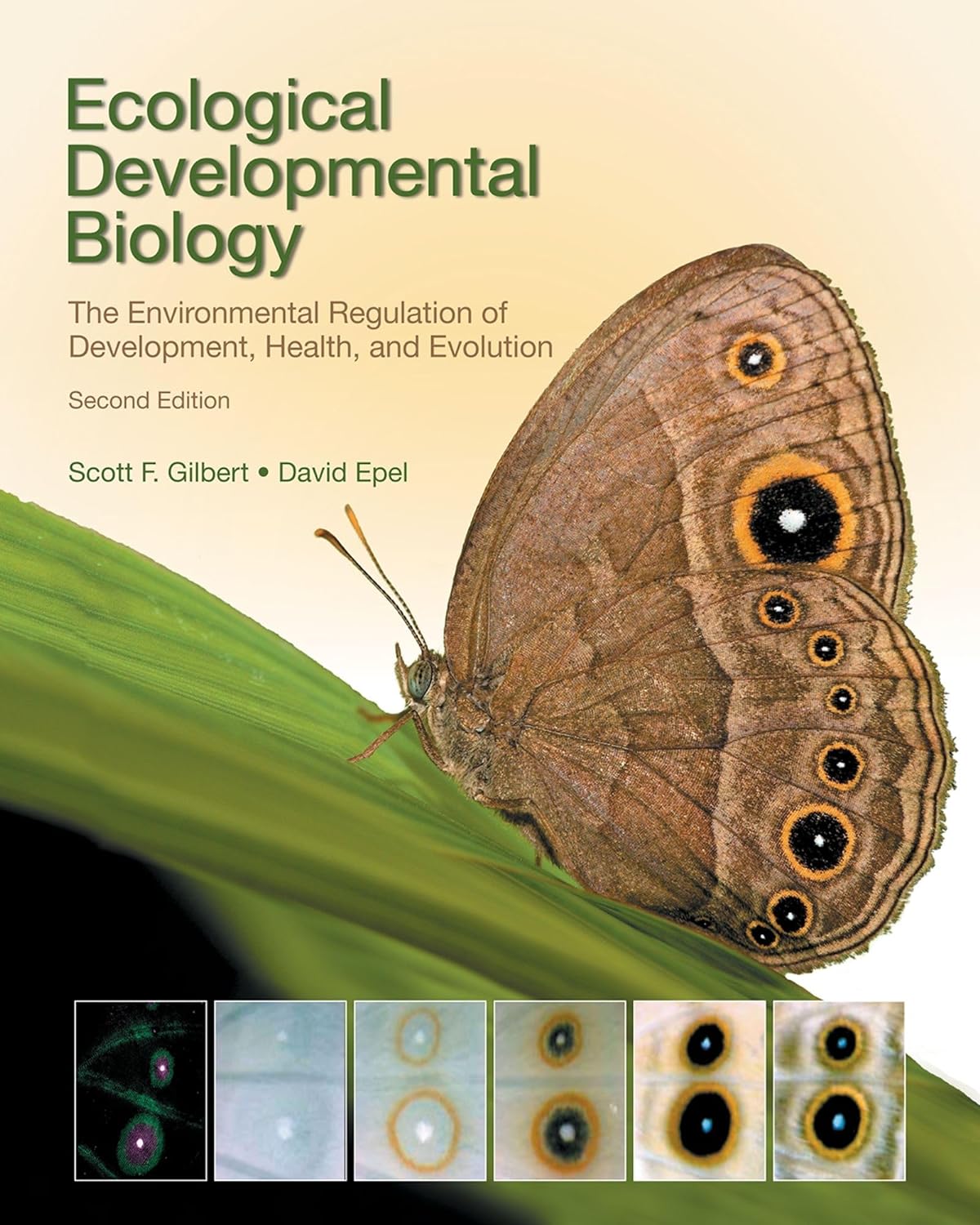
The rest of the semester we’ll work through Gilbert and Epel’s Ecological Developmental Biology. We’re going to talk about plasticity, epigenetics, symbiosis, developmental physiology, and the book has lots of material on teratogenesis, cancer, and aging (those are all developmental concerns, you know — we’re doing all the interesting and important stuff).

We’re also going to dig into the primary literature. This week, we’re reading a review by Sultan, “Development in context: the timely
emergence of eco-devo”
to get everyone filled in with the background, but subsequent weeks will be mainly about primary research papers. There’s going to be a fair amount of reading in this class!

I’ve also made the radical decision to abolish all exams: about 60% of the grade is derived from just showing up, alert and ready to contribute. We’ll see how well that flies.

I’ll let you know. I’m thinking I’ll try to post a weekly wrap-up here, so that if I fail it’ll be visible.

Should I take attendance in my classes?

I’m working on my class policy for next semester. Last semester was rough — I had bent over backwards to provide maximum flexibility, with an online option and no mandatory attendance, and it was fairly typical to have only half, or less, of the class show up. I considered changing the policy mid-semester, but it was written into the syllabus, so I had to stick with it. There will be changes next term, I tell you what.

This little video illustrates my problem.

I really like the prisoner’s dilemma twist in the middle — if only one student shows up, they pass the course and everyone else fails. There was one day fall term where that could have been invoked.

To answer the question in the title: yes, I’m going to take attendance, and it’s going to count. My big class this spring is going to be heavily interactive, and I’ll need people to show up.

The problem with Zoom…confirmed!

I was complaining about the effect of Zoom on students — it doesn’t encourage engagement and leads to apathy — and oh, look, someone did a study on “zoom fatigue”.

The study, published in the journal Scientific Reports, looked for physiological signs of fatigue in 35 students attending lectures on engineering at an Austrian university. Half of the class attended the 50-minute lecture via videoconference in a nearby lab and a face-to-face lecture the following week, while the other half attended first in person, then online.

Participants were monitored with electroencephalogram (EEG) and electrocardiogram (ECG) instruments that recorded electrical activity in the brain and their heart rhythms. They also participated in surveys about their mood and fatigue levels.

The researchers searched for physical changes correlated with mental fatigue, including distinctive brain waves, reduced heart rate and hints the nervous system might be trying to compensate for growing exhaustion during the lecture.

There were “notable” differences between the in-person and online groups, the researchers write. Video participants’ fatigue mounted over the course of the session, and their brain states showed they were struggling to pay attention. The groups’ moods varied, too, with in-person participants reporting they felt livelier, happier and more active, and online participants saying they felt tired, drowsy and “fed up.”

Overall, the researchers write, the study offers evidence of the physical toll of videoconferencing and suggests that it “should be considered as a complement to face-to-face interaction, but not as a substitute.”

I know, that’s a tiny n, tested on a yet another WEIRD group. I also think that for Zoom to work, you have to completely revamp how you teach, and this is obviously just presenting the same content in two different media. Given those problems with the study though, it aligns with my personal experience, and I’ll use it to further justify my decision to cut Zoom out of my life next semester.

Lectures are boring unless you can get some questions and other interactions during it, and I’ve noticed that, when I make my in-person lectures simultaneously available over Zoom, I get zero responsiveness from the online part of the class. I suspect I’ve put them all to sleep.