Argonauta nodosa
Figure from Cephalopods: A World Guide (amzn/b&n/abe/pwll), by Mark Norman.
Add hammerhead sharks to your list of animals that don’t need males. A captive bonnethead female in Nebraska gave birth in 2001, and genetic testing has revealed that it was produced by parthenogenesis. In a way, this isn’t a surprise: I could have told her that Nebraska is no place for a self-respecting shark to look for a boyfriend.
Parthenogenesis had been suspected, because the shark had been isolated from males for at least 3 years, and because she lacked the obvious bite marks that result from shark sex (which is another reason a lady shark might not want to have anything to do with sexual reproduction), and now the tests have shown it for sure. Nifty!
Leave it to Susie Bright to connect a review of a spectacular book about deep sea organisms to sex toys.
I’m going to get the book myself, but now I’m going to have a whole ‘nother view of its contents. Oh, wait…actually, maybe not.
Here are three animals. If you had to classify them on the basis of this superficial glimpse, which two would you guess were most closely related to each other, and which one would be most distant from the others?
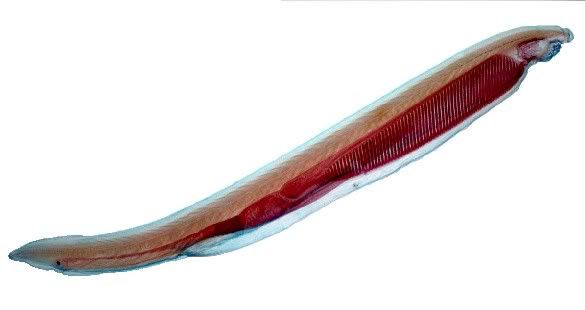
On the left is a urochordate, an ascidian, a sessile, filter-feeding blob that is anchored to rocks or pilings and sucks in sea water to extract microorganismal meals. In the middle is a cephalochordate, Amphioxus, also a filter feeder, but capable of free swimming. On the right are some fish larvae. All are members of the chordata, the deuterostomes with notochords. If you’d asked me some years ago, I would have said it’s obvious: vertebrates must be more closely related to the cephalochordates—they have such similar post-cranial anatomies—while the urochordates are the weirdos, the most distant cousins of the group. Recent developments in molecular phylogenies, though, strongly suggest that appearances are deceiving and we vertebrates are more closely related to the urochordates than to the cephalochordates, implying that some interesting evolutionary phenomena must have been going on in the urochordates. We’d expect to see some conservation of developmental mechanisms because of their common ancestry, but the radical reorganization of their morphology suggests that there ought also be some significant divergence at a deep level. That makes the urochordates a particularly interesting group to examine.
Hey, you want some science? My latest Seed column on battling beetle balls is online.
(And I’ve just arrived in Ann Arbor after a long travel day!)

Seaducer sent me this photo, taken on a dive near Bonaire—the colors and shadows and the meaty, fleshy look of the beast give it a wonderfully baleful look.
Here’s something you don’t see everyday: a bear kills a moose in someone’s driveway, and then rips its heart out and eats it. Even better, Skemono has links to the video. It makes me glad I don’t live in Alaska.
People should ask Skatje about the time she met a moose on a camping trip. She did not show up at our tent gnawing on a bloody heart, I guarantee you — but I haven’t seen her move that fast since.
I wish I could be more enthusiastic about the Encyclopedia of Life project. It’s to be an online encyclopedia with a substantive page dedicated each species on the planet, and it’s endorsed by E.O. Wilson, with sponsorship from some of the most prestigious museums around. It’s a fantastic idea that would be incredibly useful.
But then …
The demonstration pages are beautiful, maybe too beautiful. There’s the promise of a colossal amount of information in each one, although at this point all they’ve got are very pretty but nonfunctional images of what the page will look like — but you can see that the content is not trivial and the organization is detailed. I browsed the FAQ to see how they’re going to do it, and it’s awfully vague. “Mashups” of existing databases? Recruiting sources from existing online collections? They were inspired by Wikipedia? (No, please no…if it’s wikified it will be useless as a source of technical information.) I look at the money they’ve got — $12 million — and the number of species they aim to catalog — 1.8 million — and it just doesn’t add up to me. Aren’t they going to burn through that much money in just paying for the emergency room visits for the brawling systematists fighting over the ontological issues?
I don’t mean to sound so negative, since I think it’s an eminently laudable goal, but I get very, very suspicious when I see all the initial efforts loaded towards building a pretty front end while the complicated core of the project is kept out of focus. I’d be more impressed with something like NCBI Entrez, which, while not as attractive as the EOL mockups, at least starts with the complicated business of integrating multiple databases. I want to see unlovely functionality first, before they try to entice me with a pretty face.
(via John Logsdon)
My previous contributions to the basic concepts in science collection were on gastrulation and neurulation, so let’s add the next stage, and the one I named the blog after: the pharyngula.