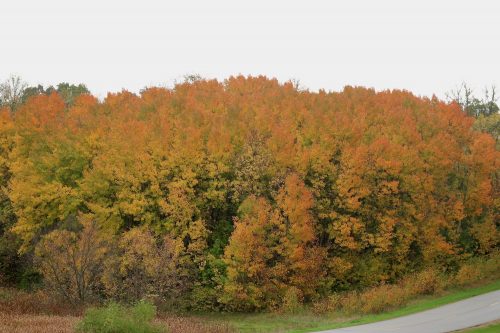
Distractions

Can’t you see I’m working here? The birds have taken over. My wife has set up multiple bird feeders, and she also sows seeds on the snow, so all day long it’s flocks of birds flitting past my office window. I’m trying to get these exams graded, but I get these constant visual distractions.
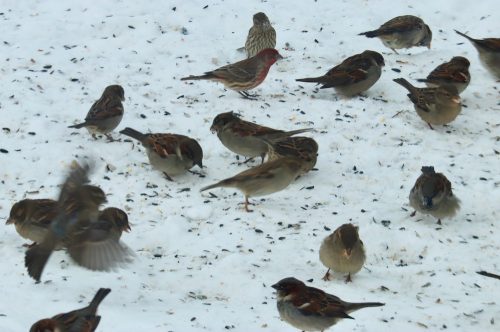
Also, bird butts.
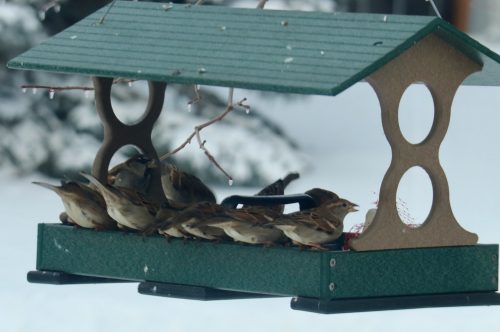
You might ask, “why not close your window shades?”. I answer that it doesn’t help, because these birds are flighty and numerous. They swoop in, peck as a mob at the seeds, and then after 10 or 15 seconds, they abruptly rise with a whooshing whirr that is quite loud and audible in my office, indoors.

Also, there’s a hawk that occasionally darts in for a snack and sends everyone in frantic flight, and I’d like to catch it in the act.

I think we done killed another tree

Years ago, when we moved into our home, it was graced with magnificent trees. In the front yard, we had this huge weeping willow, one of the notable landmarks in our neighborhood, and a pair of tall pine trees; the centerpiece of the back yard was a grand old slippery elm. They’ve all succumbed to age, and we’ve had to pay experts to come in and chop them down as they became increasingly dangerous, losing limbs in storms and just generally falling into crepitude.

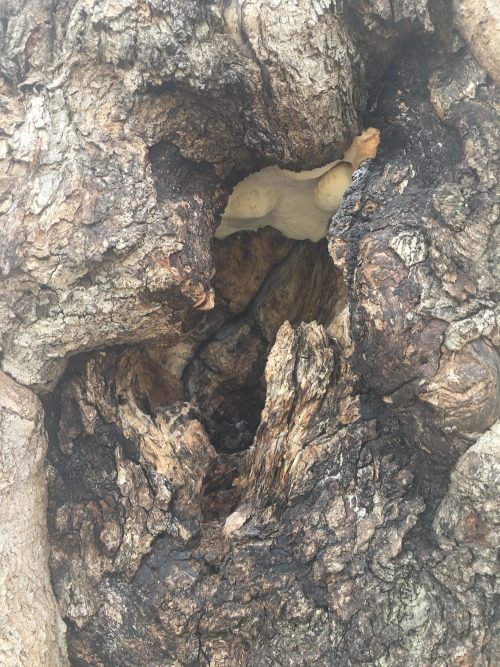
We have only one original tree left, right outside my office window. It’s a busy home to squirrels and birds. But it’s also doomed. Look at this hideous gnarled gap in the trunk.

It’s a deep wound, and that’s a horrible pale fungus eating away at the heartwood. We’re probably going to have to butcher this tree, too.

We’ve had a fair number of saplings planted around the yard, but it’s doubtful that I’ll live long enough to enjoy their shade someday.

Remember the lies

Big Oil would like us all to forget that they lied to us for decades — they tried to tell the public that global warming wasn’t a big deal, it wasn’t happening, and if it was, it was all our fault with our great galumphing carbon footprints, while they were innocently serving our needs and using the profits to do great things for the environment. Now that climate change is here to stay and dramatically and conspicuously affecting our lives, they’d like those campaigns to vanish down a memory hole. Don’t let it happen! The oil companies are literally evil villains, conspiring to cause world-wide suffering in service to their profits.

Mobil and ExxonMobil ran one of the most comprehensive climate denial campaigns of all time, with a foray in the 1980s, a blitz in the 1990s and continued messaging through the late 2000s. Their climate “advertorials” – advertisements disguised as editorials – appeared in the op-ed page of the New York Times and other newspapers and were part of what scholars have called “the longest, regular (weekly) use of media to influence public and elite opinion in contemporary America”.

Between 1996 and 1998, for instance, Mobil ran 12 advertorials timed with the 1997 UN Kyoto negotiations that questioned whether the climate crisis is real and human-made and 10 that downplayed its seriousness. “Reset the alarm,” one ad suggested. “Let’s not rush to a decision at Kyoto … We still don’t know what role man-made greenhouse gases might play in warming the planet.”

Liar, liar, planet’s on fire. These were prolonged FUD campaigns. Scientists knew what was happening and what was going to happen, and they said so, and Big Oil paid pet scientists to lie. It happens every time a company gets huge and its shareholders get greedy and rampant, raging capitalism kicks in to destroy all restraint. This is what the tobacco companies did when the scientific evidence came pouring in that smoking causes cancer — they lied. And they got away with it. It’s what Big Ag got away with with profligate spraying of pesticides. It’s what the oil companies got away with again with spewing lead into the environment.

How are we going to make them pay if we forget how much they consciously, intentionally lied to the world?

How to fight climate change in a 3-minute spot on TV

I am deeply impressed with what Michael Mann does here. He gets a good grip on this Australian politician, Barnaby Joyce, doesn’t let go, and makes him squirm while constantly hammering on the importance of addressing climate change. There’s a lot of skill at communication and media messaging on display here for such a short video.

The difficulty in these kinds of exchanges is that the professional politician is adroit at shifting the conversation to what his audience wants to hear — that the government is doing something about the Australian wildfires, and that they prioritize saving money and jobs — but Michael Mann turns that back against him, explaining that the Australian government has a terrible record on environmental issues, and that what they’re not doing is going to cost more than the jobs they vainly try to protect. And he doesn’t let Joyce get away with any lies!

And Mann comes off as a decent fellow while he’s doing it. It’s a hard trick to pull off. It’s why science communicators are important and not as common as we’d like.

I like the plan, let’s get going

I think it would be a fine idea to shut down amoral, exploitive companies, like the oil and gas industry, and while we’re at it, the tobacco companies, and we should do it soon before they metastasize any more. The question is…how? Tumbrels and guillotines are so passé, and they aren’t at all effective against abstract legal entities. We also can’t just, say, blow up their pipelines and processing plants, because that doesn’t provide for a gentle, gradual transition that won’t kill people — and as someone looking at an onrushing Minnesota winter, I can assure you that just shutting off the gas will kill lots of us. Another problem is that these companies are using their ill-gotten profits to diversify, buying up other companies that will keep them fat and happy even if we do demolish the petroleum industry, so it’ll be hard to satisfy the lust for vengeance.

OK, tumbrels and guillotines it is, then!

No, wait, here’s an article that makes some productive suggestions about shutting down the petro fuel industry. Shucks, I guess we could try this first.

Pro-abolition groups say this process would entail putting elected officials – not corporate executives – in charge of fossil fuel assets. The US government would slowly stop drilling or buying leases as it prioritizes lowering emissions and investing in clean energy. Nationalized ownership would allow the US to leave oil and gas reserves in the ground while simultaneously shrinking the fossil fuel company’s grip on the nation.

Such public intervention would also prevent oil companies from simply shutting down operations, laying off their workers and leaving behind devastated towns and counties, as coal companies have done, Skandier said. “We need to consider that a lot of these communities are highly dependent on fossil fuel revenues, so we need to plan how we’re going to build community wealth and diversify their economies to make sure they’re not only economically stable but resilient to climate impacts in the future.”

The US could take the land or reserves currently owned by the fossil fuel industry via eminent domain, the legal right governments have to seize land or infrastructure for the public interest. The federal government has done this before to create national parks and even to convert a private energy company in Tennessee into the now publicly owned Tennessee Valley Authority during the Great Depression.

All in favor, say “AYE”.

The article admits that it won’t be easy and there will be pitfalls.

Any movement to break up big oil, however, will inevitably face enormous headwinds. The industry benefits from being deeply ingrained within American society, and it’s expected that oil and gas interests would push back hard in courts. Nationalizing profitable industries would also take an unprecedented amount of political will, which has yet to materialize.

Law expert Sean Hecht warns that breaking up energy companies may lead to unintended ripple effects. History suggests that simply erasing a company’s existence may make it easier for them to ignore their financial responsibilities when they’ve caused harm.

Hecht, the co-executive director of UCLA Law’s Emmett Institute on Climate Change and the Environment, saw this firsthand in Los Angeles, where he lives. When the Department of Justice shut down Exide Technologies in 2015 for illegally poisoning neighborhoods with lead for decades, the company filed for bankruptcy and left taxpayers to foot the cleanup bill.

This is going to hurt, and there are a lot of lawyers who will savagely fight back. Of course there will be unexpected and deleterious side effects — but will they be worse than rising seas, out-of-control wildfires, gooey black muck in our water supplies, or vast tracts of land rendered uninhabitable by lethal summer temperatures? I think not.

I need those bugs to feed my spiders!

GrrlScientist reviews a book, Silent Earth: Averting the Insect Apocalypse by David Goulson, and it looks like this is another one I have to add to my pile.

In this book, we learn that insects have already declined recently by as much as 75% — which is probably not news to those of us whose automobile windscreens and grills lack the typical ‘bug spatter’ of yesteryear, particularly after long-distance drives at night. This dearth of insects translates into far fewer insectivorous birds for birders and nature photographers to chase. Yet weirdly, most people — even many birders, who should be aware of and alarmed by this steep decline in birdlife — remain blithely oblivious to these dramatic changes. This is thanks to two errors in human perception: first, shifting baselines, where we mistakenly think that the current state of the world is normal. Second, this is also attributable to a peculiar form of gaslighting where we downplay the extent of the changes that we experience around us. (Self-gaslighting?)

Up until a few years ago, I would have classified myself as a lab rat, a denizen of an environment defined by air conditioning and fluorescent lighting, but then I decided I needed a radical change and started going outdoors (!) and walking around in empty fields and woods (!!) looking at spiders. My first project (which remains unfinished because of the damned pandemic) was justified as an attempt to use measurements of spider populations as a proxy for the larger and more complex populations of insects, so this book is right there in my interests.

Despite being new to this field, and despite only paying attention in the last 5 years, even I am noticing the changes. It used to be that if I were walking home at night, there’d be a cloud of flying insects around every streetlight, and you’d hear the happy clicking of bats flitting around their hunting ground. Now we’ve only got silent dead lights. There is a crabapple tree near the walkway home, and every Fall I’d be annoyed because the rotting fruit would attract swarms of yellowjackets…but this year, nothing. In fact, I used to dread that path home because it was surrounded by trees that blocked the wind, and vast clouds of midges and mosquitos would accumulate there. Not this year, though. I’m still seeing house spiders, though, I would guess that if you’re adapted to human environments, you’re still doing OK, but I’m finding fewer, and smaller, orbweavers outside.

To GrrlScientist’s list of excuses, I’d add that we expect some natural variation. This has been a summer of drought, so maybe it’s just a temporary situation — if we get good rains next year, maybe they’ll bounce back. Maybe it’s also a targeted attack. A few years ago I learned that the university employs a pesticide company, which was specifically called in when those harmless, bumbling grass spiders would dart into university offices, looking for mates (to no avail — the ladies were outside, fellas), and so the shrubbery would get sprayed, to my horror (sorry, fellas, the ladies are all dead). While prowling around buildings looking for spiders, I noticed piles of dead yellowjackets, which tells me what happened to the insects that usually feasted on rotting crabapples. They’ve been murdered.

Will people stop spraying insecticides all over farm country? I doubt it.

Fortunately, the book provides some solutions.

Although our current situation is serious, it can still be reversed, Professor Goulson maintains, because insects reproduce extremely quickly. All we need to do is support them as their populations recover. Some of the actions that we all can take include: reduce the space occupied by lawn and replace it with flowering plants, mow the remaining grass less often and allow a corner of your garden to “grow wild” and “get messy”; incorporate a wide range of native plants that flower throughout the season into your garden, along road verges and in roundabouts to attract beneficial insects; avoid pesticide use whenever possible by giving predatory insects a chance to take care of a problem first; create your own “insect hotels” and clean them periodically to reduce the accumulation of mites and fungi that can harm bees, and reconsider beekeeping as a hobby because of the many threats that domesticated European honeybees, Apis mellifera, pose to native bees. Professor Goulson also proposes a number of actions that farmers, city dwellers, and politicians can take or enact to support the recovery of local insect populations.

Oh, yeah. We’ve got a lawn, and I hate it. It’s not exactly thriving, anyway — the drought has killed big patches of it. My wife has created a couple of native plant patches in the back, and I wouldn’t mind expanding them. We have a sort-of vegetable garden that has been neglected and is overgrown with weeds, and maybe we can pretend that’s intentional. We don’t use pesticides. Of course we encourage predatory spiders to take care of any insect problems, and even transplanted a few spiders from other locales to our home.

Previous owners of our place were much more meticulous in maintaining the traditional American monoculture of boring grass in our lawn. We even have vestiges of an automatic underground watering system, a network of pipes and sprinklers connected to a fancy-ass timer system in our garage. That died a few years after we moved in, when a break in the water mains meant the city brought in a backhoe and dug a trench across the lawn. It might be a good project to finish the job, go in and dig out the PVC pipes in part of the lawn, tear out the grass, and plant prairie grasses and forbs and encourage more wild insects to move in, before they all die off.

A happy picture

They’re bringing back the chinook salmon in Washington state rivers, where the populations have been destroyed by hydroelectric dams, among other things.

Conor Giorgi, Anadromous Program Manager at the Spokane Tribe of Indians, coaxes one of 51 Chinook salmon into the Little Spokane River, Friday, Aug. 6, 2021. Spokane Tribe of Indians, Washington Department of Fish & Wildlife, Inland Northwest Land Conservancy released the adult Chinook salmon from the Wells Salmon Hatchery into the river. Salmon have not been in the Little Spokane in 111 years. This is part of a larger effort to reintroduce sustainable salmon populations above Chief Joseph and Grand Coulee dams.

Although, I have to ask, did they really have to bring up the Program Manager’s sexuality in the text? I say that as someone entirely sympathetic with the anadromous lifestyle, and who would be swimming back to the sea myself if I weren’t so darned timid and straight-laced (I’d probably call myself diadromous, actually, I’m open-minded about which way you swing).