Tickets are now on sale for the Perspectives of Atheism AAI conference, to be held in Germany on 25-27 May. I’ll be there, you should go too!
Hey, I haven’t decided what I’m going to talk about there, yet. Any suggestions? What do you want to hear?

Tickets are now on sale for the Perspectives of Atheism AAI conference, to be held in Germany on 25-27 May. I’ll be there, you should go too!
Hey, I haven’t decided what I’m going to talk about there, yet. Any suggestions? What do you want to hear?

This video by Alexander Tsiaras is simultaneously lovely and infuriating; it’s a product of technology and science, and the narration is profoundly anti-science.
There are some technical issues that annoy me about the video — it’s a mix of real imagery and computer animation, and it doesn’t draw a line between what is observed and what is fabricated — but it’s visually stunning and otherwise fairly accurate.
But Tsiaras’s running commentary…it’s mystical airy-fairy glop. It takes awe and turns it into a celebration of ignorance.

Between making a couple videos on the Creation Museum following the 2009 trip to the Creation Museum with the SSA and running the largest atheism group on Facebook with 10,000 members, I believe I have question to answer: why I am an atheist.
I suppose it begins with nothing short of nature itself. I grew up in the hills of Kentucky. I shan’t hesitate to say that the hills of Kentucky are a lovely place – in stark contrast to everything else in Kentucky, which is pretty much the exact opposite of lovely. I spent plenty of time in the wilderness, observing the various forms of life, taking in the smells and the sounds, laying down and watching the sky. It was always regrettable when I had to put down the science books as a young child to attend the churches, which never felt quite right to me. Regardless of what I was told, something was critically wrong with the things they said. The loving Jesus message was nice, but the not-so-loving message of hell seemed a drastic affront to the idea of love.
The explanation that a loving Lord would punish people like me, who had done no other wrong than existing or doubting, seemed contrived, to say the least.
My parents were loyal southern Baptists and still are. One morning in my youth, prior to the age of ten, I was looking out our sliding doors, taking in the amazing sights of a Sunday morning. The birds could be heard loudly chirping, deer could be heard walking the hills, the sun was just about to break free from the hills and show itself to everyone. My admiration of nature’s overwhelming beauty was thoroughly broken when my father leaned a hand against the glass and mentioned some jazz about the beauty of god’s creation. Of course, something about the beauty of god’s creation seemed off. In my time, I had found dead birds, miscellaneous animal carcasses in the woods, and seen with my own eyes bugs fighting it out as a matter of life and death.
God’s creation, while beautiful, also struck me at times as particularly brutal and outright dangerous, depending on what you are. As a human, you don’t have many problems – bears and snakes – but as an animal or insect, you had a great many problems day by day. The contrast of such striking beauty with suck striking brutality was not, and is not, lost on me. Quite the opposite: there was more brutality than beauty, and the beauty was often a superficial facade which seemed to protect us from the reality of the other creatures in god’s creation.
Increasing scientific knowledge did nothing to quell my views on god’s creation. Seeing as my favorite star was eight thousand light years away, knowing that a light year is how far light travels in a year, knowing that my favorite star was at least eight thousand years old – and most likely far, far older – only made this doubt of god’s creation grow. Especially in a world where creationists and fundamentalists, a great part of the United States population (40%, as late), tend to believe the world is six thousand years old. If my favorite star were eight thousand light years away, and the oldest known sources of light were over thirteen billion light years away, what was the rationale for believing that the world were six thousand years old?
Only a book written by bronze age goat herders.
Noah’s ark I viewed as especially unlikely. Knowing the vast amount of species that exist, knowing that there were many more than I could ever know about, one hundred plus year old man and his family were unlikely to collect them all, build a boat the size of the Titanic that could last forty days on the water or hold all of these animals, how likely was this event to have occurred? Not at all, I came to realize very quickly.
So by twelve, the seeds of doubt had been well sewn. Before too long, I was headfirst into scientific research on every major topic I could cover. I saw vast amount of evidence for the science, and with that, less and less for creationism. By thirteen, I was an atheist in every aspect but title. It took two additional years to come out of the closet, but in the six years since (I’m twenty one at present), I have learned much more than I could have dreamed about how the universe works. Much more than my peers, much more than my family. I grew to realize that creationism held one back from reality as it was, and I grew to loathe it more and more as I went. I suppose, though I leave people to themselves, generally, I have become a stern anti-theist. 9/11 and the hysteria surrounding it certainly didn’t help keep me on the so-called ‘righteous’ path, and I wouldn’t have life any other way. There is no amount of ignorance that could satisfy my sheer lust for knowledge, and ever more of it.
While I learned much about willful ignorance from the Creation Museum, I can’t help but wonder how this life, a life of unknowing, is satisfying for anyone who has a great lust for knowledge, information, science, and truth. I cannot look at creationists with a sense of hatred, dislike, or what have you, but I do look at them and their kind with a great feeling of sadness and pity. I pity creationists. They deserve it.
In addition, my whole life I’ve had one key struggle that was in drastic opposition to my faith and the faith of my parents. My whole life, I have been well aware that I didn’t feel like the other boys I knew. That when I looked in the mirror, I was different. That I was wrong. My body was wrong. Some of my greatest early Christianity struggles, going back as far as I can remember, took place as the result of my feelings that I should have been born as the opposite sex.
As a male to female transsexual, I always pondered how I were supposed to be a Christian and live a life directly opposed to the gospels. How was I supposed to live happily as a female if the Bible condemns something such as the simple act of wearing the opposite gender’s clothes? I wouldn’t think it far out in the least that a good bit of my Biblical skepticism came from knowing that the way I felt was condemned, yet I never made a choice, nor asked for anything like what I had received from my earliest memories on. It had always been there, known to me, accepted by me, yet condemned by the religion I was raised into and by the people I had grown to love.
I still struggle with transsexuality, though on the basis of my family’s beliefs being in direct contrast to it. I will not be stopped by the faith of my fathers, but the pain caused by them is indeed very considerable. I hold religion itself in contempt for marginalizing people like me. My growing sympathy with homosexuals didn’t help their case, either. I figured out that if I felt this way naturally, so did the homosexuals, who were so demonized and hated… and that is simply unforgivable.
So why am I an atheist?
Nature. Science. Reality. Skepticism. Transsexualism. Lust for knowledge. A critical mind. No satisfaction in ignorance.
And I wouldn’t have it any other way.
Michael Baizley
United States

David Barton is a guy who makes a living lying about history…and now apparently he wants to add lying about science to his résumé. Here he argues that abortion and homosexuality are wrong because they are aberrations of nature.
The stupid burns white hot in that one.
It’s the naturalistic fallacy. You can’t derive what humans ought to do from what other animals do (and worse, what you imagine in your ignorance that other animals do). Other animals don’t worship the Bible or pray; therefore, it is wrong for humans to do so. At least, that’s the reasonable conclusion for Barton’s logic. We’ll also have to shed hats and shoes, stop cooking our food, and Barton will have to stop doing his clown act on TV…all human behaviors that are not shared with other animals.
It is simply not true that other animals don’t abort their young. Look at the Bruce effect; rodents will spontaneously terminate their pregnancies if exposed to a strange male. Lots of animals will spontaneously abort under stress, and it makes evolutionary sense: evolution, unlike fundamentalist Christians, favors the preservation of maternal life. It is wiser for a female to conserve her resources and bear offspring when she can afford the cost.
You want real horror stories? Look up maternal infanticide. It’s a continuation of that same evolutionary logic: if infants cost resources, and if the choice has to be made between preserving the life of the infant vs. the life of the mother (and usually, death of the mother leads to death of the infant anyway), animals will sacrifice the young first. It’s been seen in rodents, penguins, pigs, foxes, tamarins, you name it. It’s often even accompanied by cannibalism. If Barton wants to draw moral lessons for humanity from the animal kingdom, there you go.
Homosexuality is also common (here’s a list). Barton is making the common fundie Christian error, thinking sex is for reproduction and only for reproduction. As anyone with any sense knows, though, in humans and many other animals, sex is primarily for social bonding. Almost every single sexual activity in which you participate, even if it is with a member of the complementary sex in permanent relationship, is for fun and because it strengthens the relationship.
When you look at it that way, what’s surprising is how little homosexuality is going on — why are businessmen settling for a handshake and a golf game when they could really seal the deal? But then of course there are other factors, like maintaining some exclusivity of special relationships and the importance of distancing as well as intimacy in different classes of social behaviors. But you simply cannot make the blanket argument that homosexuality is unsupportable by evolution.
Also, because it’s the explanation I favor, not everything in evolution is finely tuned for optimal reproductive efficiency. I think homosexuality is common because evolution favors sexual behaviors first, and adding restrictions to limit sexual behavior to reproductive behavior a distant second.
Unfortunately, lying for favors and obstinately clinging to ignorance are typically human behaviors, too, so I can’t slam Barton with the argument that he’s an aberration.

There’s a study going around that’s getting a lot of press because of the palpably unjust conclusion that it says atheists are perceived as no better than rapists. I’ve read the paper, though, and I have to say that that’s a slightly misleading interpretation.
The paper is trying to specifically tease apart the causes of anti-atheist prejudice, and it does so with a series of tests. Their hypothesis is that there can be multiple reasons why someone could detest someone else, and they argue that, since religion is used as a test of whether someone is a member of the in-group, that religiosity is used as a proxy signal for trustworthiness.
In sum, according to the sociofunctional perspective, to understand prejudice against a given group, it is necessary to understand the threats that the group is perceived to pose. Independent theory and evidence indicates that under specific conditions, religious thinking promotes intragroup cooperation and trust, and that people use cues of religiosity as a signal for trustworthiness. Combined, these two perspectives suggest that distrust is central to anti-atheist prejudice, an insight that leads to a specific set of hypotheses regarding the nature of anti-atheist prejudice. Alternatively, another cause for hating atheists could be disgust or dislike — that their behavior inspires revulsion, or that atheists are simply unpleasant, unlikable individuals.
So let’s put it in context. This research did not establish a scale of personal attributes that ranked atheists, and found them comparable to rapists; it looked for causes, and used rapists as a category for comparison.
The kind of tests they did were surveys and examination of the likelihood of committing conjunction errors. The way they did this was to tell the subjects (who were all college students, by the way) a story like this:
Richard is 31 years old. On his way to work one day, he accidentally backed his car into a parked van. Because pedestrians were watching, he got out of his car. He pretended to write down his insurance information. He then tucked the blank note into the van’s window before getting back into his car and driving away. Later the same day, Richard found a wallet on the sidewalk. Nobody was looking, so he took all of the money out of the wallet. He then threw the wallet in a trash can.
Then the students were asked whether it was more probable that Richard was either 1) a teacher, or 2) a teacher and XXXX, where XXXX was either a Christian, Muslim, rapist, or atheist. Obviously and logically, the correct answer should always be 1, because the probability that the person will be a teacher and something else will always be lower than the probability that the person will be a teacher.
The answer they found was that people made this error about 29 times more often if XXXX was “atheist” rather than one of the religious groups, and that the responses were not significantly different between “atheist” and “rapist”. There was also a correlation between the likelihood of making the error and how important the subject rated god in their lives.
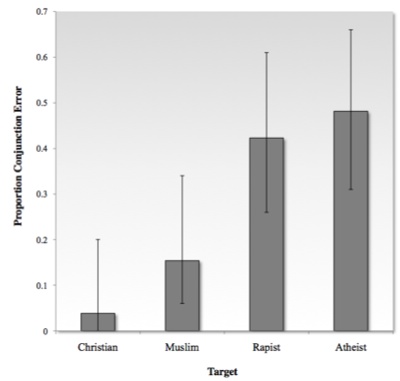
Don’t get hung up on the comparison with rapists. That was a category simply chosen because it would be unambiguously distrusted. They could have used “investment banker”, too, but then the comparison would be more difficult, because maybe a wealthy conservative college student wouldn’t consider that to be an untrustworthy occupation.
The point was not a comparison with rapists, but a comparison with other possible causes of anti-atheist prejudice. For instance, another group of subjects was told this story, as a measure of unpleasantness of character:
Richard is 31 years old. He has a rare inherited medical condition. This leads him to have dry, flaky skin and produce excess mucus. His skin often flakes off at embarrassing times, and he almost always has a dripping nose and phlegm in his throat. On his way to work one day, Richard was scratching his itchy shoulder. Some of the dry skin that flaked off caused him to sneeze, and some snot ended up on his tie. He failed to notice that the phlegm got on his tie. He wore this dirty tie through an entire work day.
Then they did another conjunction fallacy test, asking whether it was more probable that Richard was 1) a teacher, or a teacher and XXXX, where XXXX was Christian, Muslim, gay, or atheist. In this case, the result was that neither gays nor atheists were regarded as personally more unpleasant or unlikeable.
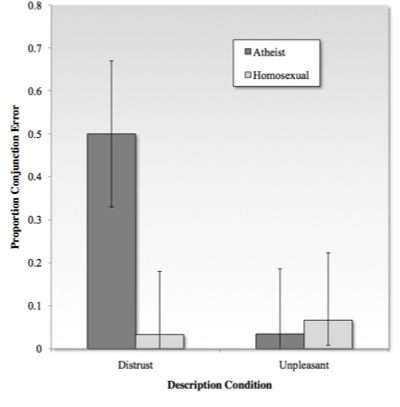
So the study has good news and bad news.
The bad news is that atheists really are not trusted by the public at large — we do not give off the positive in-group signals expected, so we get relegated to a kind of pariah status.
The good news, I guess, is the reasoning behind that. You’ll often see religious people rail against atheists and tell us how rude and awful and bad we are: take a look at the comments on this article on the study, for instance.
I think part of the issue is that some of the most visible, high-profile atheists we hear about (Dawkins, Hitchens) are vocally of the “THERE IS NO GOD AND IF YOU THINK THERE MIGHT BE YOU ARE AN IDIOT!1” variety. These are the atheists that get the press, so I can understand the source of the perception.
Or here:
I’ve never met an atheist that wasn’t an ass. I’m not saying they all are. Just those I have known.
They push harder than the Phelps’.
Those people have misinterpreted the study (or more likely, haven’t even read it). It’s actually saying the opposite: people don’t perceive atheists as being unpleasant, they see them as being outsiders. It is specifically tying the prejudice to a judgment about trust, not whether we’re icky rude nasty people.
The message I take away from it is not to avoid the assertiveness associated with the New Atheist movement — although it may highlight those in-group/out-group boundaries, that’s necessary. We aren’t trying to say we are exactly like theists, we need to demarcate those boundaries as part of establishing our identity. What the study does do, though, is affirm that those campaigns to establish the idea that we can be good without god, that we have high moral standards, are even more important, because they go directly to the issue of whether atheists are trustworthy members of the community.
Gervais WM, Shariff AF, Norenzayan A (2011) Do you believe in atheists? Distrust is central to anti-atheist prejudice. J Pers Soc Psychol.101(6):1189-206. Epub 2011 Nov 7.

I was 12. Attempting to rebel, I declared that I didn’t believe in God. My parents didn’t really care, given that we were only Buddhist at funerals. I went through a New Age-y phase where I believed in astrology, the paranormal and spirits. But as I got older, I got wiser. I was a voracious reader, and came upon the multitude of crimes against humanity committed in the name of religion – its effects on women, sexuality and science. However, my turning point came in a grade 12 biology class. A girl who I couldn’t stand, who became brainwashed when her parents accidentally sent her to Christian camp, got up to do a project on evolution. She prefaced her presentation by saying she didn’t believe in evolution because of her religion, and then proceeded to talk about Australopithecus afarensis. That kind of dichotomy astounded me. Partially because I hated her, and partially because it was the only conclusion based on reason and logic, I became non-religious. But it wasn’t until I stumbled onto Pharyngula, that I realized that there was a name for it. Atheist.
Anna Yeung
Australia

Dave Niose, president of the American Humanist Association, posted recently over at Open Salon a copy of a letter he received from an atheist friend. The friend wrote the letter to his own 11-year-old daughter, who was “very upset about her father’s non-belief” — particularly his refusal to pray for her (something apparently advocated by the friend’s wife, who is a Christian).
I won’t comment on a family situation I know next to nothing about, but it did remind me of the very issue that began the unraveling of my own faith: prayer. About 20 years ago, I was on a path to ministry. I was in the middle of co-founding a fellowship organization on my college campus and had just finished drafting the group’s constitution (as required by the school to be an official student organization and thus receive activity funds) when I had a moment of clarity while praying for guidance. Yes, I appreciate the irony.
The path I was on would have led me to fervent proselytizing. I was 19 years old, post-Catholic and in training to present the Word to non-believers. I studied the Bible with an ordained mentor and doggedly researched apologetics. I was going to provide irrefutable answers in defense of Christ in debate.
But there were no irrefutable answers.
I decided to keep on it — after all, I was just getting started and I had faith more would be revealed as I continued in my studies. But each revelation was more suspect than the last. Every question I had was answered with circular reasoning (e.g., why believe in the Bible as the inspired word of God? Because the Bible says so.). Finally, while praying to understand God’s will, a giant hole ripped in the fabric of my belief: Who am I praying to? Why? Why does God require me to pray when he is supposedly omniscient? What does that say about the nature of the god I’m praying to?
The God I believed in was supposed to be perfect. Too perfect, in fact, for mortal minds to fathom. Ultimate love. True goodness. Omniscient. Omnipotent. Omnipresent. The whole nine yards and then some. Whenever something about God didn’t make sense to me, I countered myself by saying my definition of God must simply be too narrow. But because of that, God soon became just an infinitely broad but paper-thin abstraction. It was then a very small step to the realization that the concept of a personal God was absurd. Eventually, I came to understand the fallacy of the “God of the Gaps“. There was no chance I’d turn to another religion; it was clear they’d all fail the litmus test instantly.
I claimed to be an agnostic throughout my 20s. I left open the door to the idea of a higher power but, again, was pretty sure the matter was too complex to be comprehended. It wasn’t until my 30s that I faced the issue head on and realized I had been making the same weak excuses.
A sequence of events and introspection ultimately left nowhere for my intellect to hide. Once I allowed myself to practice skepticism honestly, the absurdities appeared everywhere I looked. There was no God. And it quickly became clear that many of civilization’s messes — either directly or indirectly — were catalyzed by some form of religion. My eyes were opened, and I was faced with one big question: Now what? It didn’t take long to understand that the only sane response to an insane world was to roll up my sleeves and try to make it a better place. All alternative responses were (and remain) unacceptable. Ultimately, I discovered my ideals matched those of organized Humanism.
So yes, you could say that prayer accidentally provided me with guidance. It was exactly the spark I needed to put me on the right path.
David Spero
United States

Forgive the short notice, but the creator of “The Rap Guide to Evolution” will be interviewed by Minnesota Atheists in about an hour, at 9am Central time. I’m actually home on a Sunday for a change, so I think I get to listen.

It’s just starting, so drop a word of encouragement. The blog is We Are SkeptiXX, and the intent is to promote more female representation in the skeptical movement. We’re all in favor of that, I hope!

Finally, Richard Carrier’s blog is set up here, and now you can hear him explain Bayes’ Theorem.
People should start whining more now that “Skepticon” was a misnomer. It wasn’t a skeptics’ convention, it was a basic math and science convention!
