Santorum did not have a good idea

Now and again, some well-meaning but clueless person gets it into their head that teaching creationism in the schools is a good idea — that the clash of ideas is a good pedagogical technique. There are cases where that would be true, but doing it in the public school classroom and hashing over a bad, discredited idea vs. good science is totally inappropriate. Reserve that technique for issues where there is substance on both sides.

But now Jay Mathews is trying to revivify this nonsense in the Washington Post, suggesting that Rick Santorum has a good idea with his plan to “teach the controversy”. He’s done it before, and gotten a predictable response.

Teaching all sides of the evolution issue is supported in opinion polls. But those against it feel more strongly. When I suggested in 2005 that high school biology teaching would be improved by allowing students to debate Darwinism vs. the intelligent design theory, I received more than 400 e-mails. Seventy percent of them said I was an idiot. Many added that I was a dangerous idiot.

Heed your email, Mathews. The majority were right. And your opinion column just reveals that you don’t have the slightest idea what you are talking about.

I respectfully disagree. It is important to note that Santorum and I have different reasons for wanting high schools to allow discussion of intelligent design — the notion that some supernatural force (not necessarily God) brought life to earth. Santorum believes that God had a hand in it. But he wants to avoid injecting religion into schools, so he says classes need only examine the scientific possibility that Darwin was wrong to conclude that life evolved only because of natural processes.

I highlighted part of that paragraph, because it illustrates how wrong Mathews is. No, the Religious Right wants to inject religion into schools; that’s clearly been on their agenda from the very beginning. They want prayer, they want religion classes, and they want to expunge any scientific finding that contradicts the Bible. Santorum and his fellow travelers see intelligent design creationism as a Trojan horse to get god into the classroom.

After his failed exercise in reading Rick Santorum’s mind, an exercise that ignores the paper trail the Religious Right has left us, Mathews turns his magic powers on the minds at the Discovery Institute, and gets that wrong, too.

Advocates of intelligent design at the Seattle-based Discovery Institute have influenced Santorum. They accept many Darwinist concepts, such as the notion that humans and apes evolved from a common ancestor. They see a weakness in Darwinian theory because of the lack of much evidence of natural precursors to the animal body types that emerged in the Cambrian period 500 million years ago. How did we get from random chemicals to creatures with eyes and spines? They say that gap in knowledge leaves open the possibility of intervention by an outside force.

Many scientists and teachers think the intelligent design folks are only pretending to have an allegiance to science. They seemed sincere to me. Some have doctorates in science. Even if they are fakes, their reliance on the fossil record rather the first book of the Bible qualifies them for a science class debate.

Mathews, look at your email again. You’re an idiot.

The Discovery Institute contains a diverse group of people; some are young earth creationists who completely deny common descent; some accept that the earth is old and that we can trace the derivation of humans from prior forms. What unites them is a categorical rejection of natural mechanisms of evolution; they don’t believe that humans and apes evolved from a common ancestor. Some of them believe that the ape genome was consciously ransacked by an intelligent designer to build a new species, us, with intent.

The absence of evidence of natural precursors you are babbling about is pure ID propaganda. It’s wrong. We don’t have fossils of these things, that is true, but you have to be thoroughly ignorant of modern biology to think that fossils are the primary source of information about our biological history. We analyze molecules, not bones. And the molecules tell us much about pre-Cambrian relationships.

GAPS? You’re proposing teaching “gaps” in our knowledge? OK, the right answer is to point to a specific question and say, “I don’t know”. It is not right to say “I don’t know, but I’m going to invent a magic ghost to fill in that gap, and I’m going to call him Jesus.”

Now Mathews claims to see “sincerity” in the intelligent design creationists, which is nice and charitable, but not credible. Philip Johnson has a doctorate, sure…he’s a lawyer, and he adopted this ID nonsense when he had a midlife crisis and also became a fundamentalist Christian. Bill Dembski has a doctorate in math, and also thinks ID is a modern version of the Logos gospel. Jonathan Wells has a doctorate in biology (amazing!), and also went into his graduate program at the behest of the Reverend Sun Myung Moon, so that he could destroy Darwinism from within. They are sincere Christians. They are not sincere scientists.

I would like to see evidence that creationists rely on the fossil record. Mathews himself claims it’s about gaps; the Discovery Institute has not proposed that the way to advance their cause is by more intense study of paleontology.

So Mathews knows nothing about what the creationists actually argue. Does he know anything about biology? No, he does not.

I think Darwin was right, but boring.

It was hard for me to become interested in classroom explanations of natural selection when I was a student. Introducing a contrary theory like intelligent design and having students discuss its differences from Darwinism would enliven the class. It would also teach the scientific method. Did Darwin follow the rules of objective scientific inquiry? Does intelligent design?

Grrrr. BORING? You’re a goddamned ignorant moron, Mathews. Do not blame the instructional failures of your lousy teachers, or your inattentiveness in class, on Charles Darwin.

Right now, we have a wealth of wonderful material that can be taught in the classroom, and great texts to do it with. I highly recommend the books of Sean Carroll; I’m using his Making of the Fittest in our introductory biology classrooms right now, and it does a marvelous job of explaining the molecular evidence behind evolution. I’ve also used Endless Forms Most Beautiful in my developmental biology class — it’s great at summarizing evo-devo. We’ve also used Weiner’s Beak of the Finch as an example of modern population genetics; Zimmer’s At the Water’s Edge for the intersection of paleontology and molecular biology; and Shubin’s Your Inner Fish for human evolution. These are real pedagogical tools and interesting scientific issues that can be and have been used routinely in good science classes, without resorting to contrived nonsense.

Boring? Jebus, Mathews, you aren’t competent to lecture us on how to teach biology if you think this entire field of science is uninteresting…so uninteresting that you want to introduce crackpots and wackaloons to liven it up. Hey, how about clowns, too? That would have perked you right up in your lackluster student days — sure, let’s just fill the science classroom with a whole fucking parade of clowns!

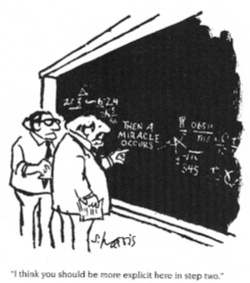
You know what classes students really find dry and boring, and complain about frequently? Math classes. I anxiously await the patented Jay Mathews solution to make math exciting — it will probably involve lying a lot, putting mathematical concepts on trial, and inventing out of whole cloth solutions to problems that have resisted actual mathematical efforts to answer. Maybe magic tricks? Perhaps he thinks this old S. Harris cartoon is a legitimate example of good math teaching style?

I teach at the college level, and I do discuss intelligent design creationism in the classroom. But first, I spend a couple of weeks discussing the scientific evidence for evolution intensively; I prepare the students with the background to analyze the questions legitimately. And then I don’t present creationism as something that has to be addressed scientifically, but as a social and political problem — and we go through a subset of their arguments and show how they neglect and contradict the scientific evidence that the students already know. It is most definitely not because we need creationism to make the science lively; it’s because creationism is a pain in the ass lie that the students should be prepared to cope with.

(Also on Sb)

It does look vaguely religious, doesn’t it?

In a completely unsurprising decision, Jessica Ahlquist has won her court case, in which she was complaining that a prayer banner was an inappropriate object to hang in a public school. The defendants tried to argue that it was “an historical memento of the school’s founding days, with a predominantly secular purpose.” Judge for yourself. It’s the banner titled “School Prayer”, which begins, “Our Heavenly Father” and ends with “Amen.” Somehow, the judge in the case was not fooled and recognized that it seemed to be rather obviously religious in tone, and has ordered it taken down.

Next thing you know, these religious gomers will try to argue that creationism is a secular, scientific theory. No one is going to be fooled by that, are they?

Why I am an atheist – Crys

I am an atheist because I read.

I was raised in Rome Italy by a vaguely Catholic mother in a pretty Catholic country. However, since I was not forced to go to church outside of Christmas and Easter, I didn’t take my first communion until I was 11 (and even then I studied my catechism with an extremely liberal nun) and my upbringing was never based on the rules and guilt-trips that are typical of the Catholic faith I did not immediately question the existence of God or the church itself. I just was not exposed to anything that was so explicitly divorced from reality from the perspective of a child. The first thing that I realized was that prayer was just not working out for me. This lead me to thinking, am I doing it right? What does being a Catholic even mean? What am I attesting to when I label myself at one? At the age of 12 I picked up the Bible and actually started to read it.

I am an atheist because I’ve experimented.

By age 13 I was studying ancient Roman history as is to be expected given the city in which I grew up. It struck me that the content of the Bible was no less fantastical than the wonderful stories I was learning about the gods that the Romans believed in. I came to the conclusion that all religions must be equally true. As my upbringing very much encouraged the belief in the superstitious and magic, as my mother is still a strong believer in everything from faith healings to fairies, I had now become a polytheist, I laid flower offerings at Minerva’s temple in the Roman forum, I practiced Wicca and dabbled in pretty much any forgotten religion I could get my hands on.

I am an atheist because I reasoned.

Although I remained a pagan until the age of 17 when I first went to college, it had become more of a ritual than a true belief. I enjoyed keeping holidays like All Hallow’s Eve, I used my prayers as a source of comfort being in a strange new country where I had to adjust. I didn’t submit my faith to the sort of scrutiny I eventually knew it deserved. It was simply something to fall back on, something to keep me company, but never something I openly shared or overly contemplated. I began to transition out of feelings of faith as I made new friends, as I realized that if I was ashamed to share with others my beliefs, it must mean that they are completely ridiculous. I had now become an agnostic.

I am an atheist because I was honest with myself.

I did not identify myself as an atheist until I was 20. By then I was in my third year in college and had fully understood the scientific method. I had shied away from the term “atheist” because I was under the misguided notion that being an atheist meant being absolutely certain that there was no God. To me, this seemed as obtuse and arrogant as being absolutely 100% certain that there is a God. However once I began to fully appreciate the scientific method I realized that this was not the case. There is nothing in this life that we can really be absolutely 100% certain about, but I began to see my lack of belief like a null hypothesis.

I am an atheist because there has been no reason for me to believe in any God. I have not been presented with nor come across a single miraculous or inexplicable event that contradicts my assumption that no God exists. However, this does not mean that such an event could never happen. The day I experience something that would give credence to a God I am perfectly happy to refute my null hypothesis, but until that day comes, it holds strong.

Crys
Italy

It’s about time Jesus & Mo got their just reward

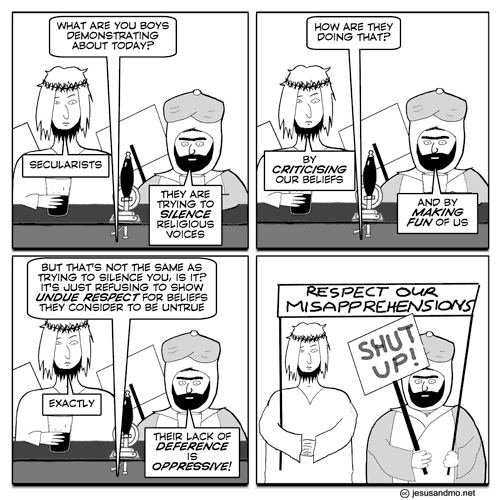
Week after week, Jesus & Mo keeps plugging along with its sacrilegious portrayal of Jesus Christ and Mohammed as a pair of oblivious lunkheads, and there have been no fatwahs, no beheadings, no riots. It doesn’t seem right.

Now at last there has been a little protest: University College London is having a censorship fight over the use of Jesus & Mo by the Atheist, Secularist, and Humanist Society. It’s much more polite than a riot, at least, but just as stupid.

The Ahmadiyya Muslim Students Association is protesting. Apparently, once you’ve been informed that a group of deluded idjits finds your signage offensive, you’re supposed to immediately take it down and apologize.

Once a particular act is deemed to be offensive to another, it is only good manners to refrain from, at the very least, repeating that act. In this particular case, when at first the cartoon was uploaded, it could have been mistaken as unintentional offense. When certain Muslims voiced their offense over the issue, for any civil, well-mannered individual or group of individuals, it should then be a question as to the feelings of others and the cartoons should then have been removed

Gosh, who knew? I find the inanity of Christian announcements deeply offensive, and all I have to do is go down to the local churches and ask them politely to stop expressing their views in public, and the church bells will stop ringing, the electronic chimes will cease blaring, they’ll stop putting up advertisements for Kent Hovind video showings at the university, and they’ll stop airing insipid church services on the local public television station. I look forward to our new era of tolerance, civility, and public respect for the views of atheists.

Why I am an atheist – Chad Brown

I am a long time reader of your blog. It has introduced me to many new concepts regarding feminism and atheism and has helped me greatly to shape the way I view my atheism today as well as my political/social stance and support for feminism. Thank you for these insights and for the time you take to run this blog. As part of my thanks, I have provided my story below for how and why I became an atheist.

I was raised in a Lutheran family in Winona, Mn. Our family attended church every Sunday, but we never talked about our religion around the house. A few years before my confirmation classes commenced I decided to read the bible. I found it obtuse, abstruse, ambiguous, contradictory, unnecessarily repetitive, and with a tendency to prattle on over irrelevant details. When I was 13 and attending confirmation, I started asking some serious questions. None of my confirmation teachers answered my questions to my satisfaction and it became pretty clear to me that our confirmation courses were less about exploration of our faith and more about indoctrination.

I started to have my doubts about religion and I didn’t know how to take my family’s silence on the matter. Was their silence an affirmation that religion was highly suspect, or was religion just too personal of a subject to broach? I sensed that I would not get clear answers at home.

For me, high school history, anthropology, and sociology were the first courses and sources of knowledge to expose religion as a sham. At the time I never even considered science as a path for leaving religion or that religion and science were naturally opposed to each other. By the time I was 16, I considered myself an atheist and really had no doubts about the matter. But the strangest thing was occurring; as I explored the subject with my closest friends, the people whom I believed thought most like myself, I found that they considered themselves believers. I was floored. Why was I alone in thinking that religion was a hoax?

In college I studied Physics and, although I do not work in a laboratory, I consider myself a scientist. In college I started to learn how science and religion are not compatible and I finally started to meet some atheist friends. Since leaving college it has been harder to come across other atheists. Coming out, on some occasions, has been costly and painful. I even had one boss tell me that my problem was that I was, “…a goddamn atheist”. I don’t think he recognized his own irony.

My family found out about my atheism by accident and I know that they are uncomfortable with it. It turns out their silence was not an affirmation of religion’s ludicrousness. I now have my own children. I try to let them know that we can talk about any subject in the house (sex, religion, politics, sexual orientation, etc.) at any level they desire. I don’t want them to spend years wondering what their parents think. Even more importantly, I encourage them to read, study and investigate so they can form their own, informed opinions over such matters.

The online atheist community has been a great source of comfort to me. It has offered me an opportunity to be introspective about my atheism and has helped my perspective on the matter to grow and evolve. I no longer feel so isolated. Your blog, and the works of others from Richard Dawkins to Rebecca Watson, is important to atheists out there like me who have been unable to find support in our local communities.

Chad Brown
United States

Of course the dog won

A while back, the Way of the Master (Ray Comfort and Kirk Cameron) came out with a board game, Intelligent Design vs. Evolution. I imagine the Discovery Institute cringes in pain every time those two clowns associate themselves with their brand, which is good; but you know it has to be an awful, horrible, brain-damaging game, which is bad. I thought about picking up a copy just for the kitsch value, but just couldn’t bring myself to pay them money for it (and now it seems to have vanished from their online store).

But Chad bought it and played it against his dog (his wife was too smart to join in). Surprise! It’s as bad as I expected!

It looks boring, too. It’s an old-school board game where you march around the board by throwing dice, landing on squares that make you answer questions on cards in order to win brain tokens. Here’s a sample question, to give you a sense of what you’ll learn.

True or False? The Bible doesn’t speak of a literal place called Hell. It is merely symbolic of the grave.

ANSWER: False (see Luke 16:19-31). Your eternal salvation may depend on your understanding of this truth. If you answered incorrectly, give two brains to the opposing team.

It’s really a test of your knowledge of fundagelical interpretations of the Bible. Now I’m even happier I never wasted any money on it.

(Also on Sb)

DJ Grothe baffles me

His response to Greta throws out several accusations: there exist something called “controversialist” blogs, and their writers have anonymously informed him they’ve been directed to go on the attack by the founders for an “uptick in hits”.

I don’t know of these blogs. Can anyone point me to some?

I can say that there have been no such directions given at Freethoughtblogs, Scienceblogs, the Panda’s Thumb, or any blog I’m associated with.

There other weird things about that comment, but I trust Greta will handle it well; I’m just surprised by this novel conspiracy theory.

Ajita Kamal has died

I am sad to report that Ajita Kamal has died. He was the founder of Nirmukta, and was a leading promoter of science and freethought in India.

Here’s one of his articles that I liked very much.

There is a very important role that anger, ridicule and passion play in any social movement. While intellectual understanding is key to a movement that is well-grounded, it is the primary emotions that provide the impetus for social organization. Without this, atheism would simply remain an idea to be discussed in academia and in private settings.

Let me give you an example. Secular Humanism has been around for more than a century. Humanists often deride the ‘New Atheists’ for their bitterness. In fact, the argument from many humanists has been that their tactics are more effective! But how many people knew about secular humanism before the ‘New Atheists’? Their whole movement was an academic one, restricted to an elite group of people who had the time and inclination for such intellectualisms. While the humanists were debating about human rights and ethics for over a century, atheists continued to remain in the shadows, in a cultural environment where they were unable to realize many of their fundamental rights. The only community that was available to most atheists was society at large. As you may well know, one of the most important functions of religion is to provide a common cultural ground to enable a common morality and social code to bring together people and form a functioning and content community. We atheists did not have this- not until a few years ago. It is easy to ignore the freedoms (from the point of view of social acceptance) we have gained towards expressing our beliefs in public and for gathering in the name of reason. It is easy to forget that millions of atheists crave the kind of social contact that religions have traditionally provided. It is even more easy to forget the role that anger, ridicule and passion have played in creating this global community of freethinkers. Without the ‘new atheists’, secular humanism would have remained irrelevant in the public sphere. Today we can meaningfully talk about replacing religion with a secular morality derived from humanistic principles only because of the social impetus that the ‘New Atheists’ like Dawkins have provided humanity with.

I also recommend this recent article by a group of the Nirmukta writers. He was one of us. We are now diminished.

Why I am an atheist – Michael Glenister

It’s been an interesting change in perspective for my mother. She was raised Church of England (Protestant) in High Wycombe, England, and remembers, as a child, the first time she met someone who didn’t believe in god. The initial response was to cry. The secondary response was to think: “Convert!”. My Dad was an altar boy as a kid, but his family were not as devout as my mother’s. Irregardless they met, grew up, got married, and then immigrated to Canada.

I was born a couple of years later. By this time my parents, particularly my mother, were no longer as devout as my grandparents and other relatives, and going to church was not a regular part of our lives. However there was a large brass crucifix on the wall of our bedroom hall, I was sent to Sunday School for a while, and remember doing some praying by myself before I went to bed.

I figured out a quite a young age that Santa Claus didn’t make sense, and applaud my parents for being honest with me when I asked. I was also an early reader, thanks to my mother’s efforts, and not long afterward someone (I don’t remember, probably a relative) gave me a large, thick, illustrated, children’s bible. I read the whole thing, cover to cover. It was certainly an entertaining read, but my mother now proudly relates that after I finished reading it, that I concluded the whole thing was nonsense and told her so.

From then on I was an atheist, and so were my parents and younger siblings. In high school we covered the Greek/Roman gods, and read “Inherit the Wind”, which gave me ample opportunity to express my opinions. A female student made my day when her essay was read in class. It included a discussion on Mary and Joseph: “An angel makes Mary pregnant. What kind of excuse is that!? If I came home and told my mother that an angel made me pregnant…”

While studying at UBC in Vancouver, I attended the annual “Does god exist?” debates sponsored by the Campus Crusade for Christ. Usually I was disappointed in the debating abilities of the Con side, and wished that I was a better debater myself. I even heard about David Suzuki attending one and getting angrier and angrier at how the Pro side was misrepresenting science.

Years later I read about Richard Dawkins in Discover magazine, did some research, and started collecting books. Consequently I’m a much better debater and look forward to JW’s knocking on my door so that I can refine my skills. As I Science/Math teacher in high school, I also encourage my students to think for themselves, and not accept things as true because an authority figure – including myself – tells them that it is true without evidence.

Now my parents, particularly my mother, and I enjoy reading Dawkins, Hitchens, and Harris, and discussing the ridiculous and irritating things the religious do around the world.

Michael Glenister
Canada