Paper: Cutting ties leads to cooperation

One field of study that greatly interests me is evolutionary game theory. The central question of the field is: how does altruism evolve? In a naive analysis, it would seem that uncooperative individuals can get ahead of the rest of their species, and uncooperative offspring will come to dominate the population. Nonetheless, in the real world we observe mixtures of cooperative and non-cooperative behavior.

In evolutionary game theory, “cooperation” is understood as a strategy in a two-player game. Most commonly, we consider the prisoner’s dilemma game, where two players each have the choice to cooperate or defect. “Defecting” is a strategy that benefits yourself, but hurts your opponent even more. And so if both players defect, then they’re both worse off than if they had cooperated.

The key to the evolution of cooperation is the ability to react to defectors. In particular, one needs to punish defectors, such that defection is no longer beneficial.

Here I’ll talk about one model that allows for such punishment, based on a paper titled, “Cooperation prevails when individuals adjust their social ties“. As suggested by the title, the mechanism for punishment is to cut off ties with defectors.
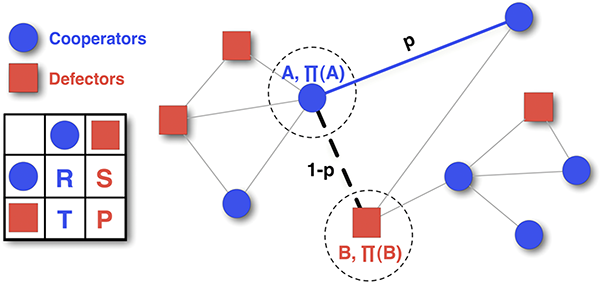
A network of cooperators and defectors
Figure 1 from the paper illustrates a network of cooperators and defectors
[Read more…]

On voting strategy

In a voting system like we have in the US (“plurality voting”), we may apply something called the median voter theorem. The median voter theorem says that in a face-off between two candidates, the candidate closer to the median voter wins. Here we’re assuming a one-dimensional preference scale (e.g. left to right) and that voters choose the candidate who is closest to them on the scale. The winning strategy for each candidate is to move closer to the median until they are nearly indistinguishable, and each has about 50% of the vote.

As a result, you can see many politicians shifting their views over time, carefully tracking the median view. In the US, voters seem to be uncomfortable with this optimal strategy, and thus they demand that politicians put on a show of having believed in their current views all along. And then when politicians visibly contradict their previous views it’s used as a gotcha. This is incredibly tedious.

Of course, it does not really seem like the major candidates follow the median. Trump and Clinton, are, after all, very far apart! In fact, I’m puzzled why US presidential elections don’t hew more closely to the median voter theorem. I imagine this is a subject of study for political scientists, but I only have baseless speculation to offer. And of course I’m ultimately trying to say something about the current election cycle.
[Read more…]

Signaling in social justice language

Social justice activists like myself have a tendency to construct a lot of rules about which words to use or avoid. For example, “gay” is preferred to “homosexual” because the latter is too formal, clinical, and distant. On the other hand, “homosexual” may be acceptable when it’s used in parallel with “heterosexual”, or if it’s contrasted with “homoromantic”. These rules can be frustrating to learn, but they have some rationale behind them.

And then there are other rules which just don’t have any clear rationale. For instance, “gay” is to be used only as an adjective, never as a noun, and certainly never as a plural noun (i.e. “the gays”). Why? We don’t have a problem with using plural nouns for other identities, such as “Americans”, “liberals” or “atheists”. Even other sexual orientations are usually acceptable, as in the case of “lesbians”, “bisexuals”, or “asexuals”.

On an individual level, the only rationale is that “the gays” just sounds wrong, and conjures negative associations. It makes me think of conservative preachers talking about all the evil things the gays are up to.

On a broader scale, this is a clear example of signaling. Following arbitrary language rules indicates that a person has taken the time to educate themselves and exercise a little empathy.
[Read more…]