Bonsai for Beginners – Part 8 – Pests, Pets, Partners & Posterity

Previous post.

There is yet another thing that I feel needs addressing before I dive fully into describing individual taxa and how to care for them, and that thing being the beings that might share your household with you and your trees.

Let’s start with a sad anecdote about partners. I don’t have a partner, but my older brother is married. And when I started expanding my bonsai collection and some of my trees started to look really impressive, he wanted to try it too. I have him one really good indoor bonsai, Cupressus californica and one mediocre but with good potential Ficus benjamina. The trees prospered for a while and looked good, but my sister in law shuffled them around the house to places where they “look good” until she shuffled them on top of the cupboard above the kitchen counter. When I have seen this on my visit, I warned them that the trees won’t survive that, because they need a lot of sunlight in vegetation. It is possible to display trees in a hallway or some other place for a while to decorate your home, but ultimately they are living beings and their needs must be met. My sister in law made appreciative noises and pretended to care, but she only shuffled the trees into places where they were even worse off. Until they died, as I predicted.

I have begun to suspect ill intent, but I could not prove anything and I could not say anything even if I had proof. My brother was determined to have bonsai trees, he bought some, he even successfully poached some from the forest against my advice, and I bought him a healthy Pinus pentaphylla, the most iconic Japanese bonsai species, and I chose a tree with really great potential. The trees seemed to prosper for a while, and then they suddenly all died and my brother lost all enthusiasm at all that labor wasted.

For a long time – until last year, in fact – I thought he has just been unlucky. Trees die, it happens to me all the time. But recently I learned that he was a victim of a concentrated effort of his wife’s family. His father in law got bitter after he split with his mother in law, he got drunk and he babbled out what really happened to someone and it came in a roundabout way to me. They deliberately sabotaged all my brothers’ hobbies and I was deemed as persona-non-grata in the household. Their family deemed all hobbies as a waste of time, only activities that make money or are work around the house were allowed. And I came in there with my perfidious influences on my brother and their grandchildren like reading books and growing useless trees in a pot and reminding my brother of his own hobbies like making models and playing chess.

The high-end trees that I gave my brother were indeed deliberately shuffled off into places where they withered and died, under the pretense of appreciation. And when they could not do that with the outdoor trees because my brother put his foot down and claimed a piece of garden for his hobby and told them to back off, they have secretly put dish detergent into the barrel he used to collect rainwater for his trees. To my knowledge, my brother still does not know this and I won’t tell him. He is happily married. But I can’t stand his wife and his mother in law.

So before you start growing bonsai trees, make sure that people who share your household are OK with it. Do not just assume they are.

I also do not have children. And I do not currently have any pets, but I used to. For both children and pets apply the same rules as for any garden- or potted plants. Make sure that anything poisonous is out of their reach so they cannot nibble at it. Or better yet, make sure they cannot nibble at any plants at all. If you are cat-owned, you will have to make extra sure your owner does not knock any pots off the shelves to teach you a lesson.

Some plants are more poisonous to birds than they are to mammals, so if you have parrots and let them out of their cages, you too need to be extra careful. For outdoor bonsai, this does not seem to be a problem. Local birds never nibble on local flora if said flora is inedible or poisonous, and I never had them nibble on small trees when big ones are nearby either. And I have never seen local birds try eating indoor plants when I put them outside. Indeed having a bird feeder near bonsai trees has even helped a bit with pests because the birds do like to sit in the trees and they pick off any wintering eggs and pupae they find while there – especially tits are helpful in this regard.

The almost inevitable companion in your household once you start to grow any kind of plant are pest insects.

Worst of these are scale insects. They tend to attack mostly evergreen plants with hard leathery leaves, like Laurus, Ficus, Citrus, and Myrtus and once these fuckers get a foothold, it is really difficult to get rid of them. I have managed to finally destroy them by a combination of mechanical removal with concentrated water spray from a small nozzle- that allows for mechanical removal from even the least accessible nooks and crannies -but the spray must not be so strong so it would poke holes in the leaves. What also helps is to wash leaves and stalks with a cloth soaked in rubbing alcohol or cheap vodka, to destroy the eggs. Sometimes even more drastic measures are necessary, like severe pruning of the tree and trimming of all leaves. Insecticides are usually useless, they do not penetrate the hard shells very well.

Wooly aphids are similarly persistent and obnoxious and similarly difficult to get rid of. Here I did not in fact succeed and I am battling with them for years now on one pine. The problem with these is they tend to attack conifers like Pinus, Picea, and Larix and they nest themselves into the nooks and crannies around the needles, twigs and in the bark recesses, where they cannot be reached at all. Some even attack roots and those are usually a death sentence. I used to keep them at bay with a timely spray of daisy extract with a drop of detergent, but daisies disappeared around here for whatever reason and since then I am only left with washing them off mechanically either with water spray or with a toothbrush. I might need to try a commercial insecticide.

Aphids can also be a problem. Birds and spiders do help with their management however, and they are much more susceptible to insecticides and even ordinary mechanical removal than the previous two. They tend to attack mostly soft, freshly growing stalks and leaves of Hibiscus, Tilia, Acer, and others with similar growth patterns (probably my new persimmon would be susceptible too by the looks of it).

Since these pests prefer different plants, mixing the species on your windowsill/bench etc. does help to prevent their spread. Yes indeed, social distancing works for trees too.

Ants are not a pest in and of themselves, but they can spread all three above mentioned pests around your collection outdoors if they are present, because all three produce honeydew and ants love them.

Spiders in a bonsai tree are desired and should not be disturbed if possible. I am sure there are some people who would like to know this.

Fungal (and bacterial) diseases come in many varieties and are mostly species-specific. You must make your own research should you encounter one. Some species are more prone to them than others. The best help is prevention and fungicidal spray. If a tree catches a fungal disease that attacks wood it is usually the end of it. You might try cutting away the whole infected branch and burning it – you might catch it in time and save the tree, but most likely it will get damage that takes years to heal, even if it survives. Fungal diseases that attack leaves /needles are less threatening and can be mitigated by the removal of old fallen leaves/needles in the fall, but not always. Even these mild fungal diseases are detrimental to the tree so they should be avoided.

On the other hand, mycorrhizal fungi are desired. Even a bonsai tree starts to prosper and grow better if it manages to get mycorrhizal fungus on its roots, the effect this has on for example oaks is remarkable- I have observed nearly double growth rate in trees with fungus against those without it, but I did not conduct a proper scientific experiment, so you only have my word for it.

Lichens on roots, branches, and bark are also desired, they add the illusion of old age. They are also an indicator of health and proper care because they grow very slowly and are finicky.

Therefore any application of fungicidal sprays on bonsai trees must be done with care and deliberation and in a targeted manner and not in a “spray and pray” fashion.

One pest that I have not seen mentioned in any of my bonsaist literature are water voles. They do not get to the trees on benches, but if you take them off the benches for wintering during a tough winter, they can get in and wreak total havoc. In 2011 I have lost this way several prime trees and many others were damaged to such an extent they still did not recover. Voles also destroy a significant portion of any trees that I plant in my garden, I was unable to replace my cherry tree due to them and I have to plant new trees in my coppice two-three times before they survive long enough to be vole-proof. Having a cat helps, although they do not like to eat voles too much. But they do kill them and scare them off. The problem in my garden was also less severe when we had a dog, And it was nearly non-existent when an owl was nesting in a nearby spruce tree. However the 2011 disaster has happened when we had two outdoor cats and a dog, but the voles were safe under half a meter of snow. Voles are a mortal enemy to me. Forget capture and release traps. You can either be on the side of the trees or on the side of the rodents, not both. So killing traps, regularly checked and put safely with proper bait in order to not catch shrews or birds by accident, it is.

And lastly – it should go without saying that if your tree is visibly infected or infested, you should not display it. Especially not in an exhibition where it could infect other trees. Visible infection or infestation is an instant disqualifying criterion in competitions, and rightly so. As a beginner, look for any of these when buying a tree and do not take any that is visibly ill. You do not want to carry these unwanted guests into your household.

Kites Arrived

And they sat on an old ash tree behind my house.

But taking pictures through a closed window at an angle, near noon and to the south-east of me is difficult. I cannot open the window due to the overabundance of bonsai trees and if I tried to go outside and get them from a better angle, they surely would flee.

© Charly, all rights reserved. Click for full size.

© Charly, all rights reserved. Click for full size.

© Charly, all rights reserved. Click for full size.

The Art of Book Design: The Red Fairy Book

The “coloured” Andrew Lang book this week is the Red Fairy Book, originally published in 1890. The colour of this book, though, is all on the cover. The illustrations are all black and white and done in the Victorian style of the period. I’ve included some of my favourites, mostly animal-related and including a dragon,  below the fold. I hope you enjoy.

Andrew Lang. The Red Fairy Book. Illustrated by H.J. Ford and Lancelot Speed. London, Longmans, Green, and Co., 1890.

[Read more…]

The Results are in….

©kestrel, all rights reserved

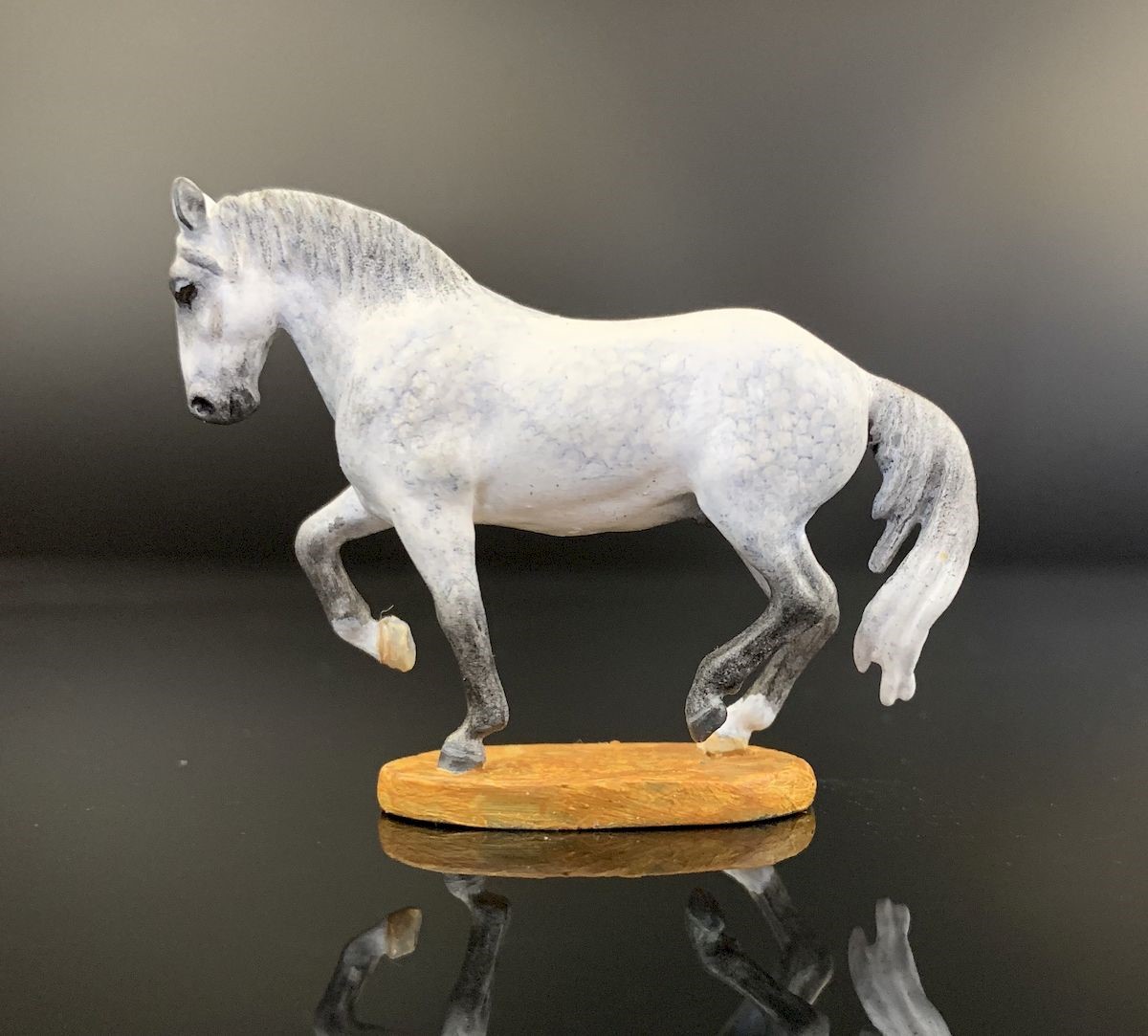
The tiny horse painting competition has been judged and Kestrel tells us,

I did not win anything but I got an honorable mention in the Gallery division, and the judge – a very well respected top level artist in the hobby – made nice comments about my entry. So that was nice, I appreciated that she made comments. Thought you’d like to know! 

Thanks for the update, kestrel. It’s too bad my vote doesn’t count because I think you should have won first place.

Tummy Thursday: Go Frothy and Multiply

Yes, I know, but what are days of the week anyway…

One of the things people have been hoarding/panic buying is yeast. I speculate that lots of it is rotting in fridges, since bakeries and supermarkets are indeed still open, though others will use the time for baking, as does yours truly. Part of it stems from my inability to plan for bread. Usually we eat pretty little bread so i buy like a pound of bread that lasts for the week. Now we need bread every single day, so different forms of frybread have been our new best friend. And who doesn’t love fresh frybread? Some days I use baking powder, but i also like yeast bread, and I was running low on yeast.


Thankfully, as long as you have some yeast and a freezer, you can be helped. Simply mix your fresh yeast, lukewarm water, a tablespoon of sugar and a cup of flour and let it rest for 15 minutes. Fill into ice cube trays (or mini muffin trays or whatever, I used my French canéles silicone tray) and quickly freeze. Put something frozen on top and don’t overfill the tray.

Freeze solid and ta-daa: lots of readily frozen yeast.

©Giliell, all rights reserved

Working with this yeast means means you need more time, but that makes a yeast dough all the better anyway.

And to prove the concept that “you can multiply yeast indefinitely”, I washed down the sides of the mixing bowl and started a sweet yeast dough. I let it rest in the cool hall over night and let it catch up speed again this morning.

©Giliell, all rights reserved

He is risen.

©Giliell, all rights reserved

Nobody in my family ever said no to cinnamon rolls.

And did I mention that I’m bad with “how  much bread do we need” and the days of the week? Well, I’d forgotten that today is a holiday and no bakery van will come, so I took some of my frozen yeast and made naan. You could cook it in a hot pan, but I prefer the pizza stone in the oven. I also need to increase the amount we pay for electricity or there will be lots of crying come January (we pay an estimated amount for water and electricity each months and then get the detailed bill in January. Usually it’s “we ow you 20 bucks / you owe us 20 bucks, but we’re home a lot more, won’t go on holiday and keep baking)

Look at this:

©Giliell, all rights reserved

That’s what the kids left us. Because fresh naan, who doesn’t like it? BTW, if you ever try to make frybread, regardless of what your raising agent, put away that rolling pin. Just gently stretch it over your hands or you’ll press out all that nice air your raising agent worked so hard to put into your dough.

Jack’s Walk

First trilliums of the year, ©voyager, all rights reserved

It’s been a beautiful, sunny day and spring has decided to kick into high gear. Today we found may-apple, trout lilies and a small grouping of trilliums that are probably red because the red ones always come up first.  I carefully noted the spot and will try to get photos of them in bloom. I say ‘try’ because red trilliums are quite short-lived, often lasting only a day or two after they bloom. They’re also more fragile than the white ones. They’re thinner and more transparent, and their stems droop, so you need to photograph them from underneath. As you might imagine, at my age, getting underneath a short flower isn’t something you attempt willy-nilly. You need to make sure that a) you have room to maneuver, b) there is something to hold on to (sturdy saplings are preferred), and c) you have someone with you in case of emergency. The expression “Help. I’ve fallen and I can’t get up,” isn’t as funny as it used to be.

Stay sane out there.

Bonsai for Beginners – Part 7 – Styles, Sizes and Composition

Previous post.

In any endeavor, there are purists, assholes and assholish purists, i.e. snobs. No doubt in bonsai circles is no shortage of such people too. I have not met any because I am not involved in any society. I have zero contact with other bonsaists and I like it that way.

I am of the opinion that if it looks like a tree and is grown in a pot, then it is a bonsai. And if it makes the owner happy and the tree is healthy, then that is all that is necessary and it is nobody else’s business to give unsolicited advice on how the tree should look.

However, that does not mean that there are no recommendations that are pertinent for any beginner regarding the style, size, and composition of their first bonsai tree.

First, let’s talk about size. Bonsai come in sizes from just a few cms to several decimeters or even over 1 m tall. And here come in play two factors – the space you have available and your physical strength. Your tree must have enough space to grow in height and width as well, and it must get enough light to thrive. For outside trees, this is not usually a problem, but for indoor, the tree(s) container(s) should be of such a size that you can put them on your windowsill diagonally and the tree(s) should not be higher than about half of the window. That way you can turn them 90° twice a week to achieve even growth and they will get enough light.

© Charly, all rights reserved. Click for full size.

And in regard to strength, square-cube law comes into play, I learned this the hard way. When you double the size of a tree and its pot with equal proportions, the weight increases eight-times. A pot that is visually just slightly bigger can become deceptively heavier and it can happen that the tree is unmanageable without help. Trees at circa 50 cm are a big handful for a single person and anything bigger than that might need an extra hand. But they look soooo damned good and impressive…

As for style, there is a whole Japanese terminology that I have never bothered to not forget. Sure, I have it in a book somewhere and I read up on it thoroughly, but it is not useful to me now. That is not to say that it is not useful at all. As all terminology, its purpose is descriptive, in order to allow better communication. And since I do not communicate about my trees too often, I do not need to remember it. If I need to describe my trees sometime, I can always look it up.

The word “descriptive” is key here. A bonsai is a tree in a pot by definition, so the only criterion here is it should look like a tree. My advice to a beginner would, therefore, be to try and shape the plant you have to look like a tree – any tree – and not try and shoehorn it into some specific style.

Both size and style are to a certain extent also species-dependent. Some trees can take heavy abuse and be contorted into wild shapes, some are fragile, sensitive and brittle, some have huge leaves, some tiny etc.

Regarding composition, the usual rules of art apply. For example, the tree and its pot should fill a picture with 4:3 or 16:9  ratio, the golden ratio applies etc. Most people have an adequate aesthetic feeling to do this properly in my opinion, There are, however, several bonsai-specific rules that are important to mention.

The tree is a statue that has a front and a backside, but it is three-dimensional. So branches should point in all directions, not only to the sides. But no branches should point straight forward towards the observer, it creates an unpleasant feeling when observing the tree, it actually strains the eyes a bit.

The trees are meant to be observed with approx 1/3 of the tree at eye height- for example when they are on a windowsill, you should be appreciating them when seated. In order to achieve the best result, the tree trunk should be bent ever so slightly towards the observer. It creates an optical illusion that makes the tree appear slightly bigger than it actually is. Trees that straight create an illusion of being bent backward and that, again, is not entirely pleasant to look at.

Big wounds, if they are not part of the composition, should be hidden on the back or on the sides. Wounds, like dead branches and hollows,  that are part of the composition should, of course, be visible and therefore positioned either on the front or on the sides. If wounds on the front side are not avoidable, the tree should not be displayed until they heal, but that is not a problem for me – or for a beginner.

And lastly, the pot is a part of the composition, so its shape and color should complement the tree, but it should not clash with it or compete with it. A straight-lined square pot will look strange with a tree that is all twisty-bendy, and plain brown pot will look a bit drab with a plant that has bright red leaves or flowers. When in doubt, an ordinary bowl works most of the time.

Hopefully, I have not forgotten anything important here. Next time I will maybe finally write about a concrete species and how to care for it.


Tree Tuesday

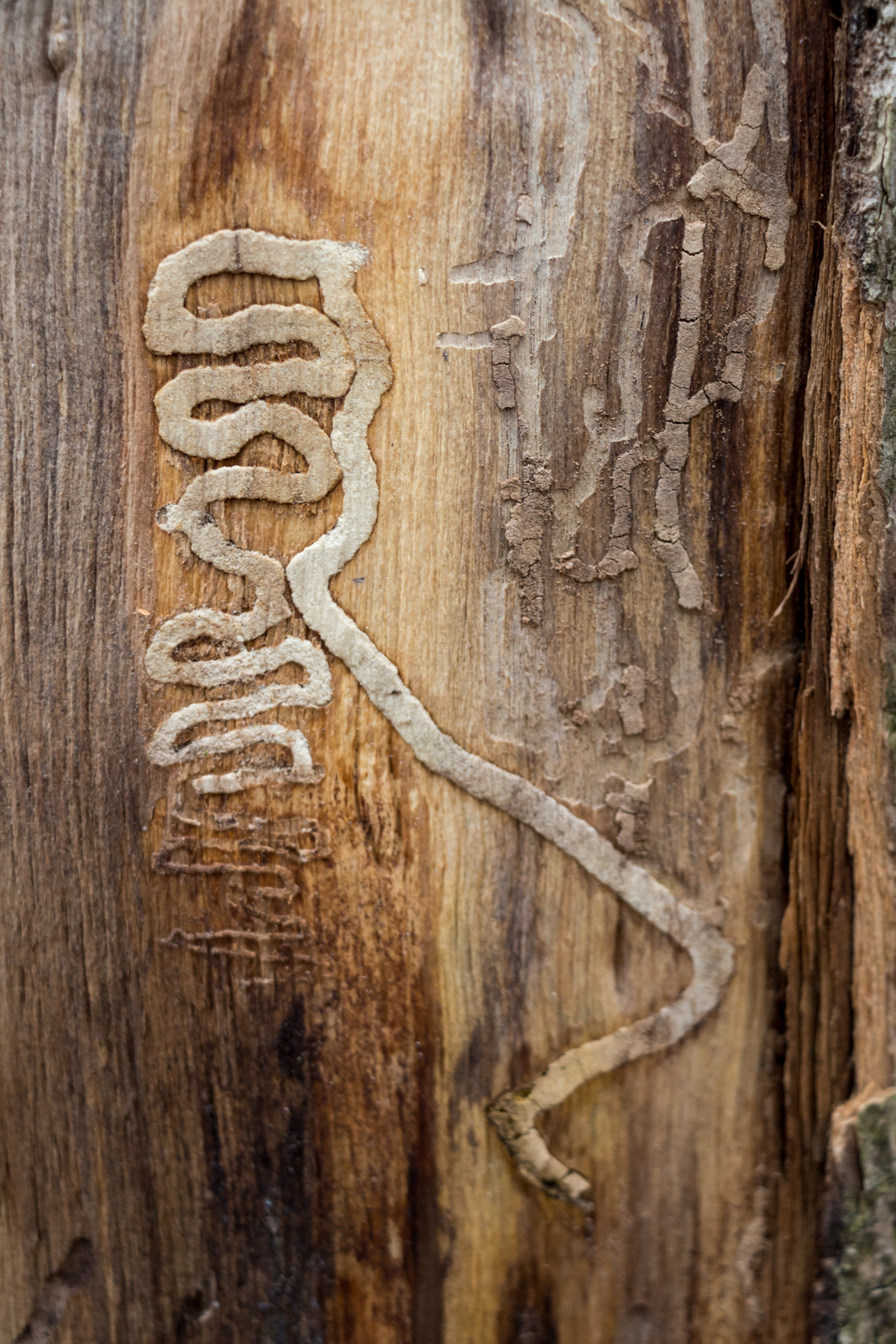
Gnomish Runes, ©voyager, all rights reserved

Recently, while talking with a couple of gnomes, I discovered that many of the markings we see on fallen trees and branches are actually a form of map-making done by the little people of the woods. I was told that they are mostly made by Gnomes and Elves, who are terribly forgetful, as a way of remembering where their caches of food are stored. I commented that they look convoluted and, after having a good laugh, I was told that they are convoluted for humans, but the little folk travel in circuitous routes because they like to see the sights and visit other little folks along the way. Well, then, I guess that explains it.