Tired of living in my worst dreams

Oh, man, what a nightmare. I dreamt that it was November, and I had just unenthusiastically voted in the presidential election. Joe Biden had swept all the primaries, had picked some unmemorable, faceless white man as his VP, and bumbled his way through a few ugly debates. The Democratic party had successfully doused the flickering flames of progressive activism in this country, inserting their establishment apparatchik into the running for the highest office, and he was prepared to appoint a phalanx of bankers and insurance executives into his cabinet. On election day I voted for that stooge, dreading the next four years of either his toothy smug grin or a repeat of the orange fascist, and, while I was unhappy with either choice, my decision was forced. And now I was just waiting for the election results. I felt exactly as I did on election day in 2016, grim and doomed.

Then I woke up.

My doctor had warned me that my toradol injection would wear off after about 6 hours and I’d have to fall back on ibuprofen for my achey bones, and she was right. Ouch. So I just took some painkillers and am waiting for them to kick in, and thought I’d write up my horrible dream.

It was just a nightmare, right? I’m not going to look at the election news. I need to get back to sleep.

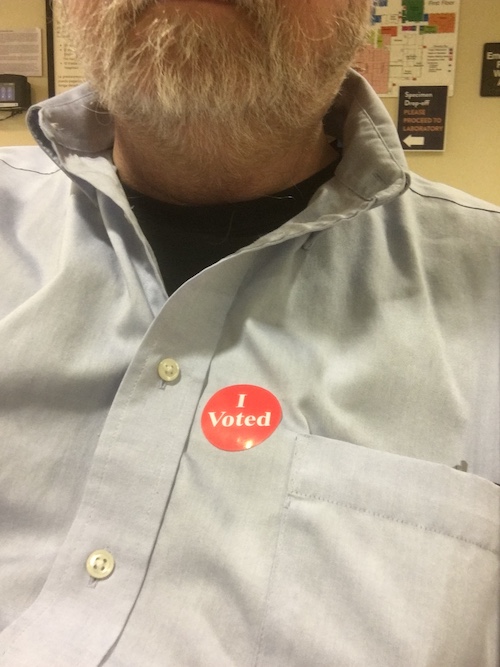
Bones rattled, vote cast

Yes I voted.

Then I dragged myself to the doctor and got a CT scan. Nothing is broken or bleeding; the doctor even said my brain looks good, so I’m thinking I ought to get that testimonial tattooed on my body somewhere. Even as I was sitting in the waiting room, though, I could feel my back and neck starting to freeze up into painful rigidity, so I think I’m going to be feeling this for the next several days.

But not right now. I got a shot of the good drugs, I might just pass out for a while.

Not a good start to the day

Walking into work today on the hellish triple-damned sloping path from my house to the university, which is always coated with a layer of ice, I slipped cartoonishly. Both feet shot out from under me and I fell straight backwards, thumping hard onto the ground, uniformly distributing the pain to my elbows, back, and head. I was wearing my backpack with my laptop and iPad inside, and honestly, my first concern was that I’d just destroyed all of my primary computing power. Fortunately, I was using my Brenthaven™ laptop bag, which was robust and well padded, and everything inside survived just fine. (Contact me, Brenthaven, if you want a testimonial).

The important stuff survived, but my brain is a bit rattled, my left forearm is numb, and my neck and shoulders are badly wrecked to the point where it hurts to turn my head. That’s a bad sign. I’m going to have to make a doctor’s appointment somewhere in this really busy teaching Tuesday.

Man, that stretch of sidewalk is my bane every winter. It’s a slight slope that gets meltwater running over it at the slightest thaw, but not steep enough that the water runs off — it just sits there and freezes treacherously. There’s no way to avoid it, either, because the university is in a shallow depression lower than my house. It would probably be safer to drive the 200 feet than to walk it.

I can tell this is just the beginning, it’s going to hurt much worse later.

NEE NED ZB 6TNN DEIBEDH SIEFI EBEEE SSIEI ESEE SEEE!!

Wired tries to defend SETI and UFOlogy. They argue that there are 3 branches of inquiry — exobiology, the search for extraterrestrial intelligence, and the study of UFOs — and each has their place in our battery of methods.

Aliens—hypothetical beings from outer space—fall into roughly three categories. They could be far-away microbes or other creatures that don’t use technology humans can detect; they could be far-away creatures that use technology earthlings can identify; or they could be creatures that have used technology to come to Earth.

Each of these categories has a different branch of research dedicated to it, and each one is probably less likely than the last to actually find something: Astrobiologists use telescopes to seek biochemical evidence of microbes on other planets. SETI scientists, on the other hand, use telescopes to look for hints of intelligent beings’ technological signatures as they beam through the cosmos. Investigating the idea that aliens have traveled here and have skimmed the air with spaceships, meanwhile, is the province of pseudoscientists. Or so the narrative goes.

The issue, the article argues, is that the boundaries of legitimate research have shifted over time and are culturally determined, not objective at all. There’s a continuum of legitimacy, and it’s entirely arbitrary that we place UFOs in pseudoscience, and don’t fund SETI, and think exobiology is valid and interesting. That is a good point, except that I think there is a solid criterion that is rooted in how we do science.

Here’s the deal: early in our training, we’re taught to keep an open mind — you use hypotheses to guide a line of research, but we must be prepared to find unexpected results and alternative explanations. We’re adapted to thinking, “My experiment to test my hypothesis should find X, but if it finds Y we’ll have to modify the hypothesis, and if the answer is Z, well, back to the drawing board, but gosh, that would be exciting.” Experiments are designed that give interesting results, and whether the results are compatible with our hypothesis or reject it are equally useful.

Exobiology fits the paradigm. We’re looking at other worlds with they hypothesis that life produces chemical signatures we can detect, and even if we don’t see them, we learn something about that alien planet. We gather data looking for biology, and if we don’t see it, we still have data on extraterrestrial chemistry. That’s the safe bet funding agencies look for, that we’ll learn something even if our preliminary hypothesis fails.

SETI doesn’t work that way. SETI is looking for specific patterns in extraterrestrial signals; they have a pre-set goal, rather than an open inquiry. Not finding a signal they are looking for is a literal failure that tells us nothing. That star isn’t transmitting anything useful? Abandon it, move on, look somewhere else. Over and over again. It also doesn’t help that all their hypotheses look like ad hoc dreck contrived to convince people that there might be someone out there, with infinitely bendable variables.

UFOlogy, on the other hand, is an extreme example of that latter phenomenon. We don’t see what we’re looking for — no little green men, no crashed spaceships — so they invent elaborate and often contradictory rationalizations. The evidence isn’t there, but they are determined to pretend that it is. It’s a kind of anti-empiricism where the accumulated data is irrelevant to the conclusion.

It’s as simple as asking, “What will we learn from doing the observation/experiment?” SETI’s answer is nothing, unless we find a one in a trillion possibility, then it’s the jackpot. UFOlogy’s answer is that they already know little green men exist, so we just have to photograph thrown pie plates until we’ve persuaded the establishment. Neither is good science.

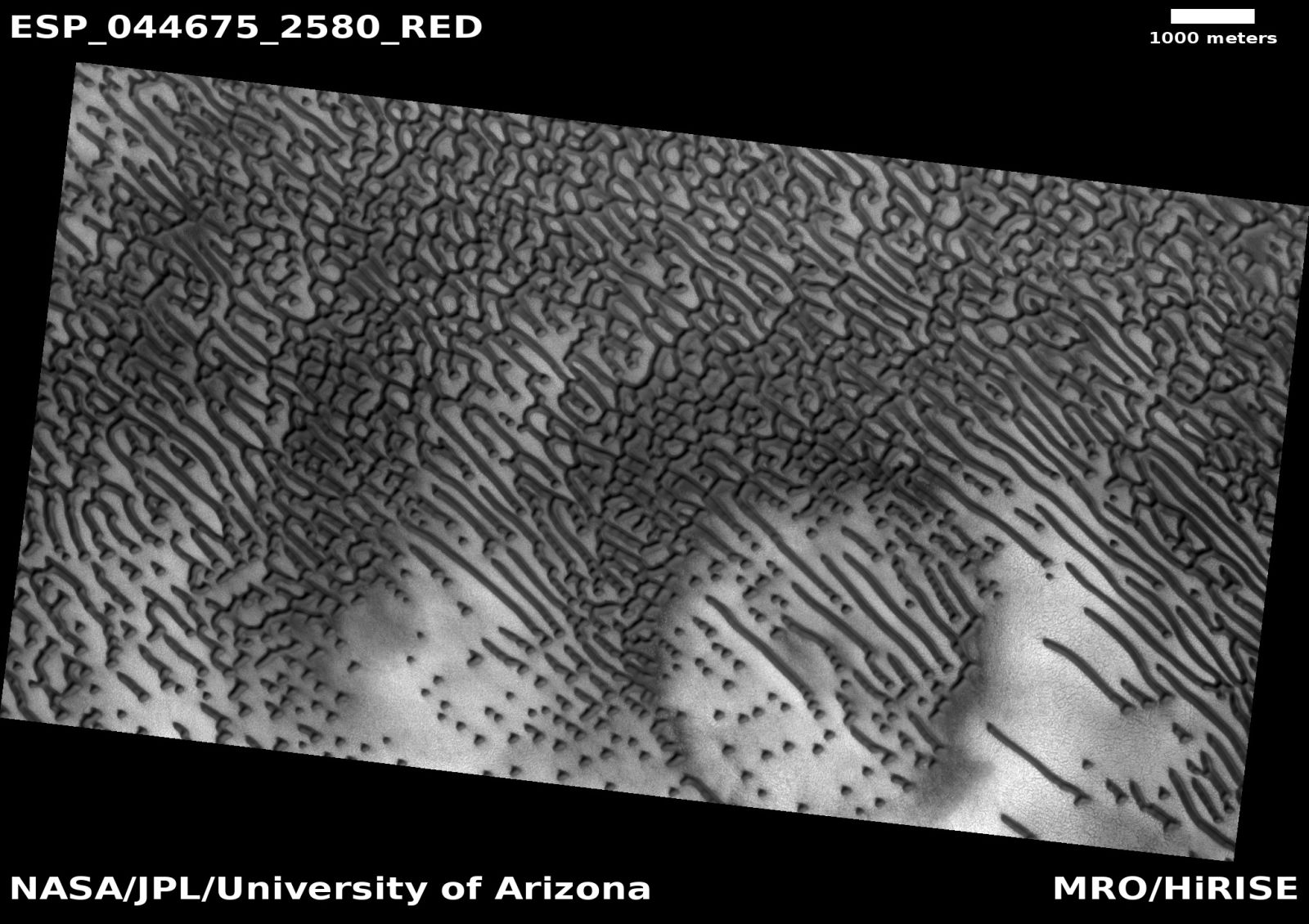
Both SETI and UFOlogy are strongly susceptible to apophenia as well. They are trying to fit complex data to a prior expectation, so there’s a tendency to impose patterns on noise. Here’s a classic example: NASA has observed complex sand dune formations on Mars.

Cool. What causes it? These are windblown rills shaped by topography and prevailing, but changeable, winds that formed under more or less chaotic pressures, producing lines and bumps and branches.

But, if you’re looking for it, it could be a signal. Perhaps, if we ignore the physical mechanisms that made them, these dunes could be Martian handwriting. Or better yet, a Martian code.

Right. So someone, probably as a bit of lark, tried to interpret them as dots and dashes, and then translated them into Morse code (why ancient Martians would have used a code devised by a 19th century American is left as an exercise for the reader). The Martian dunes therefore announce to the universe these immortal words:

NEE NED ZB 6TNN DEIBEDH SIEFI EBEEE SSIEI ESEE SEEE !!

I’m sure that means something profound in the original Martian. Either that, or it’s a compressed recipe for cored cow rectums.

That’s the problem with SETI, though. The universe produces patterns all the time, and human brains strain to impose interpretable derivations on them — SETI will milk that for all the news and attention they can get, even if it is ultimately meaningless.

Meanwhile, UFOlogists already know that the aliens are living on Mars, and have trained Bigfoots raking the dunes to send secret messages to the fleet hovering invisibly in our atmosphere, and you ignore it at your peril, you fools.

The bad news will keep on coming

A diagram putting the danger of infection with COVID-19 in perspective:

Not shown is the human cost. Deaths from the coronavirus in Washington state have crept up to 6. All of them were people over 70; the death rate for the afflicted over that age is 15%. The virus isn’t done yet, either.

“We expect the number of cases to increase in the coming days and weeks,” said Jeff Duchin, health officer for the public health agency, who stressed that most cases will be mild. “We are taking this situation extremely seriously.”

Uh-oh. My mother lives in King County, and she is over 70. I hope she’ll take this as an excuse to quarantine herself and stay home for a while.

More answers to creationists

A couple of my anti-creationist pals, James Downard and Jackson Wheat, have released a new book, The Rocks Were There: Straight Science Answers to bent Creationist Questions, Volume 1. I expect it will be good, but I just ordered my copy 5 minutes ago, so I haven’t read it yet, and can’t actually review it.

That doesn’t stop the creationists, though: it has a single one-star review from a long-winded pseudoscientist named James V. Kohl. I’ve dealt with him before, he’s a crank. Don’t let his review stop you — we need more honest reviews to counter the nonsense kooks like Kohl throw around.

When did you last wash your hands?

John Oliver has some sensible advice.

As for my handwashing…all day long. I work with students every day all day (who I avoid touching, obviously), so I tend to wash my hands thoroughly about once an hour, or before and after I go to class. Not just for coronavirus, but because they’re filthy animals and disease vectors for all kinds of crap…and I have the potential to transfer diseases to a diverse lot of people who wouldn’t normally hang out together but are forced into my classrooms for those sweet, sweet credits.

Spiders are far less infectious than other humans, you know.

The only political punditry you need

I vote in the Minnesota primary tomorrow, along with lots of people in states all across the country. There is a stultifying mass of punditry hovering over the country: ‘experts’ are all telling you who to vote for based on this mysterious thing called “electability”, on prognostications about matchups next November, on how many other people are voting for candidate X vs candidate Y. Your goal is to get on the winning bandwagon early, because as we all know, whoever guesses which candidate will win tomorrow gets fabulous prizes.

Oh, wait, no they don’t. You win nothing for picking the same candidate the most people pick.

So I have some advice for you. Ignore your friends and families. Never mind the statistics and the odds. Drop-kick FiveThirtyEight into an open sewer manhole. Fuck the commentators on CNN and Fox and MSNBC. Don’t trust me to tell you who to vote for.

Instead, be totally selfish, and think exclusively about which candidate you like best, who supports the policies you favor. The calculus of figuring out who your neighbors and the people of California and Texas will vote for is totally irrelevant. Go into that booth and vote your conscience. That’s all.

Wasn’t that easy?

Then go kick Chris Cilizza and whatever other goofball has been calling the horserace. That’s the fun part.