It’s all Matt Dillahunty’s fault. He tells me he’s carrying on a correspondence with some guy who claims to have an alternative theory of evolution, and asks me to help him wade through the gobbledygook…so I did. I just didn’t realize how much gobbledygook there was.
The guy is named Eugene McCarthy, and he calls his alternative “Stabilization Theory”. Apparently he does have some scientific background and has studied hybrids in birds; the problem is that now he sees everything in terms of species hybrids. And I mean everything. I downloaded his book — it’s free — and skimmed through all 400 pages.
Oh, man. It was like a timewarp.
The first half of the book is a total snooze. It’s endlessly wordy, tedious rehashing of basic genetics — polyploidy, heterosis, karyotypes, yadda yadda yadda. There’s nothing novel there at all, and if you know any basic biology at all, you can skip it. If you don’t…well, there are more lucid texts you can read. He sets up various controversies, but they’re all ancient history: he goes on and on about Darwin’s work with pigeons, the saltationist-gradualist debates (no, not the recent ones — this is stuff from like 1910-1920), and approvingly cites Arthur Lovejoy (!), author of The Great Chain of Being, and other authors from the 1930s-40s as if their concerns were current. The first part is the kind of book I can imagine being written in 1940 and being taken semi-seriously before being forgotten…and here it is being written in 2008.
And then it starts getting weird.
His theory is rather like Goldschmidt’s saltational theory of systemic mutations that produce abrupt transformations of form…except Goldschmidt was a piker. McCarthy claims to have a mechanism for producing those kinds of mutations. Sure, the familiar point mutations we know about in molecular biology and genetics occur, and genes can gradually change, but these changes are independent of speciation, and in fact have nothing to do with the kind of evolutionary change we see in the fossil record. Instead, the only things that can produce the morphological changes we observe are large-scale genetic changes, like polyploidy and hybridization.
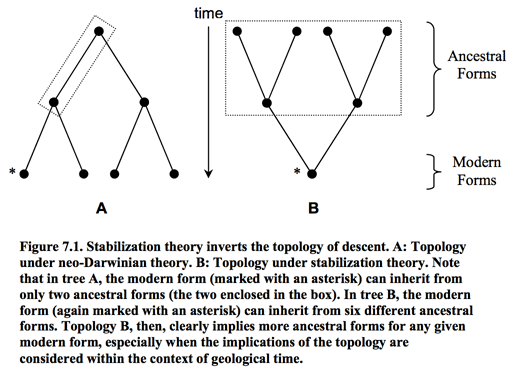
He pooh-poohs Darwinian trees of descent, like the one on the left in this diagram. That’s not how evolution occurs, he claims; it’s like the diagram on the right, where every novel species is produced by hybridization between two species.
He doesn’t like the concept of adaptive radiation, where a lineage branches and diversifies. It doesn’t happen, he claims; instead, it’s more of a combinatorial phenomenon, where different species hybridize to spawn novel, stable forms nearly instantaneously, which will then persist unchanged for long periods of time until there is another hybridization event.
It doesn’t seem to register on him that if every species were the product of two parent species, then that would show up in the genome — that modern molecular genetics would rather readily test his hypothesis. That’s no problem, though, because like I said, this book is in a timewarp from an age before molecular biology. It isn’t on his wavelength at all.
Actually, data isn’t much on his wavelength. Near the end of the book, we get to specific examples, and he chooses to discuss the origin of mammals. You know that conventional theory, where mammals arose in the Mesozoic and underwent a rapid adaptive radiation to fill niches vacated by the extinction of the dinosaurs in the Tertiary? Nonsense! Didn’t happen!
His alternative explanation is that the dinosaurs did not go extinct, but instead there was a kind of combinatorial reshuffling of species via hybridization that produced new forms.
“Say whut?”, you’re thinking. What does that mean?
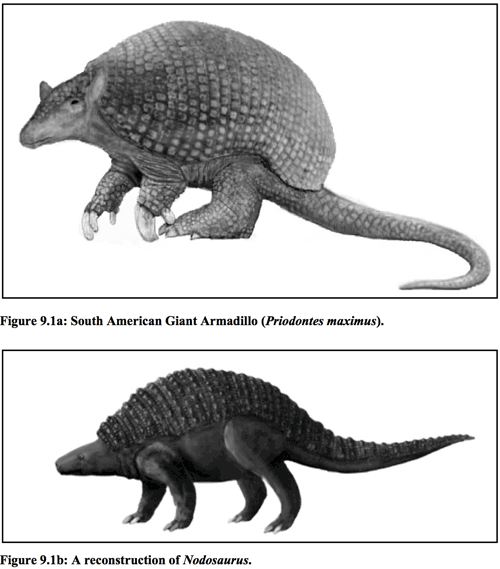
He gives examples. Look at the Mesozoic ankylosaurs: squat, armored herbivores. Now look at Tertiary armidillos, especially things like the extinct giant glyptodonts. They look kind of similar.
Therefore, says McCarthy, ankylosaurs evolved into armadillos. And pangolins are the descendants of stegosaurs.
The modern giant armadillo is so similar to the ancient ankylosaurs that it is only reasonable to suppose it is descended from them. The same is true for pangolins and stegosaurids (although the case is somewhat weaker because the exact external form of stegosaurids is a point in dispute). These similarities strongly suggest that two of the most common “dinosaurs” of the so-called Age of Reptiles—ankylosaurs and stegosaurids—were in fact mammals, and, even more remarkably, that their direct descendants exist even today. So in their cases, it seems, there was no “extinction of the dinosaurs”—there was merely a reconceptualization and reclassification (both may be cases of residual dwarfism).
So in addition to being completely ignorant of modern molecular methods, McCarthy stands stupidly in defiance of comparative anatomy. The only way to claim that an ankylosaur is an armadillo is to be utterly oblivious to any details of the skeleton.
He continues in this vein. Bats are descendants of pterosaurs. Whales came from mosasaurs. Seals are the children of plesiosaurs. Dinosaurs weren’t actually giant reptiles, they were big mammals. These ideas are contrary to all of the evidence, of course, but one thing you’ll learn from this book is that the evidence doesn’t have to be considered. It’s all about McCarthy’s belief in the fixity of species — species don’t change at all, ever, and all evolutionary novelty comes from the sudden production of new species by ‘stabilization processes’, like hybridization.
To me, organisms have a far greater value when they are seen as ancient and unchanging, existing today much a they did when they came into being long ago, in the remoteness of time. They become something more than mere pawns, forever changing at the behest of a tyrannical environment. When a new type of organism comes into being via a stabilization process, the primary selective factor is reproductive stability—a stable reproductive cycle must be established or the new form will fail to maintain itself in existence. If it survives, the new type spreads into all geographic regions to which it is suited and has access. If it ceases to have access to a suitable environment, it simply goes extinct. It does not gradually change into a new type that can tolerate a new environment. Under this view, a form’s genetic make-up plays at least as great a role in determining its characteristics as does the environment. In fact, it generally plays a far greater one. Once a new type of organism has stabilized, the environment may place limits on growth, health, and activities, but it does not significantly change the nature or potential of that type of organism, even with the passage of time on a geological scale. Living forms, under this view, are beyond and above the environment.
Well, that’s…different.
It’s also pure crackpottery. If you search the web, you’ll find almost no references to McCarthy and stabilization theory; I think I’ve just increased his notoriety a thousand-fold. No scientist is going to touch it, because it is simply laughable and bizarre. There are a few positive references from creationists, who like it because it defies science, but don’t see how to reconcile it with their biblical bullshit. Here’s one example, where it’s cited as a “possible crack in neo-Darwinism”:
From a perspective of Christian apologetics, the models presented by Schwabe and McCarthy do not directly help our cause, for they are but more claims to naturalism with no connection with the supernatural. But they at least lead in the right direction: humans appear suddenly, the genetic material was widespread at the beginning, the racism of evolution is denied, and individuals benefit from cooperation, not competition. And in the end, science might be better off, for perhaps the field will take off the blinders and consider some alternate theories.
You know, if creationists see McCarthy’s crap as a reasonable and viable alternative scientific hypothesis, they’re dumber than I thought.