Morning spider survey

I did my usual quick survey of spiders on the outside of my house. The place is swarming with salticids! Mainly Attulus and Salticus. I’ve done the usual thing of posting photos on iNaturalist and Instagram and Patreon, if you really want to see them. They really like the masonry on the east-facing front of the house, where the stones warm up fast, but I found them all over the place.

How to explain to someone that they’re wrong?

This Sunday at 3pm Central I’m convening a small group of my Patreon patrons and FtB bloggers to have a science-based conversation about all the pseudo-scientific nonsense floating about.

What I’m hoping to do is much more than just sneer at stupid ideas, but to talk about how we can persuade and inform people about why some of their ideas are bad, and what are better approaches. Let’s put together some positive science communication!

The compost bins are coming alive!

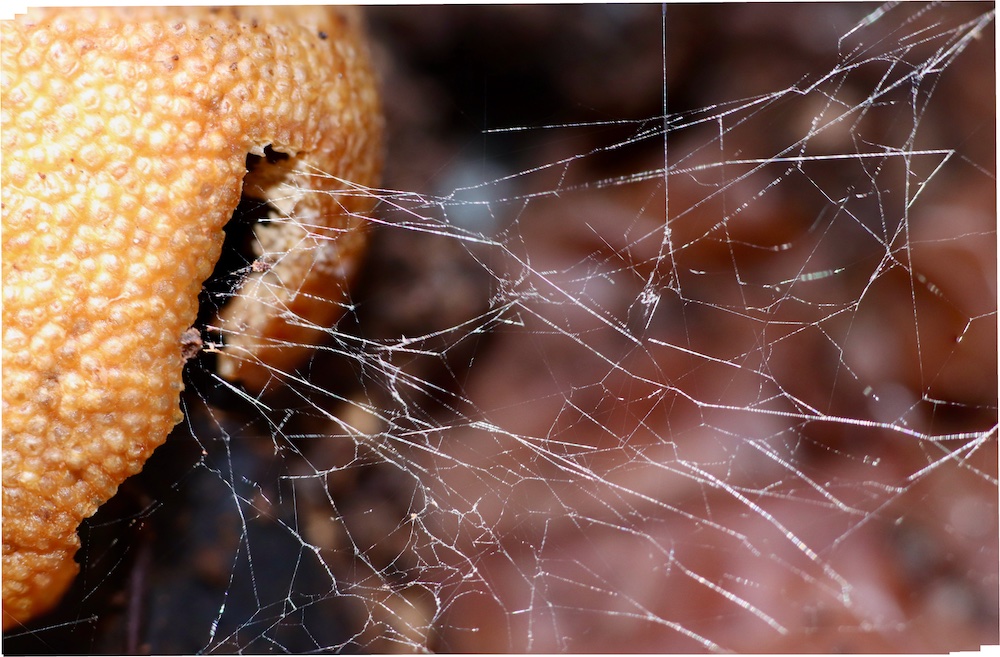
I got word from a colleague* that their compost bin was accumulating spiders again — they had a swarm of them last spring, that disappeared over winter — so I had to check it out. I opened the bin and was disappointed at first, because while I saw lots of cobwebs all over the decaying vegetable matter, there was nowhere near the number of spiders I’d seen in the spring.

I finally spotted one in a corner. Steatoda borealis, the same species that had thoroughly colonized the bin before.

Steatoda borealis is an interesting theridiidid. They seem to be the native species to this area, with the more common house spiders being immigrants from either Eurasia or South America, depending on the species. These beasts are bigger than the others, and I haven’t seen them in houses or garages much, mainly outdoors or in special environments like this compost bin. I’ve got some in the lab, and they seem less active than Parasteatoda or Steatoda triangulosa, but that may be because I’ve only observed them in the day.

I spent several moments poking around in the bin, taking a bunch of photos, making a note to myself to come back in a week or two. Then I started to lower the lid. The lid I’d been holding up all this time with my left hand. Only then did I notice that it was covered in webbing, and there were all the spiders, lots of them, gettin’ busy busy beneath my oblivious fingertips. Squeee! Jackpot!

So I had to take a bunch more photos. These spiders were paired off all over the place, mating furiously! I took photos of these wonderful piles of tangled legs, 16 at a time with agitated bodies having a grand time.

You’ve probably heard about female spiders killing their mates and eating them, but that doesn’t happen so much in environments rich in food. Steatoda and Parasteatoda can happily coexist in sprawling web communities where lots of insect life is rising up from a festering mass, and they don’t do the cannibalism thing in those circumstances.

I did notice one lonely male off to the side of a mating pair, staring intensely. I hope you find your true love soon, little guy!

Definitely going back here later. It’s a wild little hotspot for spider orgies.

This post also appears on my Patreon account, complete with spider photos. The photos are also posted on Instagram and iNaturalist.

*A colleague in math. Curious fact: two of the professors in our math discipline have the most interesting spider populations in their yards. Is it something about mathematicians that attracts spiders?

Distract yourselves with pretty moving pictures!

In news to help us drag ourselves out of the slough of despond, the Science Museum of Minnesota is closed to the public. Wait, no, that’s badly phrased — that’s not the good news. The good news is that the Science Museum of Minnesota is making their big screen science movies freely available to the public. Right now, you can just click and watch “Dinosaurs Alive!” and “Mummies: Secrets of the Pharaohs” and “Wild Ocean” on your computer screen.

Your computer screen is probably not a giant dome that you view in front of and above you from a reclining chair, so when the museum reopens you might want to book a visit to get the full experience and thank them for providing the service.

P.S. I’ve seen the dinosaur one, it’ll keep kids’ attention for a while. I’m going to watch “Wild Ocean” myself this afternoon, as a distraction from grading.

The iridescence is pretty, anyway

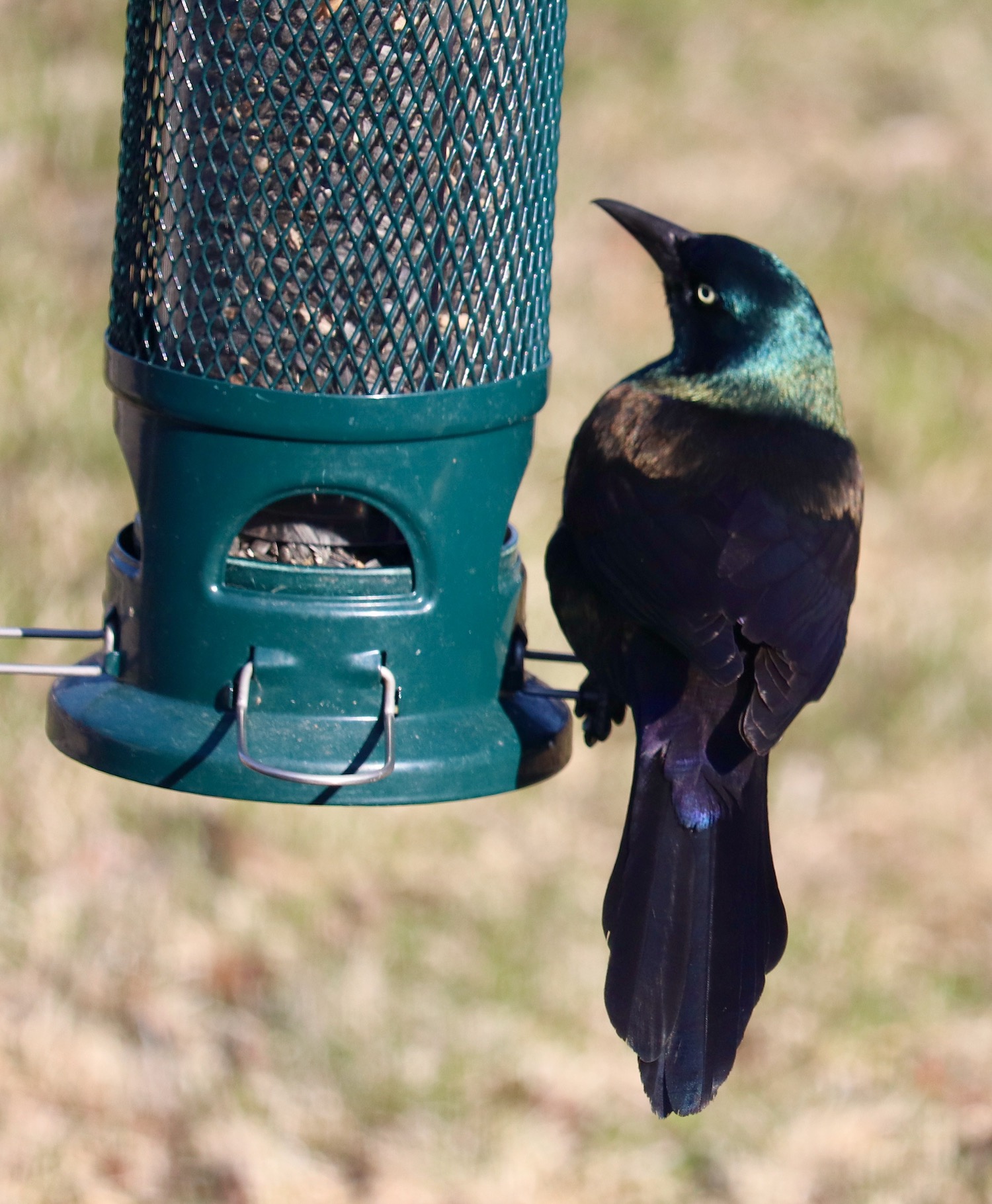
Here’s what I do. I sit in my office in front of my computer with a pile of textbooks open to my left, and sometimes I have committee meetings over Zoom, or meetings with students over Zoom, and my eyeballs are generally locked on the screen. But I also have a window to my right which looks out over the bird feeder in my yard, and I keep my camera close at hand, and sometimes some feathered beast distracts me for a bit.

Today was a grackle day. They were all over the place. I don’t like grackles much, but I do appreciate the shiny iridescence.

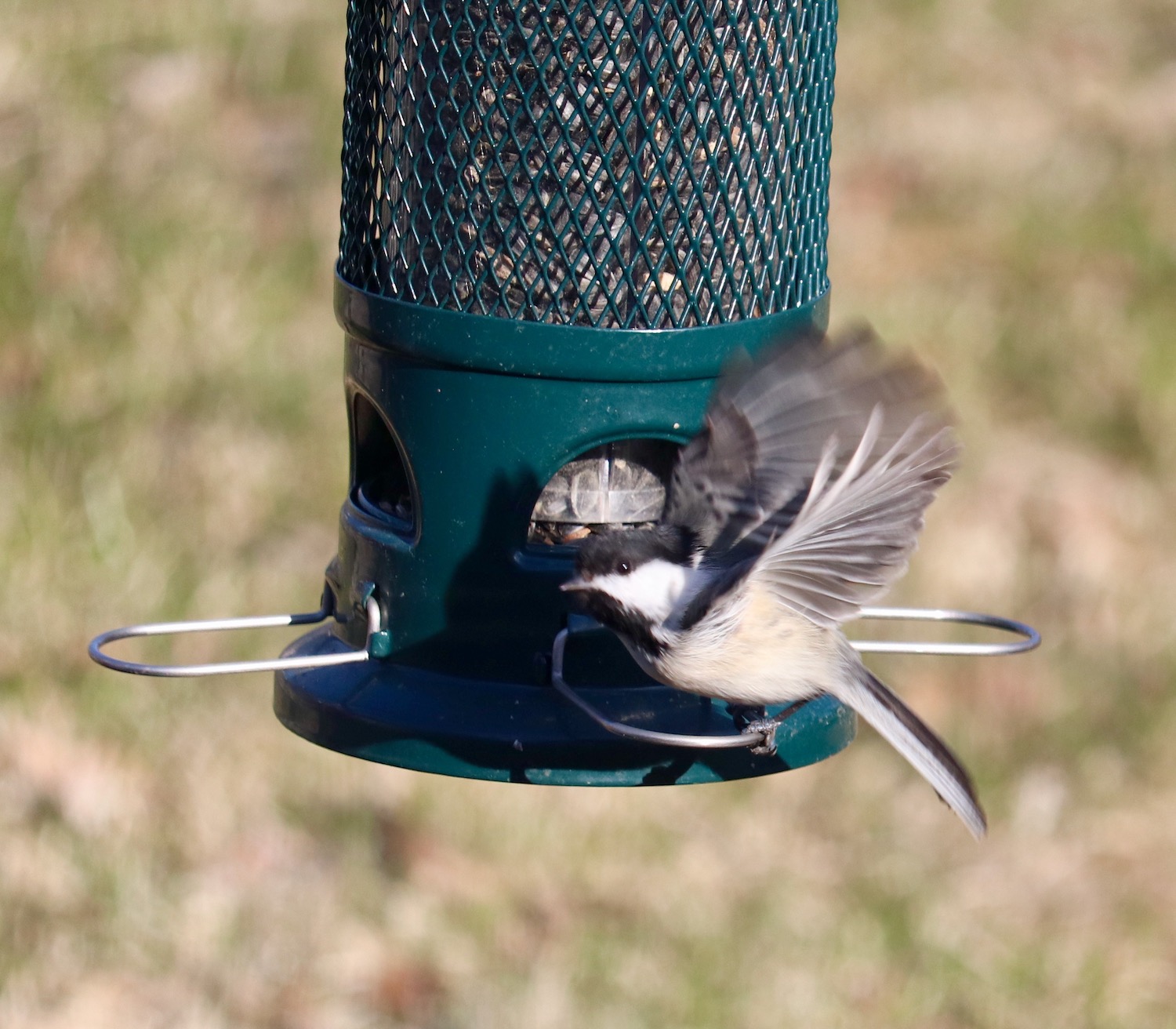
Also, the chickadees are challenging me. They flit in, I raise my camera, they immediately flit away. They are hyperactive little twits who won’t pause long enough for me to get a picture, even at 1/800th of a second. This is the best I’ve gotten so far, and look at it — it’s getting ready to take off barely after it’s landed. I think they’re doing touch-and-gos on the feeder.

At least they’re keeping me semi-sane.

Ignoramus telling scientist how science works

Would you believe Republican Senator John Cornyn had the gall to mouth off about the scientific method? Of course you would, he’s an idiot.

That’s just breathtakingly stupid. Does he have the slightest understanding of what a model is? It’s the core of the hypothetico-deductive process (which is not the whole of science, but it’s pretty essential). He’s been refuted in a couple of places by knowledgeable people already.

In a now-famous lecture, quantum physicist Richard Feynman similarly described to his students the process of discovering a new law of physics: “First, we guess it. Then we compute the consequences of the guess to see what… it would imply. And then we compare those computation results to nature… If it disagrees with experiment, it’s wrong. In that simple statement is the key to science.”

Zach Weinersmith also has a 100+ panel comic describing epidemiology and models if Mr Cornyn needs pictures to go with the words.

If Cornyn actually wanted to have a “good faith discussion” about epidemiological modeling (I don’t believe he does), I have a couple of expectations: as someone who has no training in science at all — he’s a lawyer — he ought to be more humbly asking for information, rather than poisoning the well with nonsense, and he has to admit that the source he worships, Donald Trump, is a total incompetent at science and a worthless font of misinformation. Then we can begin.

Actually, I think I’d rather begin by seeing Cornyn evicted from his office.

A patron hangout on Sunday

On Easter Sunday, at 3pm Central time, I’m inviting all my lovely supporters on Patreon to join me in a conversation on YouTube about whatever they want to talk about. I’ll come prepared with a few things I’d like to discuss, but if my guests want to go off in other directions, that’s going to be fine.

If there are any gaps in the conversation, I will be ready to talk about a few topics:

• I’m enthusastically getting ready to go spider hunting as the weather warms up. Last summer we explored a few narrow niches, this year I want to look more at spider diversity.

• I have tools and ways of exploring places for spiders, or other critters. We can talk about interesting environments here in Western Minnesota, or where others live.

• If you’re not into spiders, I’ll talk about my growing interest in photography, and show off a few of my favorite lenses. (Warning: amateur here.)

• There has been a curious shift in my thinking as I refocus my interests from lab-based developmental bio to field work on behavior & ecology & eco-devo. We can talk about philosophy of biology!

Also, most importantly, we can talk with those weirdos who support me, and they can share their interests and their expectations for the coming months. Probably not all are dreaming of arachnids.

If you’re a patron, and want to join in, you can find a zoom link on my Patreon page:

https://www.patreon.com/pzmyers

or on our Discord server:

https://discord.gg/gQhq4q

It’ll be fun! It’ll be a distraction from the fact it’s not quite warm enough to go out scouting for spiders.

Didier Raoult, pretentious git

The source of the claim that hydroxyquinone can treat the coronavirus, Didier Raoult, is a successful biomedical careerist in France, and a bit of a humbug. There are good reasons to be suspicious of the quality of his work.

Not surprisingly, Raoult’s rapid rise raised as many eyebrows as huzzahs. While his fans applaud the 3,000 scientific articles Raoult has co-signed, his critics argue that these staggering numbers do not add up. Do the math, they remark, and it turns out the Marseillais researcher publishes more papers in a month than most productive researchers publish in a career. Raoult’s method, according to one critic, is to task a young researcher at IHU with an experiment, then co-sign the piece before it is submitted to publication. “Raoult is thus able to reach this absolutely insane number of publications every year,” according to one anonymous source quoted by the site Mediapart. More disturbingly, the critic added, “it is simply impossible for Raoult to verify all of these papers.”

Yep. That’s the hallmark of a hack. But I want to focus on something in my bailiwick. He has written a book, Beyond Darwin, which is in French so I’m sorry (or perhaps relieved) to say I haven’t read, but I did read a translated interview with Raoult about it, via Google Translate (any infelicities in the translation should not be blamed on Raoult).

He belongs to a school of all-too-common evolutionary cranks who have a vague impression of what Charles Darwin said in the 19th century, know nothing at all about modern evolutionary biology, and imagine that the two are synonymous, so that they can deliver a double-whammy of ego gratification: evolutionary biologists are stupid, and he is brilliant, having discovered all the flaws in Darwinism all on his own.

For a long time, we thought that we were descended from a common ancestor: the Sapiens. In May 2010, a dramatic development: the results of an analysis of DNA taken from the bones of Neanderthals revealed that 1 to 4% of our genes come from Neanderthal. Whether we like it or not, we are related to this bastard, and not only to Sapiens “the intello”. The two met and mixed. The genealogical tree of the human species is anti-Darwinian because our ancestor is at the same time Sapiens, Neanderthal, a bacterium and a virus!

There are two gross errors in that accusation. The first is the idea that we think speciation has to be abrupt and instantaneous. Nope. No one argues that, so this is not a novel insight on his part. Speciation is often a mingling of braided streams that gradually separate, so the history of Homo neandertalensis and Homo sapiens is fairly typical of two closely related species. Calling that anti-Darwinian is kind of weird, because yeah, modern evolutionary biology is often non-Darwinian or even anti-Darwinian in the sense that we know a heck of a lot more about genes and genetics and the details of evolutionary history than Charles Darwin did. You don’t get a medal for bravery in defying 19th century beliefs in the 21st century, where undergraduate biology majors know things Darwin didn’t.

The second error is his over-emphasis on horizontal gene transfer. Of course some small amount of DNA from outside our direct lineage is occasionally inserted into our germ line via viral infection. Again, no one knowledgeable about evolution is going to be stunned by this revelation. The edifice of evolutionary theory is not perturbed in the slightest by the inclusion of yet another mechanism for mutation. What next? Gamma ray mutation means our genetic makeup has been modified by rays from outer space, therefore we’re all part alien? I probably shouldn’t give him ideas.

I occasionally run into cranks who insist there is no structure to our evolutionary history, that we’re all a melange of bits and pieces cobbled together into patchwork chimeras. Daoult isn’t the most extreme example of this nonsense, but he does have it bad.

The Darwinian tree does not exist. It is a fantasy. The idea of ​​a common core with divergent species like branches is nonsense. A tree of life, why not, but then planted upside down, roots in the air! If the species had definitively separated millions of years ago, there would in fact be no more living species on the planet. Each would have degenerated in its corner for not having been able to sufficiently renew its genetic heritage.

Except that we do have tools to measure the structure of a clade, and the evidence for it exists. I have no idea where this idea that we’d go extinct if we didn’t have other species to interbreed with comes from. I also don’t understand what “renew its genetic heritage” means.

In the Darwinian vision of evolution, everything was created once and for all, and if new species appear, it is only by gradual adaptation of existing species. In fact, nature does not just evolve, it continues to invent species.

This would be a surprising interpretation to the author of On the Origin of Species by Means of Natural Selection, or the Preservation of Favoured Races in the Struggle for Life. How does nature “invent species”, if not by branching cladogenesis? Do these newly invented species lack ancestors? Do they just spontaneously pop into existence without predecessors?

We discovered that a bacterium called Wolbachia had succeeded, by infecting a worm, in integrating 80% of its chromosome. She had, in fact, made a new species of worm! A brutal and massive evolution which has nothing to do with the slow and vertical evolution described by Darwin. If a woman carrying the herpes HV6 is pregnant, the virus having integrated into her chromosome, her son will have the virus in her genes. The boy’s grandfather will therefore be partly a virus!

This is not a particularly useful way of looking at our evolution. About 8% of our genome is made up of endogenous retroviral sequences, accumulated over many millions of years. These don’t significantly contribute to our physiology or morphology; they have accumulated precisely because they have so little impact on our overall biology that they escape natural selection for humans. So no, these things don’t fit any reasonable definition of “grandfather”.

He wouldn’t be an anti-Darwinian if he didn’t exercise a little hyperbole to show off his resentment of Darwin.

Darwinism ceased to be a scientific theory when Darwin was made a god. By introducing the concept of evolution after Lamarck, Darwin came to upset the frozen conception of creationists, who thought that the world had been stable since its creation. But, from then on, it became the object of a double myth. The myth of the diabolical for creationists, those who think that everything was created in a week, and the myth of scientists, who make “the origin of species” the new Gospel.

If you believe in the Judeo-Christian God, Darwin even makes it easier to understand him. With what we discover about biology, we come back rather to the gods of Antiquity. The men of Antiquity were perhaps animated by a just presentiment when, in mythological tales, they depicted hybrid beings, chimeras: Satyrs, Centaurs and Minotaur. Now imagine an evolutionary story written by a Buddhist scientist. It would be a question of cycle, even recycling, and mosaic beings, which we find in Nietzsche.

Hoo boy. There’s a common creationist trope, that Darwin is our god. It doesn’t work. We’re awfully critical of Darwin, and we rejoice when we discover new violations of his supposedly sacred dogma. Darwin is respected because of his careful, disciplined methodology and his appreciation of the evidence, and because he did have a brilliant insight that changed how scientists thought about history. It’s only kooks who simultaneously think Darwin is unjustly seated on a heavenly throne, and that they have had the grand, revolutionary insight that will allow them to displace him.

I won’t even get into his crap about old gods and chimeras, or his appallingly quaint rant about Apollonian and Dionysian dichotomies. Everything about this guy screams opportunistic kook with an exaggerated ego. At least it’s nice that he has found a friend in Donald Trump. They have much in common.


If you think I’m rude and dismissive, read this:

Now consider this. Raoult’s past papers show falsified data, which even resulted in his ban by ASM for one year, to which Raoult responded with threats of lawsuit. He is a patriarchal control freak and a misogynous bully who violently punishes all disagreement and uses threats against whistleblowers and victims to achieve compliance. He is pathologically resistant to criticism and believes to be infallible and omniscient: Raoult denied anthropogenic climate change in 2013 and before that, the microbiologist even denied evolution in his 2011 book “Beyond Darwin“. Raoult’s new study on chloroquine as the cure for COVID19 is obviously flawed, at best.

Should we really trust his claims and put our all lives in his hands?

Yet somehow he hangs onto his prestigious position with hundreds of underlings and publishes approximately a paper a day. This kind of abuse of the system ought to get him fired. It won’t.

Vertebrate paleontology just won’t be the same

Science has lost two great ones: Jenny Clack and Robert L. Carroll. Clack was an expert on the evolution of tetrapods, as was Carroll, who also studied reptile evolution. Normally, I’d be sitting my office right now and would be able to lift my eyes to my bookshelf and see Gaining Ground: The Origin and Evolution of Tetrapods and Patterns and Processes of Vertebrate Evolution, and re-reading them would be the best way to honor these influential scientists, but I’m stuck at home like many of us, so I’ll have to wait until I can fetch them.