Our adventure today: the Ecostation

Mary and I are getting off our butts and committing to some regional day trips with the intent of doing some spider hunting, but also to get some exercise, take some pictures, explore glorious locations, and have some fun. Today, our goal is the UMM Ecostation.

Because we’re bad at planning, we don’t expect sun-dappled lakes, prairie grasses standing tall, and glorious webs of diverse spiders everywhere — we’re leaving on a day with predicted thunderstorms all day long. Also, the Ecostation is a plot of land donated to the university about an hour NNE of us, with grand plans to construct classrooms and research labs there in the future, but none of that has happened yet. So we’re visiting an undeveloped tract of 140 acres of Wild Minnesota to wander around in the rain on a thundery day, looking for spiders who will be sensibly hiding out of the wet. It’s going to be more of a scouting trip than a great day of arachnology, but that’s OK. The way the weather has been lately, we might have to wait for August to see sunshine again, and even then it’s uncertain.

Both of us are products of the Pacific Northwest, so a little rain leaves us undaunted. The spiders might know better. We might also be surprised, which is usually good.

My first Pirate Spider

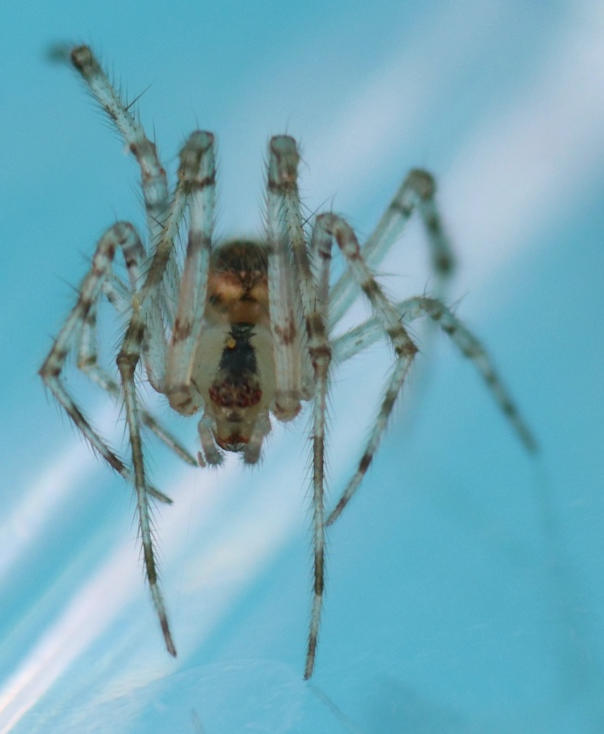
The other day, I caught a spider I didn’t recognize — this is not at all uncommon, I’m an amateur trying to learn — and I had to post it on iNaturalist to get it identified. It was a Pirate Spider! I’d never seen one before. If you’re not familiar with pirate spiders, they’ve earned their name: they are predators of spiders that board other spider’s webs and kill the owner and loot her of her life, arrrr.

Pirate spiders are members of the spider group that includes all the “orb weavers” – those that make the prototypical, circular webs we are all familiar with – but they do not make webs.

In fact, they have lost the ability. They can still produce silk, which they use to build egg sacs and wrap prey. But they are anatomically incapable of spinning a web. The number of silk “spigots” on their spinnerets is dramatically small compared to their relatives.

Instead, they invade the webs of other spiders, in a bid to lure and then kill the hapless architect. Gently, they pluck the strings of the web, enticing the host to approach.

Once the host spider has ventured close enough, the pirate makes its move.

First, it encloses its duped prey within its two enormous front legs. These are fringed with massive spines, called “macrosetae”, which they use to trap the host within a prison-like basket.

Then, the final move: the pirate bites its prey and uses its fangs to inject a powerful venom that instantly immobilises it.

I include my photo below the fold.

[Read more…]

Hsu is rightfully embattled — he shouldn’t have any authority

Look, I don’t hate physicists — I have friends who are physicists! They can use my bathroom any time! It’s more that there a few rotten apples who insist on ignorantly stepping into my discipline and making grand (and false) pronouncements about how biology works, apparently because knowing physics makes them think they know everything. And it’s annoying, especially when they get grant money for it (e.g., Paul Davies), publish rubbish in physics journals without question, and get fawned over by the mass media for it. I’ve also noticed that there’s a kind of thin actinic line of other physicists who reflexively rally to the defense of any of their own, no matter how inane, against interlopers from outside the domain of physics — which is kind of hard to imagine, since they simultaneously believe that everything is in their domain.

I have to snipe again, though, because another physicist is in the news. Students and others are calling for the removal of Stephen Hsu as VP of Research and Graduate Studies at Michigan State University.

Some physicists think that because they know physics, and physics is difficult, that they are qualified to work in other disciplines. Sometimes a physicist wandering from physics turns out fine, particularly if they make use of their obvious quantitative skill; I’m thinking here of David Layzer’s well-known critique of Arthur Jensen’s IQ work. Other times it is disastrous, such as William Shockley’s eugenic proposals. Yesterday evening the Graduate Employees Union (GEU) of my own university, Michigan State University, posted a long Twitter thread that shows that the Senior Vice-President for Research and Innovation, Professor of Theoretical Physics, Stephen Hsu, here at my own university, Michigan State University is much closer to Shockley than he is to Layzer.

I’ve written before in this space on how scientific racism gains purchase when supposedly mainstream sources publish and promote it. I find the evidence in the GEU Twitter thread to be good examples of Hsu promoting outrageous figures by appearing with them on podcasts and Youtube videos, such as that of the loathsome Stephan Molyneux.

Hsu shares a conceit all too common among physicists: that “it’s really high math ability that is useful for discovering things about the world — that is, discovering truth or reasoning rigorously.” But his behavior shows that this is manifestly untrue. All the quantitative sophistication in the world does not help in disciplines that require interpreting texts in historical contexts, understanding social nuance, or properly recounting the past for present-day audiences. Add in a heaping dose of conspiracy arguments and you can quickly end up promoting racist, especially antisemitic interpretations of history. This is what happened when Hsu interviewed his friend Ron Unz last year. The Senior Vice-President for Research and Innovation at my University heaped praise on a promoter of Holocaust denial on his podcast; clear evidence of Hsu’s complete lack of scholarly and intellectual judgement.

This isn’t some harmless academic argument, like how many aliens are dancing on the planets of the galaxy, but the promotion of bad ideas that do great harm to people. Hsu consorts with racists like Stephen Molyneux and Ron Unz; he openly promotes eugenics; he holds ridiculous ideas about the unlimited perfectability of human genetics, despite being pig-ignorant of biology; he believes women are inherently less suited to careers in science and engineering. His views are rejected by the American Society of Human Genetics, but I guess his authority in theoretical physics overrides that. The real shocker here is that MSU was willing to promote a blatant, unapologetic bigot with ties to racist, white nationalist organizations to a prestigious position in their administration. I guess believing in the intrinsic inferiority of minority students is no obstacle to putting the guy in a position of power at a university.

I tangled with Hsu a few years ago, ripping into his belief that we can breed people for an IQ of 1000, as if IQ is a real entity and breeding people is like breeding chickens. Remember the chickens, the mainstay of his argument?

That fat chicken is your brain. Let the dumbass physicist control your breeding, culling the less brilliant progeny from your line, and eventually your many-times-great-grandchildren will have great huge brains and be many times smarter than Stephen Hsu, and nah, there won’t be any side effects and we’ll just ignore the inhumanity of the process and we’ll pretend there aren’t any physical limitations. All you have to do is imagine an immense perfectly spherical brain floating in a frictionless vacuum.

How do physicists get away with publishing this crap?

And further, why does the media give them attention for it?

As the Guardian credulously claims, New calculations come up with estimate for worlds capable of communicating with others. That number is…36. What a load of bullshit. I think I’ve finally realized what the Drake Equation is good for: it’s an arbitrary formula that allows physicists to freely tweak the parameters and get a new number that they can publish. No, really, that’s all this paper is — they came up some new numbers to plug into the cascade of bullshit numbers in the Drake Equation, and got a new number. Surprise!

GIGO. It’s all GIGO.

The Guardian does get quotes revealing some of their assumptions.

Basically, we made the assumption that intelligent life would form on other [Earth-like] planets like it has on Earth, so within a few billion years life would automatically form as a natural part of evolution, said Conselice.

Wait, what? Automatically? Every Earth-like planet is going to form intelligent life within a few billion years, as a natural part of evolution? That certainly is a simplifying assumption, I guess. It means their number is hugely inflated.

He’s not done, though!

[If intelligent life forms] in a scientific way, not just a random way or just a very unique way, then you would expect at least this many civilisations within our galaxy, he said.

Oh. If the evolution of intelligence is scientific, then it produces intelligence. If chance or unique conditions play a significant role, then it’s not scientific. I hope evolution is listening. Maybe it should take some physics courses?

He added that, while it is a speculative theory, he believes alien life would have similarities in appearance to life on Earth. We wouldn’t be super shocked by seeing them, he said.

life on Earth. Like it’s one thing that he can picture in his mind. What exactly does life on Earth look like?

Is this it?

Or this?

Maybe it’s this, which Dr Physicist wouldn’t be at all shocked to see.

I have a few new rules:

  • No more papers that use the Drake equation. It’s been done to death, it can be manipulated to produce any answer you want, and most of the parameters are indeterminable fantasies. It’s like publishing horoscopes.
  • Physicists don’t get to publish papers on life in the universe unless accompanied by a responsible evolutionary biologist. All these godawful cocky physicists do is demonstrate that they don’t know jack about biology — they know less than your average non-scientist, because they’re stuffed full of bogus assumptions about how it must work.
  • The media can’t just gather a couple of like-minded physicists to comment on a “life in the universe” paper. Somehow, they always manage to find a creationist to give a “fair and balanced” perspective on biology, but a physics boffin is an unquestionable source, no matter how stupid his ideas are.

I still have my old rule: when a physicist opines on biology, throw overripe tomatoes.

I do wonder if physicists are even capable of feeling embarrassment or shame. Somebody should do an experiment.

Can I be her when I grow up?

I’m reading Tea Francis’s story, and wow, that’s me, except I waited until I was 60 to get into spiders. I wasted so much time! (Well, not really, I do have a family and a career, so I can’t complain about that.)

I have kept spiders for almost 20 years now, sometimes just one tarantula, sometimes lots of different types of spiders, but they’ve been present in some capacity ever since I was 17 or 18. After moving somewhere with more space at the beginning of last year, my collection had expanded significantly to almost 200 spiders of all different types. I decided to start an Instagram account to post about my spiders as whenever I posted anything to do with them anywhere else, I got a load of the usual ‘kill it with fire’ responses which I find grating, to say the least. I started to focus my attention on studying them a lot more closely. I invested in my very first DSLR and macro lens and set about learning how to use it. That in itself unlocked a whole new level of appreciation for them and I quickly became hopelessly, irretrievably obsessed. With new photos popping up on my Instagram feed every day, sometimes multiple times a day, they seemed to be gaining rather a lot of interest from other enthusiasts, photographers, keepers and even arachnophobes who were consciously working on overcoming their fears. This was a bit of a revelation for me & definitely a motivation to do more! I took it to Twitter as well and began posting there too, where I ended up meeting a lot of arachnology folk who were either studying towards or already active in the field I had always quietly dreamed of being involved in myself. Actually working with and researching spiders.

Then look at her lovely spider nook! It’s like fantasy land!

I’m not too jealous, though. I look at that and see a heck of a lot of maintenance work, and also sadness — most spiders aren’t that long-lived, so there’s always death among the beloved horde. Also, this would be a terrifying time to be at the start of a science career. Stay strong, Ms Francis!