Somebody tell David Barton to shut up

David Barton is a guy who makes a living lying about history…and now apparently he wants to add lying about science to his résumé. Here he argues that abortion and homosexuality are wrong because they are aberrations of nature.

The stupid burns white hot in that one.

  1. It’s the naturalistic fallacy. You can’t derive what humans ought to do from what other animals do (and worse, what you imagine in your ignorance that other animals do). Other animals don’t worship the Bible or pray; therefore, it is wrong for humans to do so. At least, that’s the reasonable conclusion for Barton’s logic. We’ll also have to shed hats and shoes, stop cooking our food, and Barton will have to stop doing his clown act on TV…all human behaviors that are not shared with other animals.

  2. It is simply not true that other animals don’t abort their young. Look at the Bruce effect; rodents will spontaneously terminate their pregnancies if exposed to a strange male. Lots of animals will spontaneously abort under stress, and it makes evolutionary sense: evolution, unlike fundamentalist Christians, favors the preservation of maternal life. It is wiser for a female to conserve her resources and bear offspring when she can afford the cost.

    You want real horror stories? Look up maternal infanticide. It’s a continuation of that same evolutionary logic: if infants cost resources, and if the choice has to be made between preserving the life of the infant vs. the life of the mother (and usually, death of the mother leads to death of the infant anyway), animals will sacrifice the young first. It’s been seen in rodents, penguins, pigs, foxes, tamarins, you name it. It’s often even accompanied by cannibalism. If Barton wants to draw moral lessons for humanity from the animal kingdom, there you go.

  3. Homosexuality is also common (here’s a list). Barton is making the common fundie Christian error, thinking sex is for reproduction and only for reproduction. As anyone with any sense knows, though, in humans and many other animals, sex is primarily for social bonding. Almost every single sexual activity in which you participate, even if it is with a member of the complementary sex in permanent relationship, is for fun and because it strengthens the relationship.

    When you look at it that way, what’s surprising is how little homosexuality is going on — why are businessmen settling for a handshake and a golf game when they could really seal the deal? But then of course there are other factors, like maintaining some exclusivity of special relationships and the importance of distancing as well as intimacy in different classes of social behaviors. But you simply cannot make the blanket argument that homosexuality is unsupportable by evolution.

    Also, because it’s the explanation I favor, not everything in evolution is finely tuned for optimal reproductive efficiency. I think homosexuality is common because evolution favors sexual behaviors first, and adding restrictions to limit sexual behavior to reproductive behavior a distant second.

Unfortunately, lying for favors and obstinately clinging to ignorance are typically human behaviors, too, so I can’t slam Barton with the argument that he’s an aberration.

Atheists as bad as rapists?

There’s a study going around that’s getting a lot of press because of the palpably unjust conclusion that it says atheists are perceived as no better than rapists. I’ve read the paper, though, and I have to say that that’s a slightly misleading interpretation.

The paper is trying to specifically tease apart the causes of anti-atheist prejudice, and it does so with a series of tests. Their hypothesis is that there can be multiple reasons why someone could detest someone else, and they argue that, since religion is used as a test of whether someone is a member of the in-group, that religiosity is used as a proxy signal for trustworthiness.

In sum, according to the sociofunctional perspective, to understand prejudice against a given group, it is necessary to understand the threats that the group is perceived to pose. Independent theory and evidence indicates that under specific conditions, religious thinking promotes intragroup cooperation and trust, and that people use cues of religiosity as a signal for trustworthiness. Combined, these two perspectives suggest that distrust is central to anti-atheist prejudice, an insight that leads to a specific set of hypotheses regarding the nature of anti-atheist prejudice. Alternatively, another cause for hating atheists could be disgust or dislike — that their behavior inspires revulsion, or that atheists are simply unpleasant, unlikable individuals.

So let’s put it in context. This research did not establish a scale of personal attributes that ranked atheists, and found them comparable to rapists; it looked for causes, and used rapists as a category for comparison.

The kind of tests they did were surveys and examination of the likelihood of committing conjunction errors. The way they did this was to tell the subjects (who were all college students, by the way) a story like this:

Richard is 31 years old. On his way to work one day, he accidentally backed his car into a parked van. Because pedestrians were watching, he got out of his car. He pretended to write down his insurance information. He then tucked the blank note into the van’s window before getting back into his car and driving away. Later the same day, Richard found a wallet on the sidewalk. Nobody was looking, so he took all of the money out of the wallet. He then threw the wallet in a trash can.

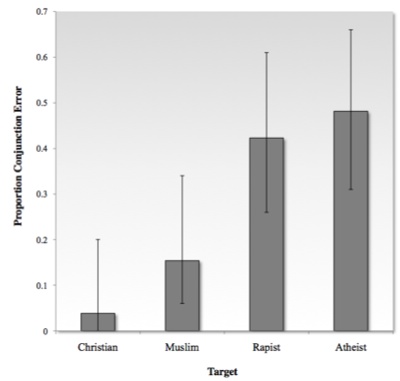
Then the students were asked whether it was more probable that Richard was either 1) a teacher, or 2) a teacher and XXXX, where XXXX was either a Christian, Muslim, rapist, or atheist. Obviously and logically, the correct answer should always be 1, because the probability that the person will be a teacher and something else will always be lower than the probability that the person will be a teacher.

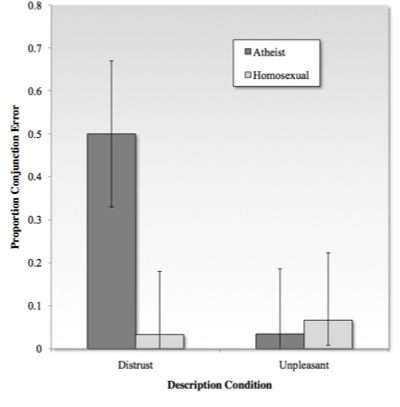
The answer they found was that people made this error about 29 times more often if XXXX was “atheist” rather than one of the religious groups, and that the responses were not significantly different between “atheist” and “rapist”. There was also a correlation between the likelihood of making the error and how important the subject rated god in their lives.

Don’t get hung up on the comparison with rapists. That was a category simply chosen because it would be unambiguously distrusted. They could have used “investment banker”, too, but then the comparison would be more difficult, because maybe a wealthy conservative college student wouldn’t consider that to be an untrustworthy occupation.

The point was not a comparison with rapists, but a comparison with other possible causes of anti-atheist prejudice. For instance, another group of subjects was told this story, as a measure of unpleasantness of character:

Richard is 31 years old. He has a rare inherited medical condition. This leads him to have dry, flaky skin and produce excess mucus. His skin often flakes off at embarrassing times, and he almost always has a dripping nose and phlegm in his throat. On his way to work one day, Richard was scratching his itchy shoulder. Some of the dry skin that flaked off caused him to sneeze, and some snot ended up on his tie. He failed to notice that the phlegm got on his tie. He wore this dirty tie through an entire work day.

Then they did another conjunction fallacy test, asking whether it was more probable that Richard was 1) a teacher, or a teacher and XXXX, where XXXX was Christian, Muslim, gay, or atheist. In this case, the result was that neither gays nor atheists were regarded as personally more unpleasant or unlikeable.

So the study has good news and bad news.

The bad news is that atheists really are not trusted by the public at large — we do not give off the positive in-group signals expected, so we get relegated to a kind of pariah status.

The good news, I guess, is the reasoning behind that. You’ll often see religious people rail against atheists and tell us how rude and awful and bad we are: take a look at the comments on this article on the study, for instance.

I think part of the issue is that some of the most visible, high-profile atheists we hear about (Dawkins, Hitchens) are vocally of the “THERE IS NO GOD AND IF YOU THINK THERE MIGHT BE YOU ARE AN IDIOT!1” variety. These are the atheists that get the press, so I can understand the source of the perception.

Or here:

I’ve never met an atheist that wasn’t an ass. I’m not saying they all are. Just those I have known.
They push harder than the Phelps’.

Those people have misinterpreted the study (or more likely, haven’t even read it). It’s actually saying the opposite: people don’t perceive atheists as being unpleasant, they see them as being outsiders. It is specifically tying the prejudice to a judgment about trust, not whether we’re icky rude nasty people.

The message I take away from it is not to avoid the assertiveness associated with the New Atheist movement — although it may highlight those in-group/out-group boundaries, that’s necessary. We aren’t trying to say we are exactly like theists, we need to demarcate those boundaries as part of establishing our identity. What the study does do, though, is affirm that those campaigns to establish the idea that we can be good without god, that we have high moral standards, are even more important, because they go directly to the issue of whether atheists are trustworthy members of the community.


Gervais WM, Shariff AF, Norenzayan A (2011) Do you believe in atheists? Distrust is central to anti-atheist prejudice. J Pers Soc Psychol.101(6):1189-206. Epub 2011 Nov 7.

On Netflix: Cave of Forgotten Dreams

Urglegurgle. I’m trying to prep a lecture on synapse formation, and just discovered that Herzog’s amazing film about Chauvet cave is available…so I’m trying to scribble up technical notes on molecular biology while getting constantly distracted by 32,000 year old cave paintings. It’s good to live in the 21st century, but I think my brain is getting full.

(Also on FtB)

On Netflix: Cave of Forgotten Dreams

Urglegurgle. I’m trying to prep a lecture on synapse formation, and just discovered that Herzog’s amazing film about Chauvet cave is available…so I’m trying to scribble up technical notes on molecular biology while getting constantly distracted by 32,000 year old cave paintings. It’s good to live in the 21st century, but I think my brain is getting full.

(Also on Sb)

Mad scientists, start drooling

The future is arriving fast. Here are the instructions for assembling a $500 home molecular biology laboratory — you can do it! And it’s getting cheaper all the time!

The widespread and increasing availability of second-hand professional laboratory equipment or inexpensive new commercial surrogates means that it is now unchallenging to set up a fully functional molecular laboratory for less than $500 in equipment costs. Coupled with the presence of sources for all reagents and supplies needed in formats that are safe for general use, the work presented here demonstrates that capacity to set up functional molecular biology teaching modules is well within the reach of even the smallest educational facilities. When coupled with outsourced PCR product Sanger sequencing available from commercial sources at prices approaching $5/reaction, the capacity of such “home labs” to start undertaking research of real potential scientific value—such as surveys of microbial biota in unusual environments—at negligible costs should not be underestimated. Similarly, the potential for setting up labs of this type for medical applications in emerging countries may be worth considering. While current best methods have moved to real-time and array-based high throughput, contamination resistant methods, the methods demonstrated here were “state of the art” for clinical and research molecular diagnostics in the Western world only some 15 years ago.

Hmmm. The kids have flown, I’ve got more space than we know what to do with…maybe this summer I should tinker with setting up something like this.

(Also on Sb)

Anti-caturday post

I used to keep these lovely little guys as pets — they’re so pretty and active, and have such soulful eyes…and so many of them. Their courtship dance is also cool, and so easily evoked; these spiders are always looking for love.

Unfortunately, the species I’ve been able to find in Minnesota are much smaller than the ones I found in Oregon, and the weather greatly limits their availability. If you’re living in warmer climes and haven’t been watching these adorable beasties you’ve been missing out. Especially if you’re keeping cats, instead.

(Also on Sb)

My turn at Skepticon

Yeah, I gave a talk at Skepticon like several other rascals here at Freethoughtblogs. Now, even if you didn’t make the pilgrimage to Springfield, Missouri, you can watch it too.

It’s a straight science talk with several swipes at creationism, so unfortunately, I don’t think it will make any ice cream salesmen cry.

(Also on Sb)

Hamza Tzortzis on the Intellectual Dishonesty of Professor Myers SHOCKING!

That’s what he titles his latest youtube video, anyway. I laughed, just like I laughed when Eric Hovind called to complain about the misinformation on my website. He also claims I “accept defeat”

Myers accepts defeat see below:

Myers changes his stance from Ireland, In Ireland Myers says the ‘Quran is Wrong’. After reviewing the iERA Research Paper he now believes its the Quran has ‘ very little opportunity for disproof, and they can be made to fit just about any reasonable observation.’

I am surprised to learn that I accepted defeat. Doesn’t he know I’m indomitable? Anyway, here’s the video where Tzortzis crushes me.

I will give him credit — he does link to my article debunking Islamic embryology, which is more than most creationists would do. But still, he’s got it all wrong.

During our encounter in Ireland, I pointed out that their specific claim of a discrete sequence of development in the embryo, from bones to muscles being added to bones, was false. In the article I wrote on Tzortzis’s strained exegesis of two verses from the Quran, I explained that you can’t make concrete claims about embryology from such a vague, cursory, and intentionally poetic source, such as those two verses. These are not incompatible arguments. The second point is not a softening of the views made in the first point.

If anything, Tzortzis has backed down. In Ireland, he and his friends were trying desperately to argue that Mohammed knew things that no man in his position could possibly have known without a divine source of information; my argument was that no, what’s in the Quran is very much in line with the knowledge of his day, derived from Aristotle and Galen. No miracles were required to write those two verses.

Now Tzortzis’s claim is greatly reduced; it is that the Quran does not “negate reality”, or does not make claims that contradict known science. That’s fine; as I said, it’s the most minuscule of verses saying the wobbliest things, and it’s derived from observations of embryos made by Greek and Roman predecessors, so it’s not surprising that it can be retrofitted to fit modern science by playing enough word games.

Tzortzis relies on what he calls “lexical analysis”, but it’s little more than compiling the equivalent of thesaurus entries for words in the verses, and then picking and choosing the ones that fit the point he’s trying to make. That’s not analysis, it’s cherry-picking.

Amusingly, he does the same thing to modern developmental biology. He’s gone rifling through legitimate embryology texts, trying to prove that I don’t know what I’m talking about, and he found one sentence in a textbook — “after the cartilaginous models of the bone have been established, the myogenic cells, which have now become myoblasts, aggregate to form the muscle masses” — that he thinks shows I was wrong and that his interpretation of the Quran phrase — “bones were clothed with flesh” — is correct.

Wrong. See, this is the problem with his “lexical analysis” approach — it means he tries to conform what he reads to what he already thinks he knows. I know what a developing limb looks like; mesodermal masses condense gradually into organized clusters of cells that differentiate in parallel. Centers of what will become bones aggregate and form cartilage (not bone, notice) as centers of what will become muscle (the myogenic cells in that description) aggregate and begin differentiation into myoblasts and myotubes and eventually muscle fibers.

Here’s what we actually see in the developing limb: branching patterns of cell fate decisions by tissue precursors, and parallel differentiation of the cellular components of those tissues.

The simplistic and discrete idea of “bones, then flesh” doesn’t even recognize that “bones” and “flesh” aren’t simple binaries, and the sequence isn’t a simple temporal switch. What you had instead was the early segregation of cells into differing mucopolysaccharide matrices, within which cells began complex sequences of shifting patterns of gene expression and differentiation into mesodermally-derived tissues.

Or more poetically, bones and flesh congealed together out of balls of snot. There are sequences within that pattern, but chondrocytes aren’t bones and myoblasts are not muscles. Tzortzis is trying too hard to fit the Quran to science, because he can’t appreciate that it’s just a book written by men trying to make sense of the world, and also unfortunately trying to add extra weight to their opinions by claiming the authority of a god behind them. A sad state of affairs that I’m afraid their modern descendants continue to perpetrate.

(Also on Sb)