(Also on Sb)

Usually, I try to accentuate the positive and tell you why other animals are so much more interesting than cats, but today I’m going right for the gutter and showing you why cats are evil. Behold, the cat penis:
You know who else has a penis like that? Satan.
Now you have another reason to get your cats neutered — so they don’t ever use that nightmarish thing.
(Also on Sb)

A few weeks ago, PLoS One published a paper on the observation of preserved chitin in 34 million year old cuttlebones. Now the Institute for Creation Research has twisted the science to support their belief that the earth is less than ten thousand years old. It was all so predictable. It’s a game they play, the same game they played with the soft tissue preserved in T. rex bones. Here’s how it works.
Compare the two approaches, science vs. creationism. The creationists basically insert one falsehood, generate a ludicrous conflict, and choose the dumbest of the two alternatives.
|
The Scientific Approach ↓ ↓ find traces of organic material in ancient fossils ↓ Cool! We have evidence of ancient biochemistry! ↓ Science! |
The Creationist Approach ↓ declare it impossible for organic material to be ancient ↓ steal other people’s discovery of organic material in ancient fossils ↓ Cool! Declare that organic material must not be ancient, because of step 1, which we invented ↓ Throw out geology, chemistry, and physics because they say the material is old ↓
|
You see, the scientists are aware of the fact that organic materials degrade over time, but recognize that we don’t always know the rate of decay under all possible conditions. When we find stuff that hasn’t rotted away or been fully replaced by minerals, we’re happy because we’ve got new information about ancient organisms, and we may also be able to figure out what mechanisms promoted the preservation of the material.
The creationists start with dogma — in this case, a false statement. They declare
Chitin is a biological material found in the cuttlebones, or internal shells, of cuttlefish. It has a maximum shelf life of thousands of years…
and
Because of observed bacterial and biochemical degradation rates, researchers shouldn’t expect to find any original chitin (or any other biomolecule) in a sample that is dozens of millions of years old—and it therefore should be utterly absent from samples deposited hundreds of millions of years ago. Thus, the chitin found in these fossils refutes their millions-of-years evolutionary interpretation, just as other fossil biomolecules already have done.
But wait. How do they know that? The paper they are citing says nothing of the kind; to the contrary, it argues that while rare, other examples of preserved chitin have been described.
Detection of chitin in fossils is not frequent. There are reports of fossil chitin in pogonophora, and in insect wings from amber. Chitin has also been reported from beetles preserved in an Oligocene lacustrine deposit of Enspel, Germany and chitin-protein signatures have been found in cuticles of Pennsylvanian scorpions and Silurian eurypterids.
So the paper is actually saying that the “maximum shelf life” of chitin is several tens of millions of years. And then they go on to describe…chitin found in Oligocene cuttlefish, several tens of millions of years old. The creationists are busily setting up an imaginary conflict in the evidence, a conflict that does not exist and is fully addressed in the paper.
The creationists do try to back up their claims, inappropriately. They cite a couple of papers on crustacean taphonomy where dead lobsters were sealed up in anoxic, water- and mud-filled jars; they decayed. Then they announce that there’s only one way for these cuttlebones to be preserved, and that was by complete mineralization, and the cuttlebones in the PLoS One paper were not mineralized.
…mineralization—where tissues are replaced by minerals—is required for tissue impressions to last millions of years. And the PLoS ONE researchers verified that their cuttlebone chitin was not mineralized.
Funny, that. You can read the paper yourself. I counted 14 uses of the words “mineralized” and “demineralized”. They state over and over that they had to specifically demineralize the specimens in hydrochloric acid to expose the imbedded chitin. And of course the chitin itself hadn’t been mineralized, or it wouldn’t be chitin anymore! Did the creationists lie, or did they just not understand the paper?
The scientists also do not claim that the chitin has not been degraded over time. They actually document some specific, general properties of decay in the specimens.
β-chitin is characterized by parallel chains of chitin molecules held together with inter-chain hydrogen bonding. The OH stretching absorbance, at about 3445 cm−1 in extant chitin, is diminished in the fossil and shifted to lower wavenumbers, showing that the specimen is losing OH by an as yet undetermined mechanism. The N-H asymmetric stretching vibration is shifted to slightly lower wavenumbers, showing that it is no longer hydrogen bonding exactly as in extant specimens. Changes in the region 2800–3600 cm−1 indicate that biomolecules have been degraded via disruption of interchain hydrogen bonds.
So, yes, the creationists seem to have rather misrepresented what the paper said. Here’s another blatant example of lying about the contents of the paper.
The question they did not answer, however, is why the original organic chitin had not completely fallen apart, which it would have if the fossils with it were 34 million years old…
Actually, they did. A substantial chunk of the discussion was specifically about that question, a consideration of the factors that contributed to the preservation. It was a combination of an anoxic environment, the presence of molecules that interfered with the enzymes that break down chitin, and the structure of cuttlebone, which interleaves layers containing chitin with layers containing pre-mineralized aragonite.
In vivo inorganic-organic structure of the cuttlebone, in combination with physical and geochemical conditions within the depositional environment and favorable taphonomic factors likely contributed to preservation of organics in M. mississippiensis. Available clays within the Yazoo Clay in conjunction with suboxic depositional environment may have facilitated preservation of original organics by forming a physical and geochemical barrier to degradation. One key to the preservation of organic tissues, in particular chitin and chitosan, is cessation of bacterial degradation within environments of deposition. Bacterial breakdown of polymeric molecules is accomplished through activities of both free extracellular enzymes (those in the water column) and ektoenzymes (those on the surface of the microbial cell) such as chitinases. Chitinases function either by cleaving glycosidic bonds that bind repeating N-acetyl-D-glucosamine units within chitin molecules or by cleaving terminal N-acetyl-D-glucosamine groups. These enzymes adsorb to the surface of clay particles, which inactivates them. Strong ions in solution like iron may act in the same manner. Once bound to functional groups within these polymeric molecules, Fe2+ ions prevent specific bond configuration on the active-site cleft of specific bacterial chitinases and prevents hydrolysis, thus contributing to preservation.
Organic layers within cuttlebones are protected by mineralized layers, similar to collagen in bones, and this mineral-organic interaction may also have played a role in their preservation. Specimens of M. mississipiensis show preserved original aragonite as well as apparent original organics. These organics appear to be endogenous and not a function of exogenous fungal or microbial activity. Fungi contain the γ form of chitin not the β allomorph found in our samples. Also, SEM analyses shows there is no evidence of tunneling, microbes, or wide-spread recrystallization of the aragonite. Therefore the chitin-like molecules detected in fossil sample are most likely endogenous. Similar to collagen in bone, perhaps, organics could not be attacked by enzymes or other molecules until some inorganic matrix had been removed.
Like I always say, never ever trust a creationists’ interpretation of a science paper: they don’t understand it, and they are always filtering it through a distorting lens of biblical nonsense. They make such egregious errors of understanding that you’re always left wondering whether they are actually that stupid, or that sleazily dishonest. Or both.
But imagine if the creationists hadn’t screwed up royally in reading the paper, if they had actually found an instance of scientists being genuinely baffled by a discovery that should not be. What if there was actually good reason to believe that chitin could not last more than ten thousand years?
Then the only sensible interpretation of this observation of 34 million year old chitin would be that the prior estimation of the shelf-life of chitin was wrong, and that it could actually last tens of millions of years. What the creationists want to do is claim that that minor hypothetical is actually correct, and that instead the entirety of nuclear physics, geology, radiochemistry, and modern cosmology is wrong. On the one hand, uncertain details about the decay of one organic molecule; in the other, entire vast fields of science, already verified, and with complex modern technologies built on their operation…and which hand would the creationists reject? The trivial one, of course.
I’m leaning towards “stupid” as the explanation for their bad arguments.
Oh, after I started this dissection, I discovered someone had already beaten me to it: here’s another analysis of the creationist misinterpretations.
(Also on Sb)

I will never forgive Leon Lederman for calling the Higgs boson the “god particle”. It’s fueled decades of unjustified patronizing nonsense from theologians, and the latest is Alister McGrath, who babbles obliviously about it.
Science often proposes the existence of invisible (and often undetectable) entities – such as dark matter – to explain what can be seen. The reason why the Higgs boson is taken so seriously in science is not because its existence has been proved, but because it makes so much sense of observations that its existence seems assured. In other words, its power to explain is seen as an indicator of its truth.
There’s an obvious and important parallel with the way religious believers think about God. While some demand proof that God exists, most see this as unrealistic. Believers argue that the existence of God gives the best framework for making sense of the world. God is like a lens, which brings things into clearer focus. As the Harvard psychologist William James pointed out years ago, religious faith is about inferring “the existence of an unseen order” in which the “riddles of the natural order” can be explained.
The parallel breaks down hard, though. Yes, the Higgs boson is a satisfying theoretical construct with much power to explain. But notice that mathematical beauty was not enough: the physicists of the world, from over 100 countries, gathered and spent over $9 billion to build the largest scientific instrument in the world to test the hypothesis. Faith was not enough.
In contrast, you couldn’t convince a Baptist and a Mormon to get together and chip in $1.98 to test their god. Because they don’t have the slightest idea how to do it, and wouldn’t be interested if they did.
That’s the real lesson to be learned from the science: you have to do the test.

I know how I’m going to spend the entirety of my Christmas break: preparing to teach my new Cancer Biology course. And since I’m going to be dwelling on cancer for the next month or so, I think it’s only fair that my students and any passers-by should also get a faceful of the stuff. So here are the texts I’ve settled on for the course:
Weinberg’s Biology of Cancer
Skloot’s Immortal Life of Henrietta Lacks
Mukherjee’s The Emperor of All Maladies
There will also be a few papers assigned throughout the term, but that ought to get everyone started on a good long depression.

He’s not a very exciting speaker, but he does present the compelling evidence well.
(Also on Sb)

I have really been looking forward to seeing David Attenborough’s latest, Frozen Planet, here in the US. I’ve seen brief snippets of the show on youtube, and like all of these big BBC nature productions, I’m sure it’s stunning. And then I hear that the Discovery Channel has bought the rights! Hooray!
But wait, experience cautions us. Remember when American television replaced Attenborough’s narration with Sigourney Weaver? And <shudder> Oprah Winfrey? And when the Oprah version dropped the references to evolution? What kind of insane butchery would they perpetrate this time around?
Well, the word is out. The Discovery Channel only bought 6 of the 7 episodes. They dropped the seventh because…it talks about global climate change.
Goddamnit.
It’s not just our dimbulbs in government, it’s active collusion by the media to suppress scientific evidence because it might be unpopular with our undereducated booberati. Jerry Coyne suggests that you contact the Discovery Channel’s viewer relations page and express your displeasure. I will not be watching a neutered version of the program on Discovery; instead, I’ll wait until I can pick up the BBC DVDs.
You know what else is annoying about this? My wife and I are having a pleasantly quiet evening at home, and what she’s been doing is watching youtube videos…of David Attenborough. She’s been gushing over these spectacular videos all night long, and I swear, I’m beginning to feel pangs of manly jealousy. At least I get to tell her that the American media has decided that he’s seditious and dangerous.
And that will probably make him even more attractive. I can’t win.
Just to end on a more pleasant note, Mary almost orgasmed over this one. You’ll like it too. Too bad the Discovery Channel thinks you hate reality.
(Also on Sb)

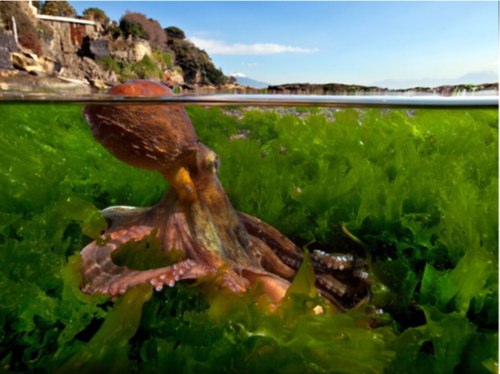
Game over, man. No cat video can ever be as awesome as this: two mimic octopuses mating.
It’s like watching a nest of snakes break out into a barroom brawl. It’s also the most erotic thing I’ve ever seen on the internet.
(Also on Sb)