What does it even mean to pass the mirror test?

The mirror test is a well known indicator for some degree of self-awareness: surreptitiously mark an animal’s face, show it a mirror, and see if it recognizes that the reflected image is of itself by whether it reaches up to touch or remove the mark. We see that behavior and infer that the animal has some knowledge of itself and can recognize that the mirror image is not another animal.

But now robots are being specifically programmed to pass the mirror test.

Ow. It makes my brain hurt.

So this is a computer that has no other indicators of consciousness or awareness or autonomous “thought” (whatever that means…my brain is hurting again), and is being coded to respond to a specific kind of visual input with a specific response…to literally pass the mirror test by rote. Does that really count as passing?

I think that all it actually accomplishes is to subvert the mirror test. It’s always been a proxy for a more sophisticated cognitive ability, the maintenance of a sophisticated mental map of the world around us that includes an entity we call “self”, and I don’t think that training a visual processing task to identify a specific shape unique to the robot design counts.

I’d also like to see what happens if two identical robots are made and put in the same room. To recognize “self” you also have to have a concept of “other”.

Dead squid can dance

Take one squid. Pin it down in a dish. Dissect out one of the peripheral nerves innervating the fin. Plug it into your iPod, and stimulate the nerve with the speaker output while playing Insane in the Membrane. Record the behavior of the chromatophores.

You have my permission, once I’m dead, to run any kind of patterned electrical signal through my nerves to see what my corpse will do. I don’t have the nice chromatophores, but maybe you could get some interesting twitches.

Who’s conscious?

A recent meeting of neuroscientists tried to define a set of criteria for that murky phenomenon called “consciousness”. I don’t know how successful they were; they’ve come out with a declaration on consciousness that isn’t exactly crystal clear. It seems to involve the existence of neural circuitry that exhibits specific states that modulate behavior.

The neural substrates of emotions do not appear to be confined to cortical structures. In fact, subcortical neural networks aroused during affective states in humans are also critically important for generating emotional behaviors in animals. Artificial arousal of the same brain regions generates corresponding behavior and feeling states in both humans and non-human animals. Wherever in the brain one evokes instinctual emotional behaviors in non-human animals, many of the ensuing behaviors are consistent with experienced feeling states, including those internal states that are rewarding and punishing. Deep brain stimulation of these systems in humans can also generate similar affective states. Systems associated with affect are concentrated in subcortical regions where neural homologies abound. Young human and non- human animals without neocortices retain these brain-mind functions. Furthermore, neural circuits supporting behavioral/electrophysiological states of attentiveness, sleep and decision making appear to have arisen in evolution as early as the invertebrate radiation, being evident in insects and cephalopod mollusks (e.g., octopus).

This is where they’re losing me. So, basically, they’re saying that aspects of consciousness are about 600 million years old? There is a bit of a slip in the text; some states and circuitry are present in insects, but then it goes on to declare certain subsets of animals to be conscious, which do not include insects. So what do insects lack that makes them not conscious? Or are they?

They seem to have reached an agreement that a mammalian neocortex is not necessary for consciousness, which seems entirely reasonable to me. But that doesn’t suffice to say what anatomical substrate is required for consciousness. It is basically a declaration that narrow, mammal-centric views of how the brain works are not adequate, and that opens the doors to considering the possibility of consciousness in non-mammalian organisms, but I’m still not clear on exactly how we’re going to measure consciousness.

Anyway, here’s their conclusion.

We declare the following: “The absence of a neocortex does not appear to preclude an organism from experiencing affective states. Convergent evidence indicates that non-human animals have the neuroanatomical, neurochemical, and neurophysiological substrates of conscious states along with the capacity to exhibit intentional behaviors. Consequently, the weight of evidence indicates that humans are not unique in possessing the neurological substrates that generate consciousness. Non- human animals, including all mammals and birds, and many other creatures, including octopuses, also possess these neurological substrates.”

Wait, I missed something again. What are the “neuroanatomical, neurochemical, and neurophysiological substrates of conscious states”? They don’t say. What are the anatomical substrates that are present in humans and not cows or mice? (Hint: I don’t think there are any qualitative differences). So this document has just declared that cows are conscious? Please tell McDonald’s.

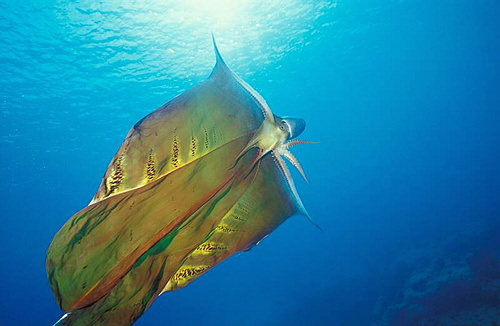
It’s nice that the octopus gets singled out as a conscious creature, but under these definitions, it seems to me that every animal with a nervous system above a nerve net (wait…is there reason to exclude those?) is conscious. Vegans will be happy to embrace this statement, but I’m left unsatisfied by the lack of concrete explanations.

Also, here is an interesting summary of evidence for sophisticated intentional behaviors in octopus. Notice that intent and mental states are inferred from observations of behavior, not by slicing open a few ganglia and noting the existence of consciousness circuitry.

The octopus is the only invertebrate to get a shout-out at all. And plenty of research has been accumulated to back up this assertion. A 2009 study showed that some octopuses collect coconut shells to use as portable shelters—an example of tool use, according to the researchers. Other research has documented sophisticated spatial navigation and memory. Anecdotal reports from researchers, such as Jennifer Mather, describe watching octopuses in the wild make errands to collect just the right number of rocks to narrow the opening to a desired den. And laboratory experiments show a distinct change in behavior when octopuses are kept in tanks that do not have enough enrichment objects to keep them stimulated.

Shorter Cambridge declaration: animals other than humans look like they might be conscious, so let’s admit that neural circuits other than those in the mammalian neocortex are involved. And that’s all.

Anti-vaxers kill another child

So North Carolina is reporting their first death (of the year, I presume) from pertussis, or whooping cough. A 2-month-old infant has died of the disease.

Whooping cough is highly contagious and spread usually by coughing or sneezing in close contact. It can be serious at any age, but it is life-threatening in newborns and infants who are too young to be fully vaccinated, state health officials said. Many infants who get whooping cough are infected by caregivers who may not know they have the disease.

This is a kid who was too young to have yet obtained the full range of vaccines, and was dependent on herd immunity…and someone carrying the disease infected them, and ultimately killed them. It’s remarkable that deaths from pertussis are now so rare that one of them will make the news—but the way we’ve made the disease rare is by preventive vaccinations. Every person who neglects to vaccinate is contributing to a deadly disease renaissance.

Anti-Caturday post

Hey, little Golden Tortoise Beetle, you’re looking adorable!

That’s a nice shiny Golden Tortoise Beetle, I love that little transparent shell over your shiny goldenness.

Golden Tortoise Beetle, you’re so shy and cute. Peep out from under your shiny carapace. Yes, you peep out, you little buggy-wuggy.

Watcha doin’, Golden Tortoise Beetle?

Golden Tortoise Beetle, you’re looking adorable!

I like Golden Tortoise Beetles!

I’m still waiting for the PZome

“-ome” and “-omic” are overused, as Jonathan Eisen has been saying for years, and now the Wall Street Journal has taken notice. There are 404 “-omics” disciplines? It’s so silly that there is now a Badomics generator to invent new terms.

It’s still missing PZomics. I’m serious, it could be a real science, you know…I don’t know why researchers aren’t lining up to get cell samples from me. (There’s probably more money in Venteromics—I say “psshhht!” to their dedication to the principles of true knowledge over mere pecuniary gain.)