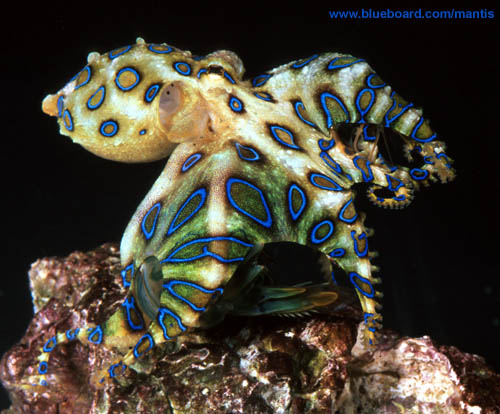
(via The Lurker’s Guide to Stomatopods.)

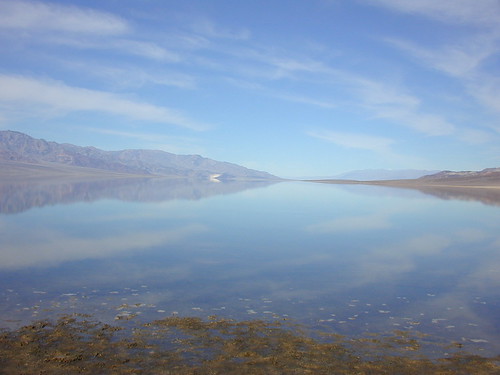
Death Valley on a much cooler day in January 2005, with Pleistocene Lake Manly reemergent at Badwater.
I say more about this over at KCET, but I’ve found it kind of surprising that today’s barrage of coverage of the World Meteorological Organization’s official dethroning of the 1936 El Azizia, Libya temperature record didn’t mention this fascinating work that came out a few months back.
The short version of today’s news: a global group of meteorologists, including Libyan scientist, Khalid El Fadli, climate director of the Libyan National Meteorological Center, went over the old records that secured El Azizia’s spot in fifth-grade geography texts as the site of the world’s highest recorded temperature. That much-memorized datum, an air temperature peak of 136°F (or 58°C for those of you in civilized countries) 90 years ago today on September 13, 1922, turns out to have been an artifact of difficult-to-read equipment combined a newbie weather technician working at an Italian Army post. The peak actual temperature that day was likely 7°C cooler, putting it well within the range of normal hellishly hot for the neighborhood I just moved out of. That puts Death Valley’s July 10, 1913 reading of 134°F/56.7°C back in the first place spot it ought to have enjoyed for the last 90 years.
El Fadli, by the way, had to go underground for a bit during the revolution. His colleagues lauded him today for taking risks to get this study done, and we wouldn’t have had this info without his taking significant personal risks as Qaddafi’s regime went through its death throes.
The thing is that those official records have a bit of built-in sampling error: namely, they derive from the places where we’ve managed to maintain weather stations for long enough to keep records. The WMO has more than 11,000 weather stations worldwide, but “worldwide” is a big place, and that works out to an average of one weather station for every 13,000 square kilometers of land surface. Admittedly, much of the really underrepresented land surface is in Antarctica, where it’s unlikely any high air temperature records will be set anytime soon. But that’s still a lot of potentially hot land not being monitored, in the deserts of Asia, Africa, and even the Sonoran Desert in North America.
The research that made the press a few months back involved measuring Land Skin Temperature (LST), which I’d embarrassingly typoed as “Land Sin Temperature” at KCET until just now, via infrared satellite monitoring of the Earth’s surface by way of the Moderate Resolution Imaging Spectroradiometers on two NASA satellites. The researchers, led by Steve Running of the University of Montana, found a number of places well away from the nearest WMO-approved weather station that had astonishingly high surface temperatures. The record? A dark and gravelly spot in Iran’s Lut Desert, where on one particularly warm day in 2005 the LST reached 159.3°F/70.7°C. The place on Earth with the second-hottest LST was an unspecified spot in the bush in Queensland, which will no doubt delight the Strines in the crowd. That temperature: 156.7°F/69.3°C. The Turpan Basin in Xinjiang, China took third place at 152.2°F /66.8°C.
Of course air temperature and LST are different animals. The WMO requires that air temperature measurement be taken 1.2-2 meters off the ground in the shade, which means comparing air temps and LST is kind of comparing apples with the sun-baked soil at the base of the apple tree. Think walking barefoot on the beach on a nice day with air temperatures in the 80s. Differences of 50°F between air temperature and LST aren’t unheard of. And until we plant a WMO-approved weather station out on the Lut Desert, we probably won’t have a good idea how those temperatures compare with Death Valley’s.
But we do know one thing: when Running’s team listed the places on Earth with the hottest Land Skin Temperatures, Death Valley didn’t make the list. So the hottest place on Earth, according to the news today, probably isn’t. It’s just the hottest one for which we have a recorded air temperature. Which doesn’t make as snappy a headline. But that’s okay: the California Desert still has that 767 straight days without rain at Bagdad, about 40 miles north of where I’me sitting right now. It’s at most in second place after the Atacama Desert, which has some places where rain’s never been recorded, ever. But we’re’ good at being in second place around here.

I am getting quite impressed with the progress being made in organ reconstruction. New techniques have allowed amazing improvements in bioengineering that allow whole complex organs to be grown in a dish and then surgically reimplanted — and much of this research is being driven by our military ventures, which provide a steady supply of scarred, damaged, and mutilated veterans who need new body parts. There I read that scientists are developing procedures to regrow penises…how could I not look up that paper? So I did, and now I have the current recipe for building new penises — or at least, corpora cavernosa — in a lab.
It’s got limitations. First, you have to start with an intact penis, preferably from a dead body. Then it has to be delicately decellularized, leaving behind a fragile, ghostly collagen matrix, the connective tissue ‘skeleton’ of the organ. This framework is completely acellular, with no remnants of the donor’s cells, and consisting of just the collagen matrix, so that it will not provoke an immune response.
Then smooth muscle and endothelial cells are harvested by biopsies from the prospective host. This is to be an autologous transplant, a regrown organ built from the host’s own cells, again so immune system rejection will not be an issue. These cells are seeded in multiple steps onto the collagen scaffold, where they proliferate and infiltrate the matrix and reassemble (you hope!) the fully functional organ.
Note the limitations, though: you have to start with a penis. There are relatively few of those to spare, although since histocompatibility matching isn’t an issue, it ought to be doable as part of an organ donor program — we’ll just grab the penis as well as the corneas and kidneys. This procedure does not regrow the entire penis, but just the spongy erectile tissue in the core; this is implanted into the sheath of skin of the normal penis. I know all you body modification fans are dreaming of the day you can have multiple penises, but this isn’t quite there yet, and sorry, I should hope injured people who need the procedure get priority over cosmetic uses.
But here’s the astonishing thing: it works. The procedure has only been tested in rabbits so far, but with amazing success. I know what you are saying. You are saying, “Really? Then show me the bunny penises, with erections.” And I will.
At the top left is an unaltered, unoperated rabbit penis; top right is the case we’re interested in, a rabbit with an implanted, bioengineered penis (say, isn’t it a little larger than the unaltered penis?). At the bottom are negative controls, penises with just the unseeded collagen matrix implanted and with nothing at all to replace the surgical deletion.
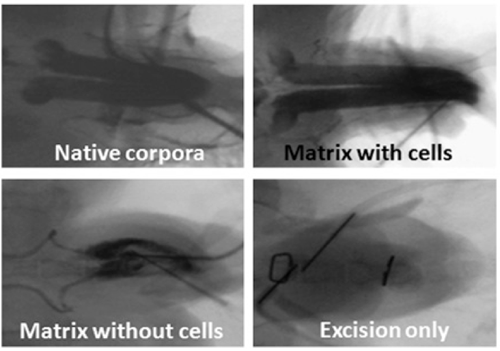
The researchers have done experiments in rabbits in which they compare a positive control group (no removal of the corpora) to a negative control group (rabbits with their penises hollowed out and the corpora removed — sad bunnies) to an experimental group (rabbits with their penises surgically cored out, and then replaced with bioengineered neocorpora), and look what happened.
The experimental and control animals were each placed with a female rabbit and mating activities were assessed at 1, 3, and 6 months after implantation. All rabbits with bioengineered neocorpora attempted copulation within 1 min of introduction to their female partners, and this occurred as early as 1 month after implantation. Most control rabbits did not attempt copulation after introduction to their female partners.
The rabbits were ready and eager to try out their new penises! Yay science!
The intravaginal ejaculation rate was determined using vaginal swabs to detect the presence of sperm after copulation and/or impregnation. In the experimental group, vaginal swabs contained sperm in eight of 12 instances, and four of the 12 females were impregnated, resulting in an intravaginal ejaculation rate of 83% (10/12). In the control group without cell seeding, all 12 vaginal swabs were negative.
And it wasn’t all just for fun, those penises worked, they successfully inseminated the females, and, typical bunnies, a third of the females were impregnated! Yay science again!
A difference between experimental and control group without cells in the intravaginal ejaculation rates of 75% was noted, with a 95% confidence interval of 36% to 89%. For the negative control group (excision only), all vaginal swabs were negative, and none of the females were impregnated (0%).
I feel sad for those bunnies with their flaccid, hollowed out penises, but I guess that is the expected result — it would have been far more surprising if the negative controls had inseminated their partners.
The bottom line is that we need more stem cell research and more bioengineering. There are wonders to be accomplished! And don’t let religious nonsense interfere with this kind of work.

Although, to be fair, both Islam and Christianity would be perfectly fine with reconstruction of the holy penis — it’s only when it steps into the task of reconstructing scarred and damaged vulvas that it treads over the line into abomination.
Chen KL, Eberli D, Yoo JJ, Atala A (2010) Bioengineered corporal tissue for structural and functional restoration of the penis. Proc Natl Acad Sci USA 107(8):3346-50.

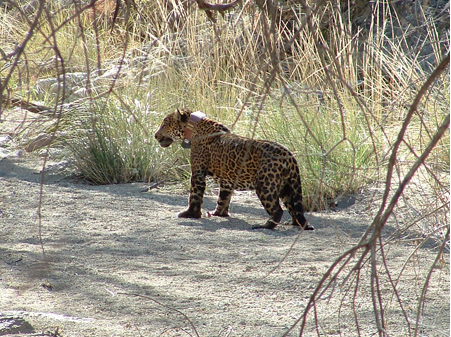
Kitty! Jaguar Macho B in 2009.
I’m honestly not sure how I feel about this article: it’s either one of the silliest pieces of writing I’ve ever seen on endangered species issues, or a fiendishly clever way of roping ecologically apathetic adolescent d00dz into getting behind a conservation issue:
Usually, endangered species stories are lame. It’s some stupid owl or lizard or some other animal that nobody actually cares about.
Not this time. This time an animal actually worth caring about it [sic] getting some protected habitat. And if we’re really lucky it’s going to maul a few hikers.
The writer’s referring to a proposal last month by the US Fish and Wildlife Service that 838,000 acres of rough terrain on the US-Mexican border be designated Critical Habitat for the jaguar, the result of a lawsuit by the Center for Biological Diversity (CBD) in Tucson. The designation covers mountain ranges stretching from the Tohono O’odham Reservation eastward to the southwesternmost corner of New Mexico. Jaguars were pretty much extirpated from the US early in the 20th Century, but there have been sightings of male jaguars over the years in parts of the proposed critical habitat, including one sighting and capture in 2009 that ended sadly.
Not mentioned in the d00dz-targeted article linked above: the largest impact of the critical habitat designation, if it’s approved, will likely be to cause problems for the proposed Rosemont copper mine in the Santa Rita mountains. CBD says the mine is its main concern with regard to protecting Arizona jaguar habitat. In response, in a statement likely to provoke wry smiles around these parts, a Rosemont Vice President accused CBD of bullying.
In any event, despite the enthusiasm of the Uproxx writer linked up top, the designation doesn’t mean we’re getting more jaguars: it just makes it somewhat harder to damage jaguar habitat with the federal government’s help.
So: stupid or clever? Uproxx writer Dan Seitz at least makes an effort to drop a little science, and he doesn’t get it completely wrong:
One theory maintains that peripheral populations are key to maintaining a species’ biodiversity. Species that live on the very edge of the range tend to develop new traits and evolve in different ways, then interbreed with other populations and pass on those useful mutations.
“Key” is an overstatement: some people do in fact suggest that peripheral populations may well be important for maintaining diversity in some species, but that certainly isn’t the only factor involved. Still, I wonder if I shouldn’t credit Seitz for slipping a little bit of science into a publication that features stories like this one, which is probably not safe for work even though it doesn’t involve stupid owls or lizards or some other animal that nobody actually cares about.


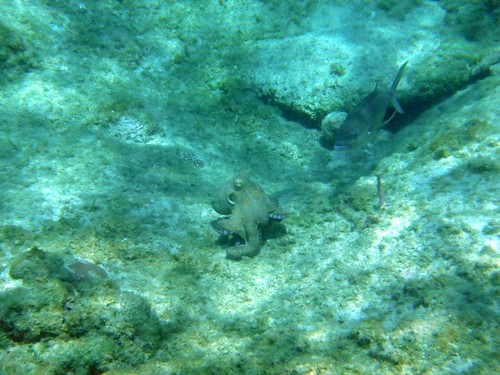
ObCephalopod: Cayman Islands reef octopus faces down boring vertebrate (Creative Commons photo by Pete)
The International Union for the Conservation of Nature’s World Conservation Congress is taking place right now in South Korea, and a report from Friday’s session is trickling through various social media, including The New York Times’ Green blog: Caribbean coral reefs are in trouble.
From the WCC’s coral reef workshop’s Executive Summary (PDF):
Some Caribbean reef ecosystems are relatively intact compared to average conditions in the region. For example, many reefs in the Netherlands Antilles and Cayman Islands have 30% or more live coral cover, little macroalgae, and a moderate (albeit strongly depleted) abundance of fish. In contrast, reefs in Jamaica and the US Virgin Islands have well below 10% live coral cover, abundant macroalgae, and virtually no fish larger than a few cm.
When local reefs that are 70% dead qualifies as “relatively intact compared to average conditions in the region,” headlines like NatGeo’s “Caribbean Coral Reefs Mostly Dead, IUCN Says” stop seeming quite so alarmist.
The issue with macroalgae is that they encroach on coral reefs and compete with the coral organisms. They’re often present in healthy reefs, kept in control by algae-eating animals. When those fish aren’t there for one reason or another, or when a reef gets a big shot of extra nutrients from on-shore fertilizers or eroded soil, the algae can get out of hand.
The Smithsonian Tropical Research Institute assembled 36 scientists in Panama to assess the region’s coral reefs, and the results of that work are what were presented at the WCC Friday. Researchers are pinning the damage on human interference. The precise mechanism by which we’re killing the reefs is open to question, but they have some prime suspects:
Caribbean reefs with the highest surviving coral cover and least macroalgae tend to be characterized by little land-based pollution, some degree of fisheries regulations and enforcement, moderate economic prosperity, and lower frequency of hurricanes, coral bleaching, and disease.
The team will have a more complete analysis of their data by mid-2013, and plan to expand their survey to other oceans’ reefs by 2016.
This isn’t a surprise: the degradation of Caribbean reefs has been talked for decades. Coral reefs serve as nurseries for commercially important fish species, they absorb wave energy and thus shelter coastlines from storm damage, and they’re just full of fascinating critters. Reefs can recover from our damage if we start to protect them: parts of Australia’s Great Barrier Reef recently recovered from bleaching events a lot more quickly than scientists had hoped.
But it’s still awful news.

How can you limit yourself to cats in a world full of strange creatures? Here’s a mammal I never even heard of before: it’s incredibly rare, it has a very limited range, it’s the lonely relic species (only two species, one in Spain and one in Russia, of its group left, all the rest are extinct) of a once diverse and successful tribe, and it’s really weird. It’s the Pyrenean Desman.
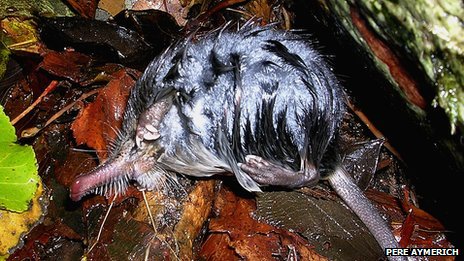
It’s a small aquatic mammal with a long snout fringed with sensitive whiskers, large hindlimbs with webbed feet, and small forelimbs; it lives in mountain streams in Spain and the Pyrenees, foraging for small crustaceans and snails in the muck. It’s a talpid, of the family of moles, but it’s uniquely adapted to swimming rather than digging.
It’s going extinct. Dams and development are destroying its habitat, and it seems to be particularly sensitive to pollution.
Wait, I say. Here is this exotic, obscure mammal with unique adaptations and its own special history, the product of a long, independent lineage of many tens of millions of years, and now, here in my brief lifetime, just as I learn about it, it looks like that novel genetic lineage will be shortly snuffed out, lost forever?
That seems to happen a lot around us humans. We need to learn to make room for our other partners on this planet.

To mate many times, see the eggs laid in droves, and to swim among the mighty accomplishments of fecund females!

(via Moss Landing Marine Labs)

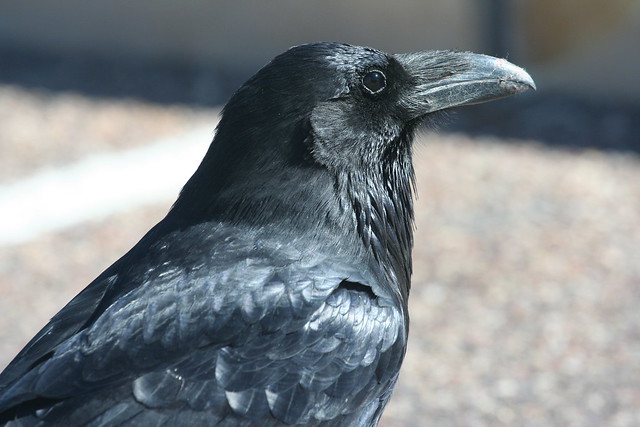
Member of a native invasive species in a parking lot at Petrified Forest NP, AZ
Lauren Kuehne has an interesting guest post at the blog Conservation Bytes talking about one of the most persistent false dichotomies in the environmental world: native versus exotic species.
A drawback to the attention garnered by high-profile invasive species is the tendency to infer that every non-native species is bad news, the inverse assumption being that all native species must be ‘good’. While this storyline works well for Hollywood films and faerie tales, in ecology the truth is rarely that simple.
There’s a desert angle here that I’ll talk about after the jump, along with some videographic reptile squee. You have been warned.