I’m currently in grading hell, so here, something to entertain you. Unless you’re a clam. If you’re a clam, don’t watch this.
I shouldn’t have bothered warning the clams. They’re stupid, they probably watched it anyway.

I’m currently in grading hell, so here, something to entertain you. Unless you’re a clam. If you’re a clam, don’t watch this.
I shouldn’t have bothered warning the clams. They’re stupid, they probably watched it anyway.

We’re not doing anything about slow, steady climate change, and we’re also not dealing with acute, local environmental risks, like the recent Washington mudslide.
The Snohomish County officials who control land use permits asserted last week that there was no way of knowing a giant mudslide would ever happen there.
In fact, the area was primed for just such an extraordinary event, according to geologist Daniel J. Miller, who twice surveyed the area for local Native American tribes who rely on the river’s health for fishing and for the Army Corps of Engineers. He wrote in his 1999 report that the Hazel Landslide, as the mountain is known, was constantly shifting, experiencing landslides and would one day suffer “a catastrophic failure.”
“This landslide moves every year when it gets wet, and pieces fall off,” said Miller, a consultant in Seattle, in a telephone interview Friday.
It was a nightmare waiting to happen.
An ancient glacier is jutting out of the mountain, making its flat plateau unstable, Miller said. The Stillaguamish River was eroding it from below. Rows of conifer trees that helped to mitigate erosion by sucking water through their roots and releasing it into the atmosphere were chopped down by loggers. Rain fell on the bald spots they left, drenching dirt and sand, making the mountain even more precarious.
March 2014 has been a record-breaker, the wettest in Seattle’s history.
Miller realized his warning was not heeded when he visited the site following a major landslide in 2006 that did not do nearly as much harm. He could not believe what he saw.
“There was new construction,” he said. “The sound of hammering competed with the sound of [destabilized] trees snapping after the mudslide. I can’t believe that someone wanted to build their home there. It was a very bad idea.”
Damn warmists and catastrophists — they keep hurting the economy, like homebuilding, with these warnings that the mountainsides have been made unstable by melting glaciers, logging, and heavy rains.
But don’t you worry. People will keep working along, because they’ve got Someone to tell them everything will be OK.
We’re a little logging community,she said.There are so many missing, so many dead. We definitely feel God protected us. My neighbor’s house is gone. My husband’s out there digging for bodies.
Thank God that God especially loved a few people so that they can dig for the corpses of those other people he really hated.
That woman, I hope, has read that article and had a moment of awareness in which she realized what a stupid thing she said. But nah, it won’t happen.

The eight year old girl who was trying to get the South Carolina legislature to make the woolly mammoth the state fossil has reason to be happy today: the ass of a state senator who was trying to insert Bible quotes into the bill, effectively killing it, has withdrawn his obstructionist amendment.
He said he removed his objection after another senator told him the story of how an 8-year-old Lake City girl had written to lawmakers suggesting the mammoth as the state fossil because fossilized mammoth teeth had been discovered in a swamp in the state in 1725.
Yeah, right. More like he saw that he was being perceived as the sanctimonious ogre who beats up on little girls, and withdrew in the face of withering scorn.

The IPCC has been issuing climate change warnings for 25 years. Here’s the net result:
But if we go back to brass tacks, it’s worth asking how the world has reacted to these repeated warnings.
Since 1990, annual global greenhouse gas emissions from burning fossil fuels have gone up 60 per cent.
Or perhaps you’d rather get it in cartoon form?
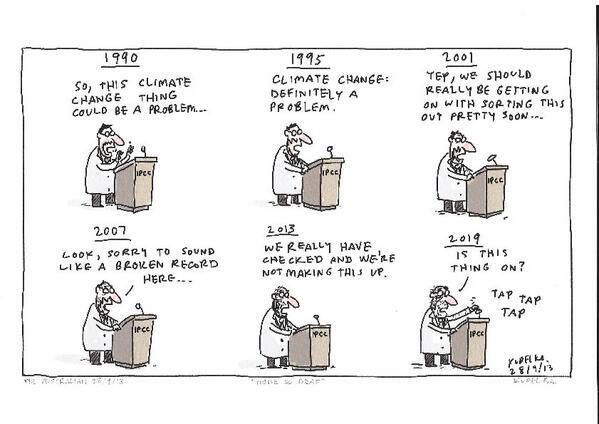
This is what happens when you ignored the scientists and instead obey the self-serving lies of industry.

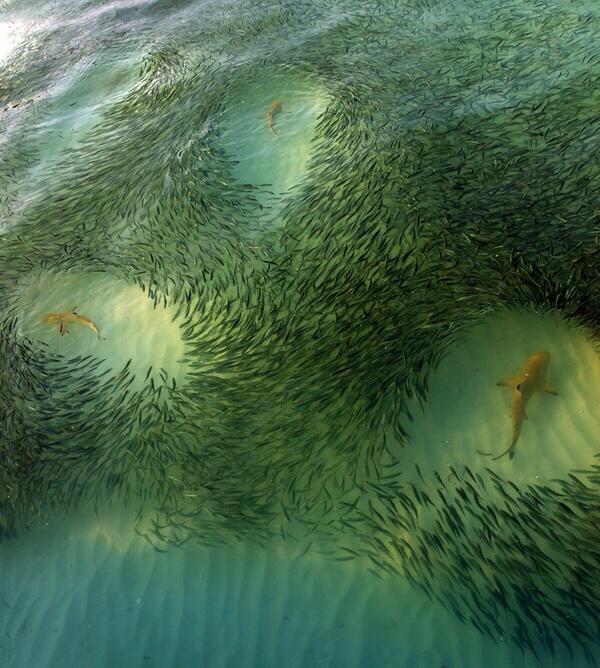
Karl Robertson

I, for one, welcome our glorious future of ubiquitous computing. Researchers have come up with a temporary tattoo that functions as a computer, complete with processing power, data storage, and wireless data reception and transmission. Also, drugs.
The researchers constructed the device by layering a package of stretchable nanomaterials — sensors that detect temperature and motion, resistive RAM for data storage, microheaters and drugs — onto a material that mimics the softness and flexibility of the skin. The result was a sticky patch containing a device roughly 4 centimetres long, 2 cm wide and 0.003 millimetres thick, says study co-author Nanshu Lu, a mechanical engineer at the University of Texas in Austin.
They’re not talking about recreational drugs (but maybe in a future update!), but that the purpose of this device is continuous physiological monitoring and delivery of therapeutic drugs in response, so a specific and very useful initial goal.
Give it a few years, though, and forget the iPhone and iWatch and iWhatever — I just my hands and forearms covered with fancy circuitry that does cool stuff.
Unfortunately, the article mentions one serious limitation: we’re waiting for the development of a thin, flexible battery to power all this gadgetry. Once that’s all worked out, though, it’ll be a wonderful fashion accessory to go with my transparent cranium.

Last night on Cosmos, Neil deGrasse Tyson explained how we know the universe is immensely old, and even took a sharp poke at that nonsensical idea that the earth is only about 6,000 years old. I figured there’d be some indignant squawking on the internet this morning, but no…the creationists are all quiet about it. Why? Well, some of them might have been tuned into the Walking Dead finale, since zombies and their theology are so copacetic. But the real reason is that they’re too busy freaking out over Noah.
The Discovery Institute is really pissed off (wait, you’re saying, why should they care about a movie that plays fast and loose with the Bible? Aren’t they a secular organization? Yeah, right). Their angle is that the movie is anti-human, because that’s all environmentalism is about, hating people.
Bottom line: Noah pushes hard on the modern environmentalist meme that — as I reported in The War on Humans — we are a terrible plague on the living Gaia. That message sells among a small group of progressive elites and misanthropic neo-earth religionists. But most of us do not consider ourselves to be cancers on the planet.
I’m sorry to have to tell you this, Discovery Institute, but yes you in particular are cancers on the culture and the planet. And have you considered the likelihood that the very worst destroyers do so confident that what they are doing is right and good, and that our personal narcissism is not exactly the most reliable measure of our worth?
They are also quite happy that humans exterminated entire species of megafauna. They deserved it, don’t you know, and had to go to allow people to live.
Whatever our role in the demise of megafauna, we should not look back in shame.
Early humans’ successful fight for survival gave us the chance to thrive. I am not upset with them: I am grateful.
For a bunch of anti-evolutionists, they sure are happy to cite ‘survival of the fittest’ as a justification for slaughter. You know, it wasn’t always a fight for survival.
Roman emperors curried favor with the public by upstaging their predecessors in killing more animals and producing more spectacular displays of slaughter (Morris 1990). Emperor Titus inaugurated the Roman Coliseum by declaring 100 days of celebration, during which enormous numbers of animals were speared by gladiators. On the opening day, 5,000 animals were slaughtered, and over the next two days, 3,000 more were killed (Morris 1990). The caged animals were kept underground in dungeons where they were not fed, and on the day of the festival, they were hauled in their cages onto lifts that brought them into the center of the arena. As the crowd roared with excitement, drums were beaten, trumpets blown, and the terrified animals were set loose (Attenborough 1987). Sometimes the animals were goaded to attack one another, and at other times, men armed with spears and tridents pursued them around barriers made from shrubs in imitation of hunts in the wild (Attenborough 1987). One arena hunt resulted in the killing of 300 Ostriches and 200 Alpine Chamois (Morris 1990).
Lions, Tigers, bears, bulls, Leopards, Giraffes and deer died after being tormented, stabbed and gored (Morris 1990). Big cats that had been starved were released into the ring where a human slave or prisoner of war was lashed to a post; the animals clawed at the person before they themselves were speared and stabbed by gladiators (Attenborough 1987). In some of the larger slaughters, 500 Lions, more than 400 Leopards, or 100 bears would be killed in a single day (Morris 1990). Hippos, even rhinoceroses and crocodiles, were brought into these arenas, and sometimes gladiators employed bizarre methods of killing such as decapitating fleeing ostriches with crescent-shaped arrows (Morris 1990).
Still grateful?
I grew up with farmers and ranchers, and I can tell you this, too: the slaughter continues. They tend to be ruthlessly intolerant of anything perceived as compromising their income. I’ve seen songbirds shot because “it was their farm, they can do what they want”.
And the big threat is habitat destruction — the prairies are almost all gone here in Minnesota, and the wetlands are being plowed over. It is not anti-human to want to preserve some natural beauty and protect biodiversity, because this is our planet and we should aspire to maintain it as something better than a giant sewage treatment plant for Homo sapiens. We are a lesser world for the absence of giant ground sloths and European lions and black rhinos — did we really have to kill them all so we could merely survive?

I had thought that Minnesota had a state fossil: it was the giant beaver, Castoroides ohioensis. But then I discovered that it wasn’t on the official list of Minnesota State Symbols, but was on the list of proposed symbols. So it never made it into law, although we do have a state photo (it’s awful) and a state muffin (blueberry).
I wonder if the same thing happened to the giant beaver that happened to South Carolina’s state fossil proposal. Olivia McConnell, an eight year old girl, had the bright idea to propose that the Woolly Mammoth ought to be the South Carolina state fossil, and she wrote a letter to the legislature suggesting it, and even giving good reasons for it.
1. One of the first discoveries of a vertebrae fossil in North America was on an S.C. plantation when slaves dug up wooly mammoth teeth from a swamp in 1725.
2. All but seven states have an official state fossil.
3. “Fossils tell us about our past.”
“Please work on this for me,” McConnell wrote to Ridgeway, signing her letter, “Your friend, Olivia.”
Nice idea. Good rationale. But then, along come the sanctimonious bible-floggers.
Sen. Kevin Bryant, a pharmacist and self-described born-again Christian who has compared President Obama with Osama bin Laden, voted to sustain a veto by Governor Nikki Haley of funding for a rape crisis center, and called climate change a “hoax,” proposed amending the bill to include three verses from the Book of Genesis detailing God’s creation of the Earth and its living inhabitants—including mammoths.
Bryant told The Daily Beast that the intent was never to hijack the bill.
I think it’s a good idea to designate the mammoth as the state fossil, I don’t have a problem with that. I just felt like it’d be a good thing to acknowledge the creator of the fossils.Bryant’s proposed amendment was originally ruled out of order by Lt. Governor Glenn McConnell (no relation to Olivia) because it introduced a new subject. Bryant has since submitted a more on-topic amendment, describing the Columbian Mammoth
as created on the Sixth Day with the beasts of the field.
The bill is now on hold. Olivia has apparently been following the legislative process as it moves along, and now has first-hand experience with stupidity, and has learned a valuable lesson in cynicism. Jeez, I’m a cynical old guy, and I’m pissed off.
I hope Olivia can retain some enthusiasm for science, even if she has lost faith in politics.


This poor woman in the Netherlands had a bone disorder that caused her skull to continuously thicken, pressing on her brain — so the doctors had a copy of her cranium made out of plastic on a 3-D printer, cut off the top of the skull, and replaced it. It worked, and she’s apparently feeling much better now. So the medical result was awesome.
But awesomer?
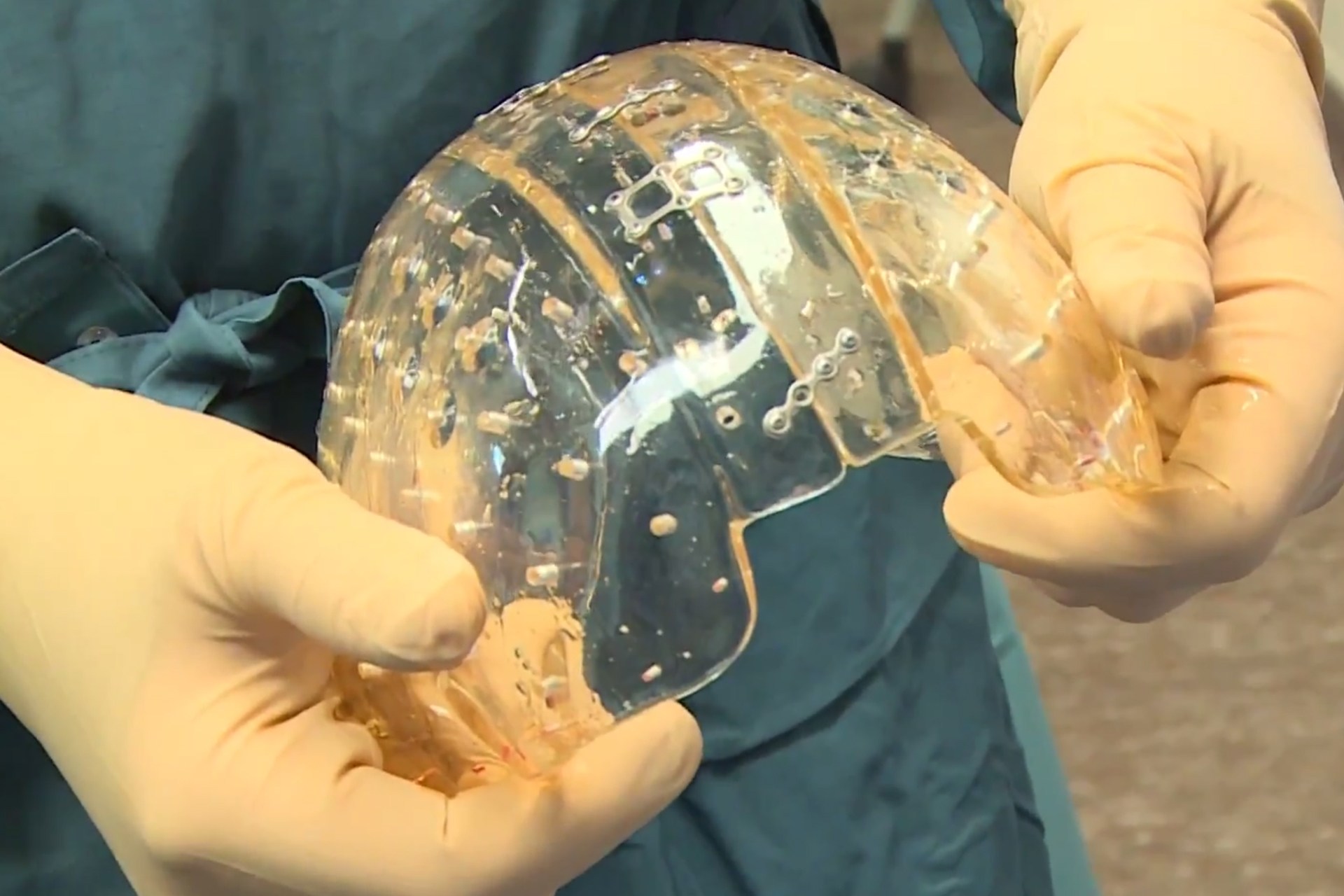
It was made out of transparent plastic. Now the doctors, of course, covered it up with her scalp and neatly stitched it all together so you can’t even see a scar anymore, but I was thinking, if I had it done, the best thing would be to simply remove all that skin and have my brain pulsing beneath a transparent dome. I’d even pay extra to have some LEDs inserted in patterns in the plastic. Can you imagine how cool it would be to teach neurobiology with your brain hanging out, decorated with little blinking lights?
Maybe someday. A guy can dream.
Here’s a video of the procedure.
Wow, but her skull was really thick. She would have been a master of the Glasgow Kiss, I think.