They’re already in their pajamas. The Monterey Bay Aquarium has a new exhibit of the Striped Pyjama Squid. Guess what they look like?
Pharyngula
Evolution, development, and random biological ejaculations from a godless liberal

They’re already in their pajamas. The Monterey Bay Aquarium has a new exhibit of the Striped Pyjama Squid. Guess what they look like?

Paul Campos commits a really good deconstruction of the NY Times article on Jason Lieb’s resignation for harassment. He teases out all the understated assumptions in the article, and exposes the biases that minimized the consequences of Lieb’s actions…and the culpability of the institutions that have been hiring him.
But this is also a case where I’ll tell you to read the comments. They’re entertaining. The audience seems to be lawyers and the so-called softer side of academia, and they’re all talking about how the sciences get so much more money, and how so many scientists are dismissive of philosophy and the liberal arts and think the humanities are worthless, and how STEM is hostile to women.
As someone imbedded in that STEM community, I would just like to say that they’re completely right. It’s a serious problem.

I’m teaching genetics. It’s pretty much 15 weeks of pushing flies around in the lab, although I have to say I do lecture about plant and bacterial genetics, so it’s not all animal stuff. But I have learned from Cell that I’m thinking about it all wrong.
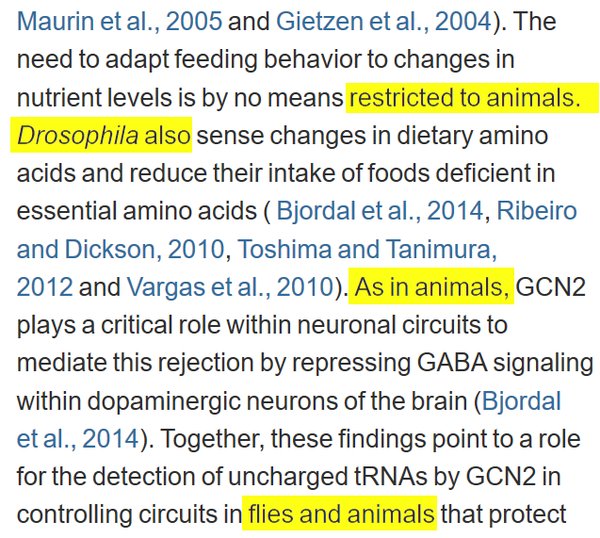
I’m now trying to figure out what kind of class this is. Am I teaching botany now? Or microbiology? Maybe flies are just ambulatory fungi now. I can never keep up with the taxonomy.
(via Björn Brembs)

You’ve all heard this kind of nonsense before, from the worst kind of ignorant creationist.
Evolution is not a fact. That’s why it’s called a theory! There’s more evidence that the Bible is true.
It’s just jam-packed with stupidity — if only we could condense science as densely as people do ignorance, we could educate everyone in a day. Evolution is a fact, there’s an immense amount of evidence for it; this person doesn’t understand the scientific meaning of “theory”; and no, there’s evidence that the Bible exists and was written by an assortment of human beings, but no evidence that it is of supernatural origin or contains a particularly accurate history of the universe.
Unfortunately, the person who wrote that pile of ineptitude was the head teacher at St Andrew’s Church of England school in Oswaldtwistle, Lancashire.
She is trying to defend herself against all the scorn being poured out against her.
Amid criticism and calls for her to resign on Twitter, Wilkinson issued a statement saying: “I’d like to make it clear that we teach the full national curriculum in school and that our pupils receive a fully rounded education.”
She also said her tweet was sent from a personal account and “represents my own views”. However, her Twitter handle was @WilkinsonHead, apparently referencing her role as headteacher.
That is not an adequate defense.
I’m glad to hear that the students are getting a proper education, in spite of the incompetence of the head teacher. But one has to wonder at her capabilities to implement that education when it defies her views of science, and one has to wonder why any institution would hire someone who rejects the values of their organization.
You are certainly allowed to have your own opinions. No one is saying that you can’t have strange opinions (I have a few of those myself) — the problem is that she’s promoting her own version of facts, which are contrary to reality and unsupportable, especially in the context of education. She can go to church, if she wants (and almost certainly does), but when she publicly hectors other teachers about the proper way to teach science, a subject she obviously has no talent in, then a response that tells her loudly and clearly that she’s wrong is not out of line. It’s actually necessary.

Maybe you haven’t noticed, but there’s been some fascinating arguments online about the proper way to analyze evolutionary trees. I’m not even going to try to dig into the details, but I thought this summary was clear and interesting. Go read that.

Peter Doherty explains the likely outcomes of the Zika virus pandemic.
What we are seeing in the Americas is a classic “virgin soil” epidemic. Enormous numbers of people and mosquitoes are being infected, the virus is transmitting at a very high level, and there may be as many as 4×10⁶ cases. Apart from affected neonates, all will likely recover, with increasing “background” immunity progressively limiting the number of new infections in subsequent years. The current molecular technology is such that making a protective vaccine should be technically straightforward, but the process of safety testing and evaluation could take several years.
…
The long-term prospect with Zika virus is that we will live reasonably comfortably with it, especially if there is a vaccine to protect women of reproductive age. The principal decision for responsible authorities, like National Governments in endemic areas and the WHO, is whether there is a case for fast-tracking, then funding, a vaccine to protect all young women. For the present, pregnant women are advised not to travel to these countries and, for those where this in not an issue, insect repellant also offers some protection against much nastier viruses like dengue and Chikungunya.
It’s spreading rapidly, and one contributor to that is the ridiculous attitudes of conservative Christianity, but this one, tragic as its consequences can be, isn’t the big pandemic that will kill us all. And the answer to it lies in natural properties of adaptive immunity and vaccines.

This claim that beards are good for you is unadulterated anecdotal nonsense.
In an investigation led by the BBC, beards were found to contain microbes that kill bacteria — in other words, a potential new kind of antibiotic.
First clue: the BBC is not a scientific institution. They’re a media company.
Second clue: they set up an imaginary conflict with a hypothesis by another media company: the New York Post.
By that point, the third paragraph, you can just dismiss the whole crapfest.
I kept going, but their whole methodology is pointless. They sent off swabs taken from men with beards to be dabbed on petri dishes, and some were found to have bacteriocidal properties. Whoop-de-doo. You can do that with dirt, too. Why are people surprised that there are complex and diverse interactions between organisms at the microbiological level?

At least, that’s what came to mind when I watched this video.
At the end, though, I wasn’t sure whether it was time to just throw the dish out, or time to inoculate it with phage.

It’s easy to find lists of dumb things creationists say, and I’m familiar with that lot, but here’s a fun new time-waster: Things Anti-Vaxxers Say. Here’s a beautiful example of something I’ve rarely seen so clearly stated: they get the facts totally wrong, actually the reverse of the actual situation, but nope, that doesn’t stop them from inventing a bogus rationalization around them.
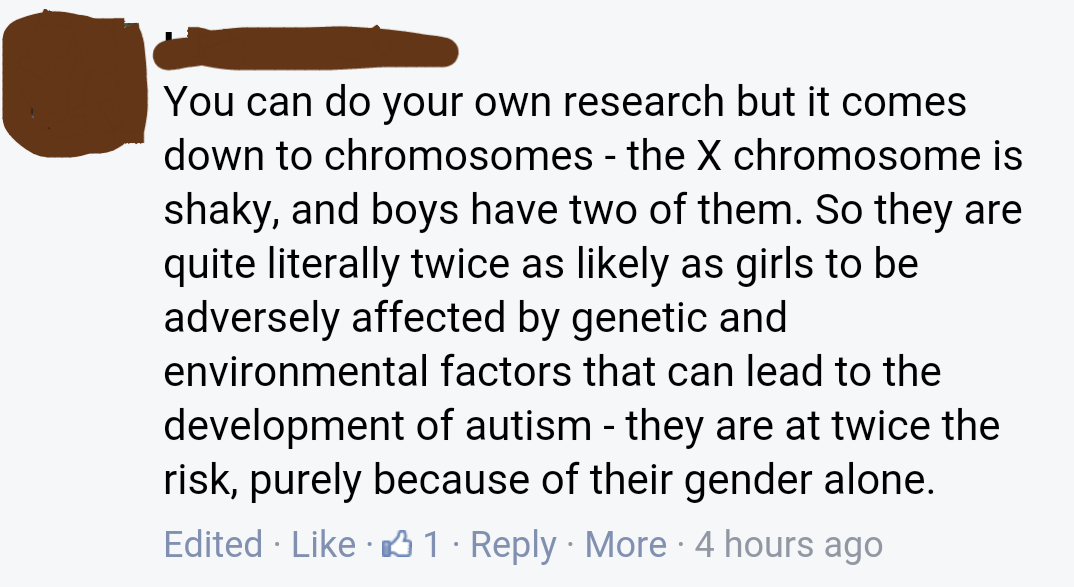
You can do your own research but it comes down to chromosomes — the X chromosome is shaky, and boys have two of them. So they are quite literally twice as likely as girls to be adversely affected by genetic and environmental factors that can lead to the development of autism — they are at twice the risk, purely because of their gender alone.
Uh-oh. I have 22 other chromosomes besides my sex chromosomes (I’ve actually seen them!), and…they’re all in pairs. I’m doomed.
But wait! I only have one X chromosome! I’m saved by the reduction in its pernicious influence!

There is a myth about how science progresses: great men have a eureka moment, and rush in to the lab to do the definitive experiment, often bravely and with the opposition of the Science Establishment, and single-handedly revolutionize a discipline. It’s nonsense. I can’t think of a single example of that kind of work that has gotten anywhere — the closest might be Isaac Newton, who developed some great ideas working privately at his home in Woolsthorpe, but even he was tightly connected to a community of fellow scientists. Science is very much a communal and communicative endeavor, and is built “on the shoulders of giants.”
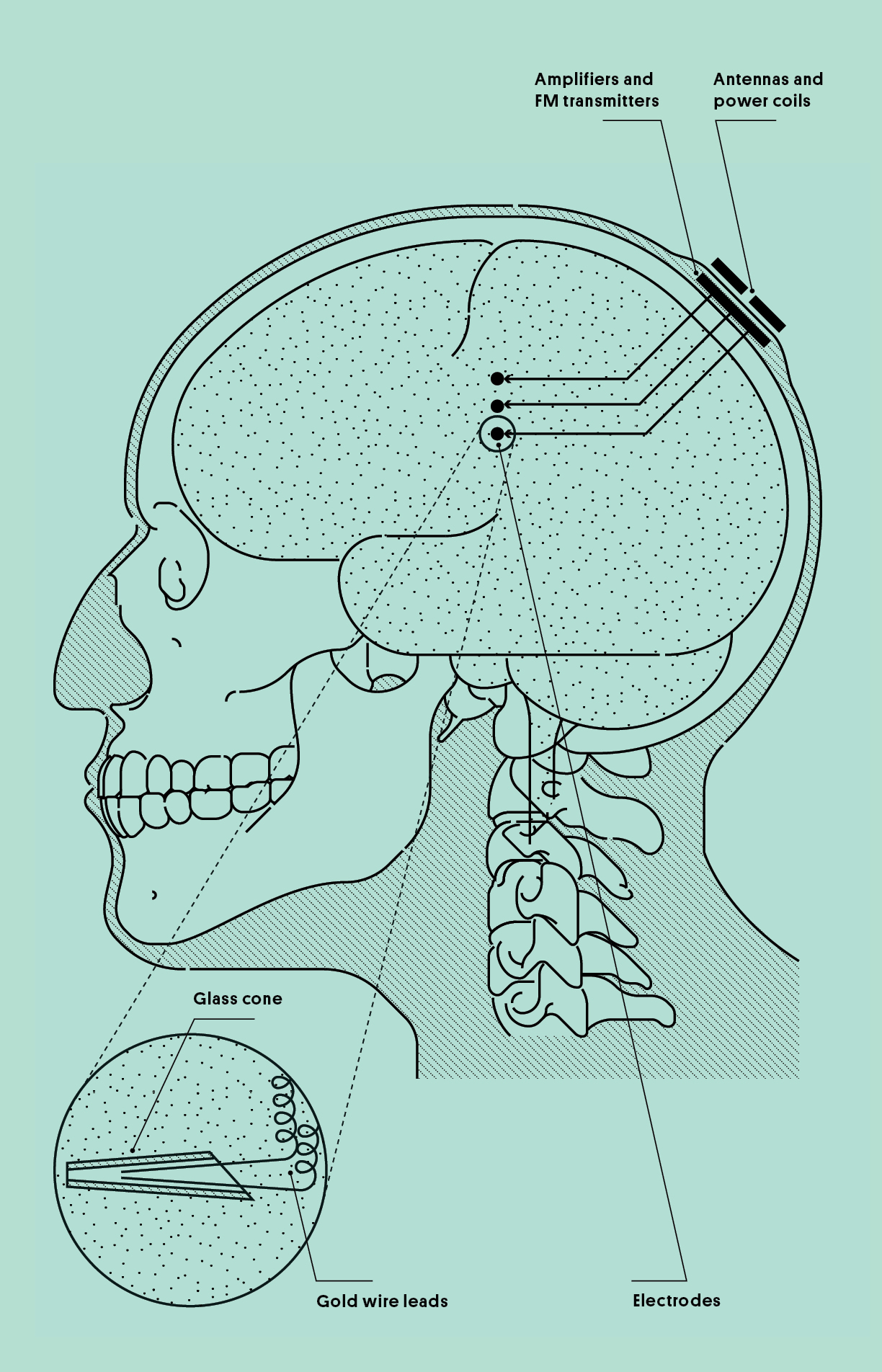
So I do not approve of the work of Phil Kennedy, which looks like a lot of hare-brained Frankensteinian self-indulgence. Kennedy could not get approval for his experiments in implanting electrodes in human brains — I wonder why? — so he charged off to the Caribbean and had bits of wire and glass stuck deep into his own brain. It did not go well.
The brain surgery lasted 11 and a half hours, beginning on the afternoon of June 21, 2014, and stretching into the Caribbean predawn of the next day. In the afternoon, after the anesthesia had worn off, the neurosurgeon came in, removed his wire-frame glasses, and held them up for his bandaged patient to examine. “What are these called?” he asked.
Phil Kennedy stared at the glasses for a moment. Then his gaze drifted up to the ceiling and over to the television. “Uh … uh … ai … aiee,” he stammered after a while, “… aiee … aiee … aiee.”
Don’t worry, he got better — his deficits were caused by post-operative swelling of his brain, and that eventually diminished, and he started recording data off his electrode.
