
They’re planning armageddon.
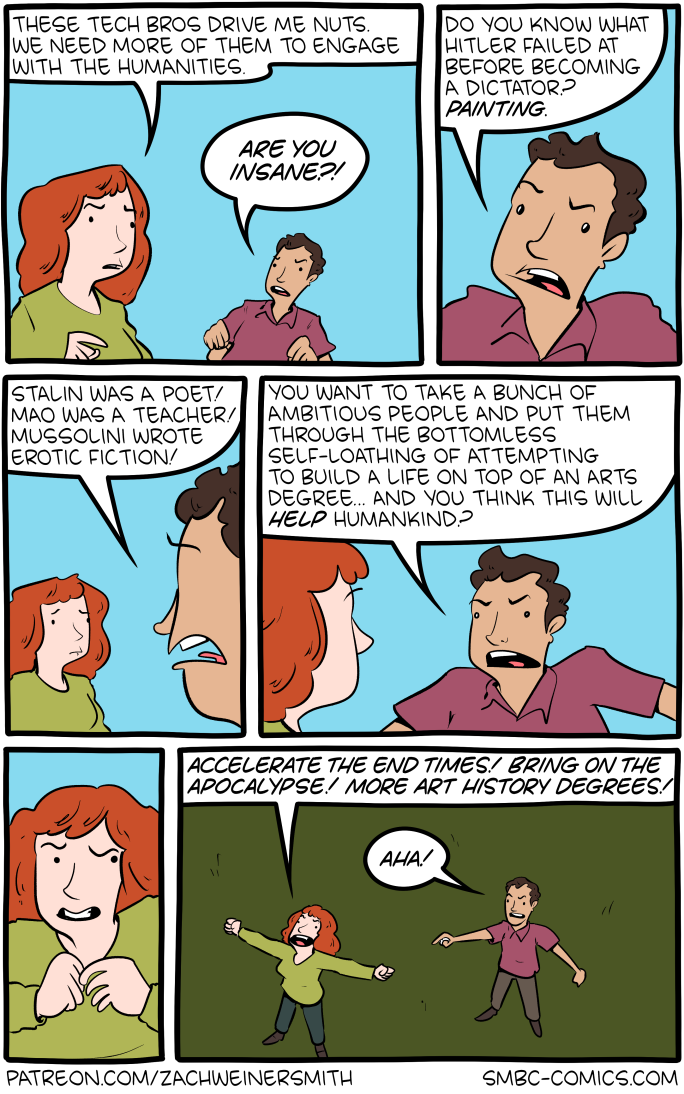
The floating text for this cartoon reads, “Anyone who thinks the humanities makes people more expansive should spend four minutes in an English department meeting.” It’s too true. I would never go over to the other side of my campus for one of their meetings, but here in the sciences building we have a statistician as chair who bangs through the meeting agenda on a tight schedule and doesn’t permit too much digression. We’re scared of the anarchy in the English department.
I don’t want to try to imagine what’s happening in the Art or Music departments. I’m pretty sure it involves other-worldly horrors and ritualistic chanting.

A cheerful “Cthulhu R’lyeh Ftagn” to you from Liberal Arts!
It’s a confusion between cause and effect. Just because most sensible people will appreciate the value of art does not mean that teaching art will result in sensible people.
Once people have lost their empathy, teaching arts and humanities will not correct the issue. It’s like teaching proper driving rules to someone who actively wants to ram their car into a crowd of innocent people. It’s trying to fix the wrong problem.
As the sensationalist reporter said during the airship crash: ‘Oh, the Humanities’
Speaking of Reason vs. Emotion:
https://static.existentialcomics.com/comics/ReasonandPassion.png
Our founder was a librarian in a college music dept. He remembers an old joke:
boy1: my mom plays piano by ear!
boy2: That’s nothing, my grandpa fiddles with his whiskers!
I’ve gotta’ lighten things up after all the doomscrolling with morons in PZ’s article /2026/03/30/they-never-learn-2/
We really like this site. To get a better, more complete experience, see:
https://existentialcomics.com
Easter Egg: If you hover over the headline (with any decent browser), you will get a different remark of the day each day.
All of the offices in the Humanities building have papier-mache jammed into the inner angles of the rooms. If the meetings go on too long you can sometimes hear the hounds trying to get through.
Rich refers to https://en.wikipedia.org/wiki/Hounds_of_Tindalos
@#6 Not to be confused with the Sounds of Tindalos
We need to teach empathy. As in, classes specifically geared towards teaching students empathy, at every level of education. Teaching arts and the humanities is about teaching arts and the humanities first and foremost. Those things are valuable in and of themselves, and they may foster the growth of empathy in people who already understand empathy to some extent, but they’re not about teaching empathy.
The simple truth is that, if you want people with little or no understanding of the concept to learn empathy in a classroom, then you have to teach them empathy in the classroom. We have this idea that empathy is an innate characteristic that one either has or doesn’t, but that’s simply not true. Empathy is a skill, and it can be taught like any other.
Empathy must be taught, if we are ever to have a hope of creating a society in which people understand civilization- and survival-critical concepts like the common good, or why things like enslaving millions and ruining the environment to produce cheap crap for the short-term enrichment of an extremely tiny minority of humans is bad.
vucodlak: “We need to teach empathy. As in, classes specifically geared towards teaching students empathy, at every level of education.”
Futile. Equine hydration syndrome.
Analogically, I was taught religion. It did not take, to understate it.
Same thing. All you can teach is to fake it, if it’s not in one’s nature.
(That is, affective vs. cognitive)
“Empathy must be taught”
It can be developed and improved, but it cannot be taught.
You can’t change people’s basic nature by teaching shit.
@John #9. Is that true though?
Certainly there are people incapable of empathy. Some don’t even know what we mean by it, like a blind person trying to grasp color.
But empathy can, I think, be understood and appropriate responses built by the intellect, even if empathy is not built in.
Its an interesting thought. I might toddle off and see what research is available.
DanDare, unfortunately, there are few human universals.
Empathy ≠ theory of mind.
(Also, empathy ≠ sympathy)
Alas, affective empathy can be operationalised for cruelty, not because empathy motivates harm, but because the informational component of affective resonance sharpens the model of what will hurt most.
@ John Morales, #9
You may as well say that teaching math is futile because some people never grasp more than basic arithmetic, or that teaching basic language skills is futile because some people choose to never read anything more complicated than a stop sign.
So… your argument is that, because you can choose not to use things you were taught, or reject them outright, it’s futile to teach them? You can say that of literally anything we teach children. That doesn’t mean we should just turn them lose in the wilderness until they’re 18 and hope they pick up what they need to be productive members of society.
I, too, was taught a religion. I learned it, and I worked it like any other thing I was taught. When I finally broke past the “never question” part of it and realized what I was taught was some pretty evil shit, I rejected it. I tried another for a while, but it didn’t work out like I expected so I rejected all religion. After about a decade, I started learning a different religion.
“Religious” is not an innate characteristic. I choose to be religious because, among other things, it fills a need in me. Many people don’t have that need, and I definitely don’t think it’s necessary for a society to have religion. I know there are many who would argue that no one actually has a need for religion, and I’m not sure I agree with that, but I think that’s a topic for another time. Whatever the case, I don’t think religiousness is analogous to empathy.
Let me put this a different way:
We all need to eat. I’ve learned to cook because I want to be able to make foods that I and others can enjoy, but that wasn’t actually necessary. Neither I nor anyone else has to cook in order to eat. However, it’s far better for society that someone prepares food people eat safely.
Cooking and safe food handling practices, I would argue, is a better analogy for empathy than religion. Can our civilization survive without cooking? Yes, but food-borne illness would take a heavy toll. Likewise, civilization can survive without empathy, but the lack thereof exacts a heavy toll indeed.
Utter and complete nonsense. Empathy is a skill. It’s not like being a wizard in some fantasy book where you’re either born with the ‘magic’ of empathy or not. That some people seem to have an innate knack for it while others have to learn it does not make it something one has or has not anymore than not having a head for numbers makes one incapable of grasping addition and subtraction.
It is in my nature to be cruel and violent. In fact, a part of me enjoys violence a great deal. If I hadn’t been taught empathy (and if I’d drowned a few million brain cells in pure grain alcohol) I could very well have turned out like Petey Kegsbreath. Alas, a number of people taught me empathy, so I learned not to be a complete fucking monster.
I still have impulses to violence. I have them all the time. That’s my nature. My parents are and were angry, cruel, violent people. My mother was particularly adept at subtle cruelties, while my father was and is more given to rage. That is my inheritance, both what I was taught, and I suspect that it’s at least partly organic as well.
It was from books, television, my grandmother, and a few friends that I learned empathy was a better path to the kind of world I want to live in. I don’t act on those impulses because I’ve learned that other living things also feel pain and sorrow and fear, and it’s not right to inflict on them what I haven’t wanted inflicted on me.
I won’t pretend that it was easy to learn. Every day I struggle against what I am with what I have learned. However, given that I’m not a serial killer or mass murderer, I can safely say that empathy can not only be learned, but it can win out over both nature and a great deal of… I guess I’ll go ahead and call it “nurture,” although it galls me a bit to do so.
The point of that meandering story is that I firmly believe that, barring organic issues like brain damage, the vast majority of people can learn empathy if they apply themselves. Not everyone, no; I would never claim that. Some won’t be able, and some simply won’t care enough to try, any more than everyone we try to teach to read will bother to use the skill. That doesn’t make it futile to try.
Civilization would be better off if we treated empathy the same way we treat literacy, and try to teach as many people as possible. It’s far more difficult to allow other people to come to harm when you understand that they’re just people pretty much like you. Not impossible, but harder.
What? No I don’t.
I don’t even think you think I think that.
No. No, I do not.
Ever heard of mirror neurons?
You lacked empathy until you were taught it. Got it.
Futile. As I noted.
All it means is one can apprehend the sentiments others feel.
As I noted, useful for torturers and for those anyone who wish to cause pain with precision, because affective access gives them the felt‑sense of exactly where and how to hurt.
Stupid. Not many people are like me, at all.
(Luckily, nor like you)
But now you are empathetic, thanks to books, television, my grandmother, and a few friends.
You get to avoid your nature, or so you think.
I don’t fool myself in that manner.
I am what I am, so I don’t lie to myself.
X-D
(For extra comedy value, Morales in posting this on… the internet.)
Srsly. It’s like this guy’s auditioning to play Ted Bundy. I mean, c’mon.
vucodlak @#12 I think ‘upbringing’ would be a less kindly sounding word.
And that should have had this additional bit – although I realise you are contrasting nature and nurture.
Prof Myers: Don’t confuse arts and humanities faculty with students, even majors, and don’t judge those majors on the basis of what happens in faculty meetings.
Perhaps the larger problem is that, traditionally, the arts and humanities were the core of a ‘liberal arts’ education, and at least since WWII the sciences, even the soft sciences, have come to occupy a larger and larger place in academic life, especially in academic budgets. At the 3 R1s at which I taught, the English department in each was the largest single academic department in the university, and the English faculty had a number of tactics for maintaining that supply of faculty lines and budgets. For example, universities often have a freshman comp requirement, and freshman comp is often taught by English Lit grad students, whose graduate careers are supported by TAships and instructor positions. At my last university, I pointed out to our provost that grad students in many departments would be perfectly qualified to teach freshman comp, and could even tailor such a course to student interests: writing in chemistry is not the same as writing in philosophy or literature, so why not have a chemistry grad student teach a freshman comp course for STEM majors? The provost laughed and said that the English department would never stand for it — they controlled 33% of all TAships in the college of arts and sciences and would never give that up. That’s just one example of the larger issues…. I’ll step down from the soap box.
Okay, that’s really weird. I posted a link to a song called “The Sounds of Tindalos”. On my laptop, that’s the song that shows up. On my desktop, it shows up as a Smashing Pumpkins song.
@NitricAcid:
And I’m seeing ‘White Stripes – The Hardest Button to Button’ with a Simpson-esque static image.
@ John Morales, #14
I never said you do, did I? I said you may as well. It’s a comparison, and I know you know that, so I don’t know why you’re pretending I was saying that I believe you believe those things.
Yes. You are aware that brains are not immutable lumps of hardware installed at birth, aren’t you? As we learn and experience the world, our brains change. A person with a difference in one area can often nevertheless adapt and learn to live among those different from themselves.
If torturers possessed a functioning sense of empathy, they could not be torturers. All being a skilled torturer requires are reasonably good observational skills and a lack of empathy. It’s not hard to see that others suffer when you deprive them of sleep or oxygen. You don’t have to share in their suffering to know that sawing off someone else’s toe will cause them pain.
Yes, you’re a special snowflake surrounded by dull motes of dust.
On the contrary: there are lots of people like me. The savage bloodlust I feel is nothing special or particularly interesting. It’s certainly not a superpower, as so many in the current US ruling regime seem to think it is.
Yep. I am inclined to cruelty and violence, and I am restrained by empathy.
LOL no. Not ever. I would love to be able to avoid it, but everywhere I go, there I am, wanting to tear someone’s skin off and eat it because they’re standing too close to me. I don’t, because A.) empathy and B.) people taste bad.
I jest, but I’m also dead serious. I don’t get to play the fool and pretend I am something I’m not. Violence comes too easily to me, and if I ever forgot that I might harm someone.
Whatever lets you sleep at night.
Ah, feisty vucodlak. Fair enough.
Why? That is entirely different. No. I may not as well, because that would be stupid.
Your brain may mutate, mine just works.
You cannot teach empathy any more than you can teach religiosity or kindness or homosexuality or whatever. It’s a disposition!
You can teach how it works, how to fake it, you can even develop what is there.
Clueless, you are. I already gave you the nub of it: what they lack is sympathy.
The empathy is helpful.
Fact is that (e.g. ) childhood abuse survivors often develop exquisitely sensitive cognitive and affective empathy for threat, fear, humiliation, and vulnerability. Then they go on to abuse others as adults.
Everyone is fucking special. We are all unique. And you are the one who generalises, not me.
Now, if you truly imagine I am just like you, fair enough. But I am not.
Do I seem like the typical commenter here? Not in any way special?
(heh!)
Right.
So when you say , that is pure wishful thinking.
(One’s nature is what one does!)
Bullshit. That’s like a cat puffing its fur.
The irony is amusing.
I don’t need such crutches to sleep at night.
Facts are inescapable.
And I don’t pretend to be a violent cruel monster who is not actually cruel or violent because they were taught empathy.
Shared feeling is what it means. Look it up.
You do get one can feel empathy for, say, Donald Trump? Understand his feelings and motives viscerally?
Thing is, you do that stupid thing that imagines empathy is a positive, kind, nice thing.
It ain’t.
vucodlak, palliative for you (I do like you): https://ifp.nyu.edu/2024/journal-article-abstracts/bul0000453/
Categories of training to improve empathy: A systematic review and meta-analysis.
Psychological Bulletin, Vol 150(10), Oct 2024, 1237-1260; doi:10.1037/bul0000453
Due to the vital role of empathy in promoting prosocial behaviors and nurturing social bonds, there is a growing interest in cultivating empathy. Yet, the effectiveness of existing training methods on empathy, especially on different dimensions of empathy (i.e., affective, cognitive, motivational, and behavioral empathy), varies tremendously, and the underlying causes for this heterogeneity remain insufficiently explored. To address this issue, we categorized various training methods into three distinct approaches based on the premise that empathy can be influenced by factors associated with the subject, the object, and their relationship. Respectively, these are Subject-Oriented, Object-Oriented, and Socially Oriented approaches. To examine the effects of training and sustainability of these approaches on different dimensions of empathy, we conducted a meta-analysis encompassing 110 eligible studies with 32, 44, 39, 39, and 91 samples for affective, cognitive, motivational, behavioral, and composite empathy, respectively. Results showed that trainings produced small and unsustainable effects on affective empathy, moderate and unsustainable effects on cognitive empathy, small and sustainable effects on motivational empathy, and moderate and sustainable effects on behavioral empathy. The effects of training on composite empathy were robust but decreased over time. Among the three training approaches, Socially Oriented approaches were the most effective in improving all dimensions of empathy. Subject-Oriented and Object-Oriented approaches were effective only in improving cognitive and composite empathy. Altogether, our study offers practical guidance for selecting appropriate training approaches and proposes theoretical principles for developing optimal training strategies in both basic research and clinical applications. (PsycInfo Database Record (c) 2024 APA, all rights reserved)
[one can read the full article]