That’s quite a headline

Dr Gary Kohls is extraordinarily angry about a deep injustice that he writes about in a column for the Duluth Reader, but it might take a while for you to figure out what it is. It’s certainly not in the headline: Lessons from Martin Niemoller for Justice-seeking Activists that are Currently Being Oppressed by Government, Corporate or the Mainstream Media Powers-That-Be America has been Taken Over by Anti-democratic Forces that are Inside Both Government and Industry – and Your Movement Could be Their Next Target. It starts with the usual quote from Martin Niemoller, about Nazis. Then it has a long quote from The Invisible Government, an 1963 book about stealthy government agencies, like the CIA. Then it has a third long quote from a book titled Greed, Inc., about sociopathic corporations. OK, I get it: there’s an evil, Nazi-like cabal of capitalist corporations and secret spy organizations planning to…what? That’s what it takes a while to figure out.

It turns out that this wicked camarilla is out to … vaccinate children. His strategy in this article is to constantly associate vaccines with Nazis, to the point where it becomes a parody of itself.

The Godfather of Propaganda, Joseph Goebbels (loyal Hitlerite and Nazi Minister of Propaganda and Public Enlightenment), didn’t have an internet to spread his propaganda, but he had the planet’s newest technology – the radio – and he had his brownshirt thugs who were energized and mobilized by the many Nazi rallies and the even more frequent radio broadcasts that got the fascist message across.

It was on Hitler’s orders that these brownshirts burned every book that had been written by anti-fascist intellectuals (communists, socialists, liberals) throughout history. Brownshirt thugs later gleefully smashed every liberal printing press in Germany and imprisoned every liberal newspaper editor and journalist, thus accomplishing even more efficiently what the tyrannical powers-that-be are all trying to do in our supposedly democratic society.

Authoritarian entities inside wealthy, powerful and influential Big Corporations like the pharmaceutical corporations put a lot of money and strategizing effort into silencing pro-justice activists that pose threats to their profits, even when the activists have unbiased science on their side.

Two perfect examples that I am personally involved in are the world-wide anti-over-vaccination movement and the opposition to the experimental copper mining planned for the lakes area of northeast Minnesota. The efforts to silence the truth-tellers in those two movements will soon be applied to other resistance movements that are happening simultaneously.

OK, I can sympathize with his stance in opposition to allowing mining interests to rip into the Boundary Waters, one of the natural treasures of this state. I don’t think, though, that they’ve got an army of brownshirts imprisoning liberals and burning canoeing guidebooks.

I also don’t think that doctors following tested, safe vaccination protocols are at all equivalent to concentration camp guards. You want to convince the public that anti-vaxxers are nuts? This is how you convince the public that anti-vaxxers are nuts.

Then he closes his argument with 17 mostly irrelevant quotes from various people like Robert F. Kennedy and Joseph Goebbels. All right, Gary G. Kohls, MD. You’ve persuaded me. You’re a kook. Also a bad, lazy writer who pads his columns with extensive over-quoting.

Hey, @carinbondar and Olivia Judson!

@RD_Denton will be using your books this summer!

Also, hey students, this looks like fun.

This course will be an broad introduction to Biology (genetics, evolution, development, ecology, behavior) through the lens of sexual reproduction. The students will be reading two great books aimed at general audiences (Dr. Tatiana’s Sex Advice for All Creation by Olivia Judson and Wild Sex by Carin Bondar), taking part in classroom discussions/activities, and video-chatting with multiple scientists who study reproductive biology and evolution.

Bad science on vaccines from a so-called science fiction author

The anti-vaxxers aren’t my usual beat, but this guy was so egregiously ignorant I couldn’t sit quietly. Jon Del Arroz, “the leading Hispanic voice in science fiction” (we’ve encountered him on these pages before) believes that vaccines are population control and makes some very silly arguments.

Rockland County has in effect declared Martial Law on its citizens because of the measles. The media is calling it an “unprecedented move” as it’s banning children from public places.

Something smells fishy here.

Those are two useful words, “in effect”. No, Rockland County did not declare martial law. They declared a state of emergency because they’ve had a constant stream of measles cases for six month, and they’ve only banned infected children from public spaces. They are trying to break the chain of transmission by telling people you can’t stage involuntary pox parties and infect other people’s children.

Misrepresenting the situation is not a promising start.

First, if vaccines worked so well and they made us all immune, why should we be panicked about someone having it?

Because not everyone has been vaccinated. Babies typically are vaccinated against measles at 12-15 months…so my baby granddaughter, for instance, is still vulnerable. Why does Jon Del Arroz want to make babies sick? Does he just hate children?

Also some people are immuno-comprised and more susceptible. Then there are all the dangerous fools who think vaccines are bad and have avoided them for themselves and their children — and while it might seem just that they should suffer from a life-threatening disease and remove themselves from the gene pool, it is not what a humane society should do.

The whole claim is that this ends the disease and we have to therefore inject tons of dead viruses into our body in order to have a healthy society. It seems counterintuitive that we should then be scared of the same disease we were told we eradicated.

Measles was eradicated from the Americas by diligent vaccination efforts. However, it’s still prevalent worldwide, and almost 100,000 people die of measles every year. It’s staging a comeback here in the US because we’ve accumulated a vulnerable sub-population who refuse vaccination for specious reasons. We’d rather reduce that population which acts as a breeding ground for disease by vaccinating them, than by allowing them to die.

The truth is, most outbreaks of measles and mumps happen to VACCINATED people. So it appears whatever vaccine is being used is not all that effective. For outbreaks to be a big problem, this would have to be the case, and it means all the shutting down discussion on any vaccine topic by shaming anyone trying to discuss it seems to have a deeper purpose.

This is flatly false. People who have been vaccinated are safe from measles outbreaks, according to the CDC. However, roughly 10% of the American population has not been vaccinated against measles. Those are the people we’re concerned about.

10% of the US population is about 32 million people. Why do you hate your fellow Americans, Jon Del Arroz?

Second, how many people constitutes an “outbreak?” We’re told it’s only 150 cases in the last year or so. How many people have it now? 154 over an entire year spread out could mean as little as 4-5 people have the disease.

And yet they declared martial law.

It’s not martial law.

The disease was declared eradicated in the US because the chain of transmission was broken by the relatively high rate of vaccination — you were unlikely to encounter someone with the disease, so even if you were susceptible, it wasn’t likely that you’d meet someone who was infected. In local areas like Rockland County, where the number of infected individuals has risen, that’s no longer true — susceptible people, like little babies, have a good chance of randomly encountering a measles carrier. That’s the purpose of the state of emergency, to get people to stop risking other peoples lives and health by bringing the measles virus into public spaces.

It’s very similar to government overreach in New Zealand based on one shooting–they’re grabbing all of the populace’s guns.

Oh god. One track minds.

It’s more like telling people they aren’t allowed to fire their guns randomly into public spaces. You believe in responsible gun ownership, don’t you, Jon Del Arroz? Why do you think people should be allowed to spew infectious snot into crowds?

On the vaccine end, the discussions need to be had. Is every vaccine effective? Is putting them all together in a cocktail healthy for children? Or is there something else at play? Are these used for something else, like creating a populace who ARE chronically diseased all the time and further dependent on the government healthcare?

These discussions have been had. Where were you? You can find discussions of vaccine policy in the scientific literature and at places like the CDC.

Different vaccines have different degrees of effectiveness, because infectious organisms and viruses evolve. Influenza varies frequently, for instance. The measles vaccine is effective and safe.

The vaccine schedule has been empirically evaluated and determined to be safe, much safer than the diseases they prevent.

Vaccines do not make you chronically diseased. They prevent disease states. You will need less healthcare, government or otherwise, if you don’t catch a disease than if you catch one. Your conspiracy theories are bogus.

Our own president said it: “Healthy young child goes to doctor, gets pumped with massive shot of many vaccines, doesn’t feel good and changes – AUTISM. Many such cases!”

I’ve yet to see him be wrong.

Vaccines do not cause autism. It’s been tested over and over again. Your own president was wrong.

He has also made claims about Puerto Rico that were factually wrong. He was wrong about Mexico. Do you also believe that wind turbines cause cancer?

Jon Del Arroz is a science fiction author, emphasis on the fiction part. I prefer that my SF authors have at least a passing acquaintance with how science works. Jeez, at least learn how to look the facts up.

Signs of Spring (spider edition)

It’s an unboxing video! I hear those are popular. Only what I’m unboxing is a pair of spider egg cases.

Spoiler: I don’t find any spiderlings inside. I find evidence of them being there, in bits of molted cuticles, but nothing was moving. I’ll let them warm up for a few days and look again.

If you want to know more about how spiders overwinter, here’s a source:

Tanaka K (1997) Evolutionary Relationship between Diapause and Cold Hardiness in the House Spider, Achaearanea tepidariorum (Araneae: Theridiidae). Journal of Insect Physiology 43(3):271-274.

The relationship between diapause and cold hardiness of the house spider, Achaearanea tepidariorum, differed geographically. In a cool-temperate population, enhanced chilling tolerance and supercooling ability were observed in diapause individuals, whereas a subtropical population showed only chilling tolerance. Because this spider is considered to be of tropical origin, it would follow that the ancestral diapause of this spider was equipped with chilling tolerance, but not with an increased supercooling ability. It seems that the ability to lower the supercooling point evolved through natural selection in the course of expansion of this species to the northern climates.

Now I have an excuse to visit Florida on a collecting trip, to gather representatives of southern populations. Maybe I should go in, like, February.

One other thought I had about the barrenness of these egg cases: it’s like the Donner expedition. Maybe one of the ways spiderlings survive the long cold winter is by eating their siblings, and this winter was particularly harsh.

Discovery Channel is evolving into the Men’s Pulp channel

Several years ago, the Discovery Channel had this successful promotion featuring people singing “boom de yada” while doing awesome sciencey things, mostly. They were also promoting shows about fishing and blowing things up, but OK, it was sweet and memorable. It also featured brief clips of women doing things.

I guess they tried to repeat the success this year, only they forgot someone.

OK, all the stuff about manly men cleaning crab and driving cars and blowing stuff up again is…well, all right, it’s a way to get people interested in science, at least, even if it is only tangentially related to science. I try to be open-minded about approaches to stirring up enthusiasm for science. But it’s all men doing stereotypically masculine activities — there is precisely one woman in the whole thing, she doesn’t speak, she’s wearing skimpy clothing in a long shot as she walks through a forest. That’s it!

Come on, Discovery Channel. I know actual intellectual, thoughtful content isn’t on brand for you, but could you at least have a woman blowing up a truck while swimming with a shark or something?

It reminds me of all those men’s magazines from the 1960s which showed men in dangerous situations (everything in Nature is trying to kill you, you know, even turtles, and your role is to fight them off to rescue Your Woman). Discovery Channel is regressing. Maybe they should rename themselves the Saga or Argosy or True Men channel.

Tucker Carlson is simply a dumb, sexist bully

I got glasses in high school. It was great — I still remember marveling at all the things I could see. Apparently, objects 10 feet away from you aren’t supposed to be blurry. I also remember the school bullies having a blast laughing at ol’ four eyes, who was clearly a nerd now, with the final signifier in place.

Smarmy, sneering Tucker Carlson reminded me so much of those chickenshit bullies. He recently went on air to mock Chris Hayes for wearing glasses, which was a symptom now of being a feminist. Further, he spoke contemptuously of Alexandria Ocasio-Cortez, a woman and “29 year old former bartender” who dared to talk about science. Chris Hayes is what every man would be if feminists had power. I had no idea that forcing men to wear glasses even if they didn’t need them was on the feminist agenda; I guess we’re all going to be forced to get degrees from Brown University and a Harvard fellowship, too.

There was more. He compared Hayes to Ellen Degeneres, as if that was some terrible insult.

“He looks like Ellen, kind of a fusion show,” Carlson said. “But did you hear what he said? Our only hope for survival. Holy smokes. That is terrifying. Help us, Chris Hayes.”

That’s not what Hayes said, of course. He said that some saw the Green New Deal as the only way of protecting our way of life. But Carlson’s frequent shtick isn’t to engage with arguments on the merit, preferring, instead, to levy insults.

As he did when first mentioning Hayes.

“Chris Hayes is what every man would be if feminists ever achieve absolute power in this country,” Carlson said. “Apologetic, bespectacled and deeply, deeply concerned about global warming and the patriarchal systems that cause it.”

Let’s compare Carlson to what science says…or at least, what one correlational study found.

To measure this, the researchers looked at Google searches for terms that associated with that insecurity — erectile dysfunction, hair loss, “how to get girls,” etc. — and cross-referenced the frequency of those searches with voting patterns in 2016 and 2018.

“We found that support for [President] Trump in the 2016 election was higher in areas that had more searches for topics such as ‘erectile dysfunction,’ ” the researchers wrote in an article for The Post. “Moreover, this relationship persisted after accounting for demographic attributes in media markets, such as education levels and racial composition, as well as searches for topics unrelated to fragile masculinity, such as ‘breast augmentation’ and ‘menopause.’ ”

But maybe the fact that Carlson is bleeding advertisers is more relevant to his deep insecurities.

Also, if you’re going to sneer at someone who graduated cum laude from Boston University for not being competent to explain science, you might want to get your facts straight, and not misrepresent what was said. What was that about “3 million years of human history”? Homo sapiens is about 200,000 years old, and for most of that we don’t have a record that would count as ‘history’. Is he counting australopithecines in that history?

Baltimore is a lovely place to visit, a real arachnotopia

Especially with this new attraction, An Immense Concentration of Orb-Weaving Spiders With Communal Webbing in a Man-Made Structural Habitat. You had me at “Immense Concentration”, but then they doubled down with “extreme spider situation”.

In late October, 2009, the managers of the Back River Wastewater Treatment Plant in Baltimore, MD sought assistance in mitigating what they described as an “extreme spider situation” in their sand filtration facility. The building, consisting of almost 4 acres (16,099m2) under a single roof but with no side walls, had been prone to extensive colonization by orb-weaving spiders since its construction in 1993. However, the present infestation was considered worse than normal, and the facility’s maintenance and operations personnel had voiced concerns over the potential risk of bites.

OK, I’m already gurgling with anticipation, but then the article is full of photos and graphic details about the magnitude of the webbing. It is amazing and beautiful. They used the volume of webbing and density of spiders to estimate the total population in this building.

Over 100 million spiders! And just yesterday I reported counting 63 in my garage. I feel so inadequate.

I said there were photos. Behold and be awed.

[Read more…]

Spider Update

It’s been a while since I had anything new to report — the colony is just sitting there, waiting for me to provide the ladies with some males, since they ate all of them. But we’re gearing up for a field season, so there were a few things I was able to try.

I’ve written up a protocol for our summer spider survey. It’s mainly a series of steps we’re going to carry out as we scan a garage, because consistency is important. We’re not going to be able to see every spider in every place — they’re sneaky, quiet little buggers — so we need to survey each environment in the same way, so that we can compare the residences, even if we know we’re going to miss animals. So Mary and I put on headlamps, plunged into our frigid garage and went through the motions to see how practical my plan was.

We didn’t expect much. It’s been a hard winter, and while today felt much warmer and the snow is melting, it really is still only 2°C, hardly happy weather for spiders, and not any better for their prey. We went spider hunting anyway.

As expected, there wasn’t much alive out there, maybe. The only spiders we saw were cellar spiders, Pholcidae, and they didn’t seem to be up to much. In fact, they might have all been dead. They were all inert and unresponsive to touch, but were still strangely plump and life-like, if still. They could be little frozen corpsicles, or possibly estivating. We couldn’t tell. We counted them anyway, if they looked intact and like, maybe, they’re going to rise from the dead at some point. It was all practicing the protocol, anyway.

The end result is that our cold and unpleasant and rather cluttered garage, 5.3m wide and 6.1m deep, has walls that are all covered with cobwebs, especially any part of the wall that is more than just a bare surface. If there was so much as a nail sticking out of a sheet of fiberboard, there was a cobweb on it. We counted a total of 63 zombie pholcids in that little space, and also found 11 egg cases of at least 3 different types. We’re starting to think our biggest challenge will be counting all the spiders in a reasonable amount of time once summer arrives with the mosquito season and the happy little beasts start fornicating fiercely.

One neat little surprise: along a back wall, there’s an area with a rack of shallow shelves, and Mary excitedly tells me that she has discovered spiderlings! I was skeptical and thought that was metabolically improbable given the ambient temperatures, but when I looked, sure enough, there were sheets of webbing in all of those shelves, and in all of them there was an explosion of tiny white dots with itty-bitty hairlike protrusions. They were of the right size, and that was the kind of scattering I’ve seen in newly hatched spiders in the lab, but I couldn’t imagine they might have survived a Minnesota winter, and they didn’t.

I twirled a patch of cobweb with the putative spiderlings onto a brush, and brought it into the lab, and sure enough…spiderlings. Well, the molted cuticles of many adorable baby spiders. Here’s a photo.

[Read more…]

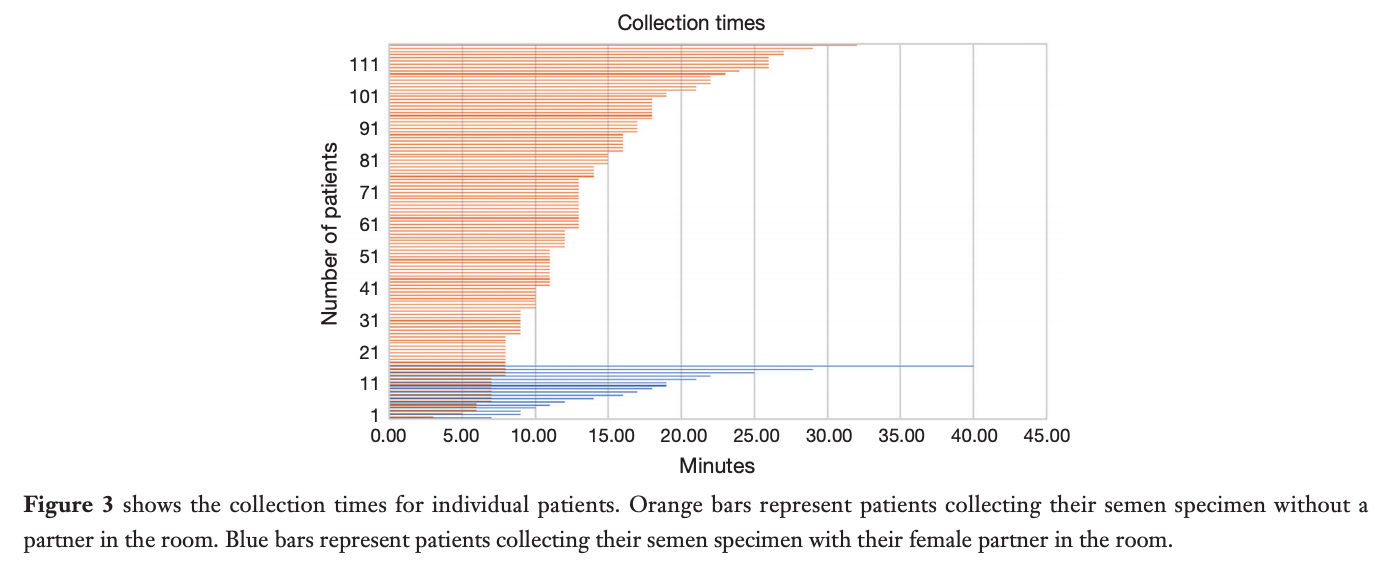
How long does it take a man to collect his semen specimen in a busy infertility clinic?

That’s the question asked by this paper, How long does it take a man to collect his semen specimen in a busy infertility clinic? They have a clear motive, to figure out what factors might be reducing the throughput at these clinics. Guys, you’re taking up essential space and monopolizing the porn magazines! Ejaculate quickly and get out!

So they timed the men (the pressure!), and to answer the question: the median time was about 12 minutes, with a range of 3 minutes to almost 40 minutes. They only looked at two variables that might affect that time. One was whether the purpose of the visit was cryopreservation or not. The most common reason for giving a semen sample was to evaluate it for fertility issues; some people are there because they’re about to get a vasectomy or undergo chemotherapy, so they want to preserve a sample. Men ejaculating to preserve a sample take about two minutes longer, but I wouldn’t attach much significance to that, given the huge amount of variability and the small sample size.

The second variable was whether the men were attended by their female partner; if they were, it took about 4 minutes longer. Again, it’s impossible to read anything into that number. They aren’t examining the patients with so much as a questionnaire to figure out what’s going on. Go ahead, let your imagination run wild, but there’s no data here.

I am, however, deeply offended by how they plotted the data. This is a terrible chart.

Unforgivable. You’re supposed to compare the collection times between unattended men (orange) and men with their partners (blue), but it’s plotted by raw numbers of men — so all you’re really seeing is the difference in sample size. You have to imagine the blue bars stretched on the vertical axis to do any comparison — it should have been plotted by percentiles — and then the differences are small, and you can see that both groups have a substantial range. It’s very misleading. Bad graphing, bad.

I’m not impressed with their conclusion, either.

The only variable with a negative impact on the collection time was the presence of a female partner in the collection room. Our findings can aid in optimizing the scheduling of patients requiring semen collection in a clinical setting.

You know, you’ve got patients who are concerned about infertility, or are going to be treated for cancer, and there’s also some embarrassment about the situation. I think that how much time it takes them to spurt out a sample ought to be a low priority here, and it’s rather insensitive to be thinking that kicking partners out is to be considered as a way to “optimize the scheduling”, and given the degree of variability here I don’t think you can arrange matters to favor Mr Jackrabbit over Mr Slowhand, nor should you.

As we all know, if you really want to speed things up, the only solution is a rectal probe to deliver electroshock to the prostate.

That’s the fanciest Keurig machine I ever did see

Except it doesn’t make coffee. It does everything else important, though.

We got a demo this morning of this fancy new structured illumination microscope from Keyence. It actually looks like this:

Oooeee, I’ve always wanted a cyborg in my lab. I was impressed. It’s modular and compact and robust, and fully computer controlled. I could see using this in our teaching as well as our research, because you just open it up…

…place your slides or well plates in the chamber, and then close it up and control everything from the keyboard. That removes the anxiety of undergraduates having to tinker with fragile optics and electronics, and makes it feasible to just put this thing on a cart and wheel it to different labs when we need it. And it takes beautiful images, does quantitative microscopy, all the kinds of things we would drool over.

And it’s relatively cheap at $50,000 for the base model. Keyence has adopted the DLC model of revenue, so you buy the core gadget and then additional features at extra cost. That actually makes a lot of sense for a small university like ours, where we could just pick up the minimum we need for our faculty’s focus.

“Just” $50,000. Maybe a little more if we decide that some of those extra features would be nice. Sure. I’m guessing I’m going to be writing an NSF grant proposal soon.

Or…if we just had a sugar daddy/sugar momma who wanted to make a tax-deductible donation to the University of Minnesota Morris, earmarked for biology discipline equipment, it would spare me a fair bit of work. We’ll even get a nice plaque made and bolt it to the side with your name on it. After all, if MIT and Harvard and the University of Toronto can get hundred million dollar donations, surely someone can invest 0.1% of that in an appreciative liberal arts college, right?

We’re not going to let you buy admission for your kid, though.

OK, I’ll write the damned grant proposal.