‘Journalists’, feel some shame for your profession

So I checked the lead political story on CNN:

CNN poll: It’s a dead heat

Then I checked the lead political story on MSNBC:

NBC/WSJ poll: Very close race with one day to go

Feeling desperate, I even checked Fox News:

CLOSING TIME: In Final Hours, Are
There Still Undecideds Left to Swing?

Do you sense a theme? It’s one that we’ve suffered with for the entire election season: news media that are obsessed with the horse race rather than the issues.

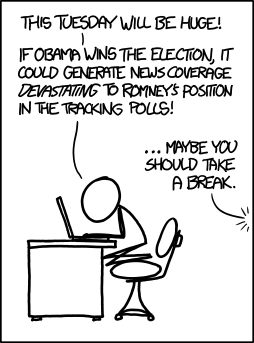
Fuck the media. Only xkcd sees the truth.

And tomorrow is the race itself, with non-stop coverage of exit polls, with maps showing trends, and predictions, and declaring that one state has gone to one candidate or the other — it’s all our media live for, I think, is the ultimate orgasm of who wins, rather than the substance of the consequences of electing either of these people.

I hate them. I hate them all. I will not be watching any of those channels, I will not be visiting their websites at all tomorrow: I am going to vote and then I am going to shut out the yammering ninnies for the whole day, and I will check my newspaper for who the winner was on Wednesday. I might be nice and create an election day thread for you all here, but I will not be reading it myself.

The real election campaign is long over. We were supposed to have news that clearly discussed the differences and similarities between the two. We didn’t get that, so now we get numbers filtered out of noise.


Also, Salon’s top two articles on tomorrow’s election are all about the polls…but they also have an article by Robert Reich on Romney’s destructive policies. More of that, please. I don’t give a damn about the polls — the only one that counts is the election itself.

A billion ghosts immanentized

You should go read this excellent post on Technosociology, which makes two points, one that I’ve written about before and one that I’ve been meaning to write. The first is a rebuke to the free speech fetishists of the internet who regard their ability to shout at someone as an absolute right rather than a responsibility.

…the common equation between not wanting governments to regulate offensive speech on the Internet and the position “therefore everyone should be allowed to post whatever they want” is not just wrong, it is likely going to be the end of the kind of free speech we want to protect because sooner or later, most governments who do want to ban speech on the Internet for political reasons are going to be able to legitimately point at these sites and most parents and other sane people will come down for strong regulations on the Internet. Yes, I believe that these regulations will then be used to crack down on “unwanted” political speech but be assured that most people in the world, including the United States, will choose “less speech” criticizing the powerful if they are convinced that without such restrictions, there is no way to stop predation of children and violating women’s dignity and privacy from proliferating on mainstream sites. (There is high-quality poll data from the General Social Survey which confirms this–free speech as an absolute value is a minority position in the United States). It is up to the Internet community to make this a false equivalence and this requires that “but it’s free speech” is not the first, intermediate and last and only phrase we utter when faced with offensive or intimidating content.

The internet has an abundance of freedoms and a dearth of accountability and responsibility. Somehow we’ve acquired the notion that because it’s possible to create throw-away accounts and use pseudonyms, it is therefore good to create them at will and discard any sense of identity while still pretending to be a good faith contributor to online discussions. And then we get people who are outraged that you won’t listen to them when they rant under an obscene pseudonym that they will change again when you ignore them; and in fact, they get particularly outraged when you do ignore them, because they think they have the right to speak while everyone else has the obligation to listen. The petty obsessives of internet free speech all have a bit of Dennis Markuze in them.

And further, the Violentacrez case has highlighted another mistaken idea: their privilege to abrogate all other rights held by others in the name of their right to free speech. Suddenly, anonymity also becomes their right and no one else’s — they can splatter the faces of teenagers in their underwear on the web to serve their right to masturbation material, but if you dare to reveal that they are human beings with identities in the “real” world, you’re violating their rights.

That’s the second thing I appreciate in this essay. It’s time to stop thinking of stuff we say on the internet as somehow not part of the real world. For many of us, the bulk of our communication with others is through this medium; we have more friends who we know well and talk to regularly here on our screens than we meet face-to-face.

Another variant of the argument has been that “it’s just the Internet.” Chill. This, of course, rests of on something I’ve long been railing against, the notion that the Internet is somehow not real, that it’s virtual or that it is “trivial.” (My friend Nathan Jurgenson coined the phrase “digital dualism” to refer to this tendency). In fact, a reddit contributor makes the argument that Gawker, by publishing the real name and location of the person behind “creepshot” did real harm they have “purposefully taken this off the internet and into real life” and this affects “violantacrez’s future employment and immediate safety.”

“JoelDavis” on Reddit: The reason that axiom [It’s Just the Internet] has taken hold is because the idea is that even if a website gets bogged down in even the worst trolling imaginable, all you have to is realize the website’s no longer worth going to anymore and stop going. Problem solved. With this, a formerly anonymous reddit user has to worry about physical attacks in real life by someone who would view a person like that as a target. In other words, Adrian Chen has purposefully taken this off the internet and into real life so it’s no longer “just the internet.” This affects violentacrez’s future employment and immediate safety. All so Chen could make some money, and no other reason.

This snippet is very revelatory in how it reveals how the construction of what is real, trivial or virtual is indeed an assertion of power & privilege. “JoelDavis” considers predatory photos of children to be “just the Internet” but a person’s name –just their name linked to real acts they committed—to be “real life.” (I again refer to Lili’s great post about what this reveals).

It’s an odd phenomenon, too. When the printing press allowed newspapers to appear, when people sent correspondence around the world through the mail, did anyone suggest that this process was insignificant and that the discussion was less “real” than talking? I don’t think so. I have the opposite impression, that people felt that writing made the ephemera of conversation have more substance and permanence — the act of weighing words carefully and making the effort to lay them down in print made them more powerful, and publication was a conjuration of great power.

The internet made publication trivial. It apparently diminished the substance of communication — no more crackling bits of paper that pile up on your desk. Media like twitter and facebook encourage you to blurt casually, with little attention to the words you write. It leads to the illusion that communication online is as insubstantial as the conversation you had with your cat.

But it isn’t. In the vast howling noise of the internet, what you say has become more important — voices that babble and shriek don’t rise to prominence and become regular draws (they can be brief freak show sensations, though, and we do see a tendency for voices of minimal talent or intelligence striving to become louder through more extreme viciousness or stupidity). Because something is written in the intangible pattern of electrons doesn’t make it less substantial, but instead makes it easier to distribute, copy, and archive — you could burn an incriminating letter, but once it is on the internet, it is spread far and wide and, while not completely unerasable, is harder to remove…and actively trying to remove something tends to make it more noticeable and more widely disseminated. Meanwhile, I’m finding hardcopy to be less useful — I get dunned with so much junk mail, all those crackling bits of paper that offer me new credit cards at low low rates and advertisements for big screen TVs on sale and sweepstakes I must enter to win millions of dollars, that I increasingly devalue stuff that is written down. I used to photocopy journal articles every week and file them away in a cabinet — I’ve still got a huge pile of these things from 20-30 years ago — but now I rarely print anything, it’s far more useful to have a searchable, indexable, archived PDF that I can also instantly email to students and colleagues.

Just because some old fogies don’t comprehend or appreciate the volume and content of all the communication that goes on by this medium doesn’t make it less real. The internet is not the place where a billion ghosts chatter over matters of no consequence — it’s the new reality, the tool that many of us use to make connections that matter. It’s the greatest agent of information and communication humanity has yet invented, and it deserves a little more respect than dismissal as something “unreal” where trolls can roam unchecked.

(via Stephanie Zvan)

Minnesota mooks don’t like MOOCs

Every once in a while, some news comes down from on high that reveals that the people we’re trusting to lead don’t have a clue about what they’re doing. Now Minnesota’s Office of Higher Education has banned online courses, specifically the excellent suite of free online courses from Coursera.

We do have a law on the books that has the goal of shutting down diploma mills — you shouldn’t get to browse a website and be awarded a Ph.D. in quantum neuroscience. But Coursera doesn’t do that: they don’t issue degrees or even credits, they just provide massive open online courses for free. So you can learn stuff. For free. You don’t go there so you can pretend to learn and get a fancy diploma to hang on your wall, it’s just free information.

This ban is utterly unenforceable and absolutely ludicrous. All you Minnesotans should take your laptop or iPad into the bedroom or bathroom or someplace private, turn off the lights, and browse Coursera — I recommend the biology section, obviously. Oh, look: Rosie Redfield has a course on practical genetics. That should be good. Sign up for something.

Now feel the thrill of being an outlaw. Go commit crimes: learn something.

Hey, maybe the Minnesota OHE is trying reverse psychology on us?

How not to be a good person

OK, kids, today I’m offering a simple lesson in basic human decency. I know most of you already know all this — I picked up on it when I was a child — but this is the internet, and a few of its resident have been raised by wolves or read too much Ayn Rand as a teenager, and they’ve lost some really basic principles.

  1. When someone is hurting, don’t spit on them because someone else is hurting more. It’s smart and sensible to invest your time and money wisely, and if you see two people in pain, you get to choose which one you’ll help first, and that’s fine. But it’s counterproductive and destructive to dismiss efforts to help the other person, and it’s particularly repellent if you choose to kick at the people who are helping someone you consider a lesser cause to the extent that you aren’t helping anyone at all.

    There’s a principle in medicine called triage—look it up. It does not mean “stick a knife in the patient you don’t want to help.”

    See? This is so simple. If you see someone donating money to prostate cancer research, don’t berate them because they should donate to breast cancer research instead, because you think it’s a more serious disease. Or vice versa. Both are bad, and it’s good that we have people supporting research into both.

  2. So you’ve decided to help someone — good for you. However, you shouldn’t then advertise your goodness and throw a tantrum if people don’t praise you enough. You especially shouldn’t then retract your offer of assistance because there wasn’t enough love given to you. You aren’t the one in trouble, and the situation isn’t about you at all.

    You see, that makes it obvious to everyone that you weren’t offering to help because you’re a good person: the offer was patently a bribe to win good will for yourself, and when you announce your refusal to help you’re really just trying to extort some flattery out of others. This is not good behavior.

    I hear a version of this all the time: don’t annoy the Christians with that atheism stuff or they might retract their support for science and science education. Well then, they weren’t really good supporters of science in the first place, were they?

I know, you’re all saying that was really obvious to the point of being stupid, but there are people on the internet who don’t understand these basic concepts. Sad, I know, but don’t get cranky if I occasionally reach out to help the ethically benighted in addition to bashing creationists and that sort of thing. There are many good causes we can all fight for.

Sunday Sacrilege: Free speech is not freedom from responsibility

I’ve been struck by the twisty complications of the recent outing of the creepy redditor Violentacrez as Michael Brutsch, a programmer for a financial consulting company, by Adrian Chen of Gawker. I’m particularly interested by the fact that the case has become a focus of concern by defenders of free speech — people who regard free speech as sacred and absolute.

Well, you know what I think of the sacred.

[Read more…]

The Amazing Atheist reveals his lack of humanity again

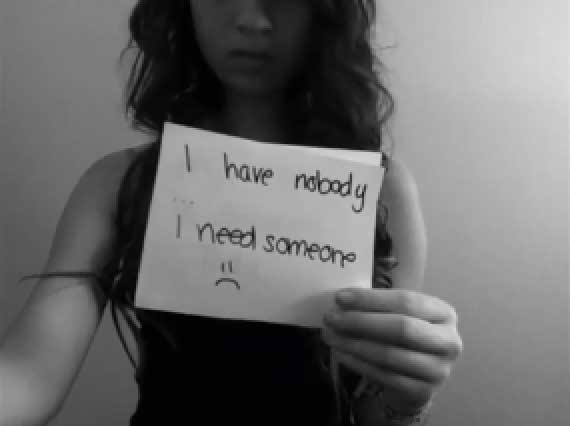
I’m sure you’ve all heard the tragic story of Amanda Todd, the teenage girl who killed herself after prolonged bullying. Normal human beings will read about her and be near tears; she was broken by callous sexual predators, her life made miserable, and she finally gave up on it.

The Amazing Atheist is not a normal human being.

Instead, The Amazing Atheist raged at the fact that this young woman was getting attention when other people have died, too. She was a well-off Western girl with plenty of privileges, so how dare we consider her story particularly tragic? There are so many other people who are worse off than she was!

Well, you know, we have a couple of choices in our lives.

We could, for instance, search the world for that one person who is in the worst circumstances of anyone; the person who is suffering the very most right now. We can do this while turning up our nose at each other afflicted individual who isn’t hurting enough for our standards; why, you’re a quadriplegic dying in a ditch? But you don’t have shingles! And both your eyes are intact! I’m sure we can find someone worse off than you. And then when we find that ultimate person in pain, we can promise to do everything we can to help them.

But I’ve noticed that people who make that kind of argument aren’t actually offering to help anyone. Their perversely inverted, demanding standards are really an excuse to turn away from the miserable they consider undeserving, to justify refusing to help…because that ultimate sufferer will never be found.

But you do have a choice. The other thing you could do is recognize deep pain in others and do what you can to help them. If one person had sincerely and honestly turned to Todd when she was being abused, and offered to help, maybe she’d still be here, and the world would be a slightly better place.

She wasn’t asking for much.

The Amazing Atheist begrudges her that much.

I don’t see any difference between him and the bullies who beat her up and mocked her on facebook and poured scorn on her in school.

And some people wonder why there is a growing rift in the atheist movement. All you have to do is look at people like the Amazing Atheist to see that some atheists, people who are convinced that there is nothing beyond ourselves, that we are dependent entirely on our fellow human beings and nothing more, lack that humanity that is our only source of unity and our only true reason for living.

Don’t be surprised that some of us want nothing to do with such sociopaths.

Terraforming the easy and fun way with desert plants

I spend a lot of time paying attention to threats to the organisms that live in the desert, and what with all the environmental bad news available online these days that can be pretty damned depressing. This past weekend, though, I was reminded that there is actually hope for the future. Centuries from now we may well find that desert plants, especially those that now live within a day’s drive of Los Angeles, have a vital role to play in making yet-undiscovered planets habitable.

I was reminded of this while re-watching a set of documentary films describing the terraforming of an entire complex system full of dozens of more or less habitable planets, in many cases using entire vegetative suites once native to the California desert. I’ve gone back and taken some screenshots of these films to illustrate some of the ways in which the terraformers used desert plants, and they — along with discussion of the terraformed vegetation –are below the fold.

[Read more…]

The best thing I’ve read today

I know it’s early, but I expect it to be the best thing for a few days yet. David Byrne writes about his love affair with sound, and I came away from it feeling like I’d both learned something new and that it fit well with other ideas I already had — it was a revelation to see how well music and evolution fit together.

Because music evolves. Byrne’s thesis is that it evolves to fit its environment (sound familiar?), and that you can see the history of a genre of a music in its sound. It’s all about the spaces it was played in, which shapes the kind of sound can be used effectively…and he makes the strong point that you can’t fully appreciate the music of a culture or a time when you transpose it to a different space. He goes through all kinds of music, from medieval chants (cathedrals!) to hip hop (cars!). The iPod isn’t just a passive delivery system for generic music, it influences how music will sound — ear buds represent a completely different sonic environment from a cluttered dance club.

Apparently, David Byrne is an Ecological Developmental Biology kind of guy. I like him even more already.

Because that’s what eco devo is all about. Development and environment are all intertwined, with one feeding back on the other — species are products of the spaces they evolved and developed in, and cannot be comprehended in isolation. It’s one of the weird things about modern developmental biology, that we preferentially study model systems, organisms that have been able to thrive when ripped out of their native environments and cultured in the simplified sterility of the lab. My zebrafish live now in small uncluttered tanks with heavily filtered water; their environment is like iPods, simple, streamlined, focused with relatively little resonance. The zebrafish evolved in mountain streams feeding into the Ganges, in lands seasonally flooded by great monsoons, a vast and complicated opera hall of an environment. A wild zebrafish and a lab zebrafish are two completely different animals.

Oh, look. I have a new metaphor for issues I’ve been thinking about for some time. Thanks, David Byrne!

I might just make his essay part of the readings for my developmental biology course next term.