How about if we all end the killing?

deathtoatheists
One point! One demand! Atheists must be hanged!

Half a million Islamists marched in Bangladesh, chanting their desire to murder people who don’t believe in their demented, angry god. I take that personally — they want to kill people like me, for the crime of not thinking as they do. If I’d been there, that mob would have torn me to pieces.

And it’s not just atheists they hate. Women must live in service to the men, they are to have their rights diminished. Education is to be crippled, reduced to rote memorization of their holy books. This is awful, poisonous stuff, and I condemn it without reservation.

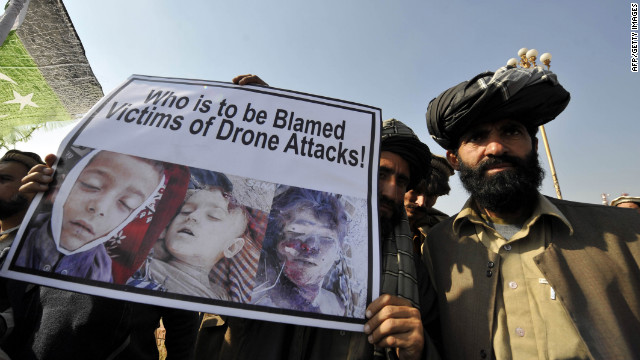
But let me remind you, the United States has been carrying out routine drone attacks against Muslims…attacks that kill children.

drone-attacks

So angry mobs threaten and howl and promise to roll their culture back to the Middle Ages. Americans calmly sit in air-conditioned rooms and push buttons and joysticks and send robots through the skies to pour death on civilians. Obama calmly rationalizes the murders and cracks jokes about predator drones.

obama
The rules outside of the United States are going to be different than the rules inside of the United States.

One side wants to kill people like me, is furious and destructive, and rages passionately about killing the Other; the other side wants to kill people outside our borders, is calm and dispassionate, and marshals machines to execute the Other without risk to ourselves.

I cannot condemn one without condemning the other. Especially since our tactics seem to be so much more effective at butchering people.

What I taught today: FINAL EXAM TIME!

I’m in Arizona, on my way to Orange County, but that doesn’t stop me: I’ve given my students a take home final exam. I wouldn’t want them to be bored over finals week, you know.

1. In the last lecture, I tried to give you a little context, and explained that a dynamic picture of biology would include evolution, ecology, and development, all subdisciplines that deal with change over time. You’re all upper level students; explain to me how developmental biology fits into the perspective on biology that your experience here at UMM has given you so far. Are there pieces you wish our curriculum emphasized more? Why?

2. We’ve spent most of the semester talking about animals — as it currently stands, evo-devo has an unfortunately limited emphasis on metazoans, with an occasional nod to higher plants. Explore a little deeper. What would an evo-devo of fungi, or bacteria, or protists talk about? Is the toolkit we’ve been talking about truly universal? Give me a brief precis of the developmental principles for any other kingdom.

3. Imagine that after you graduate, you find yourself in an unexpected job: you’re working in university press office or as a science journalist. You have to explain scientific research to the public every day. What general principles would guide you? These should be ideas about ethics, effective communication, psychology, etc. in addition to purely scientific concerns. Tell me what standards you’d have to become a great reporter of science.

There. That should make them think.

When science is criminalized, only criminals will do science

I hate the way chemistry has been infantilized to the point where you can’t even buy a decent home chemistry kit for kids anymore, but this story takes it a step further. A teenager in Florida did a simple experiment that made a small plastic bottle go boom and spew out some smoke (and no one was hurt, although apparently the student was surprised), and the school over-reacted: they expelled her.

It was a simple reaction: aluminum + sodium hydroxide releases hydrogen gas and the pressure ruptures the bottle. It was also a poor decision to do it unsupervised in a school yard, but good grief…kicking her out of school means that interest is now quelled. Channel that perfectly reasonable curiosity into constructive academic pursuits! This school seems to be more concerned with shutting down exploration and keeping everyone unchallenged and safe than in engaging in that dangerous business of education.

What I taught today: toroids!

Hox 11/13 expression in an echinoderm blastula

It was the last day of classes for us. I brought donuts.

Dammit, I just realized I missed a golden opportunity. I should have talked to them about Thrive and Pivar and Fleury and Andrulis. Crackpot fringe developmental biologists all seem to have a thing for donuts.

Rats. Well, I’ll just send all my students an email and tell them they have to come back. They don’t even realize the importance of our little snack together.

IRON MAN 3! WOOHOO!

The Morris movie theater is going all out and having a midnight premier of the new Iron Man 3 movie, and I was mildly disappointed that I was going to have to postpone seeing it because I’ll be at the Orange County Freethought Alliance convention. But now I am greatly disappointed, because I have seen the trailer, and it blows my mind.

Awesome. So awesome. I hope I’m not disappointed when I finally see the whole movie, because this sets expectations phenomenally high.

Animal-rights activists are the danger to animals

It is possible to have a conscientious opposition to research on animals, and every university has channels by which activists can register their dissent, and by which they can also influence ethical decisions made by institutional animal research review committees. There is a right way and a wrong way to protest. And the wrong way is charge into a lab, disrupt experiments in progress, and “liberate” highly inbred, specialized animals that are dependent on laboratory care for their health and survival. Protesters in Milan chose the wrong way.

Activists occupied an animal facility at the University of Milan, Italy, at the weekend, releasing mice and rabbits and mixing up cage labels to confuse experimental protocols. Researchers at the university say that it will take years to recover their work.

Many of the animals at the facility are genetic models for psychiatric disorders such as autism and schizophrenia.

I don’t even understand the mindset here. Where are you going to release lab animals to? They may require special diets and care, they most likely have been raised in a very specific environment and have no ability to cope with a different place, and they may have genetic diseases that make them completely unable to compete with wild forms. Years ago at the University of Oregon, ALF pulled a stunt like this; they released lab-bred animals along the side of I5. The only animals to benefit in the area were the red-tailed hawks who saw a sudden bounty of terrified white rodents.

And further, scrambling the data for research into human neurological disorders accomplishes nothing other than slowing research. Why? This is nothing but hatred of science.

There’s not much one can do in the face of determined stupidity other than to show a united front. Sign the Call for Solidarity with the scientists in Milan.

What I taught in the development lab today

After our disastrous chick lab — it turns out that getting fertilized chicken eggs shipped to remote Morris, Minnesota during a blizzard is a formula for generating dead embryos — the final developmental biology lab for the semester is an easy one. I lectured the students on structuralism and how there are more to cells then genes (there’s also cytoplasm and membranes and environment) earlier today. This afternnon I’ve given them recipes for soap bubble solution and told them to play. They’re supposedly making little model multicellular organisms by chaining soap bubbles together, and observing how the membranes follow rules of organization just like the ones we see in living tissue.

In case you’re wondering what the recipe is so you can do it too, here’s my bubble soap formula:

  • 5ml Dawn dishwashing soap

  • 100ml DI water

  • 1ml glycerine

It gets better as it ages — there are perfumes and a small amount of alcohol solvent in the dishwashing liquid which evaporate off with time. The students are playing with concentrations, and if you’re making it up fresh and don’t want to wait until tomorrow, you can increase the concentrations of soap and glycerine.

The more glycerine you add, the more long-lasting the bubbles are…and unfortunately, the heavier they are. If you want bubbles that will waft gently on the breeze, you’ll want less glycerine. It’s a very forgiving recipe, just play.

I’ve also provided the students with a couple of books: the classic Soap Bubbles: Their Colors and Forces Which Mold Them by C.V. Boys, and The Science of Soap Films and Soap Bubbles by Cyril Isenberg. They’re more about math and physics, but they have some nice illustrations. These are projects you can do at home with cheap ingredients bought at the grocery store, so those of you with kids might try playing with it this summer. There are simple rules about the angles of intersection between bubbles — if you’re mathematically inclined, take pictures and use a protractor and see if you can work them out. There’s also some really cool stuff going on with colors, since the bubbles have a gradient of thickness from top to bottom and you get wonderful colors caused by refraction and reflection and phase shifts across the membrane.

OK, if you don’t have kids, you have my permission to play with soap bubbles, too. Tell everyone who looks at you funny that you’re doing Science!

What I taught today: a send-off with an assignment

Today was the last day I lecture at my developmental biology students. We have one more lab and one final class hour which will be all about assessment, but this was my last chance to pontificate at them…so I told them about all the things I didn’t teach them, and gave them a reading list for the summer. (I know, there’s no way they’re going to take these to the beach, but maybe when they move on in their careers they’ll remember that little reference in their notes and look it up.)

So here are the books I told them to go read.

We’ve been all up in the evo-devo house this semester, so I urged them to read the antidote, just to get some perspective. This is the great big book all the grown-up developmental biologists read and admire and regard as gloriously wrong in many ways, but still an important reminder that physical and chemical properties of whole cells and organisms matter — it’s not all genes. And of course that legendary book is On Growth and Form by D’Arcy Wentworth Thompson. I tell all my students that if ever they want to get serious about developmental biology, they must read Thompson.

For the more modern gang who like computers and math and logic puzzles, I point them at At Home in the Universe: The Search for the Laws of Self-Organization and Complexity and The Origins of Order: Self-Organization and Selection in Evolution by Stuart A. Kauffman. He’d really benefit from more time in a wet lab, but still, there’s some very provocative stuff in those books about how complexity can spontaneously arise. I also gave them a bit of an introduction to NK network theory.

There is always a philosopher or two in the class, so for them I suggest that they read The Ontogeny of Information: Developmental Systems and Evolution by Susan Oyama. Developmental Systems Theory suffers for its lack of applicability — it really is a little too abstract for most scientists — but I love it for its more holistic approach to development.

For the hardcore biologists, the ones who are ready to read a book where every page makes them think very hard, I suggest Developmental Plasticity and Evolution by Mary Jane West-Eberhard. It’s quite possibly the most brilliant book I’ve ever read, but it’s dense and challenging. Intentionally challenging: she really does question a lot of the dogma of evolutionary and developmental biology, and forces you to realize there are a lot of wide-open, intensely interesting questions out there.

And finally, I brought up a book I seriously think about making the class text every year, Ecological Developmental Biology by Scott F. Gilbert and David Epel. The course as it is now is a fairly traditional modern molecular genetics and development class, with a solid overlay of evolutionary biology. The Gilbert and Epel book integrates all that with ecology — and I firmly believe that the well-rounded biologist of the type a liberal arts university tries to generate ought to have a balanced conceptual understanding of ecology, development, and evolution.

That’s the short list. It’s too bad I don’t have total control of my students’ lives, or I’d have them studying ten or twenty books over the summer. Or they probably think it’s a good thing I don’t.

Fortunately for Matt Yglesias, Lindsay Beyerstein only leaves him in a metaphorical smoking crater.

A couple of commenters here have persisted in defending Matthew Yglesias’ odious bleat that life is cheaper in Bangladesh because it ought to be because reasons, and that any anger we Westerners might feel about the horrendous loss of life in the recent factory collapse ought more helpfully be directed to buying clothes made in those collapsing sweatshops so that eventually the people making a few hundred dollars a year will have flat screen televisions just like us.

Yglesias is doubling down. In a followup post, he stands by his conclusion that poor countries need to have less stringent workplace safety standards, and adds, as a prelude to accusing his critics of “poisoning the atmosphere,” [see update at end of post]

I’m not really sure what Americans can constructively do to get better enforcement of building codes in Bangladesh

As it turns out, Lindsay Beyerstein has a possible answer:

A group of Bangladeshi and international trade unionists put forward a bold plan to make the garment industry in Bangladesh safer. A surcharge of 10 cents per garment over 5 years would raise $600 million a year, enough to radically transform the infrastructure of the garment industry in Bangladesh. Walmart and the Gap rejected the proposal in 2011.

So that’s pretty handy: All America has to do to make sweatshops in Bangladesh safer is to stop fucking obstructing their being made safer. It’s win-win!

Oh, and a protip to Yglesias: If you persist in discussing the worker safety aspects of US investment in South Asia, you might want to consider not using “poisoning the atmosphere” as a way to tone-troll your critics. We have a 30th Anniversary coming up late next year that will turn that phrase a bit unfortunate.

Updated: in comments, nialscorva correctly points out that I misread Yglesias’ reference to “poisoning the atmosphere.”  My bad. Leaving the post as it was for transparency’s sake.

Bruce Alberts, failure

This is not a very exciting video, but I might just inflict it on my cell biology students in the fall. We got a fair amount of flak from students last time around who were frustrated when labs didn’t work like a recipe from a cookbook — yet that’s how science usually proceeds, with lots of tinkering and frustration and repetition.

I also like his point about how teaching is important for science (although the students won’t really care about that.) I don’t think I really got the breadth of my discipline until I had to master it in order to teach it — there’s nothing quite like the panic behind “I’ve got to lecture for an hour on vesicle transport tomorrow!” to focus the mind wonderfully on a subject you might have found of only passing interest previously.

(via Sandwalk.)