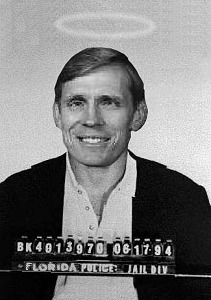
As you know, I’m not impressed with the American legal system — it has built-in deep injustices and biases, and also, while I benefit from many of them as a white man, it also has loopholes that allow every crank and bad actor to manipulate the system, shaking it as if it’s a piggy-bank to harass people and dream of getting rich. Wouldn’t you know it, Kent Hovind is one of those delusional manipulators who wants his money. He was in jail for 9 years for his money schemes — Dinosaur Adventure Land wasn’t just a tool to evangelize, but an illegal money-making operation for the Hovinds to get rich off of — and was legally convicted of his crimes, and also lost an appeal. Now he and his crackpot lawyers have convinced themselves that there was an error, a technicality, that will allow them to invalidate his conviction and sue the federal government for $500 million. It’s a fantasy. He was caught playing games with his money to avoid taxation, and he can’t deny that. What he is now claiming is that the federal government needed a “verified complaint” to even begin action against him, and therefore the entire trial should be thrown out.
As Peter Reilly explains, it’s a nonsensical complaint. What triggered his arrest, trial, and conviction was a grand jury indictment that evaluated the evidence at the time, and concluded that there was cause to pursue the matter further. Hovind is making yet another Sovereign Citizen style argument based on Imaginary Law. He’s not going to clean up and get rich with this lawsuit, but is only going to pour more money down a legal rabbit hole. I guess I can’t complain about that.
I am a little concerned about Reilly’s analysis, though.
Robert Baty alerted me to the filing. I think there are others involved but he seems to be the prime mover behind Nightmare. Kent has a tendency to refer to his critics, other than those who have deserted him, as atheists. Baty is not an atheist, but rather a Christian who has a problem with Young Earth Creationism.
Baty is a retired IRS agent and Kent maintains that Baty has been called out of retirement to “get Hovind”. I find that accusation highly implausible. My evaluation of Robert Baty is that you should never underestimate a cranky old man with a couple of obsessions, an internet connection and time on his hands when he is not watching the grandchildren.
<gasp> I feel seen!
By the way, Kent Hovind posted another comment in my latest video.
How can you BELIEVE the amazingly complex genetic code in ANY form of life happened by random chance over billions of years? How can you teach the silly evolution religion to students and still sleep at night? Call 855-big dino ext 3 to schedule a debate on the very best three evidences you have for evolution. I’ll post the debate unedited (unless profanity needs bleeped) on my kenthovindofficial YouTube channel where my rebuttal of your position was posted a few weeks ago. Come visit our Dinosaur Adventure Land REAL Science Center in Lenox, Alabama and I’ll give you a tour. :) Kent Hovind
I don’t believe organisms evolved entirely by random chance, so as usual, his criticisms are not based on reality. I’ve informed him, though, that my fee for wasting my time in debate with idiots has risen to $7000/day, a special rate just for him. Maybe when he wins his absurd lawsuit, he’ll be able to afford my rates. Unlike him, though, I’m not counting on the windfall, ever.