What a deal!

You’re all looking forward to Skepticon (9-11 November, in Springfield, Missouri), but did you know you could preorder your very own Skepticon5 t-shirt right now?

And because we’re special, the Pharyngula Horde gets a special code: enter “CrocoduckLives” in the box, and you will get a free surprise gift with your t-shirt order. It probably won’t explode or shower you with razor-sharp shrapnel or stab you or poop on you. Probably. But does it matter? It will be a surprise!

Counter-gishing

The Gish Gallop is a notorious tactic used by creationists: spew out lots and lots of bad arguments at a rapid fire pace, and mire the poor scientist in efforts to refute them one by one…which she can do, but only at a slower pace than the creationist can assert them. For a perfect example, Don Batten has 101 arguments for a young earth, every one of them stupid and dishonest. Imagine a debate in which your opponent rattles off all of those at you!

Fortunately, there’s this thing called the interwebs, where people at their leisure can organize and refute such nonsense. I recommend to you this rebuttal to 101 evidences for a young age of the Earth and the universe. Start reading.

I get email – Singularity edition

The major cataclysm that struck my inbox was, of course, that silly incident with a cracker. I still get hate mail from Catholics, and intermittently still receive politely horrified regular mail from little old Catholic ladies who want to pray for me.

But the second biggest outrage I ever perpetrated may not have caught the attention of most readers: I criticized Ray Kurzweil! I still get angry email from people who stumble across this post I originally wrote in 2005, and are really pissed off that I think Saint Kurzweil is a charlatan.

“Singularly silly singularity” – You have much in common with the creationist you so despise.

For a PhD and self-proclaimed intellectual you show an utterly remarkable incapability to understand what the Singularity even is, though this does not stop you from attacking it in the cocksure fashion of the creationist attacking evolution as what he believes is the direct conversion of ape into man.

The Singularity, though inextricably related to the increasing rate of technological advancement, IS NOT a statement that this acceleration alone will lead to the sorts of things Kurzweil proposes. The Singularity is describing what occurs after the creation of a smarter-than-human artificial intelligence. By it’s very nature the workings of this AI’s ‘mind’ will be unintelligible to us. This incapability of understanding, which will compound upon itself as the AI makes advances and improvements of it’s own, acts as an ‘event horizon,’ (I should take this moment to point out that you would do well to learn what a gravitational singularity is, as it may help you understand why you are so off the mark in your incorrect understanding of the Singularity) obscuring the ability to make predictions about what course the future will take.

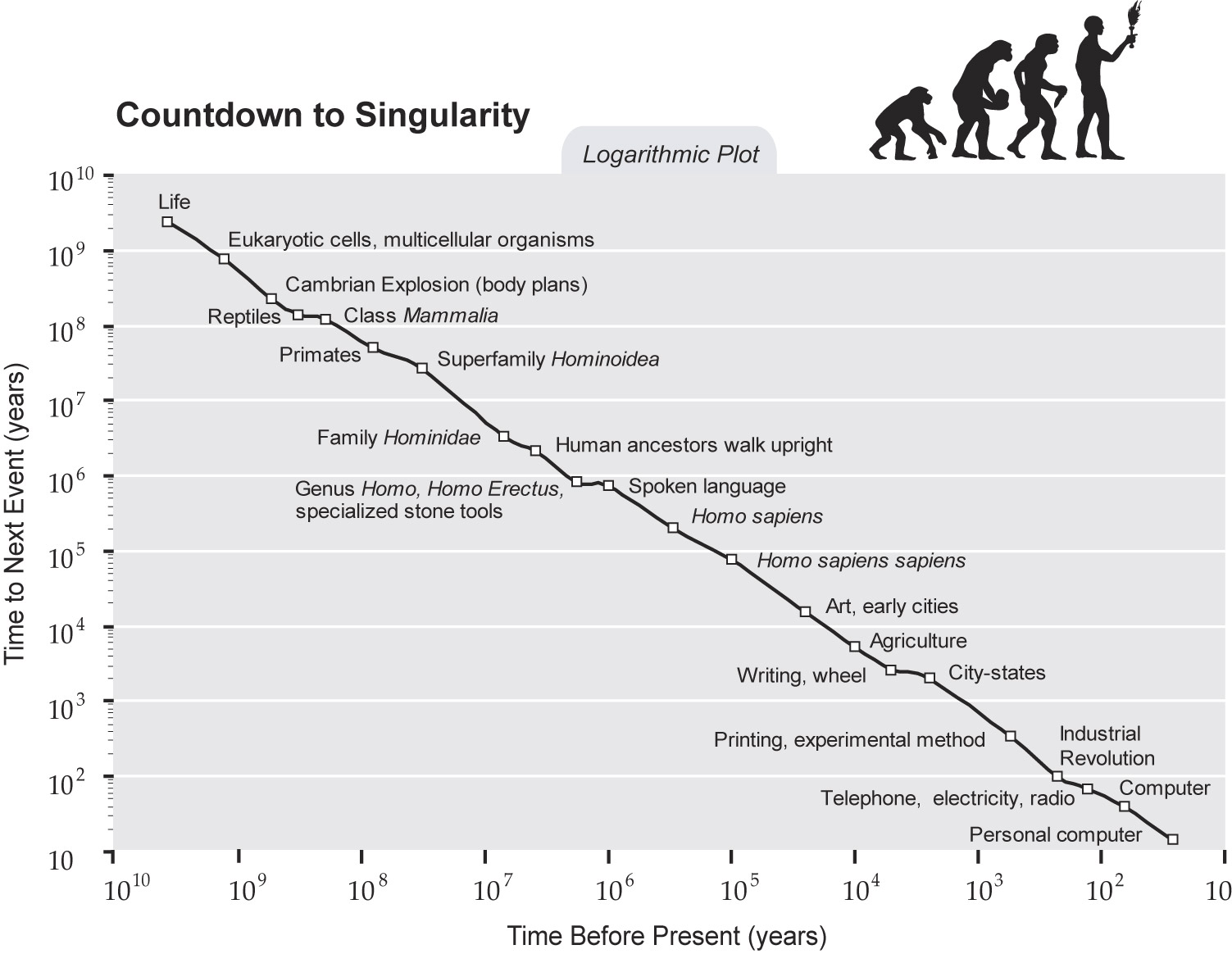
I’ll even grant you the underlying argument of your article opposing Kurzweil’s “Countdown to Singularity” graph (even though you clearly do not understand log vs. log graphs, which cannot be extended into the future). Stating that there is no trend of the acceleration of the rate of technological advancement DOES NOTHING to disprove the existence of the Singularity as the Singularity is a statement about what happens AFTER the creation of faster-than-human AI and not about what happens before it.

You should perhaps try thinking rather than just knowing.

-Wyatt

You know, I appreciate the fact that there is an increasing pattern of technological change — I’ve lived through the last 50 years, where we’ve gone from computers being vast arcane artifacts that cost millions of dollars to plod through mundane calculations, to being stupid little machines that let us play pong on our televisions, to becoming the routine miracle that we now use to process all our media and communicate with our friends. I get that. I do expect to be dazzled over the next few decades (if I live that long) as new technologies emerge.

But predictions of incremental advances on the basis of past experience are routine; predictions of a single, species-defining moment of radical transformation for which there are no predecessors is a data-free assumption. It can’t be justified.

Despite my correspondent’s claim that the source for the claim of a singularity is not accelerating technological advancement, that’s all Kurzweil talks about: the entire first third of The Singularity is Near (yes, I have a copy…it’s even a signed copy that he sent to me!) is a repetitive drumbeat of graphs, graphs, graphs, all showing an inexorable trend: per capita GDP, education expenditures, nanotechnology patents, price-performance for wireless data devices, on and on. That really is the foundation of his whole argument: technology advancement is accelerating, therefore we’re going to get immortality before we die. All you have to do is hang on until 2029.

What really bugs me about Kurzweil is that he blatantly fudges his data. I picked on this chart before: the data is nonsense, comparing all kinds of events that don’t really compare at all — speciation is equivalent to Jobs and Wozniak building a computer in a garage? Really? — and arbitrarily lumps together some events and omits others to create points that fit on his curve. Why does the Industrial Revolution get a single point, condensing all the technological events (steam engines, jacquard looms, iron and steel processing, architecture, coal mining machinery, canal building, railroads) into one lump, while the Information Revolution gets a finer-grained dissection into its component bits? Because that makes them fit into his pattern.

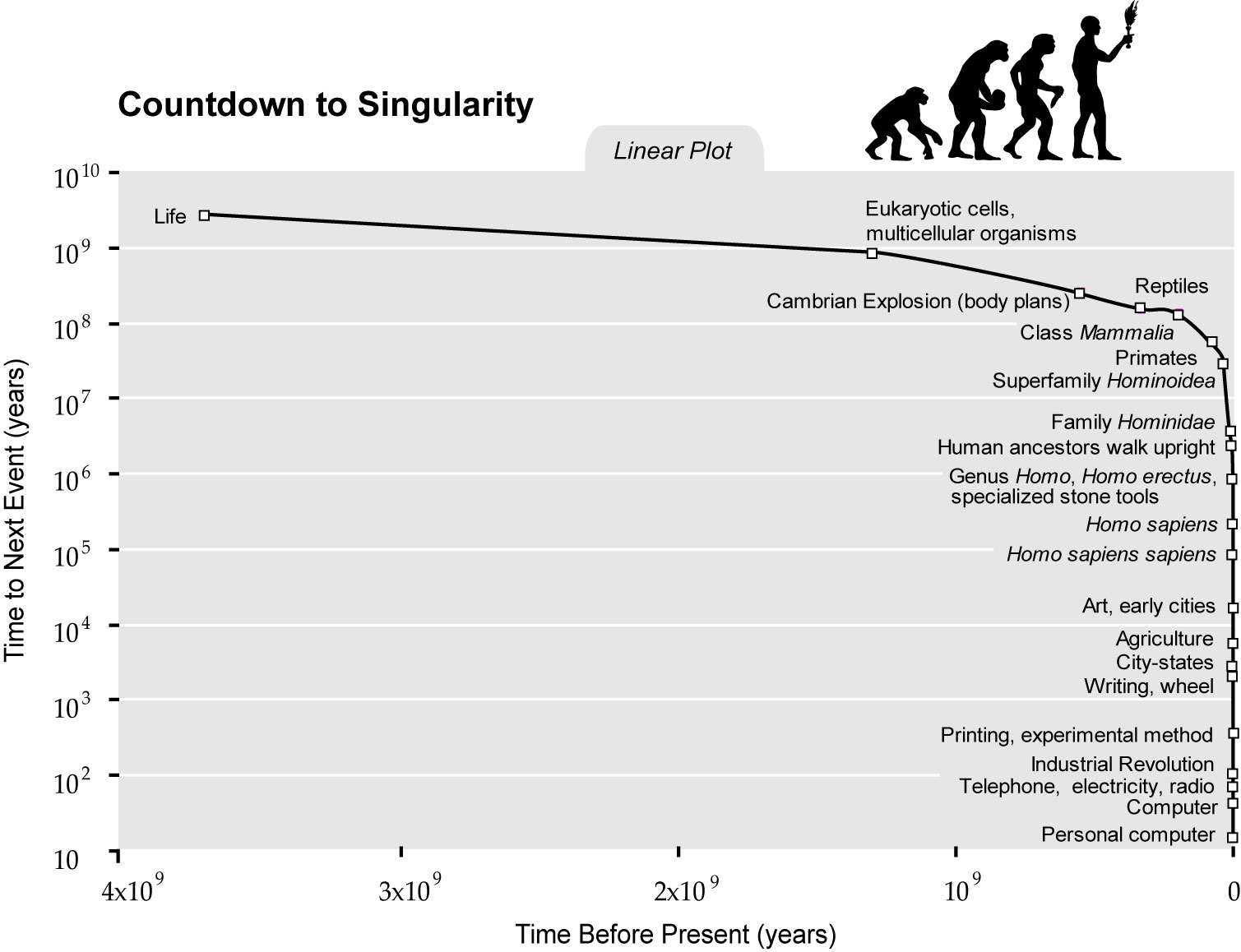
He also shows this linear plot of the same data, which I think makes the problem clear.

It’s familiarity and recency. If a man in 1900 of Kurzweil’s bent had sat down and made a plot of technological innovation, he’d have said the same thing: why, look at all the amazing things I can think of that have occurred in my lifetime, the telegraph and telephone, machine guns and ironclad battleships, automobiles and typewriters, organic chemistry and evolution. Compared to those stodgy old fellows in the 18th century, we’re just whizzing along! And then he would have drawn a little chart, and the line would have gone plummeting downward at an awesome rate as it approached his time, and he would have said, “By Jove! The King of England will rule the whole planet by 1930, and we’ll be mining coal on Mars to power our flying velocipedes!”

I would also suggest to my correspondent that if he thinks extrapolating from graphs is not appropriate, he look a little more closely at Kurzweil’s writings and wonder why he’s extrapolating from graphs so much. I didn’t create those charts I mock; Kurzweil did.

Why I am an atheist – CM

Like others, I was raised in a fundamental Christian household, first as an Independent Baptist and then a Southern Baptist. We went to church at least three, sometimes five times a week. I was a good girl, very obedient and believing, but I remember being thrown by a Sunday school teacher’s answer when I asked where your soul was – floating above your head, she replied. So I was a bit skeptical of souls from third grade on. (Side note – I reasoned there was no santa when I was five because santa’s presents were addressed to me in my dad’s handwriting. Ditto with easter bunnies and tooth fairies. I wasn’t completely naïve, just when it had to do with religion.)

I excelled in everything God- and church-related; I wanted to be a good example of a Christian from an early age. So after I was saved at four years old I worked hard to learn as many Bible verses as possible, to be obedient, to witness to my friends, to hand out popsicles at the park on hot days, etc. One of my proudest moments was when I won my state’s Southern Baptist youth Bible Drill contest and got to go to nationals. I taught Sunday school and Vacation Bible School from high school on, sang in the choir, helped lead our music program while in college. Over the summer of my junior year of college I married the pastor’s son, my high school beau (because God told us to get married), and we led the youth group together, intending to go to seminary after a couple years. At this point I had been part of the church for twenty years and it was the source of all of my comfort, friends, fun, and work.

My changes started while in high school. I was convicted over and over that I wasn’t “truly saved” and spent many nights and mornings desperate and crying while studying my Bible. One day something clicked, I forget what it was, but I had an “experience” that I thought was salvation for real, so I got re-baptized. A year or so later my new year’s resolution was to understand how salvation works, so I spent a lot of time analyzing Bible verses and reading Christian authors. Except that things started unraveling. I gave up the notion of the soul entirely, then later miracles, then prayer. By the time I got married in college I believed God had pre-ordained everything and didn’t interfere with the world, because that wouldn’t make sense. An astronomy course my senior year of college opened my eyes to actual science and messed more with my already-hanging-by-a-thread belief system. It didn’t help that my husband was a philosophy major who discussed logic puzzles with me every day. So for a year my beliefs came undone as I watched, helpless, rationalizing everything in an attempt to hold it together. Then one day I narrowly avoided a car crash and realized I hadn’t prayed. It’s impossible to describe the floor falling from under your feet , the helplessness. I knew I didn’t believe in God anymore, but had no idea what to do. My husband was headed to seminary, my church was my lifeline, my whole life revolved around God and Jesus.

After some months’ awkwardness, I discovered my husband had also stopped believing in God. We finished up at the church and fled town within a year, anxious to separate ourselves from religion. Now I had no friends or family, no work, only a husband who was as unhinged as I was. Lots of alcohol, some counseling, and ten years later, we’re still together. It’s a rare thing to have a friend who shared such an experience.

So why am I an atheist? The short answer is because I finally saw my religion for what it was: a confusing set of beliefs that made no sense once carefully considered. That said, I would not wish this experience on anyone. Sure, I consider myself more moral and caring than I ever was before, but I also lost all my friends and am still rebuilding the trust of my family and my husband’s family. In the end, it’s worth it to be a rational person, but I will always feel haunted by my past and have regrets.

CM

Where? North Texas?

I’ve got to say it: I never heard of Frisco, Texas before, and had no idea where it is. But it’s apparently a big city of 100,000 people out in the northeast part of the state, north of Dallas/Fort Worth, and they are putting on an atheist convention! These things are getting to be everywhere, and I think this is an excellent development. We just had an excellent event out here in a much more obscure part of the world (but where it is needed), and now Texas is popping up pockets of rationality everywhere.

Let’s see Amarillo and Midland and Corpus Christi join in the trend — a great wave of people of reason standing up and making themselves known all across the state.

Until the Great Texas Atheist Revolution, though, you’ll have to go to the North Texas Secular Student Convention. It’s got a great lineup; everyone in the region should hop into your Volvos with the gay pride bumper sticker and head to Frisco on the 14th of April.

As well as a debate featuring:

Why I am an atheist – Nick Harding

Richard Dawkins likes to compare openness about one’s atheism with coming out of the closet, but in my case they were even more closely related.

Like so many kids I repressed my homosexuality out of religious (in my case, Christian) compunction and social phobia. But once I finally begrudged myself some sex in college, I knew intuitively that I hadn’t done anything wrong. I reacted against the idea of the victimless crime, described as sin by the Bible. But while I had shed my denominational identity, I remained stuck in a kind of anachronistic deism. Indeed, having jettisoned the doctrine of original sin, I probably overcompensated with an overly optimistic view of nature and its presumbaly benevolent creator.

So I was in for a shock when some of my friends started coming down with, and dying from, AIDS (this was the early nineties). Of course I knew about it from reading the newspaper and watching television, but I had put off revising my worldview until now. How to explain AIDS? Of course I already knew that it wasn’t divine punishment because there was nothing wrong with sex and, anyway, it had spared many “fornicators” including myself. But it didn’t exactly accord with my new-model deism either. I was experiencing a crisis that was as much intellectual as emotional.

Resolution beckoned in the form of evolution, which I had learned in high school but never related to my daily life in that hiatus between polio and AIDS. With its frequent mutations in response to medication, HIV was (and still is) the poster child for evolution. I began to take a more jaundiced view of nature, which seemed increasingly like a struggle for existence. But I found reassurance in the thought that all this took place without reference to morality or values, instead deriving from the virus’s need to replicate and adapt to its environment.

I suppose plenty of people going back to Asa Gray have been able to reconcile evolution with their religious beliefs. But as I was seeing it in its cruelest guise, I could not. To me, evolution was an irrational and wasteful process that was fundamentally incompatible with any definition of creation. And if you take away creation, what is left for a god to do?

So it was my experience as a gay man, specifically of religious homophobia and the AIDS epidemic, that brought me to atheism. At first glance, those seem to have little in common besides their coincidental effect on the gay community. But in accepting my sexuality and recognizing the true nature of AIDS, I embraced what is rather than what cannot be. To me, atheism is the “reality-based community” of journalists’ dreams.

Nick Harding

It never ends — Bemidji is afflicted with the toxin of creationism

So this past weekend, we had the Midwest Science of Origins conference here in Morris, Minnesota. At precisely the same time, about 190 miles north-north-east of us, in Bemidji, Minnesota, a team of lying clowns from the Institute for Creation Research were repeating the same bullshit that provoked our students to organize our conference. I hope the Bemidji State biology faculty were paying attention, and that their students are right now planning some remedial education for the community; I’d be happy to help if they want to contact me.

It was a seminar titled “Rebuilding the Foundation: Demolishing the Pillars of Evolution”, and it was held in Bemidji High School. How embarrassing for Bemidji. How typical of creationists, though.

The seminar, consisting of six hour-long presentations, was presented by the Institute of Creation Research out of Texas and led by John Morris and Nathaniel Jeanson.

This is just weird, but they’re always doing it, and I don’t get it. It was the same thing last year here in Morris; Terry Mortenson of AiG showed up and did these back-to-back lectures, while refusing to answer questions (he claimed to have a sore throat…which didn’t interfere with 7 hour long lectures).

I see we missed an opportunity. We should have just told Neil Shubin to come here and spend all day talking. Unfortunately, when you’re talking science, it’s actually hard work and you have to back up everything with evidence and demonstrate some rigor and care; when you’re a creationist, it’s easier because all you have to do is make stuff up non-stop.

You might be wondering who these two guys are.

Morris has a doctorate of geological engineering and has led 13 expeditions to Mt. Ararat in search of Noah’s ark. Jeanson has a Ph.D. in cell and development biology from Harvard Medical School.

First, when your most notable contribution to “science” is haring off to chase down myths, you ought to be laughed off the stage. Morris is a deluded charlatan.

And Jeanson…he’s an embarrassment to Harvard. I’ve described Jeanson’s competence before — he’s a guy with an undergraduate degree in bioinformatics, who lectures creationists on genomics, who knew nothing about how the chimpanzee genome sequence was acquired or how it compared to the human sequence.

Students generally are taught evolution theory in early high school, Cairns [Steve Cairns is the superintendent of schools!] said.

“But it is expressed as a fact,” Penni Cairns said. She said students raised on Creationism concepts can be confused and frustrated with evolution theory teachings because their beliefs are shot down by teachers following educational guidelines.

Yes, I’m sure that is frustrating to have your superstitions constantly shot down by reality.

“There are so many unexplained aspects of evolution, such as the missing links,” he said.

In Morris’ morning session, “The Fossil Record: A Problem for Evolution,” he showed images of fossils that mirrored the images of the animals that exist today: A 200-million-year-old crocodile is still a crocodile, a 300-million-year-old dragonfly is still a dragonfly, a 65-million-year-old bat is still a bat.

Cairns keeps trumpeting his ignorance in this article. Why is he superintendent of schools again?

Harun Yahya also makes this argument — it’s about the only thing he says over and over again. Let’s show a picture of a fossil and a contemporary organism to someone who wouldn’t know a femur from a cercal bristle, and they’ll happily say that they look exactly the same. Meanwhile, someone who actually knows some systematics and anatomy will look at the 200-million-year-old crocodile and immediately spot the differences that make it a unique species.

And yes, it certainly is true that there were dragonflies 300 million years ago, and there are dragonflies today; it’s a successful form. It doesn’t follow that organisms separated by a third of a billion years of time are indistinguishable from one another, or that we ought to be surprised about it. What matters is that we have change over time: there were no T. rexes in the Triassic, and there are no T. rexes today, but there were T. rexes in the Cretaceous. The existence of successful taxa that span that range of years does not negate the reality of change.

He also showed pictures of actual fossils that show, in his interpretation, how animals died catastrophic, sudden deaths. Fish died in sediment-filled waters; land-dwelling animals drowned. He showed pictures of dinosaurs fossilized with their heads arched backward and up, saying they were struggling to find air, but were drowning.

“Every dinosaur fossil is like that,” he said.

No, they’re not…but it’s true that a lot are. It is silly to claim that opisthotonus (the arched neck in those fossils) is always a consequence of drowning; there are multiple possible mechanisms behind it. But it’s even sillier to claim that all of the dinosaurs not only died of the same cause, but died in the same cataclysmic event over the course of one year. It’s like noting that some human skeletons show evidence of fatal cuts, bludgeoning, or gunshots, therefore they all died in the American Civil War, which was global and explains all violent deaths in all of history.

But of course, Henry Morris is an idiot.

He also argued against evolution by saying that there is no hard evidence that shows one creature evolving into another. If a fish did turn into an amphibian, there would be a “missing link” or transitional fossils proving such steps. Yet none exist.

At the very same time that Morris was making that stupid claim, Neil Shubin was pulling out a cast of Tiktaalik, a transitional form in the process of fish evolving into amphibians, and showing it to a room of 200 people in Morris.

“Yet none exist.” Lying dumbass.

But OK, world. Any students out there shopping for colleges right now? Are you looking at Bemidji State University vs. University of Minnesota Morris? I think the smart choice is crystal clear.

But then, I expect someone at the university will soon come roaring back with a strong response. I’m looking forward to it.


P.S. One other odd thing about that article. It keeps touting “Intelligent Design”, and Cairns is promoting the inclusion of Intelligent Design creationism in public schools. Yet the talks are by the ICR, a specifically young-earth-creationist organization that believes the earth is less than ten thousand years old and that all of geology can be explained by a global flood, patently religious claims that the Discovery Institute tries mightily to sweep under the carpet in their pretense of being a secular, scientific organization. Somebody has apparently looked at the claims of both and can’t tell the difference. Which is not surprising.

(Also on Sb)


It turns out there is a letter from a Bemidji State University professor in that newspaper. It’s not what I expected.

Although I don’t work in the lab, I am the local professor who teaches epidemiology to undergraduate and graduate students throughout the state. In this capacity, I know of no one doubting the mutative action of skin-invading bacteria. But that’s a far cry from going from nothing to everything. Macro-evolution appears unable to explain the Irreducible Complexity of life as we observe it.

This conference, Saturday at the BHS auditorium, from 9 a.m. to 4 p.m., presents a wonderful opportunity to engage in civil and respectful discourse on a very foundational subject.

An epidemiologist who doesn’t understand evolution and thinks young earth creationism is reasonable — how strange and unfortunate. It’s not surprising at all that Karl Salscheider emphasizes civility and respect in his letter, though; when you’ve got nothin’ of any substance, pound that drum demanding respect for your superstition equal to that given to hard-won science.

Why I am an atheist – Ben Ehrmann

I suspect that there are a variety of origins and influences that flowered our reasoning processes or otherwise led us to connect with our sense of rational thinking, and by extension, to our atheism.

For me, the seeds were started in early youth; a fascination with how things work, a desire for understanding, a love for experimentation, tinkering and measurement,… a burgeoning appreciation of science as a tool for discovery and truth, an envy and respect for all the groundbreaking scientists with their efforts and trials throughout history, as well as a strong respect I had for my older brother whom I looked up to for his extensive reading and desire to know what is ‘real’ in the world, especially its mysteries.

Much of what I’ve seen over the past three decades has been disconcerting, as youth seemingly lack a desire to be instilled and inspired with the wonder of science and the freedom of rational thought.

There are some freethinkers (and theists of various persuasions) feel a desire to ‘coexist’ (as the artistically clever bumper sticker expresses) with others of different beliefs, or simply feel that the dogmas inherent in the belief systems of others are just not ‘on the radar’ and don’t pose much in the way of cultural or intellectual threat. Personally, I started to get a worried sense about the shift in cultural and social attitudes as we entered the 1980’s and began, as a country, a gradual ‘creep’ to the political right, with its associated disregard for–even hostility toward– certain areas of education (especially science), art ( with a penchant for censorship), media ( the ‘ liberal “elite” ‘). Some, like Newt Gingrich and others, lament the ‘decline’ of Western culture and values, as they ironically fail to pay even lip service to some of the foundational blocks of Western culture–free thought, logic and reason– while espousing and defending the virtues of the religiously devout (which they themselves often conveniently ignore). Yes, religion is an essential tool in the toolbox of the political right; manipulating and harnessing the dogmas of the devout for political gain (and presumably personal gain), reciprocally, as the vociferous devout among us flex the political muscle of right wing politicians to further their narrow, religiously ideological agendas.

These issues are central to my disdain for religious belief and many of its practitioners, stemming strongly from this insidious marriage of religious belief and political power and the danger it poses. Increasing religious influence in our political systems presents a potential for long range threat to the material and social structures of our national and international cultures, with its most corrosive influence on the most essential tool for cultural advancement and continuing understanding of the universe we’re immersed in: the minds of future generations and how they evaluate, discover and accept what is real,… and what is reliable about how we explore our world.

I believe this corrosion needs to be widely understood, exposed and actively countered in the United States in particular. It’s hopeful to see there are many notables with influence and reputation in the scientific, philosophical and educational communities who are standing up and working hard to build a strong front. I certainly hope to continue to learn, understand and support, in my own way and time, what may turn out to be a new Enlightenment,..or perhaps a Re-Enlightenment.

Ben Ehrmann

I get email

Seriously, people, I am so sick of the April Fool’s jokes. I just got this in my email.

Dear Dr. Myers:

I’m writing to you in your capacity as a biology faculty member at University of Minnesota Morris. I’m originally from Minnesota— I’m from just south of Mankato, and I’m a St. Olaf alum. Currently, I’m the Dean of Research at the National College of Natural Medicine (NCNM) in Portland, Oregon. My PhD is in Immunology, from the University of Colorado, and I did a post-doctoral fellowship at Yale University. I noticed that you earned your PhD at U of OR. My partner’s daughter graduated from U of OR 2 years ago.

This past year at NCNM, we’ve launched a Master of Science of Integrative Medicine Research (MSiMR) program. It’s a 2 year accredited program that is a combination of an MPH and a Master of Clinical Research program. As integrative medicine is on the rise, it’s important to determine what works and what doesn’t. Our MSiMR students are building the evidence base for integrative medicine. We do applied, basic, and clinical research. It’s an exciting program that examines nutrition, exercise, behavior change, massage, herbal medicine, and other natural modalities.

In addition, the MSiMR program has the potential for international medical research. I personally have collaborations in Tanzania, Brazil, and Nicaragua, and will be taking two students with me to Tanzania this summer. Thus, students who are interested in global health may be interested in this program. I’m attaching 2 brochures so that you can get a flavor of the program.

I know Morris is a little out of the way, but I’m going to be in Minnesota visiting my family April 18th-22nd, and I’m happy to make the drive if you know of students who are interested in natural medicine (naturopathic or Chinese medicine degrees) or integrative medicine research. I interviewed at Morris when I was looking at colleges for undergrad. In the past, I’ve met with the pre-med clubs at St. Olaf, Gustavus, and Minnesota State Universities. I’d like to make sure that Morris students have the same opportunities. If you’d like me to give a seminar or an informal talk for pre-med or graduate school bound students, I’m happy to do so. I’m also available to drop by a classroom and chat for 10 minutes if you think your students would be interested.

Thank you for your time and consideration.
Best,
Heather

I am being teased. I would so love to have Heather visit my classroom, just to see the look on her face when the horde of students raise their heads, eyes all a-glitter, and smile and bare their needle-sharp fangs in those last few minutes before she is shredded. I suspect, though, that if I eagerly offered her access to the students, she’d look a little closer at the content of my site and flee like a tuna before the shark.