Because I am an adult.
Graham Martin-Royle
United Kingdom

Because I am an adult.
Graham Martin-Royle
United Kingdom

In my recent speech at the Reason Rally, I closed with a rather cryptic suggestion that I wanted us all to be bad without god. I couldn’t expand on it there — I was right down to the wire in my 15 minute time slot — but I can explain myself here. I’ve been feeling a bit bugged by the common “good without god” campaign, and I’ve been thinking about what it means.
On a glib and superficial level, I sympathize with its intent. Atheists have a bad rep, and the general public thinks we’re all amoral, corrupt monsters who reject god so that we don’t have to be held accountable for our wild drug-snorting, baby-chomping gay sex orgies. It’s a false stereotype; most atheists are indistinguishable from their Christian neighbors and make many of the same ethical choices they do. So a campaign that emphasizes that atheists are also good citizens and cheerfully socialized human beings is a good thing.
But sometimes the pendulum swings too far the other way. Announcing that atheists are “good” is a repudiation of our actual goals, which are subversive. We aim to change the culture. By the definitions of the people we’re trying to reach with that slogan, we’re actually very, very bad. So here are a few of my objections, and why in principle I can’t say any longer that I’m “good without god”.
“Good” is an over-used and generic word; the only word worse would have been to declare that we are nice without god. It’s so vague and context-dependent that it is meaningless: tell Rick Santorum “be good!” and he’ll make a speech declaring women to be ambulatory ovaries, slaves to their husbands; tell me “be good!”, and I’ll be thinking about a weekend of beer and sex and heresy. And I suspect that every one of my readers has a completely different vision of what goodness involves.
The implication of “good” is thorough conformity. Has challenging an authority figure ever fit the definition of being good? When abolitionists broke the law by smuggling slaves into Canada, when suffragettes picketed to demand the vote, when Stonewall erupted and Martin Luther King marched, when students protested the war in Viet Nam, were they being “good” in the general public’s understanding of the term? I don’t think so. They were being very, very naughty. Which was good. See what I mean? It’s an empty word that offers nothing but vague reassurances.
It gets worse. We’re addressing the misconceptions of Christians by telling them we’re good, but many Christians have a specific understanding of goodness: it’s defined by their religion. Being good involves obeying the laws of their faith, of heeding the rules that their god uses to determine whether you get into heaven. Do you obey the ten commandments? Do you believe in Jesus? We overtly and explicitly reject the rules: by their definition, we aren’t good at all. They see our claim to be “good without god” as a contradiction in terms that proves that we’re bad.
Yet I can still see myself as “good” because my definition of the word doesn’t involve obedience or blind loyalty or acceptance; it’s all about integrity, honesty, principles, questioning, independence. Try replacing “good” with any of those words — it becomes more accurate, but it also loses the blandly reassuring quality that is intended.
And that’s really my big problem with the phrase: I don’t want to be reassuring to people whose awful bogosity I oppose. I want to provoke and challenge, I want to change the status quo, I want to tear down the gooey conventionality of morality and narrow standards of public behavior. I want us all to mock and laugh at public professions of piety. I want to change how people think, and I want people to reject the absurd claim that our morality is founded on an odious holy book. If you want to have a wild weekend of sex and drugs and rock and roll, as long as you don’t hurt anyone, I will say, “good for you.” If your weekend is spent as an escort at an abortion clinic, if you spend it lobbying for separation of church and state at your Capitol, if you spend it heckling homophobes, good.
Nobody ever changed the world by being complacent, obedient, pleasant, or “good”. Atheists intend to change the world. Therefore, atheists should be as bad as they can be…productively, aggressively, happily bad.

Growing up as a little kid I was not exposed much to devout religion. I only went to church when my sister and I were visiting our grandparents who were southern baptist. One time I remember sitting in the pew listing to the pastor talk one moment about how we should fear Jesus Christ and the next moment how Jesus was Love. It didn’t make sense to me one bit. That’s when I started questioning. As I grew I started having intense sexual feelings for other guys, even before puberty. I wished and prayed to god that I wasn’t gay but the feelings just grew and became more intense. I began hating myself for who I was because I felt if god made me this way he must hate me too. When my grandfather passed away when I was 14 all the church folk stood around saying things like, ‘God has called him back,’ and ‘God works in mysterious ways.’ To me it sounded as if they were saying god gave my grandfather lung cancer and made him suffer a terrible death just to bring him back to Him. I realized that was total BS. If there really was a god that was all loving and powerful, he would not give someone a horrible disease causing gross suffering just to ‘bring him back.’ He would not work in mysterious ways, he’d be upfront and to the point. With that realization I was able to free myself of the homophobia of religion and just struggle with the societal taboo of homosexuality. I eventually overcame my self hatred and came out at 18. One year later my mother came out to me. Oddly enough when she came out as a lesbian she ‘Found Jesus’ through the local gay church and became a born again gay christian. Yes, those do exist. She once admitted to my sister and I that one of her biggest regrets is that she didn’t find Jesus sooner to allow us as kids to share in her revelation. I looked at her and basically said I am alive because of the absence of Jesus. Growing up I hated myself for being gay. If I hadn’t been able to free myself of the thoughts that god hated me as well I firmly believe I would have killed myself for being gay.
Erik
United States

A simple question deserves a simple answer: I am an atheist because I have no reason to be otherwise.
I was raised religious, but even at a young age, it didn’t “take”. I accepted what I was told as truth, but I didn’t believe what I was told. I’m not actually terribly good about believing in things, which is what I appreciate about the scientific method and the natural world. What I believe is not important to the world outside of my head, but what I do is. It’s extremely liberating to not have to invest belief in things- I just accept what works and ignore what doesn’t. New evidence can’t challenge my beliefs, only change what I accept as useful.
I’m still a human being, and I still very much want certain things to be true. I can’t claim that I’m always so coldly rational, but it’s something I get to aspire to.
Remy Porter
United States

I just discovered a short write-up of an encounter I had at the Reason Rally with a gang of evangelicals.
Blake Anderson and I had a very pleasant talk with him. Blake invited him to his church again; Myers had already blogged on Blake’s earlier email invitation to him. He declined explaining that he liked to be polite in public but he could not be polite in church. He acknowledged we were being polite here. He asked, “Are they ridiculing you here?” We said they hadn’t been so far. He said, “They should be.”
Leave it to Christians to think that being polite was a triumph. They set the bar very low for themselves, don’t they?
I do like this comment, though.
In that short interaction, PZ Myers was quite charming, quite polite and warm, and at the same time quite intentionally insulting and rude.
It’s a gift.

Once upon a time, I was a child (believe it or not). My mother taught me to read very early, at about two or three, by reading to me and showing me what it was that she was reading. She tested me, by reciting from a different page: I caught her. She taught me to read for imagination and entertainment, and for information and education. I learned to love to read, for all purposes. In addition to the old standbys, like the Alice in Wonderland books, we had Uncle Remus and The Little Engine that Could (teaching acceptance of race and gender), the Golden Encyclopedia. National Geographic (the magazines and the maps), someone’s textbook of anatomy and physiology, and anything else that looked interesting.
Mom taught me something else of vital import to this subject. She had told me, many times, of seeing people and events that on-one else saw: the universe she lived in differed from mine, but no-one in the family seemed to find it remarkable. Since no mention was ever made that her condition was not abnormal, I accepted that it was what everyone did. Among the lessons were:
I had to find my own universe, by reading, listening, observing, and synthesizing some coherent (to me) place to live and think;
I need to accept people as they are, rather than imposing my arbitrary ‘should be’ on them;
any statement (in memory or in discourse) of information must always be accompanied by source and reliability identification.
I was in my fifties before anyone –her psychiatrist, in this case — mentioned ‘paranoid schizophrenia’ as a description of Mom’s reality.
We would spend the summers on her father’s farm, to escape the city heat, she said. Dad joined us when he could. Grampaw was a tenant farmer on forty acres of reasonably good dirt; he was also a deacon, and sometime preacher, at a local Southern Baptist church. Thus, he imposed on me the rule that only material ever worth reading was his bible. The farming magazines in the sitting room were pretty skimpy. It was either too hot and stinky, or too dark and stinky, to read the Sears catalog in the outhouse. So I read his bible: the whole thing. It was terrible, containing nothing of interest (no reality, no reliability, no entertainment, nothing worth imagining). It must have impressed Grampaw that his 6-year-old grandkid could read that well; he let me read his magazines after that.
I had learned, independently, that doing some things would result in a feeling of severe unpleasantness; I later learned that this feeling was called ‘guilt’, and the only remedy is to fix whatever my actions had broken. The actions that caused such guilt were characterized as ‘bad’. My problem was that my attempts to predict whether a given action would be ‘bad’ or not were not very reliable: there were to many false negatives. Later in my childhood, someone told me that these predictions were called ‘morality’, and that ‘morality’ was what churches were all about. So, with Mom (and sometimes, Dad, a Mason), I investigated.
We examined the teaching of many different christianities, like Disciples of Christ, Episcopalianism, Methodism, Lutheranism and Baptism. None of them could give me any guidance on improving my moral understanding: I still had to learn by doing, and suffering the consequences. None of them were of assistance towards my goal. Each of them, however, taught a conflicting story: “We go by the bible; we’re right and everybody else (that goes by the same bible) is wrong.” My lesson there was: ok, ignore the christianities, in their arrogance, and go straight to the putative source. Although I had read the bible, years earlier, I realized that I had grown some over those years. Maybe, says I, I was too young to catch any meaning in the work. I read it again, more than once: still no coherent, morally useful content, other than a few obvious things that were not at all original.
I gave it up, and called myself an agnostic for the next few years. In college, I encountered Ayn Rand, both her fiction and her non-fiction. The fiction works are ambiguous, so that some people find there ideas that I have never seen (greed, mostly), and they fail to see the ideas that I find useful (empathy, honesty, cooperation). Her non-fiction is more concrete and (shall we say) objective, particularly her works on epistemology.
From that, I learned this lesson: the arrogance of faith never works; the humility of the scientific method does. That taught me, in turn, to call myself an agnostic atheist: I don’t know whether any gods exist (or an specific god exists); without such knowledge, necessarily based on scientific processes, I cannot profess any belief in such a crittter.
From early Libertarianism (more Randish than now), I finally got the ‘moral compass’ that none of the christianities offered: Do not initiate force or exercise fraud on anyone.
Se Habla Espol

This will come in handy. If you compress the known geological record into the 6000 year timespan allowed by young earth creationists, here’s what you get:
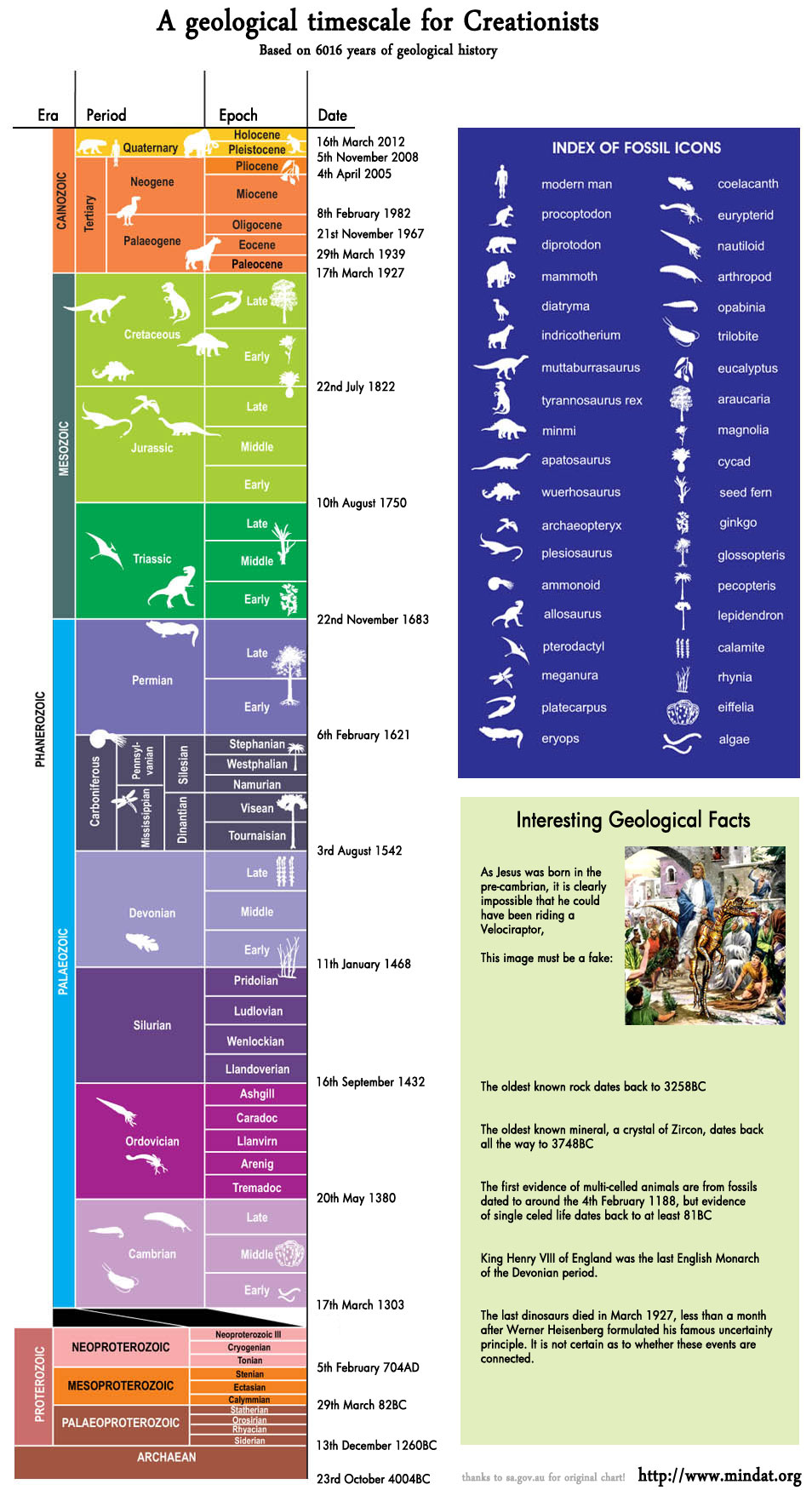
So I was born in the Eocene (I’m older than I look!), Jesus was pre-Cambrian, and the American Revolutionary War was fought in the Jurassic. Radical.

Uh-oh, atheism is in trouble. We keep losing our great leaders, seduced away by the entirely reasonable arguments of Christianity.
The Christian news media is all excited about winning over this “longtime atheist activist” to Christ. Not only has he become a follower of Jesus, but he’s planning to study to become a Baptist pastor.
There’s one catch to this fabulous story of recovering a lost soul: who the hell is Patrick Greene? Atheist activist? I had no idea who this entirely forgettable person was, until I did a little digging to remind myself.
He’s a crank.
He’s a somewhat notorious kook in the atheist movement, best known for calling into The Atheist Experience show and threatening to sue Ray Comfort over a bumper sticker he found offensive. His “activism” consisted of making ill-founded accusations and getting thoroughly chewed out by the real atheist activists, like Matt Dillahunty and Russell Glasser.
The real story is that Patrick Greene is getting old and having medical problems, and a local congregation raised money to help him out. He’s been bought, in other words. Even in his “atheist activism”, he was simply a litigious fool who clearly had his own self-interest in mind, so it’s no surprise that he’d cheerfully flip sides at the first sign of personal gain.
They’re welcome to him. He’s an idiot who was repudiated by atheists for his actions.

Or more specifically why I am not a believer in baseless unsubstantiated authoritarian truth claims on penalty of unending unendurable permanent agony and immolation on behalf of an all knowing all powerful father figure whose love and compassion for me is rivaled only by his plans to punish me for the most vanishingly small signs of disobedience. I don’t believe, not as a matter of blind faith but because nothing substantial has been presented upon which I can make a conscious choice. My “belief” is a conclusion not jumped to. I’m am not unconvinced, rather there is nothing present to be convinced by one way or the other. My “belief” in God is exactly equal to the belief that I am God and the creator of all that is and exactly as valid as any other such truth claim.
David Bramblett

The parasites are crawling out in Australia, anticipating the Global Atheist Convention (next week! Ack!). The latest is a Christian group that is trying to put together some kind of counterdemonstration in Melbourne, called Undeniable.
I deny Jesus. Well, that was a quick and easy refutation.
Also, this is being put together by the son of the guy who published that ridiculous rag, the Regal Standard. I don’t have high hopes for this crowd, given the quality of their work so far. Apparently, they’re just going to mill about expecting people to ask them to evangelize.
And so I’m boldly asking every man, woman and child from every church and denomination to come to Federation Square on Sunday 15th April. Come wearing a white T-shirt (or top) and bring your glow sticks. We will also have a limited number of printed T-shirts with the words “ASK ME MY STORY.” Our message to the media is that there are thousands of us with a unique story to tell. Our testimonies are evidence that there is a God, because He has changed our lives.
Now I’m going to have to make sure to pack a black t-shirt. Fortunately, that seems to be the most popular color in the atheist crowd.
