I’m going to Seattle!

It’s a good deal — I’m going to spend a few days with my family, and then on Thursday, 5 June, at 7:30pm, I’ll be at Town Hall to talk about An Atheist’s Insight. I’m planning on specifically addressing the conflict between science and religion, and then opening it up to a nice thorough Q&A — you’ll be able to grill me. Lots of fun!

One catch: they’re charging admission. You’ll have to cough up a whole $5 to have the privilege of pestering me.

Oh, also, the big reason for doing this: The Happy Atheist is coming out in paperback. There will be a book signing. Or if you’d prefer, a book burning (it’ll sell copies, so that’s fine with me). I’ll also be in town most of that week, so if we want to do an informal get-together, we might be able to arrange that, too.

How kinesin actually moves

Recently, Carl Zimmer made a criticism of the computer animations of molecular events (it’s the same criticism I made 8 years ago): they’re beautiful and they’re informative, but they leave out the critical aspect of stochastic behavior that is important in understanding the biochemistry. He’s talking specifically about kinesin, a transport protein which the animators are particularly fond of illustrating.

Every now and then, a tiny molecule loaded with fuel binds to one of the kinesin “feet.” It delivers a jolt of energy, causing that foot to leap off the molecular cable and flail wildly, pulling hard on the foot that’s still anchored. Eventually, the gyrating foot stumbles into contact again with the cable, locking on once more — and advancing the vesicle a tiny step forward. This updated movie offers a better way to picture our most intricate inner workings…. In the 2006 version, we can’t help seeing intention in the smooth movements of the molecules; it’s as if they’re trying to get from one place to another. In reality, however, the parts of our cells don’t operate with the precise movements of the springs and gears of a clock. They flail blindly in the crowd.

The illusion of directed, purposeful movement is a simplifying shortcut: as Zimmer describes, there actually is a lot of noise in the system, it’s just that the thermodynamics of the interactions promote a directionality to the motion. This is Chemistry 101. I figured that everyone with an undergraduate level of understanding of molecules would be able to grasp this.

I did not take into account willful ignorance, however. Jonathan Wells is angry that anyone dared to question the perfect “stately grace” of molecular machines, and accuses proponents of stochastic motion of Flailing Blindly: The Pseudoscience of Josh Rosenau and Carl Zimmer. He has a Ph.D. in biology, and he doesn’t understand what I just said was Chem 101? For shame.

But that’s not what the biological evidence shows. In fact, kinesin moves quickly, with precise movements, to get from one place to another. A kinesin molecule takes one 8-nanometer “step” along a microtubule for every high-energy ATP molecule it uses, and it uses about 80 ATPs per second. On the scale of a living cell, this movement is very fast. To visualize it on a macroscopic scale, imagine a microtubule as a one-lane road and the kinesin molecule as an automobile. The kinesin would be traveling over 200 miles per hour!

The speed of the reaction doesn’t say anything about the specifics of the molecular movement…and it’s especially not convincing when your trick is to multiply the actual speed in the cell by approximately 1012 to scale it up to the size of a car. The flow rate of the Mississippi river is about 1.5 miles per hour here in Minnesota — if you multiply that by 1012, oh my god, the water is moving at about 2000 times the speed of light!

But let’s set aside the stupid inflation for a minute. Wells cites a couple of papers to back up his claim of the rate of ATP consumption. It’s true. But it doesn’t show that the movement is steady and machine-like and precise at all. He must be trusting us to not bother even reading the paper.

Here’s the deal: we can actually watch single molecules of kinesin behaving. The typical trick is to use a fluorescent bead, attach that to kinesin, and then record the glowing bead’s movement as it is moving along with optical-trapping interferometry. That’s the problem with Wells’ accusation: we actually see the behavior, and it’s not linear, smooth, and graceful.

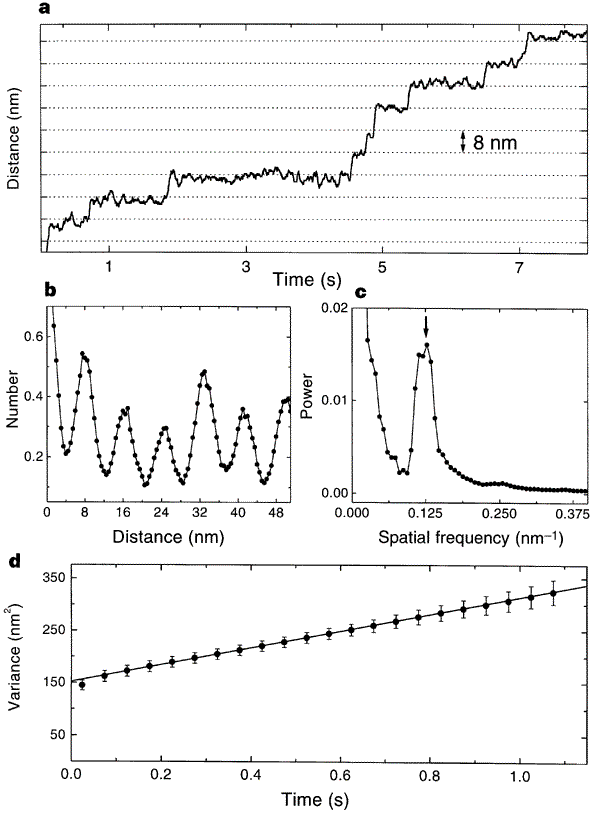
This is the data that the paper used to measure the quantum, jerky behavior of kinesin. Just look at the top graph: that’s a record of the bead’s movement over time. You should be able to see that the line holds steady at one distance for variable lengths of time, and then jerks upward. The “jerks” are distances of about 8nm, and the other graphs are power spectra to show that there is a peak periodicity of 8nm. It shows the opposite of what Wells claims; there are long pauses and sudden shifts in the directly observed track of kinesin movement. The 8nm emerges because when one “foot” of kinesin releases and wobbles forward to connect to tubulin, it has an 8nm step.

Horizontal grid lines (dotted lines) are spaced 8 nm apart. Data were median-filtered with a window width of 60 ms. b, Normalized histogram of pairwise distances between all pairs of data points in this record, showing a clear 8-nm periodicity. c, Normalized power spectrum of the data in b, displaying a single prominent peak at the reciprocal of 8 nm (arrow). d, Variance in position, averaged over 28 runs at 2 microM ATP (dots), and line fit over the interval 3.5 ms to 1.1 s. The y-intercept of the fit is determined by equipartition,  left fencex2right fence = kT/alpha, where alpha is the combined stiffness of the optical trap and bead–microtubule linkage. The rapid rise in variance at short times reflects the brownian correlation time for bead position.

Horizontal grid lines (dotted lines) are spaced 8 nm apart. Data were median-filtered with a window width of 60 ms. b, Normalized histogram of pairwise distances between all pairs of data points in this record, showing a clear 8-nm periodicity. c, Normalized power spectrum of the data in b, displaying a single prominent peak at the reciprocal of 8 nm (arrow). d, Variance in position, averaged over 28 runs at 2 microM ATP (dots), and line fit over the interval 3.5 ms to 1.1 s. The y-intercept of the fit is determined by equipartition, left fencex2right fence = kT/alpha, where alpha is the combined stiffness of the optical trap and bead–microtubule linkage. The rapid rise in variance at short times reflects the brownian correlation time for bead position.

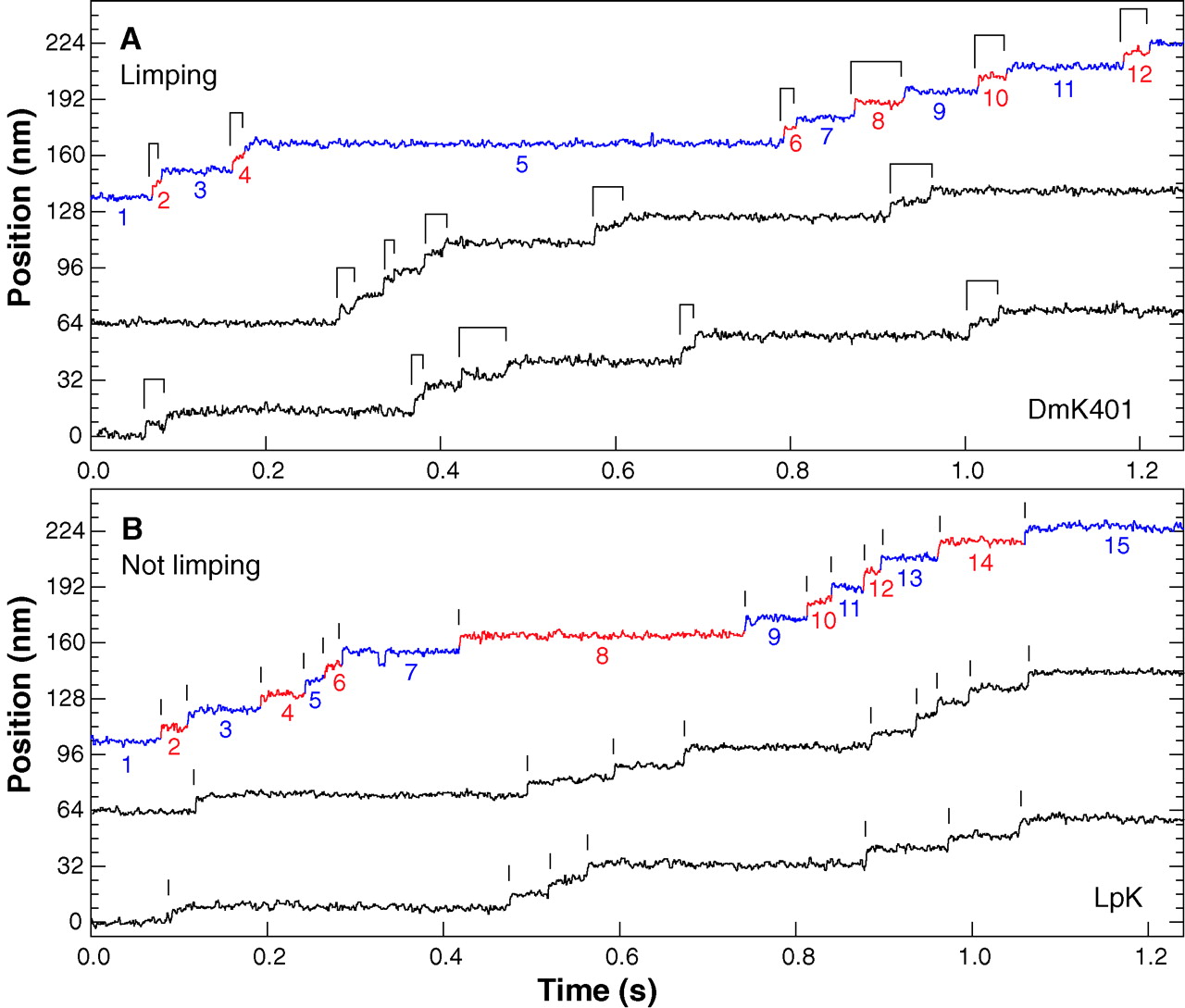
You can find lots of papers with direct observations of kinesin movement. Here’s data from another paper that essentially shows that the two ‘feet’ of kinesin alternate in their movement, because they made recombinant, asymmetric kinesin with slightly different step distances. Again, note the long dwell times punctuated with surges of movement.

Representative high-resolution stepping records of position against time, showing the single-molecule behavior of kinesin motors under constant 4 pN rearward loads. (A) Limping motion of the recombinant kinesin construct, DmK401. The dwell intervals between successive 8-nm steps alternate between slow and fast phases, causing steps to appear in pairs, as indicated by the ligatures. (B) Nonlimping motion of native squid kinesin, LpK. No alternation of steps is apparent; vertical lines mark the stepping transitions. Slow and fast phase assignments, as described in the text, are indicated in color on the uppermost trace of each panel (blue and red, respectively), and the corresponding dwell intervals are numbered. All traces were median filtered with a 2.5-ms window.

Representative high-resolution stepping records of position against time, showing the single-molecule behavior of kinesin motors under constant 4 pN rearward loads. (A) Limping motion of the recombinant kinesin construct, DmK401. The dwell intervals between successive 8-nm steps alternate between slow and fast phases, causing steps to appear in pairs, as indicated by the ligatures. (B) Nonlimping motion of native squid kinesin, LpK. No alternation of steps is apparent; vertical lines mark the stepping transitions. Slow and fast phase assignments, as described in the text, are indicated in color on the uppermost trace of each panel (blue and red, respectively), and the corresponding dwell intervals are numbered. All traces were median filtered with a 2.5-ms window.

The contrast is between “stately grace” and “jiggle and jump”. The evidence shows that it is the latter. Yet, somehow, Wells closes his weird series of non sequiturs with this question, as if he expects everyone to give him the answer he wants.

So, who are the pseudoscientists?

The answer is obvious. Wells and his cronies at the DI.


Asbury CL, Fehr AN, Block SM (2003) Kinesin moves by an asymmetric hand-over-hand mechanism. Science 302(5653):2130-4

Schnitzer MJ, Block SM (1997) Kinesin hydrolyses one ATP per 8-nm step. Nature388(6640):386-90.


By the way, I found about this because the Discovery Institute sent me email (silly season and all) proudly announcing that they were about to release evidence that would clearly rebut Zimmer’s assertion that kinesin “flails blindly” — they are making a computer animation showing that it doesn’t.

Yes, they are that stupid.

I get email: Still looking for an obliging geophysicist

This guy wrote to me back in September, when he was regurgitating creationist rationalizations for the global flood, at the behest of wacky ol’ Walt Brown. He called me again this morning and sent me another missive. On the phone, he sounded a bit miffed that I didn’t immediately remember who the heck he was, but it’s all come back to me now, after reading this.

Dear Dr. Paul Myers,

Like I said, I read your Happy Atheist and regularly read Pharyngula.

RE: Your “Looking for a geophysicist” blog.

What are the facts and what are the beliefs?

1 FACT:

Estimations of the biggest and strongest Supercontinent and all the reservoirs of water under pressure below it Earth possibly had are altogether unheard of.

Its continental landmasses’ three-hundredfold greater concentration of heavy, radioactive elements than our found elsewhere in the Earth aren’t confirmed by observations with measurements to have been in it when the continents yet had all the former connectedness they had (however connected they may have been).

Dr. Bruce Buffett who earned a doctorate in geophysics from Harvard and is now Chairman of Geophysics at Berkeley, considered the no.1 at geophysics research in America).

http://211.144.68.84:9998/91keshi/Public/File/34/485-7398/pdf/485319a.pdf

He has answered my questions and can’t explain why geophysicists never consider that before our planet’s 52,000-mile globe-encircling Mid-Oceanic Range uplifted, fitting like a jigsaw puzzle with specific continental shelf edges, it may have had great reservoirs of water under pressure below a supercontinent, even only one supercontinent in Earth history.

I asked him, “Could not it have thereby had its greatest explosivities of outbursting water and eroded rocks, greatest magnitude earthquake, and super-intense volcanic and earthquake lightnings >1 million amperes whereby electrons shooting through them with >1 MeV produced magnetic pinch effects”?

I hope by the following it will be clear to you what is being proposed as a solution to the problem of Earth’s concentration of heavy, radioactive elements inconsistent with the nebular hypothesis.

Regarding Richard P. Feynman, Ph.D.(physics) Surely You’re Joking Mr. Feynman, (W.W. Norton: New York, NY, 1985), pp. 341, 343:
Physics Nobel Laureate Richard Feynman noted what is: “generally missing in cargo cult science. . . It’s a kind of scientific integrity, a principle of scientific thought that corresponds to a kind utter honesty—a kind of leaning over backwards. For example, if you’re doing an experiment, you should report everything that you think might make it invalid—not only what you think is right about: other causes that could possibly explain your results; and things you thought of that you’ve eliminated by some other experiment, and how they worked—to make sure the other fellow can tell they have been eliminated.
Details that could throw doubt on your interpretation must be given, if you know them. You must do the best you can—if you know anything at all wrong, or possibly wrong—to explain it. . . put down all the facts that disagree with it, as well as those that disagree with it . . .
. . . give all of the information to help others to judge the value of your contribution; not just the information that leads to judgment in one particular direction. . .
I’m talking about a specific, extra type of integrity .. bending over backwards to show how you’re maybe wrong, that you ought to have when acting as a scientist. And this is our responsibility as scientists, certainly to other scientists, and I think to laymen.”

“Earth’s radioactivity was confined to the crust, a few tens of kilometers thick.”

(John D. Stacey, Physics of the Earth, 3rd edition (1992), p. 45)

“Uranium, thorium and potassium are the main elements contributing to natural terrestrial radioactivity.. All three of the radioactive elements are strongly partitioned into the continental crust.”

(J. A. Plant and A. D. Saunders, “The Radioactive Earth,” Radiation Protection Dosimetry, Vol. 68, 1996, p. 25)

“The molten rock oozing from midocean ridges lacks much of the uranium, thorium, and other trace elements that spew from some aboveground volcanoes.”

(Sid Perkins, “New Mantle Model Gets the Water Out,” Science News, Vol. 164, 13 September 2003, p. 174.

Theories of an unsupernatural ultimate origin and formation of Earth call for the agglomeration of its particles thrown together by cosmic winds. They segregated into the core, mantle, and crust by gravity and heat. However, the heaviest naturally occurring elements: uranium and thorium are not nearly as concentrated under the continents and oceanic floors as they would be if the Earth formed from an interstellar medium. . . . If uranium and thorium were among the nuclides that the universe assembled into the Earth, they would be more concentrated toward its deeper parts. At least, they would be expected to have been evenly distributed throughout it. Yet: “90% of uranium and thorium are concentrated in the continents”*;–Earth’s continents are only 0.35% of its mass.*

*Dan F. C. Pribnow, Ph.D.(geophysics), “Radiogenic Heat Production in the Upper Third of Continental Crust from KTB,” Geophysical Research Letters, Vol. 24, 1 February 1997, p. 349.

* “The Earth’s continental crust occupies 41.2% of the surface area but represents only 0.35% of the total mass of our planet.” (Hugh Richard Rollinson, Ph.D.[geochemistry], Early Earth Systems [Blackwell Publishing: Malden, MA, 2007], p. 134)

“Heat production rate is well correlated to lithology; no significant variation with depth, neither strictly linear nor exponential, is observed over the entire depths of the [two German holes].”

(Christoph Clauser, et al., “The Thermal Regime of the Crystalline Continental Crust: Implications from the KTB, Journal of Geophysical Research, Vol. 102, No. B8, 10 August 1997, p. 18,418)

Germany’s Deep Drilling Project discovered variations in heat-exuding radioactivity related to the rock types, not to depths.

Are there higher concentrations of heavy radionuclei in Earth’s continental crust beneath its fossil-bearing rock layers where the one Supercontinent in its history had comparatively greater intensities of lightnings lightening it via having been more violently quaked or comprised of stronger rock types that generated more frictional electrifications and charge condensations?

“Surface rocks show traces of radioactive materials, and while the quantities thus found are very minute, the aggregate amount is sufficient, if scattered with this density throughout the earth, to suppy, many times over, the present yearly loss of heat. In fact, so much heat could be developed in this way that it has been practically necessary to make the assumption that the radioactive materials are limited in occurence to a surface shell only a few kilometers in thickness” (Leonard R. Ingersoll, et al., Heat Conduction : With Engineering, Geological and Other Applications, revised edition [University of Wisconsin Press: Madison, WI, 1954], p. 102)

You wrote on blog saying: “There was no global flood.” I’m not altogether certain of that.

Perhaps almost all of Earth’s fossil-bearing rock layers and all their heavy, radioactive elements bound to lighter elements evidence that it had extraordinary lightnings in enormous sub-Supercontinental water and in a Supercontinent erupting it whereby the seven continents it divided into were entirely and totally overflowed with tsunamies.

Thank You, Rick Keane

Too long? Shorter Rick Keane: Why haven’t geophysicists considered that there was a giant ocean of water beneath the continent(s) that exploded outward with a lot of lightning?

I don’t know. Why haven’t geophysicists consider my theory, that the earth is a giant eukaryotic cell, that continents are rafts of cell surface molecules, and that volcanoes are examples of exocytosis? Huh? Why? They’ll all be so surprised when the planet undergoes mitosis, I tell you what.

I also have a theory that the KT event was actually a sperm fusion event. Ask me more, maybe I’ll spin out a few thousand words with lots of quotes.

It also explains why someone would write to me asking about geophysics.

Polls of the American public are so depressing

Especially when they poll them on science knowledge. An AP poll on science doesn’t surprise me at all.

AP-GfK-March-2014-Poll_SCIENCE

At least it’s good to know that finally, after 50+ years of hard lobbying and information campaigns, it has finally sunk in that smoking causes cancer. What isn’t so good are the numbers on evolution and climate change. Only 31% are confident that humans evolved, while 42% are not confident. Why? Goddamn religion.

Confidence in evolution, the Big Bang, the age of the Earth and climate change decline sharply as faith in a supreme being rises, according to the poll. Likewise, those who regularly attend religious services or are evangelical Christians express much greater doubts about scientific concepts they may see as contradictory to their faith.

Here’s the problem, though: religious apologists. When even scientists, religious scientists in particular, are making excuses for a hoary old book of myths and poetry, how can we possibly advance understanding?

But evolution, the age of the Earth and the Big Bang are all compatible with God, except to Bible literalists, said Francisco Ayala, a former priest and professor of biology, philosophy and logic at the University of California, Irvine. And Darrel Falk, a biology professor at Point Loma Nazarene University and an evangelical Christian, agreed, adding: "The story of the cosmos and the Big Bang of creation is not inconsistent with the message of Genesis 1, and there is much profound biblical scholarship to demonstrate this."

OK, Ayala, define “god”. Go ahead, I keep waiting for a concrete, clear answer, but these apologists won’t give one, or they’ll mumble platitudes (the Ground State of All Being, they’ll say, which means fuck-all).

And hey, Darrel Falk, where in the scientific theory of cosmic origins is there a near-instantaneous creation of a garden on Earth (which didn’t even exist at the time of the Big Bang), a tree of magic fruit, and a talking snake? Sure, it’s compatible, as long as you ignore what the book actually says and pretend it’s all a big metaphor. Of course, you’re missing the One True Over-Riding Metaphor, which is “Humans are gullible saps who’ll believe anything.”

Patterson and Kehoe, and the great lead debate

You know what is really impressing me about Neil deGrasse Tyson’s Cosmos? That he doesn’t hesitate to draw connections between science and how we live our lives — there is an implicit understanding that science has become fundamental to how we see the universe. Last night’s episode was no exception. What started as an explanation for how we know the age of the earth (4.55 billion years), as established by the rigorous measurement of the ratio of lead to uranium in meteorites by Claire Patterson, became an exploration of health and the misuse of science, as personified by Robert Kehoe.

Patterson was an expert in analyzing trace elements; Kehoe was a doctor who was in the pocket of the petroleum industry. Patterson saw rising levels of lead in the environment as a consequence of its use as a fuel additive; Kehoe was getting paid to sow doubt. Patterson focused on the effects of environmental lead on human health; Kehoe was more concerned with the profit margins of industry. The campaigns for lead additives in fuel resemble the abuses of science used to promote cigarette smoking and to fight actions to curb greenhouse gases. I dug up a review from the 1990s by Jerome Nriagu, and it also reminded me of something else: the damned limited perspective of proper science by the non-scientists in the skeptics movement.

Here’s the first part of the abstract.

In 1925, Robert A. Kehoe enunciated a paradigm predicated upon categorical distinction between expectations and conjecture (“show me the data” mentality) from hard scientific facts on exposure outcomes. It led to a precedent-setting system of voluntary self-regulation by lead industry as a model for environmental control and implicitly signaled the level of industrial responsibility for lead pollution.

“Show me the data”? What could be wrong with that? Isn’t that what we’re supposed to do?

What that attitude fails to do, though, is to recognize degrees of uncertainty — that we don’t have absolute knowledge, but that all of our information comes with two measures: here’s what we’re pretty sure is true, and here’s a measure of variability or uncertainty to give you an idea of the bounds of our confidence. So Patterson measured the age of the earth at 4.55 billion, ±70 million years (that bound is now down to around 20 million years). The uninformed or the devious can choose to emphasize that uncertainty of 70! Million! Years!, which is a very long time, while the scientists are looking at the 4.55 billion part.

That is the Kehoe Paradigm: emphasize the noise in the data. Talk about nothing but the variability. Make it sound like the scientists are baffled by their own data, simply because they are aware of the limitations of their knowledge.

Cosmos was relatively gentle with Kehoe; he was clearly the villain of the story, but it didn’t make a big deal of the fact that he was a paid hack of the oil industry who was hiding the evidence in the name of profit. Well, not as big a deal as they could have, anyway — Kehoe was enabling world-wide environmental poisoning.

Here’s the rest of that abstract.

It combined a cascading uncertainty rule (there is always uncertainty to be found in a world of imperfect information) with a highly skewed cost-benefit concept (immediate benefits of tetraethyl lead additives must be weighed against possible future health hazards). Many studies were funded by the lead industry to develop a theoretical framework for the paradigm which served as a strong defensive strategy against lead critics. It resulted in an unfettered growth in automotive lead pollution to over 270,000 tons per year in the United States and 350,000 tons per year worldwide during the early 1970s. Clair Patterson is credited with being the first person to mount an effective challenge against the Kehoe paradigm, and with his success came an upsurge of activity and attention to the risks of environmental lead pollution on public health.

That should sound familiar: multiply uncertainty, and balance it with a biased cost-benefit analysis. How libertarian!

Maybe not all of you remember the 1960s-1970s, but I do: I remember the ads everywhere touting one brand of gasoline that put a “tiger in your tank!” I didn’t know at the time that the tiger was tetraethyl lead, and that a rather nasty environmental toxin, in addition to the carbon monoxide and carbon dioxide, was pouring out of everyone’s exhaust pipes.

The heart of the Kehoe Paradigm was to first piously state that if it could be conclusively shown that tetraethyl lead was a public health danger, then of course the lead industry would stop, as the only rational and morally acceptable response. But then he would go on to argue that it wasn’t conclusive at all, yet — so the default response should be to allow industry to continue to profit until the consequences to public health were undeniable. And this neglect of responsibility was all neatly wrapped up in the claim that it was the “scientific” way of thinking — that somehow, science only deals with absolute truths and that you can’t draw scientific conclusions until every detail is knitted up with complete certainty.

The signals that this was all wrong should have been recognized early. Science is about a gradual convergence on a truth, and we make provisional statements about reality that are always subject to revision. If the preponderance of evidence leans one way (and that breathing tetraethyl lead was bad for humans was rather obvious), the onus is on dissenters to provide strong counter-evidence…not to natter on about what the scientists don’t know for sure. Need I point out that this is also familiar creationist strategy, that rather than actually providing a coherent theory and supporting body of evidence, they’d rather go on and on about our areas of uncertainty?

But also there was another obvious problem. Kehoe was bought and paid for.

Robert Kehoe and the lead industry were very closely entwined in more ways than just the theory and practice of occupational health protection — the lead industry built and equipped a laboratory for him, paid his salary (minus the $1.00 per year he received from the University of Cincinnati), and financed most of his research. The return for the symbiosis included an unprecedented control on research and knowledge about occupational and environmental lead hazards and the stifling of environmental pollution control programs in the United States for many decades.

I’m sure you’ll be pleased to know that this villain lived in prosperity and prestige to the ripe old age of 99, dying in 1992, after a lifetime spent making sure that Big Oil could freely poison all the children in the country.

Another approach of the Kehoe Paradigm was to emphasize “thresholds”. A little bit of poison is OK; it’s only when it reaches some particular threshold that it becomes bad for you, and as long as the industry doesn’t cross that line, it is doing you no harm. In the case of lead, Kehoe argued that the threshold was 100 µg/m3 — which is a hell of a lot of lead. It’s also not true that there is a “threshold”. I recall getting harangued by my old genetics professor, George Streisinger, who had been testifying for the Downwinders (people who had been exposed to fallout from nuclear tests), that there is no such thing as a threshold for radiation exposure — it’s a continuous sliding scale of increasing probability of damage with increasing dosage. But if you draw an arbitrary line, sanctify it with the label of science, and say anything below the line can’t hurt you…well, Science says it’s safe, so it’s fine. Unfortunately, the evidence doesn’t say any such thing.

Patterson really was a hero, and I was happy to see Cosmos give the man credit. He used evidence to fight against Kehoe; for instance, he did measurements (as shown on the program) to show that pre-industrial levels of lead were 0.0005 µg/m3, in contrast to the modern American levels of approximately 1µg/m3 — we were breathing in 2000 times as much lead now. To argue that the lead industry was not making a massive contribution of poison to the environment was raw nonsense.

He also found fault with the whole “threshold” idea. The clinical responses to acute lead poisoning were just an extreme on a continuum — he speculated that “below the then accepted threshold concentration there were some effects which clinically might be difficult or impossible to detect or ascribe to their real cause.”

But he also emphasized the problem of bias. “You can use the data to justify your purposes. If your purpose is to sell lead alkyls, then you look at these data one way. If your purpose is to guard public health, you will look at this data in another way, and you will reach different conclusions.” Ataxia, coma, convulsions, and death are easy to diagnose, so using those as markers for a threshold may be convenient, but it ignores the subtle neurological effects, which might be important, too. Perhaps it isn’t surprising that crime levels have been in decline since lead emissions were limited (this is another case of a purely correlational measure, but let’s not ignore it — we’ve removed a neurological poison from the atmosphere, and simultaneously see a shift in human behavior? Reasonable mechanism, measurable response, worth pursuing more).

Patterson testified before congress, as shown on Cosmos, and really chewed out industry and Kehoe for their misappropriation of science.

It is clear, from the history of development of the lead pollution problem in the United States that responsible and regulatory persons and organizations concerned in this matter have failed to distinguish between scientific activity and the utilization of observations for material purpose. [such utilization] is not science…it is the defense and promotion of industrial activity. This utilization is not done objectively. It is done subjectively. … It is not just a mistake for public health agencies to cooperate and collaborate with industries in investigating and deciding whether public health is endangered—it is a direct abrogation and violation of the duties and responsibilities of those public health organizations. In the past, these bodies have acted as though their own activities and those of lead industries in health matters were science, and they could be considered objectively in that sense.

Patterson eventually won on this one specific issue, and we’re no longer burning tons and tons of lead. I wish I could say he’d won on the broader principle, though, because he didn’t — the Kehoe Paradigm is still the standard pseudoscientific approach used by industry to justify great evils. For instance, CEI is arguing that we shouldn’t expand regulation of industrial chemicals just because of a little ol’ spill in West Virgina with a slew of half-truths…including the claim that MCHM has “low toxicity”. It’s the threshold argument again.

We’re still trying to unravel the tangle he made of science policy, though. Kehoe’s Paradigm lives on at various right-wing think tanks, for instance, the Heartland Institute, where the headline that greeted me when I just visited was Climate Change Reconsidered, which concludes that the human effect is likely to be small relative to natural variability, and whatever small warming is likely to occur will produce benefits as well as costs. Change climate change to environmental lead, and it could be straight from Kehoe, and is just as honest.

At least Cosmos is making an effort to show that good science matters, and matters everywhere in your life.


Nriagu JO (1998) Clair Patterson and Robert Kehoe’s paradigm of “show me the data” on environmental lead poisoning. Environ Res. 78(2):71-8.

I guess I don’t know the right Christians

Right now, I get more vicious hate mail from atheists, a little bit from Christians, and almost none from Muslims — but I shouldn’t take that as representative. You have to look in the right place to find Christian hatred.

You know if any of you commenters said anything like that about any group here, it would be grounds for banning, right?

Salon sucks so bad

I give up. I’ve deleted my bookmarks to Salon. The final straw: two articles published today that are appalling in their inanity.

First up is Charles Darwin’s Tragic Error: Hitler, Evolution, Racism, and the Holocaust. Just the title tells you it’s a dishonest pile of crap. Most of it has nothing at all to do with Darwin (so why are they blaming him?), but here’s the key graf:

Modern racism had several different intellectual sources, and only with difficulty could one say which of these was most important. I will focus here on the “scientific” strand of racism, which drew its inspiration from Charles Darwin’s theory of evolution through natural selection. Several factors dictate this emphasis on Darwinian racism. First, Darwinist racism explicitly motivated Hitler and many other leading perpetrators of the Holocaust. Second, Darwin inspired the researchers, most notably in biology and anthropology, who gave racism its aura of scientific certainty. Third, Darwinian thought may well have been more popular in Germany than anywhere else during these years, in part because Germany was the world’s leading center of biological research before World War I and the Germans were exceptionally literate. Finally, Darwinist racism was the brand of racism most easily understood by the widest number of people, in part because Darwin’s theory was astonishingly simple and easy to explain.

Right. “Several different intellectual sources,” but notice the absence of any mention of the Catholic or Lutheran churches, which were far more powerful sources for promoting anti-semitism. All the author has is the claim that Hitler’s racism was “inspired” by Darwin.

No, it wasn’t. Hitler did not make scientific arguments; he did not cite or credit Darwin; he did think God was peachy-keen and justified his actions on behalf of the right German people. His actual sources did not much care for Darwin.

RationalWiki has a good discussion of the subject. In particular, it discusses Houston Stewart Chamberlain — you cannot seriously discuss Hitler’s race arguments without referencing Chamberlain, and it’s a sure sign of a hack when Darwin is given more blame than Chamberlain.

Houston Stewart Chamberlain was an influence on Hitler’s antisemitism. In Chamberlain’s book, “Foundations of the Nineteenth Century” he wrote of “A manifestly unsound system like that of Darwin …” (Author’s Introduction, page lxxxviii), “… Darwinian castles in the air …” (First Part, Division II, Fourth Chapter, “Scientific Confusion” volume 1, footnote beginning on page 264), “… no tenable position can be derived even from the most consistent, and, therefore, most shallow Darwinism.” (Second Part, Ninth Chapter, “Historical Criterion” volume 2, pages 215-216)

The Protocols of the Learned Elders of Zion, an infamous anti-Semitic fraud of some influence, includes Darwin among the Jewish conspiracies:

“Protocol 2: … 3. Do not suppose for a moment that these statements are empty words: think carefully of the successes we arranged for Darwinism, Marxism, Nietzsche-ism. To us Jews, at any rate, it should be plain to see what a disintegrating importance these directives have had upon the minds of the GOYIM.”

The Salon article is the kind of ahistorical hackery I’d expect from the Discovery Institute.

The second article reflects Salon’s recent dumbassed pandering of religion: Science Doesn’t Disprove God: Where Richard Dawkins and New Atheists Go Wrong. It’s embarrassingly bad. The authors argument is that science cannot build an AI, therefore God had to have created consciousness.

No, seriously. That’s his argument.

The question about consciousness is key to everything we are discussing. Modern cognitive science relies on the principles of evolution and posits that consciousness is something that can be produced artificially. Life-forms become more and more advanced through evolution, and eventually consciousness is the outcome. Thus, many cognitive science practitioners believe that machines can develop a consciousness as well, although this has never happened. Consciousness has never been produced in the lab, not even close.

That is not the basis of the anti-dualist argument. We expect that an AI could be constructed, but the reasons that we think the mind is a natural product of the activity of the brain rest on knowledge of how the brain works, how damage and chemical modification affect consciousness, and the mapping of activity in the brain to thought.

I don’t know of any biologist or atheist who is waiting to see a conscious machine before concluding that the mind is a product of the brain; there is simply no expectation that that is a necessary prerequisite. But this wanker is throwing out all of neuroscience because this one experiment can’t be done with current technology. OK, and the stars are only 500,000 miles from the Earth, and you can believe that right now because we haven’t built a starship to fly to Alpha Centauri.

He then makes the usual arguments from ignorance: gosh wow, but you can’t possibly create Leonardo’s Mona Lisa, Picasso’s Guernica, Beethoven’s Ninth Symphony, or the palaces on Venice’s Grand Canal with brains made of meat, because they’re just too beautiful, therefore…

Therefore… (can you possibly guess what?)

Therefore…GOD. (You couldn’t possibly have seen that coming, could you?)

An alternative explanation is that God gave us the mental abilities and that extra something we use in making decisions and in creating great works of art, sublime music, magnificent architecture, beautiful literature, and science and mathematics. Our incredible brains can do all these things because they contain some ingredients that science has not yet found or explained and whose origin remains one of the deepest mysteries in all of science.

Fuck me. I can’t read this bullshit anymore. The Salon editors are just letting drivel through now.

Scientists can’t build a conscious robot yet, but God-diddlers can imagine superpowerful beings that are magically inserting thoughts into our heads, therefore theology wins.

Teaching confidence rather than knowledge

Dunning-Krueger strikes again! A survey of Oklahoma students showed that their high school biology course caused a net reduction in their knowledge of evolution.

The study, conducted by Tony Yates and Edmund Marek, tested biology teachers and students in 32 Oklahoma public high schools via a survey the pair called “the Biological Evolution Literacy Survey.” The survey was administered to the teachers first, to get a benchmark of their grasp of evolutionary theory. The survey was then administered twice to the students — once before they took the required Biology I course, and once after they had completed it.

Yates and Marek found that prior to instruction, students possessed 4,812 misconceptions about evolutionary theory; after they completed the Biology I course, they possessed 5,072. Of the 475 students surveyed, only 216 decreased the number of misconceptions they believed, as opposed to 259 who had more of them when they finished the course than before they took it.

The scary part is that the students were more confident of their knowledge, despite being even more muddled than when they started.

How could this be? One contributor:

This may be because “about one-fourth of Oklahoma public school life-science teachers place moderate or strong emphasis on creationism.” In fact, two students scored higher initially on the Biological Evolution Literacy Survey than their respective teachers.

We clearly need to do a better job teaching the teachers.

Here’s something else oppressing Ken Ham

He hates Tiktaalik. He hates it so much he even has a hard time spelling its name correctly.

Tikaalik is again being popularized through the new PBS series "Your Inner Fish.” it’s really a desperate con job on the part of evolutionists who can’t defend their evolutionary fictional story.

He actually surprises me a little bit: one of his arguments that it can’t possibly be a transitional form is that it is only a fossil. That’s one I hadn’t heard before. So extinct species can’t be evidence for evolution anymore, because only living species count?

Because it belongs to the group of lobe finned fishes (like Coelacanth /lung fish), and is only found as a fossil, the secularists force their evolutionary worldview onto this fossil in their desperate need to try to convince the world they have found a transitional form (when in reality such transitional forms should be abundant both fossilized and living).

I have heard creationists tell me, though, that extant forms can’t be ancestral (obviously), therefore living examples of intermediate forms can’t be used as evidence for evolution, either. That leads to perfect, irrefutable arguments for creationists.

Evilutionist: “The shared expression of Sonic Hedgehog and it’s homologous role in limb development in the limbs of different forms is evidence of common desc…”

Creationist: Doesn’t count. It’s alive. Are you trying to pretend that modern limbs are ancestral forms? God clearly created it that way.

Evilutionist: “OK, here’s Tiktaalik with limbs that exhibit a bony core of homologous…”

Creationist: Doesn’t count. It’s dead. Transitional forms have to be living creatures.

Evilutionist: <stunned into silence by the stupidity>

Seriously, reading anything by Ken Ham is discombobulating.

They claim that Tiktaalik is the link between fish and “terrestrial tetrapods”—four legged animals that walk on land. Tiktaalik’s discoverer Neil Shubin even calls his big fish a “fishapod” to emphasize his belief that it is a transitional form. (Most people hearing about Tiktaalik even think it had limbs, but it didn’t—it just had fins, like fish do. Having a special kind of fins with bones in them—as lobe-finned fish do—did not mean they were legs or limbs.)

Having a special kind of fins with bones in them…but, but, but — that’s what makes them transitional. They have a combination of characteristics of the fins of fish and the limbs of tetrapods, being neither quite one of the other. Once again, we enter the realm of Catch-22.

tiktaaliklimb

Evilutionist: “Here’s the Tiktaalik limb. It’s got these internal bones, unlike a fish fin, that are similar in organization to our limb bones…”

Creationist: Then it’s a land animal. Case closed.

Evilutionist: “But it wasn’t strong enough or anatomically capable of actually walking on land, and it’s got traces of membranous fins…”

Creationist: Then it’s a fish. Case closed. It’s got to be one or the other, because transitional forms don’t exist, therefore I say it’s all fish.

Evilutionist: <wondering why she is wasting time with this idiot>

It wouldn’t be a Ken Ham rationalization if it didn’t drag out his usual claim that both the evilutionist and the creationist are using the same data, and only differ in the worldview they use to interpret it.

All this talk about Tiktaalik is also a reminder that the battle is not ultimately about evidence–Liz Mitchell and the evolutionists are looking at the same fossil. It’s not the fossil that’s different–it’s the worldview one has (and the starting point it is built from–God’s Word or man’s word) the determines how one interprets this fossil in regard to the past. But looking at the fossil, one can see it won’t directly fit into an evolutionary worldview–but it does fit directly into a worldview based on the Bible, as it is a particular type of fish for which we have similar types of living examples (e.g. Coelacanth ).

But we aren’t using the same data. The scientist is using the totality of the data, looking at both similarities and differences, to try and account for its place in history and biology. The creationist, as Ham has just clearly demonstrated, handwaves away all the unique characters of the fossil to claim it’s just like a coelacanth or a lungfish — he is explicitly ignoring any datum that contradicts his presupposition that it must be just another fish.

And then to take it that extra step further, and argue that his naive vision of what Tiktaalik was, stripped of all of its significant and unique characters, is somehow evidence for creationism that contradicts its clear evolutionary niche…

Evilutionist: “Holy crap…you’re an idiot, Creationist. Go away.”