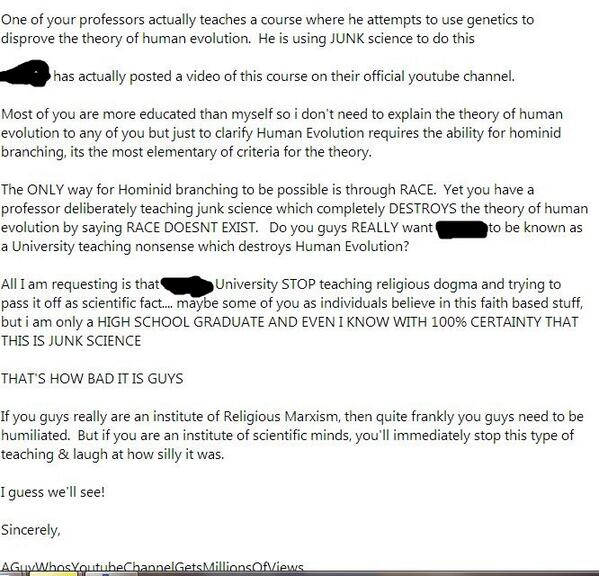
The ‘human biodiversity’ racists are at it again

I have roused the furious slap-fighting anger of the HBD crowd, that’s for sure. They have now come up with a priceless argument to refute everything I’ve said, and are accusing me of being a creationist.

This image is priceless. Yes, @pzmyers, by definition, is a creationist. Why does PZ hate Darwin so?

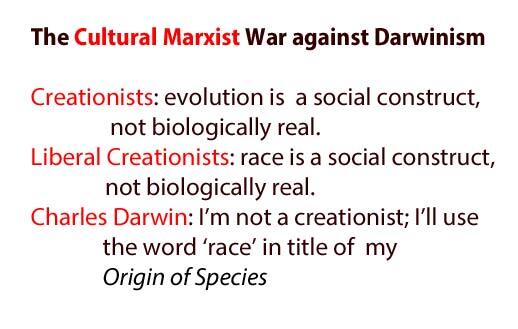
This must be a doozy of a refutation, encapsulated in a single image. And here it is.

The Cultural Marxist War against Darwinism Creationists: evolution is a social construct, not biologically real. Liberal Creationists: race is a social construct, not biologically real. Charles Darwin: I'm not a creationist: I'll use the word 'race' in title of my Origin of Species

The Cultural Marxist War against Darwinism

Creationists: evolution is a social construct, not biologically real.

Liberal Creationists: race is a social construct, not biologically real.

Charles Darwin: I’m not a creationist: I’ll use the word ‘race’ in title of my Origin of Species

You might have seen an earlier version of this argument in the comments here, but that was before they ran out and got the juicy quote from Charles Darwin.

I confess, the first thing that had me confoozled was that term “Cultural Marxist”. I had to scurry over to Wikipedia to look it up, I’m embarrassed to say. Here’s the definition:

Cultural Marxism refers to a school or offshoot of Marxism that conceives of culture as central to the legitimation of oppression, in addition to the economic factors that Karl Marx emphasized. An outgrowth of Western Marxism (especially from Antonio Gramsci and the Frankfurt School) and finding popularity in the 1960s as cultural studies, cultural Marxism argues that what appear as traditional cultural phenomena intrinsic to Western society, for instance the drive for individual acquisition associated with capitalism, nationalism, the nuclear family, gender roles, race and other forms of cultural identity; are historically recent developments that help to justify and maintain hierarchy. Cultural Marxists use Marxist methods (historical research, the identification of economic interest, the study of the mutually conditioning relations between parts of a social order) to try to understand the complexity of power in contemporary society and to make it possible to criticise what, cultural Marxists propose, appears natural but is in fact ideological.

Oh. Hey. I am sympatico with most of that (I’d disagree with the arrow of causality implied in that phrase “to justify and maintain hierarchy”, but this is just a synopsis so maybe the reality is more sophisticated than that). I guess I am a Cultural Marxist then, in the sense that I oppose the appropriation and distortion of natural processes to justify ideological ends.

You learn something every day.

Of course, I don’t think my critics use the term in that rational sense. They are using it as a conservative insult.

In current political rhetoric, the term has come into use by some social conservatives, such as historian William S. Lind, who associate it with a set of principles that they claim are in simple contradiction with traditional values of Western society and the Christian religion. In this usage, political correctness and multiculturalism, which are identified with cultural Marxism, are argued to have their true origin in a Marxian movement to undermine or abnegate such traditional values.

I have to go along with that, too: fuck Western tradition and religion.

And then, conveniently, the racist wackos have lately been sending me a link to their favorite definitions. Here’s one from a site called Destroy Cultural Marxism.

Cultural Marxism: An offshoot of Marxism that gave birth to political correctness, multiculturalism and “anti-racism.” Unlike traditional Marxism that focuses on economics, Cultural Marxism focuses on culture and maintains that all human behavior is a result of culture (not heredity / race) and thus malleable. Cultural Marxists deny that biological reality of race and argue that race is a “social construct”. Nonetheless, Cultural Marxists support the race-based identity politics of non-whites. Cultural Marxists typically support race-based affirmative action, the proposition state (as opposed to a nation rooted in common ancestry), elevating non-Western religions above Western religions, speech codes and censorship, multiculturalism, diversity training, anti-Western education curricula, maladaptive sexual norms and anti-male feminism, the dispossession of white people, and mass Third World immigration into Western countries. Cultural Marxists have promoted idea that white people, instead of birthing white babies, should interracially marry or adopt non-white children. Samuel P. Huntington maintained that Cultural Marxism is an anti-white ideology.

Now that’s more like it. That’s the attitude I get from these loons: that I’m a race traitor because I recognize the humanity of people who are not white, and think our society perpetuates racist myths that require active opposition. It’s also a load of nonsense. I don’t tell white people that they should marry black people, or any other color-matching bullshit: I think people should be free to marry whoever they love.

That site also has some other charming definitions that I never wanted to know, but are very revealing.

Concepts to oppose Cultural Marxism:

Genophilia:  The love of one’s own race. A natural instinct that Cultural Marxists want to deny (at least for whites).

Identitarian Religion:  An older form of religion that stresses ancestral obligations.  Adamantly opposed by Christian Cultural Marxists (at least for whites). Throughout nearly all human history, identitarian religion (aka, ethno-religion), has been the norm.

Leukophobia:  The irrational fear of whites organizing racially.

Nation:  The very word ‘nation’ (from Latin ‘nasci’) implies link by blood.  The traditional (non-Marxist) understanding of nation implies racial homogeneity.  (Until very recently Europe has always been racially homogenous and USA, in 1960 census, was 90% white.)

It’s true. I don’t love my own race. I love people, though, and I don’t see any reason to exclude the majority of humanity from my circle of friends simply because of their ancestry, nor do I think it’s a good thing to start slicing up countries into tinier fragments of pure ethnicities, bolstered by a racist religion. And what are these people going to do in a few decades, when the USA is less than 50% white? Leave and go back to their racial homeland? Which is where?

As for their bogus syllogism that tries to equate denying that something is biologically real with being a creationist, some things aren’t biologically real — there are no fairies, unicorns, or winged monkeys. Stating that they don’t exist does not make one a creationist. There are differences between individuals that are genetic, and therefore the distribution of individuals carrying them fall into clades, but that does not imply that all of humanity cleaves naturally into a small number of discrete groups. That is a recipe for hate, as well as being biologically invalid. Which, I guess, makes the Human Biodiversity phonies all a bunch of creationists, by their own reasoning.

Also, bad news: Darwin was a racist. He carried a great many of the prejudices of a typical Victorian gentleman, and they come through in his writings; but at least they were softened by his humanism, and he aspired to be more egalitarian. But you don’t get to call St. Chuck your perfect ideal. He was flawed. And the theory does not rely on the perfection of one of its discoverers.

Holly Dunsworth also has a relevant quote from Darwin’s The Descent of Man.

Man has been studied more carefully than any other organic being, and yet there is the greatest possible diversity amongst capable judges whether he should be classified as a single species or race, or as two (Virey), as three (Jacquinot), as four (Kant), five (Blumenbach), six (Buffon), seven (Hunter), eight (Agassiz), eleven (Pickering), fifteen (Bory St. Vincent), sixteen (Desmoulins), twenty-two (Morton), sixty (Crawford), or as sixty-three, according to Burke.

I’ll add to that this quote:

Although the existing races of man differ in many respects, as in colour, hair, shape of skull, proportions of the body, &c., yet if their whole structure be taken into consideration they are found to resemble each other closely in a multitude of points. Many of these are of so unimportant or of so singular a nature, that it is extremely improbable that they should have been independently acquired by aboriginally distinct species or races. The same remark holds good with equal or greater force with respect to the numerous points of mental similarity between the most distinct races of man. The American aborigines, Negroes and Europeans are as different from each other in mind as any three races that can be named; yet I was incessantly struck, whilst living with the Fuegians on board the “Beagle,” with the many little traits of character, shewing how similar their minds were to ours; and so it was with a full-blooded negro with whom I happened once to be intimate.

Darwin isn’t your friend, HBD racists, and even if he were, it would be an element of his character to deplore, not reason to accept race hatred as a necessary component of evolutionary thought.

Think about why it was trending

Remember that video by Joshua Feuerstein in which he claimed to destroy evolution in 3 minutes? It went viral. The BBC interviewed him, and got Aron Ra’s perspective. Feuerstein himself is bragging about the power of Social Media.

But they don’t ask why that video got so many views. I saw it because so many other atheists were linking to it…and laughing. It was this beautiful distillation of rank, raving creationist idiocy — a supremely confident ignoramus gushing over creationism’s dumbest hits as if they haven’t been smacked down a thousand times before.

Feuerstein got his moment of fame because he was that week’s stupid cat video, or comedic compilation of crotch punches, or amazingly clueless thing said by a Republican.

What is wrong with Chris Hedges?

I was grumbling about Chris Hedges 6 years ago, and every few years after that he seemed to spew more nonsense about atheists again. And then he gave an incoherent, illogical, dishonest talk at UMM last January. He’s been busily undermining his reputation as a journalist for years with babbling drivel.

And now I learn, via Ophelia, that he’s committed the unpardonable sin for a journalist: Chris Hedges is a serial plagiarist. Somehow, I’m not surprised. When I heard him speak, I was convinced he was a lazy hack, and so it’s not unexpected that he’s been stealing other people’s work and presenting it as his own. Perhaps the reason his anti-atheist material has been so much less persuasive than his work in other areas is because, in this case, he’s been reduced to stealing from creationists and far right wing ideologues.

The battle for Hedges’ reputation has begun with a familiar refrain.

Kaufman went on to note the “relative positions in the journalistic community between Salon and Truthdig and between Mr. Ketcham (and his spouse) and Mr. Hedges.” Because of these “relative positions” in the hierarchy of journalism, Kaufman stressed that “the issue of commercial motives cannot be disregarded,” and cited without elaboration “possible personal, economic and commercial gain that would be derived by Salon and Mr. Ketcham from damaging the reputation of Truthdig, Mr. Hedges, the Nation and other competitive publications and authors.” Nowhere in her letter did she address the Postman correction and its implications.

Get that? Hedges and Truthdig are so lofty and prestigious that Ketcham (the fellow who noted the plagiarism) and Salon (which was planning to run the piece, and then backed down) must be doing it for the vast monetary benefit to be gained from criticizing a famous writer. That has to be the only explanation. Integrity doesn’t exist — the only possible reason for criticizing a Big Man has to be for the attention/clicks/money. Sam Harris has done this, too, as have many of the big names in the atheist community — even the same people I’ve argued have been misrepresented by hacks like Hedges. And it’s a bad argument. It doesn’t work that way. Whistleblowers and critics of the power structure do not gain from their efforts, ever.

I though this comment from mesh at Butterflies and Wheels was insightful. They’re taking about Jaclyn Glenn, who has another video out (no, not that stupid one, but a new one that I thought was pretty damned stupid, too).

The last bit is particularly revealing when you consider the frequent charges of attention-whoring for blog hits; you don’t become popular by fighting the status quo, you become popular by promoting it. If such trends are any indication the way to get hits is to rage about the castration agenda of the feminazis, blame everything except attitudes towards women for their treatment in any given circumstance, and laugh at people who receive rape threats. If someone’s a feminist just for the attention they’re doing it horribly, horribly wrong.

You don’t get fame and fortune by disagreeing with a Movement Star, you get it by hitching your wagon to them. Rather than profit, one hopes the reward is for that intangible gain of being right and true.

This is also not about hating on Hedges — I have actually liked his anti-war, anti-authoritarian message, and some of his stuff has been very good and powerful (although now, unfortunately, I have to wonder where he cribbed the good stuff). I was dismayed to see the irrational turn his mind had taken with his anti-atheism writing, and it is dismaying to see worthy ideas tainted by these bad associations.

Weird ways of thinking

Breatharian crank Jasmuheen believes she doesn’t need food or water to live — she claims to absorb nutrients from sunlight and air. She was rather easily exposed, as are all these breatharians, by putting her up in a nice hotel with people to monitor her eating, and observing the subsequent quite rapid deterioration as she failed to thrive and wasted away quite dangerously.

The people who were testing her terminated the experiment to avoid risking her health. Breatharian claims are absurd and trivially debunked, but what is fascinating is Jasmuheen’s logic as she is gradually falling apart. She has to know that in her day-to-day life she is regularly drinking and eating; she has to know that she’s hungry and thirsty during the test; she has to know that she’s physically suffering from dehydration and starvation. Yet she denies it all.

I think she was trusting the common sense of her testers: she knew that they could not in good conscience allow her to go on, that the experiment would be terminated while she protested that she was fine, and that she could get out of the dangerous situation while maintaining her fiction of dietary abstinence, no problem.

Her claims are not interesting at all — they’re ludicrous — but I find her psychology fascinating. Last year she was in a bogus documentary about ‘living on light’, and now, years after her failed test, she twists it into a triumphant victory.

Wow. New Age delusion at its finest. I loved this statement, though:

What was recorded, what was presented to the world was not my truth, was not how I interpreted it.

So truth is entirely subjective, it’s whatever you decide it should be, and we can entirely disregard physiology…or video technology. Nothing can beat that rationalization — these are people living lives of radical solipsism. It’s too bad that people are dying trying to follow their claims.

Speaking of psychology, another odd thing in the documentary jumped out at me. It’s a German documentary. I’ve run into these breatharian loons sporadically over the years, and they always babble about not eating anything ever…but leave it to the Germans to focus on something I hadn’t heard much about before, that breatharianism meant never pooping. The German obsession with all matters fecal is just a little odd. Odd but harmless, compared to the American obsession with shooting things and blowing them up, I suppose.

Louie Gohmert really is the dumbest man in congress

And when the dumbest Christians collides with one of the smartest Christians I know, the contrast is dazzling. Here’s Gohmert grilling Barry Lynn on proper Christian beliefs. Apparently, he doesn’t want to judge — only God can do that, he piously declaims — but he does want Lynn to declare that all non-Christians are condemned to Hell right this minute. Don’t ask me how that simultaneously judgmental and non-judgmental thing is supposed to work, I think you have to have a gigantic hole in your brain to accommodate both views at once.

And it’s true that even when talking to a swarm of atheists, Lynn doesn’t hide the fact that he’s a Christian minister.

How not to do science

Via Mano, we get to learn what it was like working in the stem cell lab of Piero Anversa.

The day to day operation of the lab was conducted under a severe information embargo. The lab had Piero Anversa at the head with group leaders Annarosa Leri, Jan Kajstura and Marcello Rota immediately supervising experimentation. Below that was a group of around 25 instructors, research fellows, graduate students and technicians. Information flowed one way, which was up, and conversation between working groups was generally discouraged and often forbidden.

Raw data left one’s hands, went to the immediate superior (one of the three named above) and the next time it was seen would be in a manuscript or grant. What happened to that data in the intervening period is unclear.

A side effect of this information embargo was the limitation of the average worker to determine what was really going on in a research project. It would also effectively limit the ability of an average worker to make allegations regarding specific data/experiments, a requirement for a formal investigation.

The general game plan of the lab was to use two methods to control the workforce: Reward those who would play along and create a general environment of fear for everyone else. The incentive was upward mobility within the lab should you stick to message. As ridiculous as it sounds to the average academic scientist, I was personally promised money and fame should I continue to perform the type of work they desired there. There was also the draw of financial security/job stability that comes with working in a very well-funded lab.

On the other hand, I am not overstating when I say that there was a pervasive feeling of fear in the laboratory. Although individually-tailored stated and unstated threats were present for lab members, the plight of many of us who were international fellows was especially harrowing. Many were technically and educationally underqualified compared to what might be considered average research fellows in the United States. Many also originated in Italy where Dr. Anversa continues to wield considerable influence over biomedical research.

Wow. I was sure lucky. When I was in grad school, I was in a research group of about the same size, with primarily 3 people running 3 labs: Chuck Kimmel, Monte Westerfield, and Judith Eisen. They were independent and co-equal. Their post-docs and grad students and undergrads pretty much had free run of all of the labs, to the point where it was often difficult to tell who was officially associated with which lab. We had weekly lab meetings in which we’d freely share data with each other; if someone had a good idea or a set of relevant skills, we’d have collaborations. When it was time to publish a paper, the people who had done the work would get together to write it, and authorship reflected the research team, not some hierarchy…so I emerged from grad school with papers published with both Monte and Judith, but not a one with my titular lab head’s name on it, because he had these scruples about not putting his name on work to which he had not personally and directly contributed.

I thought that was how everyone did science, as an open and egalitarian process. I guess I was wrong.

If you want more examples of science being done badly, Harvard has released the full report on the Marc Hauser scientific misconduct case. It’s clear that he faked data, and demanded that his students confirm his hypotheses. Hauser’s defense: “people in his laboratory conspired against him, due to academic rivalry and disgruntlement”, a claim that did not hold up in the investigation.

I seriously cannot imagine Chuck Kimmel, or any of my academic mentors, ever tolerating any of the shenanigans Hauser was pulling. Just the idea that you’d gather data and then pass it up a hierarchy for analysis, and be told by your advisor what it meant…bizarre.

Man, was I lucky. I hope all of you who are in grad school are following these scandals, and seeing modeled how science should not operate — and are standing up for scientific integrity in your own labs. Be involved in every step of an experiment, collaborate and share ideas, question authority. It’s the only way to do good science.

Multi-component, schmulti-component

I’m having a light dinner while traveling off to a visit with Humanists of Minnesota, and I thought I’d deal with a little email. I got a request to address a fairly common creationist argument–here’s the relevant part of the claim.

As a member of the Greater Manchester Humanists I was recently involved in a discussion with the Ahmadi sect of Islam with regards to evolution. They had asked me to look at a couple of chapters in a book entitled ‘Revelation, Rationality, Knowledge and Truth by their prophet Mirza Tahir Ahmad. One of those chapters was called ‘The Blind Watchmaker who is also Deaf and Dumb’ – riffing badly on Dawkins’s book, of course. Suffice it to say, there was very little of any of that in the book, but during the discussion one of their number said he did not believe in neo-Darwinism because he could not see ‘how all the supporting and connecting mult-component systems could all have evolved as, for example, the eye, as it progressed through geological time.’

He quoted the hagfish and work done by Prof Trevor Lamb to show ‘just how complex those multi-component systems are’ – but when I looked up Lamb’s work it is quite obvious that he is a supporter of evolution, and that he in no way suggests that such complexity is divine in nature….!

Yep, he’s got us. If evolution were sequential, linear, and goal-directed, this would be a serious problem. If you’re used to imagining that the only way complexity can possibly emerge is by purposeful, serial action to build an end result, rather like putting together your furniture from Ikea or building a model airplane, then gosh, it all seems so impossible.

Unfortunately for the follower of Mirza Tahir Ahmad, none of that is true, and this is just a variant of the “it’s too complicated to evolve” argument, with more sciencey sounding words and references to misinterpreted fragments of the scientific literature.

Let’s consider the major misconceptions in the question.

  • Evolution isn’s sequential. It’s massively parallel. Massively. Humans have about 20,000 genes, and all of them are evolving at once, with trial runs in about 7 billion individuals. New variants are arising all the time, and then they’re tested to destruction in multiple combinations over time. Scrap your weird idea that the pieces of a complex system must be developed one at a time — they can’t, and all of them are being constantly tinkered with. It is the most badly designed scientific experiment or engineering program ever, with no controls and every variable getting randomly tweaked at random intervals. So don’t be surprised that multiple elements are getting juggled.

  • Evolution doesn’t care how it arrives at a solution — all that matters is the final effect on the organism. In the case of the eye, the viable end result is an organ with sufficient resolution and contrast, and various special purpose detectors for things like motion or looming. The organism doesn’t know or care how that comes about — it is born with a combination of attributes, and lives or dies by their success. It may have accomplished its end by, for instance, refining the lens, or fine-tuning the receptor, or building in secondary signal processing elements…or all of the above and more. The organism doesn’t care and doesn’t have any control. And in a massively parallel system, probably every level is being tinkered with, and the final solution is going to be multi-component. It would be weird if it wasn’t.

  • Evolution is not teleological. An organ like the eye is not being assembled to a set of specific, detailed instructions — it just has to work, or the organism is at a disadvantage to other organisms with better eyes. So a hodge-podge of solutions is accumulated, and the end result has all kinds of complexity. But you don’t get to argue after the fact that the details imply some specificity of purpose.

    For example, here’s a number: 343767. It’s kind of big, you might be tempted to argue that it’s a fancier or more complex number than, say, 300000 (you’d be wrong), or you might want to argue for the significance of individual digits, or find a pattern in it. Humans tend to do that. But the reality is that I just went to a random number service and asked for a 6 digit number. Similarly, eyes wandered through a random space constrained by functional requirements and ended up at a somewhat arbitrarily complex configuration — and different lineages followed different paths.

OK, that’s my off-the-cuff explanation scribbled up while I nibble on a fruit salad at a cafe in Minneapolis. The whole multi-component problem is a red herring contrived by inadequate minds that can’t see beyond their preconceptions.

Good news!

The reason we get so much resistance within the atheist community is that atheism is changing.

More and more, the strongest atheist voices are talking about nonbelief less as an end in itself, but as part of a larger conversation about social justice. It could hardly be any other way: atheism is growing not only in numbers, but in diversity. When Dawkins, Harris and Hitchens were at their most prominent, a frequent (and credible) criticism was that the faces of atheism were all white, male and affluent. To make the same claim now is to deliberately ignore some of the most vital atheist and skeptic voices that have emerged in the last 10 years.

Read the whole thing — I’m happy to see that several of the “most vital atheist and skeptic voices” are right here at Freethoughtblogs.

Dear Mr Atheist allow me to destroy evolution in 3 minutes!

That’s the title of a video I was sent that is supposed to utterly crush my faith in evolution. By the way, why is it that people who worship faith as a perfectly valid way of knowing so insistently insist that evolution is wrong because it takes too much faith to believe in it? Shouldn’t that be a sign to them that it’s even better than God?

I don’t know why anyone is impressed. It’s an ignoramus ranting at his cell phone camera, reciting tired, familiar creationist tropes.

evolution is not a science…because it was never observed…which is why it is called a theory.

But people have observed and documented evolution, and done experiments to test its predictions, gone out in the field and the lab to do science guided by the theory. Of course it’s a science! And it’s called a theory because it’s predictions have been successfully tested, and the mechanism has a lot of useful properties to inform the science. I don’t think he knows what “theory” actually means, but if you stuck it out to the end, you know his grasp of language is rather weak.

Then he blathers on with creationist misconceptions about evolution. We developed different characteristics because we willed it? “Will” doesn’t play any role in evolutionary theory. And of course he has to trot out Creationist Thermodynamics, which he defines as chaos can never produce order…because it defies the logic and laws of science, which is not something the laws of thermodynamics claim, and naturally he has to babble about tornado in a junkyard. Thanks, Fred Hoyle, your legacy lives on!

Then he wraps it all up with made-up etymology. You know what universe means, right? Uni, one; verse, like in a poem. Therefore Uni-verse means one single spoken statement, just like the book of Genesis says. Too bad the dictionary says otherwise:

late Middle English: from Old French univers or Latin universum, neuter of universus ‘combined into one, whole,’ from uni- ‘one’ + versus ‘turned’ (past participle of vertere ).

As long as we’re making up word origins, I think it’s clear that it’s like “united” + “versus”, meaning “everyone against”, reflecting the inimical, conflict-driven nature of existence, and therefore we have to all gather and laugh at the dumb-ass obnoxious mouth-breather who made that video.