Pacific Northwest Tribes vs Fossil Fuel.

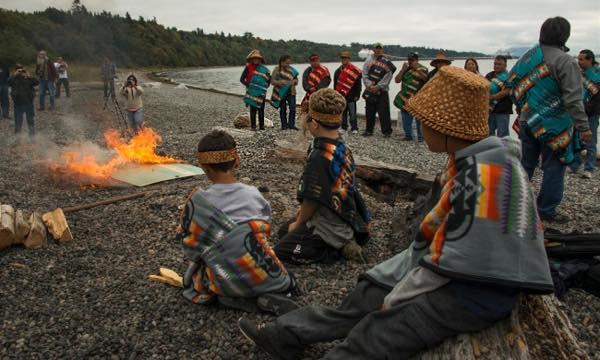
Members of the Lummi Nation burn a symbolic check in protest of the proposed Gateway Pacific coal export terminal in 2012. The terminal was eventually defeated when the U.S. Army Corps of Engineers ruled that the project would impact the Lummi Nation’s fishery at Cherry Point, which is protected under the 1855 Treaty of Point Elliott. Credit: Paul Anderson.

Members of the Lummi Nation burn a symbolic check in protest of the proposed Gateway Pacific coal export terminal in 2012. The terminal was eventually defeated when the U.S. Army Corps of Engineers ruled that the project would impact the Lummi Nation’s fishery at Cherry Point, which is protected under the 1855 Treaty of Point Elliott. Credit: Paul Anderson.

The Quinault own and manage Lake Quinault and the Quinault River from the lake to the Pacific Ocean, and co-manage the fisheries throughout their fishing areas—inland and at sea. But the tribe’s ancestral lands and resources are under threat by Houston-based Westway Terminals, which has applied for permits to expand its current crude oil shipping and storage facilities in Grays Harbor, Washington.

If approved, the expansion would add capacity to receive, store, and ship about 17.8 million barrels of oil annually by rail, and store an additional million barrels on site. It’s one of many proposed projects that would increase the transfer of raw fossil fuels to proposed ports on the Pacific coast, dubbed the “gateway to the Pacific,” for export to lucrative Asian markets.

In response, the Quinault have joined a growing coalition of other governments and allies to form a resistance to fossil fuel expansion along the West Coast, at the heart of which is hundreds of years of treaty rights and case law.

“We are a fishing, hunting, gathering people who care deeply about our land, water, and resources, as well as all life dependent on a healthy ecosystem,” said Fawn Sharp, the nation’s president. “These proposals threaten our economy, our environment, and our culture.”

[…]

Sharp, who is also president of the 57 Affiliated Tribes of Northwest Indians, said the best solution to the challenges created by what she called “the temperament of greed in this country” is the grassroots momentum that rises when the people—both tribal and nontribal—share a common vision and take action in their votes, voices, lifestyles, and the lessons they convey to their families.

“We know this country can’t break its addiction to oil overnight,” she said. “But we know that, over time, it has to be eliminated from use, and we know that process of elimination is a task that must be undertaken now.”

[…]

Throughout the Pacific Northwest, strength against the persistent intimidation of the fossil fuel industry has been found in this tribal-led coalition. “Tribal people are now, and have always been, the caretakers of the land,” Sharp said. “Our words have not always been heard. But when it comes to our sacred land, air, and water, we will always take a stand on behalf of life and the natural heritage we have inherited.”

web_80-wa-infographic-yes_mag-lummi-terri_hansen

Full story at ICTMN.

Honouring Viola Desmond.

A portrait of Viola Desmond, a businesswoman and civil rights advocate, circa 1940. (Communications Nova Scotia/Bank of Canada/Flickr) .

A portrait of Viola Desmond, a businesswoman and civil rights advocate, circa 1940. (Communications Nova Scotia/Bank of Canada/Flickr).

Canada is finally addressing the wrong done to Viola Desmond, a remarkable woman, who made a stand for civil and human rights, and was punished for doing so, then thoroughly whitewashed.

You can read all about Ms. Desmond here, and Canada’s move to repair those earlier, despicable actions.

Black Atheists Matter.

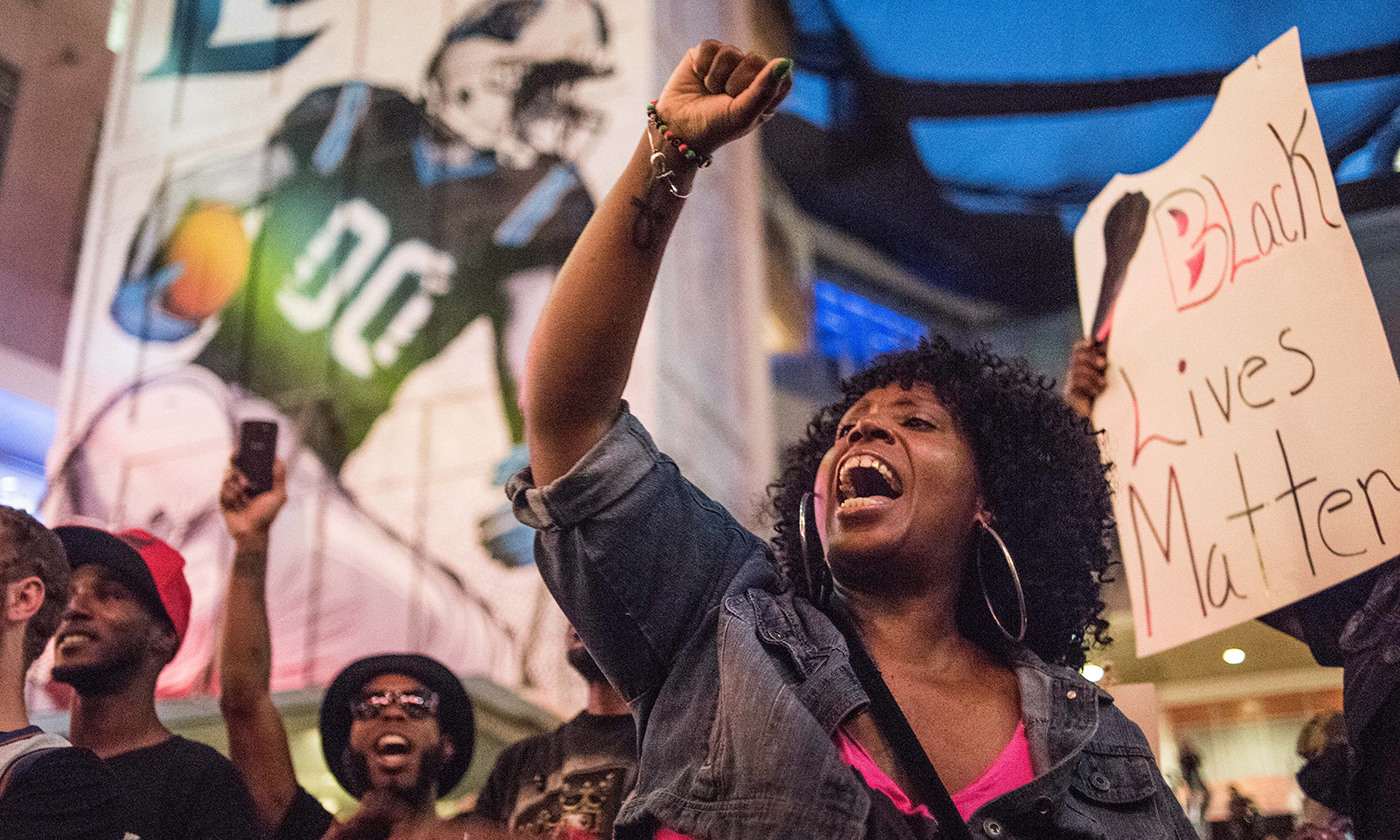
In Charlotte NC. Photo by Sean Rayford/Getty.

In Charlotte NC. Photo by Sean Rayford/Getty.

Christianity has played a central role in African-American life from the late 18th century to the present. Black churches raised funds for fugitive slaves, served as schoolhouses, and provided space for political meetings and activities, among other functions. Leaders of black congregations such as Richard Allen or Daniel Payne were often leaders of the broader black community. The spiritual messages of redemption and justice appealed to a people who experienced the brutality of slavery and the indignities of Jim Crow segregation laws. However, while many black churches were radical advocates for political and economic equality, others remained conservative institutions that failed to challenge the status quo. This conservatism helped give rise to an increasingly vocal and influential group of African Americans ­– the new black atheists.

Who are the new black atheists and what is behind their recent growth? First, let’s briefly look at the ‘old’ black atheists.

[…]

With women leading the contemporary freethought movement, the politics of respectability and its sometimes anti-feminist tendencies are being undermined. As Hutchinson notes in her book Moral Combat (2011), ‘for many black atheist women, atheism’s appeal lies in its deconstruction of the bankrupt mores, values and ideologies that prop up patriarchy, sexism, heterosexism, racism, white supremacy, imperialism and economic injustice’.

Feminism is an essential part of the new black atheists’ humanism. New black atheists think that it is not enough to deny the existence of God, teach evolution in schools or fight for the separation of church and state. They want to bring worldly solutions to practical problems. Many have embraced Black Lives Matter (BLM), a secular movement that is notably unaffiliated with black religious institutions and ideology. In doing so, they believe they will improve the lot of blacks in particular but also promote a more just, democratic and less racist American society.

As the black atheist Sincere Kirabo posits of BLM: ‘There’s a social activist movement underway continuing the unfinished business of the Civil Rights movement era. Want to make a difference? What we need is grit and involvement in the struggle, not a tribe satisfied with the empty promises of scriptural white noise. Please, for the sake and love of our own futures: abandon your fabled white messiah. Wake up. We are our own salvation.’

Black atheists matter: how women freethinkers take on religion. An excellent essay by Christopher Cameron, highly recommended. As history shows, attempting to to go along with white colonial doctrine doesn’t further people, as a group, or as individuals. It doesn’t decrease bigotry, either, because you’ll never be white enough, even if you manage the christian enough part. You only ever be an “oh, they are okay for a _____ person.”

Seeing Through The Distortion.

CREDIT: AP Photo/Eugene Hoshiko.

CREDIT: AP Photo/Eugene Hoshiko.

It’s not a simple matter, cutting through the constant distortions and lies which characterize the new administration here in uStates. There’s a strong inclination to simply dismiss Trump as an irrelevant blowhard, but that’s not the smart thing to do, because whether or not Trump has the slightest idea of what he’s doing (not much, in my opinion), the people behind him, those appointed and who now have unprecedented power, they do know what they are doing. They also know what they want. There are certain similarities to the Bush Jr. regime, but there’s much more “baffle ’em with bullshit” and “give them a reality show!” going on here. With Bush, there was a deadly calculation put into the manipulation of the public at large. Fear was whipped up to a point that people were willingly signing their rights away. I’d like to think that isn’t going to happen again, but it’s already in process. Whatever rights we thought we had are being carved away in great swathes, there’s no subtle whittling away here. Too many people simply want a ‘good’ show to watch, and Trump is capable of that much. What’s shameful here is that so much of the public doesn’t seem to want much more than that. If they ever do wake up, it will be much too late.

If Bush and Rove constructed a fantasy world with a clear internal logic, Trump has built something more like an endless bad dream. In his political universe, facts are unstable and ephemeral; events follow one after the other with no clear causal linkage; and danger is everywhere, although its source seems to change at random. Whereas President Bush offered America the illusion of morality clarity, President-elect Trump offers an ever-shifting phantasmagoria of sense impressions and unreliable information, barely held together by a fog of anxiety and bewilderment. Think Kafka more than Lord of the Rings.

It is tempting to suppose Trump built this phantasmagoria by accident — that it is the byproduct of an erratic, undisciplined, borderline pathological approach to dishonesty. But the president-elect should not be underestimated. His victories in both the Republican primary and the general election were stunning upsets, and he is now set to alter the course of world history. If he does not fully understand what he is doing, his advisers certainly do.

Steve Bannon, former head of the white nationalist outlet Breitbart News, is Trump’s Karl Rove. He knows. In a recent interview with the Hollywood Reporter, Bannon suggested that the key elements in his strategy are dissimulation and “darkness.”

[Read more…]

George Takei: We Can’t Go Back.

1-aneepxqjrjtc9f3plz1lig

My mother was born in Sacramento, the daughter of Japanese immigrants, and my father grew up in San Francisco. They met and married in Los Angeles, where I was born in 1937, and where we lived happily until December 7, 1941.

When the Japanese attacked Pearl Harbor, life changed for our family and thousands of other families like us. Suddenly we were presumed to be the enemy. We were questioned, followed, suspected, and accused of being spies or saboteurs simply because of our ancestry. The government that was supposed to protect us against mob rule suddenly had become the mob. It is hard to describe a more gripping, more pervasive sense of terror.

Just a few weeks after my 5th birthday, the military forcibly removed us from our home. Two soldiers with bayonets marched upon our driveway on Garnet Street, pounded on the front door, and demanded we vacate immediately. We took only what we could carry. My younger brother and I both held a suitcase; my mother, tears streaming down her face, held my baby sister with one arm and a duffle bag with another. We lost our home, our car, my father’s book collection.

I will never forget that day.

George Takei’s full article is here, and it’s one everyone should take to heart.

Standing Rock Syllabus: Learn, Teach.

Credit: C. Ford.

Credit: C. Ford.

The New York City Stands with Standing Rock Collective then met again and we talked at length about the syllabus and how to curate emergent sections. We want our readers and future teachers to understand that we take Sioux notions of history seriously but came to impasses with certain materials that we wanted to include, but felt inadequate to interpret. So we direct educators and students to the crucial archives of Lakota Winter Counts. One of the founders of the resistance camps at Standing Rock, LaDonna Brave Bull Allard, has devoted her life to the interpretation of these counts and any responsible curriculum will point to them and invite students to think about and with them. Recognizing then, our limitations, we volunteered to work with our strengths and to curate specific sections of the syllabus, to take charge of, so to speak, the content and the form. Matthew Chrisler managed the group and ordered the text with Jaskiran Dhillon, New School Assistant Professor of Global Studies and Anthropology who stepped in at certain points to read over entries. Along with Matthew Chrisler, Sheehan Moore, a doctoral student in anthropology at CUNY, organized all of the PDFs to attach to our website for syllabus readers to view and download. In this way, there were multiple eyes on each section as it took shape. We also asked curators to narrow their selections to book chapters and specific articles to further focus the syllabus and keep it accessible for people who would read and download it in short amounts of time. We wanted people to read the syllabus and teach the material, but also to have access to the readings for themselves and their students and/or community members.

Although a “work in progress,” the current #StandingRockSyllabus places what is happening now in a broader historical, political, economic, and social context going back over 500 years to the first expeditions of Columbus, the founding of the United States on institutionalized slavery, private property, and dispossession, and the rise of global carbon supply and demand. Indigenous peoples around the world have been on the frontlines of conflicts like Standing Rock for centuries. The syllabus foregrounds the work of Indigenous and allied activists and scholars: anthropologists, historians, environmental scientists, and legal scholars, all of whom contribute important insights into the conflicts between Indigenous sovereignty and resource extraction. It can be taught in its entirety, or in sections depending on the pedagogic needs. We hope that it will be used in K-12 school settings, community centers, social justice agencies training organizers, university classrooms, legal defense campaigns, social movement and political education workshops, and in the resistance camps at Standing Rock and other similar standoffs across the globe. As we move forward, we anticipate posting lesson plans on our website that will be derived from individuals and communities using the syllabus in their respective locales.

While our primary goal is to stop the Dakota Access Pipeline, we recognize that Standing Rock is one frontline of many around the world. This syllabus can be a tool to access research usually kept behind paywalls, or a resource package for those unfamiliar with Indigenous histories and politics. Please share, add, and discuss using the hashtag #StandingRockSyllabus on Facebook, Twitter, or other social media. Like those on the frontlines, we are here for as long as it takes.

The #StandingRockSyllabus and accompanying PDFs can be found here.

The full story on the syllabus is here#StandingRockSyllabus. As Peter D’Errico says:

True to the purpose of digging to the roots of events, “#StandingRockSyllabus places what is happening now in a broader historical, political, economic, and social context going back over 500 years to the first expeditions of Columbus, the founding of the United States on institutionalized slavery, private property, and dispossession, and the rise of global carbon supply and demand. Indigenous peoples around the world have been on the frontlines of conflicts like Standing Rock for centuries.”

Importantly, #StandingRockSyllabus aims for audiences beyond the standard academic world: The authors built it for use “in K-12 school settings, community centers, social justice agencies training organizers, university classrooms, legal defense campaigns, social movement and political education workshops, and in the resistance camps at Standing Rock and other similar standoffs across the globe.”

This is an invaluable opportunity for teachers, please take advantage of it. This is also an invaluable resource and opportunity for those who wish to understand. As this is supposedly Native American Heritage Month (more on that later), spreading this everywhere would be be a great gesture. Lila wopila to all who do. (Many Thanks).

Another Standing Rock Waits in the Wings.

Tohono O’odham Elder, second to last on the right in gray shirt. Credit: C. Ford.

Tohono O’odham Elder, second to last on the left in gray shirt. Credit: C. Ford.

Some of you might remember this from one of the many camp posts:

The Tonoho O’odham elder spoke again, about the loss of much of their way of life when they lost the Gila River. He spoke of Roosevelt’s “offer” to move them to Oklahoma (translation: you walk there), and how the people refused, wanting to stay on their own land, and how so many of them died. He spoke of Sihasin, saguaro, who are guardians. He spoke about the insanity of imposed borders where he lives, and the rabid people trying to keep people out. He spoke of a time when there were no artificial borders, and of how often he crosses this border himself, to get water or medicine. He said he is always stopped, but he speaks to people in his language, which they do not understand, and they always let him go. Other people had also spoken of the imposed borders, in the attempt to keep primarily Mexicans out, and pleaded with all tribes to offer people sanctuary, as these borders are not ours.

The Tonoho O’odham elder who was the head of their runners, those of their nation who ran all the way from Arizona to the Oceti Sakowin camp in nDakota, often spoke about the imposed borders his people had to put up with. Their peoples’ land extends past the artificial borders, and they feel free to ignore such impositions, especially when they need to get certain plants, or visit sacred sites. As far as they are concerned, wašichu borders are stupid and meaningless. Now there’s Trump, who plans to build a big old fucking wall, to keep everyone in. Oh, I mean out. The Tonoho O’odham have a different idea.

President-elect Donald Trump says that he will build a wall along the U.S.-Mexico border. It will stop undocumented immigrants from entering the country. It will stop drugs from entering the country. It will be 50 feet tall. It will be nearly a thousand miles long. And it will cut the traditional lands of the Tohono O’odham Nation of Arizona in half.

The Tohono O’odham reservation is one of the largest in the nation, and occupies area that includes 76 miles of the U.S.-Mexico border. However, the tribe’s traditional lands extend deep into Mexico, and tribal members live on both sides of the border: With tribal identification, they cross regularly to visit family, receive medical services, and participate in ceremonial or religious services.

The prospect of slicing their homelands in two? Not welcome.

“Over my dead body will a wall be built,” says Verlon Jose, vice chairperson of the Tohono O’odham Nation. “If he decides to build a wall, he’s going to need to come talk to us, unless he wants to see another Standing Rock.”

In other words, to build the wall, Mr. Trump will have to fight for every single mile of Tohono O’odham land—legally, and possibly even physically.

And they’re not the only tribal nation that would be impacted by the wall.

Robert Holden, deputy director of the National Congress of American Indians, points to the Ysleta Del Sur in Texas and tribes in California, such as the Kumeyaay, who have relatives in Mexico. “There’s significant tribal sovereignty at stake here,” Holden says.

[…]

This doesn’t mean things are peachy down on the Tohono O’odham reservation, though: Tribal members say they are routinely harassed by Border Patrol; cultural and religious items are frequently confiscated; and detentions and deportations of tribal citizens are not uncommon. In 2014, two tribal members were hospitalized after being shot by a Border Patrol agent. The situation has often been compared to a Berlin Wall-like scenario, but the tribe has fought for and maintained the ability to enjoy its traditional homelands—at least more than if a wall were running through the middle of it.

“Let me come into your home and build a wall directly in the middle of your house and tell me what impacts that would have on you?” says Jose. “This land is our grocery store; this land is our medical facility, where we get our medicinal remedies from; this land is our college and university. Our sacred sites are in Mexico; our ceremonies are in what is now Mexico. The border is an imaginary line to us.”

Full story is at YES! Magazine. Also of interest: Norway’s Largest Bank Divests From Dakota Access, Launches Own Investigation and What the Trump Victory Means for Standing Rock.

Mni Wiconi: The Stand at Standing Rock.

Courtesy Standing Rock In the midst of federal government deliberations over the Dakota Access Pipeline, the Standing Rock Sioux tribe has released a short film titled “Mni Wiconi: The Stand at Standing Rock.”

Courtesy Standing Rock
In the midst of federal government deliberations over the Dakota Access Pipeline, the Standing Rock Sioux tribe has released a short film titled “Mni Wiconi: The Stand at Standing Rock.”

In the midst of federal government deliberations over the Dakota Access Pipeline, the Standing Rock Sioux tribe has released a short film titled “Mni Wiconi: The Stand at Standing Rock,” a new, eight-minute film exploring the nearly eight-month battle to stop construction of the pipeline on sacred tribal lands.

The short documentary can be viewed on Standing Rock Sioux Tribe’s Facebook page or website.

[…]

The Standing Rock’s Facebook page states the following requests:

We are asking dozens of individuals and groups to share a new short film, found here:Facebook or website.

Please share with all your followers – Facebook or website – so people around the world understand the gross injustice taking place against the Standing Rock Sioux Tribe in North Dakota.

We need to keep the pressure on President Obama. He might be our last hope.

Here are a series of potential social media posts the Standing Rock Sioux Tribe is suggesting readers share:

#StandwithStandingRock – Watch and share this new short film – Facebook or website– about the tribe’s fight against energy development and injustice. #NoDAPL

Ask President @BarackObama to deny the easement! Call Obama at 202-456-1111. #StandwithStandingRock #NoDAPL

Mni Wiconi, Water is life. Tell Obama DENY the easement by calling 202-456-1111. #StandwithStandingRock

Watch this story about why it’s critical we #StandwithStandingRock. Obama MUST deny the easement now. #NoDAPL

We all #StandWithStandingRock. The time is NOW to say #NoDAPL. Call Obama at 202-456-1111.

No more delays, no more excuses. Get on the right side of history and say #NoDAPL. Deny the easement! #WaterIsLife

Here are links to share:

https://www.facebook.com/Standing-Rock-Sioux-Tribe-402298239798452/?fref=nf

http://standwithstandingrock.net/mni-wiconi/

Learn more about the Standing Rock Sioux Tribe at standwithstandingrock.net. For ongoing updates, please follow our Facebook page at Standing Rock Sioux Tribe.

Full story at ICTMN.

Highly recommended reading: To Brave White People: Be Braver. * A Few Thoughts on The Election and What President Trump Means for Indian Country.

DAPL Ignores Army Corp. Again.

Courtesy Dr0ne2bewild Shiyé Bidziil/Vimeo. Energy Transfer Partners has gone so far as to build its drilling pad for tunneling under the Missouri River at Lake Oahe, even though it still awaits the necessary easements.

Courtesy Dr0ne2bewild Shiyé Bidziil/Vimeo.
Energy Transfer Partners has gone so far as to build its drilling pad for tunneling under the Missouri River at Lake Oahe, even though it still awaits the necessary easements.

The U.S. Department of Justice is about to announce next steps on de-escalating the standoff regarding construction of the Dakota Access Pipeline, according to the Standing Rock Sioux Tribe.

“Today, the Department of Justice announced in federal court that it will be announcing the next steps on a ‘path forward’ for the Dakota Access Pipeline crossing at Lake Oahe,” said Standing Rock Sioux Chairman David Archambault II in a statement on November 10.

Energy Transfer Partners is refusing to stand down on its construction plans despite two requests from the U.S. Army Corps of Engineers that it do so.

The company, builders of the Dakota Access Pipeline (DAPL), said on Tuesday November 8 that it planned to begin drilling in two weeks—even though at the moment it does not have the easements necessary for it to tunnel under the river legally.

Full story at ICTMN.

November Is…

Speaking of, Alysa Landry has an excellent article up at ICTMN, about spending the last forty-five weeks writing about all the U.S. presidents, and their impact on Indigenous peoples: Indians Are Invisible: What I Learned Researching US Presidents. Highly recommended reading. The whitewash goes deeper than anyone thought.

44.

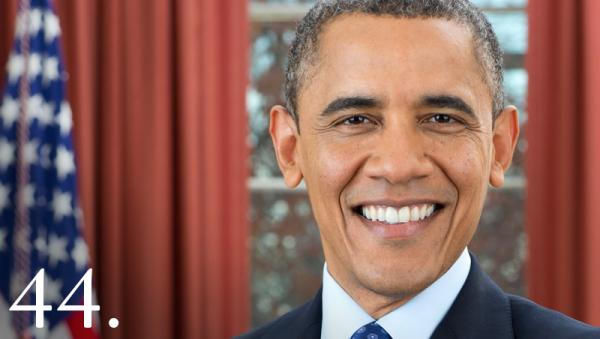
President Barack Obama. Whitehouse.gov.

President Barack Obama. Whitehouse.gov.

During his eighth and final White House Tribal Nations Conference, President Barack Hussein Obama delivered an intimate message to Native Americans.

“This whole time, I’ve heard you,” he told tribal leaders who gathered in Washington, D.C., in September 2016. But Obama’s comments were intended for a wider audience—all Natives in their respective home communities. “I have seen you. And I hope I’ve done right by you.”

The remarks, which came near the end of Obama’s presidency, revealed an emotional connection to Native Americans, said Kevin Washburn, who served as assistant secretary for Indian Affairs under Obama from 2012 to 2016.

“Early on, as a candidate, Obama identified Indian country as something that was important to him, an area where he personally wanted to make a difference,” said Washburn, a law professor at the University of New Mexico and a member of the Chickasaw Nation of Oklahoma. “From the beginning, we saw that he was intellectually committed to Indian country. By the end, he was emotionally committed. I don’t think we’ve seen that before.”

Obama, whose two-term presidency ends in January, began championing for Indians prior to taking office. In fact, Obama announced his federal Indian policy six months before defeating John McCain in the 2008 election.

The full two page article is at ICTMN.

North Carolina: Still Losing.

Attorney General Roy Cooper (D) and Gov. Pat McCrory (R) debating earlier this month. CREDIT: AP Photo/Gerry Broome.

Attorney General Roy Cooper (D) and Gov. Pat McCrory (R) debating earlier this month. CREDIT: AP Photo/Gerry Broome.

NC continues to lose out on the economic front, some might say NC has been hemorrhaging jobs and money since the beginning of HB2, but as usual, McCrory continues to defend this attempt at legalizing bigotry and hatred. There simply isn’t any way for McCrory to save face at this point, but his refusal to back down and withdraw HB2 points to him being a very small man indeed, one who cannot, and will not admit he was wrong. I will give him this, he’s a fine example of what happens when a person embraces bigotry to the exclusion of all else. McCrory is now down six points, but I expect he still thinks he’ll win. I imagine he’ll lose, not only because he has lost his state so very much economically, but out of the sheer embarrassment on the part of many North Carolinians.

This week, North Carolina found out it is not getting 730 new jobs and a quarter-billion-dollar impact that it was the top contender for. The reason? Its anti-LGBT law, HB2, which bans trans people from using the bathroom and bars municipalities from protecting LGBT people from discrimination.

CoStar Group Inc., a real estate analytics company, had been shopping around cities to build a new research operations headquarters, and the contenders were Charlotte, Richmond, Atlanta, and Kansas City. The Atlanta Business Chronicle heard from sources that Charlotte was the favorite. But the jobs are going to Richmond.

According to David Dorsch, CoStar Group’s commercial real estate broker, “The primary reason they chose Richmond over Charlotte was HB2.” CoStar Group was itself, a bit mum, simply confirming the jobs were going to Richmond — and no expansions were planned anywhere else. But Dorsch was adamant that the jobs were another casualty of the discriminatory law. “The best thing we can do as citizens in North Carolina is to show up on Nov. 8 and think about which party is costing us jobs and which one is not.”

[…]

But McCrory’s administration denies there’s been any backlash whatsoever. His Commerce Secretary, John Skvarla, insisted this week that HB2 “hasn’t moved the needle one iota.” Indeed, he claimed that the state is financially and operationally in the “best position” it’s ever been.

Oh sure, that’s why McCrory “redirected” half a million dollars from the state’s emergency disaster fund, because you’re in the best position. FFS.

They’re not in total denial, though. Skvarla also admitted that the state made PayPal give back a ceremonial wooden bowl that McCrory had given to the company as a gift celebrating the original plan to expand in North Carolina. As the Observer described it, “state officials did what any jilted ex might: Asked for their stuff back.”

You can not make this stuff up, you just can’t. One would think McCrory and his cronies were a gang of foot-stomping 6 year olds. I expect that’s unfair to 6 year olds, most of them probably much more mature than McCrory.

McCrory, who is fighting for re-election in two weeks and is down six points, continues to defend HB2 and deny that it’s a problem. His opponent, Attorney General Roy Cooper (D), refuses to defend the law in court and staunchly opposes it. In a recent debate, Cooper called out McCrory’s version of reality: “Gov. McCrory continues to go across the state and tell people it is not hurting our economy. He attacks businesses who are opposed to it and says everything is going fine. Governor, what planet are you on?”

I would guess most of us would like an answer to that one.

Think Progress has the full story.

43.

George W. Bush. Whitehouse.gov.

George W. Bush. Whitehouse.gov.

One year before winning the election of 2000, George Walker Bush, then Texas governor and Republican frontrunner in the presidential race, championed for states’ rights, which he believed trumped the rights of tribes.

During a trip to Syracuse, New York, in October 1999, Bush, already an adversary to Indian casinos in his home state of Texas, advocated a position that contradicted both the U.S. Constitution and more than 200 years of federal Indian law.

“My view is that state law reigns supreme when it comes to the Indians, whether it be gambling or any other issue,” he told the Syracuse Post-Standard on October 24, 1999.

[Read more…]