
Edward M Massey. New and Original Magic. New York, Spon & Chamberlain; England, Wilford Hutchinson, 1922.

Edward M Massey. New and Original Magic. New York, Spon & Chamberlain; England, Wilford Hutchinson, 1922.
The persimmon tree did not change leaves color at all in the fall, which is a bad sign, but eventually, they fell off and did not dry on the plant, which is a good sign. I have stored it together with my citruses and other subtropic plants at 10-15°C, but about a month ago I have re-potted it together with my Ulmus parvifolia bonsai because those both started to grow already due to the abnormally warm winter.

© Charly, all rights reserved. Click for full size.

© Charly, all rights reserved. Click for full size.
During that, the plant had very nice and healthy roots. The main root was not overly long and it was not carrot-like at all, which is the worst that can happen. As you can see, it had nice and bushy side-roots on the whole length, an ideal situation. So I have cut off half of the main root and the cut was, again healthy-looking, white and wet. I covered the cut with lots of charcoal and I planted the tree in a wider and shallower pot than it was before
Lastly, I moved it into my room to be able to better control the substrate humidity to avoid root rot. I have expected the tree to wake up in the warmer room and start growing, but so far nothing and it is making me anxious. After all, my Ulmus parvifolia grow like mad despite being in the coldest room in the house.
And today I realized that I need not try and cope with that anxiety alone, so here you have it, now you can be anxious too. Ain’t I grand?

© Charly, all rights reserved. Click for full size.
The terminal bud is still bright green and the top leaf is soft to touch and that is a good sign.
But it does not grow, dammit. Maybe this tree reacts to daytime length before it starts growth?
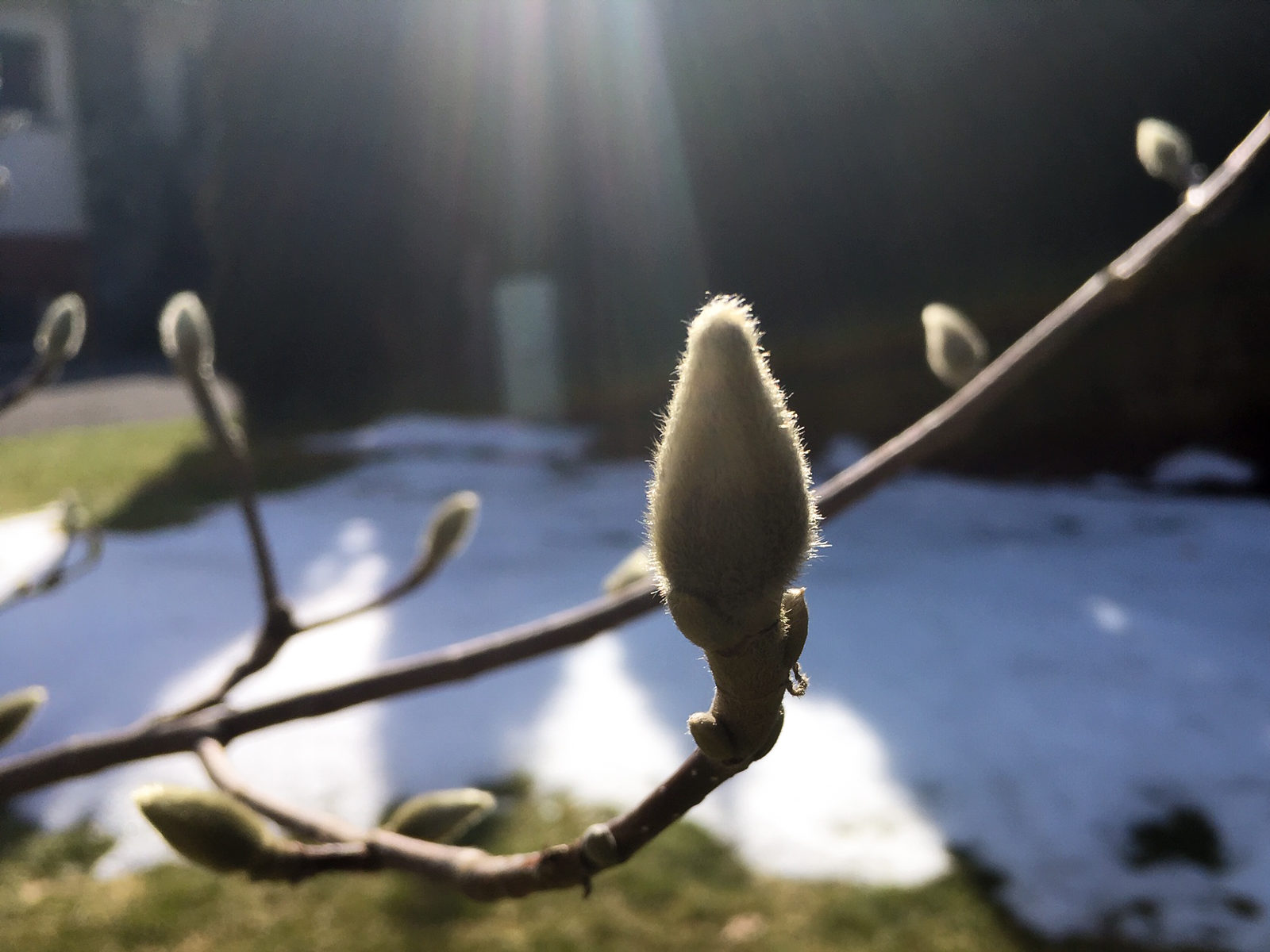
Spring has arrived ahead of schedule. ©voyager, all rights reserved
“Shit!” I heard my husband cry out this morning, waking both Jack and me rather suddenly.
“Voyager, get up.” I immediately knew what the problem was. Mr. V. had an out-of-town appointment for a test today, and we’d overslept. I quickly glanced at the clock to see that it was already after ten, and our test time was for 10:15, and it was a 45-minute drive to get to there. Shit indeed.
I jumped up (ok, it was more of a grunting wobble-up than a jump) and grabbed my phone to call the Dr’s office. Then I had to search for my glasses so that I could actually see well enough to use my phone, and I called the clinic to let them know we had a problem (I tried to be as vague as possible) and that we’d be seriously late.
The receptionist was very understanding and said to try to get there as soon as possible, and she would fit us in. I told the Mr. to lie back down so I could apply his leg compression neoprene stockings because he needs them on before he can get dressed. We managed that quickly, raced through our ablutions, then I grabbed from my closet rather than do my usual ‘what about this or maybe that’ and we were dressed and ready to go in about 10 minutes.
Poor Jack was still sleepy and in bed, but he came when I called him for breakfast. I swear he ate as slowly as possible, but he finally lifted his head out of the bowl and gave me a happy smile and a cheery good morning. Since there wasn’t enough time to go for a walk, we decided to take Jack with us, and I called him to the front door. Bubba doesn’t ‘do’ rushed, and he meandered toward me at a snail’s pace until I finally met him halfway and snapped on his leash, hoping it would speed him up a bit.
It didn’t, but a slow crawl and two pees later, we finally made it to the car and got underway. Luckily, traffic was light, and we arrived at the clinic in a bit under 40 minutes.
Jack was a bit grumbly on the way, but he soon cheered up when I took him for a walk while the Mr. went in for his test. Jack and I live in a small city of about 40,000 people, but the clinic is in a large city of about 400,000 people, and it’s full of exciting smells. It took us 15 minutes just to walk the length of one block because Bubba kept stopping to sniff. Some places required a long, thorough sniff, some spots required a small touching by the tongue for taste and some needed a bit of extra pee, which Jack happily added, By the time we made it back to the car, the boy was empty and tired. I lifted Jack into the backseat (he gets the front half in, and I heft up the Mr. Heavybum half), and my sweet Bubba adorably curled up on his bed and went to sleep.
Soon, Mr. V was back, and we set off home with Jack snoring the entire way. Jack’s sleepiness is a sign of his advancing age, and so is my own oversleeping, but we’re still together, and today we enjoyed the simple pleasures of sunshine, blue skies, trees in bud, and a symphony of strange smells in a new neighbourhood.
Jack says to thank you all for the birthday greetings, and I thank you for all of your kind words.

Clara Ingram Judson. Garden Adventures of Tommy Tittlemouse. Chicago, New York, Rand, McNally & Company, 1922.

Blanche Sellers Ortman. The Old House, and other stories. Chicago, The author, 1910.
The notes for this book state that only 500 copies of the book were privately printed for the author by Rand McNally Press. This makes the book rare, but probably not worth anything. If the stories were good, it wouldn’t have needed a “private” publication. It has a lovely and tasteful cover picture, though. I also like the gold font, but perhaps the family crest with Latin is a bit much.
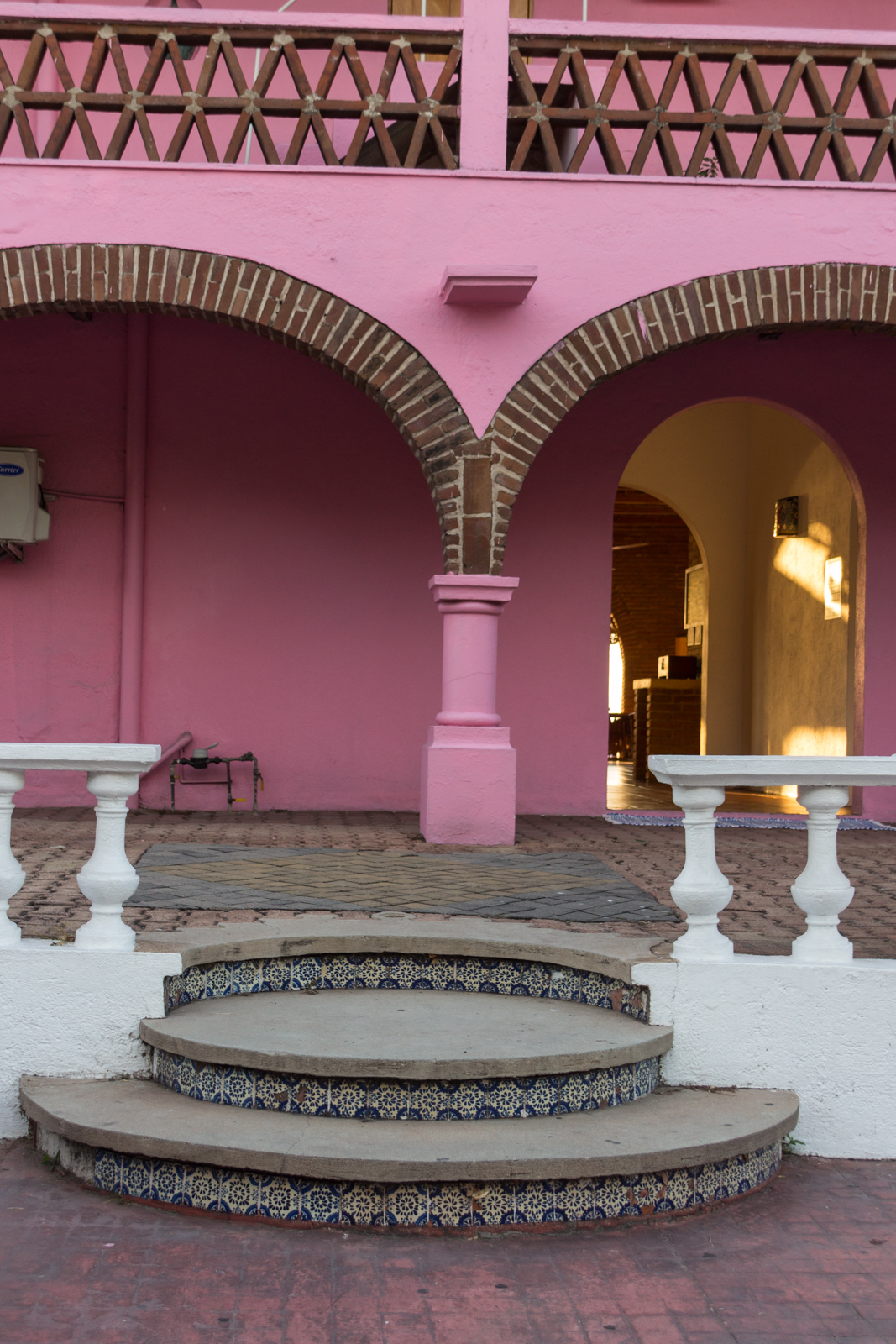
Evening at The “Pink” Posada, Manzanillo, Mexico ©voyager, all rights reserved
It’s hard to admit that you’re not coping well, but today’s walk is an admission of sorts.
While I was in Mexico, I had limited access to wi-fi, and rather than struggle trying to find a place to read and post, I gave up and took an internet break, which turned out to be edifying. It goes back to the time my mother was dying last year. Mom suffered constant anxiety and required a lot of support, which her caregivers at the nursing home struggled to meet. Neither she nor I had the funds to hire extra help and I took the task on myself. It turned out that I was spending 6 to 10 hours a day with her, hand-holding, calming her fears and helping with her personal care needs. She was expected to die in mid-August from an acute infection, and in agreement with her Dr., we withheld antibiotics as a palliative measure, keeping her as comfortable as possible, but not treating the cause. As it turned out, Mom beat the infection, surprising everyone. She didn’t recover, though, and her decline took many more weeks until she finally succumbed at the end of October. Each and every day I was there – for most of the hours of the day and many hours of the night. My husband and friends all worried about me doing too much, but I couldn’t see a way clear to change things. I’m an only child and so was my mother and all of our family is in Germany, so there was no one else to help.
My mother suffered from Borderline Personality Disorder (BPD), and she could be difficult to deal with. Our relationship was complicated, and I was hoping that by being there for her at the end of her life, we could make peace with each other. That didn’t happen. She wasn’t able to give me what I wanted, but over those many weeks, I lost the need for it. I accepted that her BPD dictated who she was and how she related to the world around her. Slowly I found compassion for her and came to realize how distressing her emotional life had been. My care for her gradually became about pure love for a mother who did the best she could despite her own struggles. It was an emotionally complicated time for me, and there were many days that I fought my own anger, exasperation and disappointment. By the time she finally died, I had let go of a shit ton of crap, but in the process, I burnt myself out, and I never really recovered from it.
Being unplugged in Mexico, I had time and space to reflect on a lot of things, and one of the more difficult epiphanies that I had was that I’ve been putting too much energy and time into this blog. I posted my first Jack’s Walk on March 23, 2018, and since then, I’ve been here every day in one form or another. That’s almost 2 years of daily effort, and I’m worn out. It’s also partly my fibromyalgia. I have a good regime in place (thank you, medical marijuana), and I can often ignore the smaller symptoms, but the larger ones still crop up, especially when I’m tired or overstimulated. Please, don’t get me wrong… I love this blog and the people who populate it. I wouldn’t have come this far otherwise, but Jack’s Walk has been feeling stale and repetitive, and I need a bit of a break from it.
What does that mean? I’m not really sure in the long-term, but for now, it means Jack and I will only be here twice a week on Mondays and Thursdays. In between those days, there might be a post about Russia or Mexico or maybe something else altogether or nothing at all. I have other ideas and maybe taking a break from The Walk will allow me the energy to explore some of them. I’ll still be around every day, but some days it might just be in the background. Charly has thankfully recovered and is posting regularly now, keeping us informed about setting up a new knife-making business and forge with ingenuity and resourcefulness. He’s also sharing with us the art of Bonsai. Giliell still shares her work struggles, her beautiful photos, her art of food and resin, as well as her fearless fight against the Patriarchy, so that relieves some of my stress about keeping this blog alive and viable, which has been my goal since the beginning.
Being a blogger was never something I set out to do; it happened because of the death of a friend, but this blog is one of the greatest gifts I’ve ever been given. I always wanted to write, and thanks to all of you, I’ve been able to do that. Now, I hope to catch my breath and focus a bit more on my real life so that I can keep writing and maybe even improve at it. My final thought for today is one of gratitude. The best part of this blog is the way the world has opened up to me. I’ve made friends all over the globe, and I appreciate all of them… all of you. I’ve always said my favourite thing about this blog is reader submissions, and I mean that. Your comments, the photos you send and the stories you share are what make this a meaningful endeavour for me. I think of this place as a community founded by Caine and maintained by all of us, and it is still my pleasure to help keep the lights on.
Jack says hi and wants you to know that even though he’s just turned 12, he is not over the hill and that he plans to have many more adventures.
I think the idea is genius: taking ordinary (and some serious) complaints from everyday people and turning it into a piece of music.
I hope our Finnish readers can enjoy this one particularly.
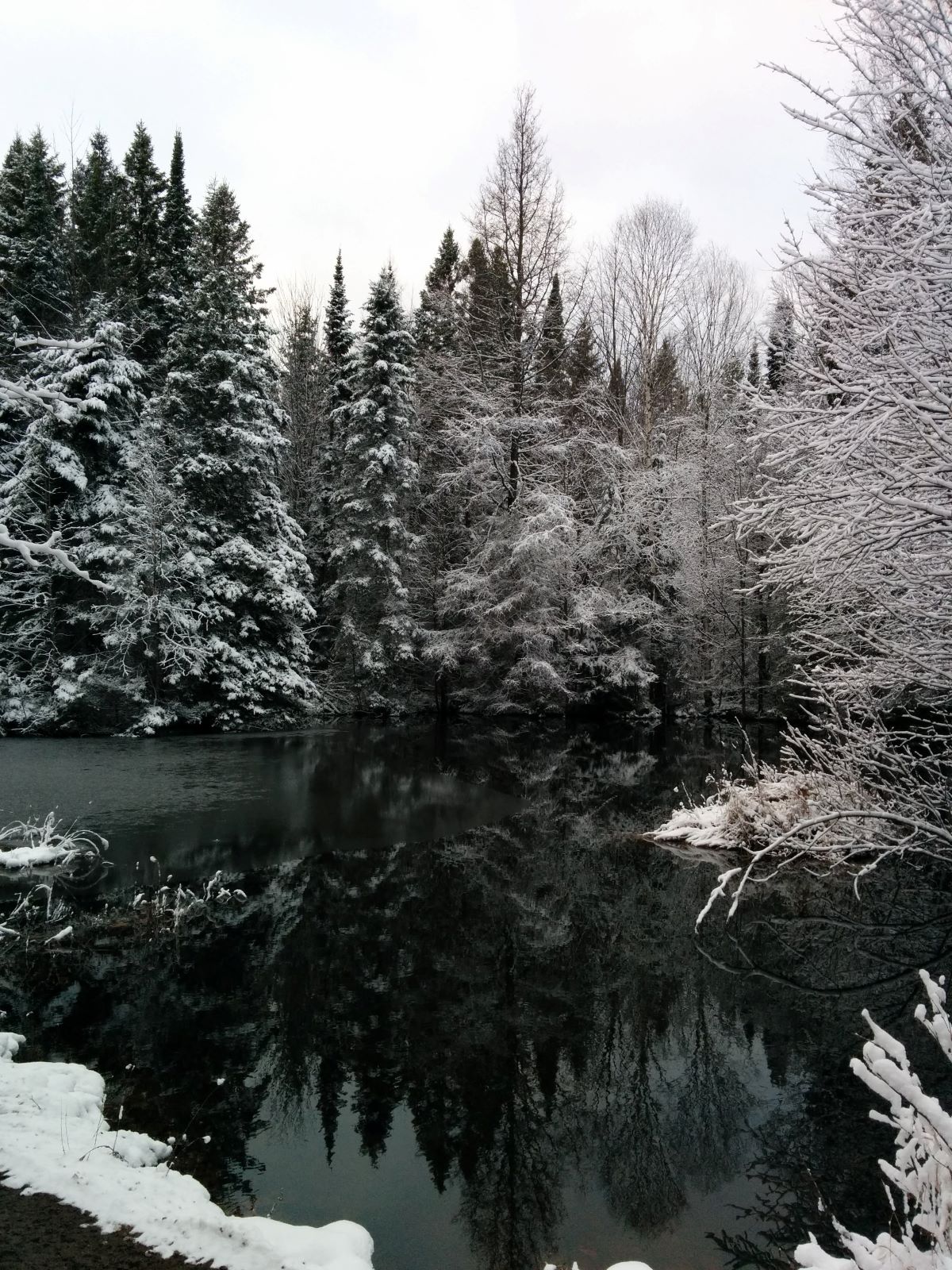
Photo by Erin H.
Today’s tree photo was sent in by VBFF. It’s a picture taken by her niece Erin, who has given her permission for me to share it with you. Erin used the photo to make Christmas cards, and I think it captures the quiet, still, soul of winter and I hope you love it as much as I do.

Camping in the Canadian Rockies. Walter Dwight Wilcox. New York; London, G.P. Putnam’s Sons, 1896.
via: The Internet Archive

Happy 12th Birthday Jack ©voyager, all rights reserved
Well, I’m home from Mexico, and I’m none too happy about it. We left Ajijic, Mexico, at 8 a.m. on Wednesday, February 26 and arrived home nearly 24 hours later. Our connecting flight to Houston arrived in good time, but we were delayed in Texas by bad weather in Toronto. We finally took off and managed to land in Toronto, but after landing, we sat on the tarmac for over an hour while ground crews cleared the snow. By the time we got off the plane, it was 2:30 a.m., and we’d missed our shuttle bus home.
It had been 18 degrees and sunny when we left Mexico, and it was -10 with blowing snow here, which was quite a shock to the system. Despite all the bad weather, we felt lucky to get as far as Toronto, because all outgoing flights from the airport had been cancelled. The shuttle service told us the bus was still running, though, and, finally, at 4:30 a.m., the airport bus pulled up. Janet and I both let out an excited “there it is,” as it rolled to a stop. The driver loaded all our cases, and away we went, slowly and carefully, into the storm. About 2 hours later, we finally arrived home to our snow-covered city, where Mr. V and Jack were excitedly waiting for me.
Jack has been a bit clingy since I arrived home from Mexico, and I’m alright with that in the short-term, although it would be nice to use the toilet without being watched. In any event, we didn’t venture out far over the weekend because the storm lasted until late yesterday. Today, though, it’s warmed up to 6 degrees, and it’s raining. Oh, Joy!
I did make it home in time for a significant event, though. On Saturday, February 29, my baby boy, Bubba, turned 12. It’s only the fourth real birthday he’s ever had, so we made it special. He had toast with jam and yogurt for breakfast, then he got a new rubber pig-pig and a rather sizeable birthday cookie plus a walk around the neighbourhood. For supper, he had steak and the rest of his birthday cookie, then we played pig-pig again and to top off the day, he had ice-cream before bed. We sang the happy birthday song to him a few times and Jack was pleased with that. He likes it when we fuss over him. I got him a hat to wear, but Jack told me that he didn’t want to wear it because he felt silly, so I didn’t push the issue. I feel a bit silly in those hats, too. All in all, it was a good birthday, and even though Jack is now a senior citizen, he still has a few adventures left to share with me… and you.

Mme. La Comtesse Sophie Rastofichine Segeur. Baltimore, J.P. Piet, 1881.

Multiple Authors. The Lady in the Tower and Other Stories. New York, Cincinnati, Chicago, Benziger Brothers, 1909.
This bit is, alas, often not discussed in bonsai literature as much in detail as it should too. Some books mention it in passing, some do not mention it at all. The talk is about types of tree growth. (note – the used terminology is my own, I have long since forgotten the official technical terms and anyway I am too lazy to search for them in foreign language)
There are three basic types that every bonsaist needs to be aware of, and it is vital to know which type each of your plants has because they determine what kind of care they require to get turned into a bonsai and survive the procedure.
1 – Continuous growth.
This does not mean that the plant grows continuously throughout the year, although usually when a plant does grow the whole year, it has this type of growth. But the growth might slow down or stop completely in certain conditions, like drought or cold or insufficient daylength. However, when the growth slows or stops, it does so without any apparent change in the plant’s physiology. No special structures develop, the plant just stops growing and when the conditions get right again, it continues. The “buds” are simply a bundle of small leaves/needles bunched up together.
In temperate regions, typical representatives of this type of growth are some evergreen conifers, like junipers or thujas. It is most typical for many subtropic trees – citruses, olives, and hibiscus. And of course tropical plants and succulents, like a ficus and money tree. This type of growth have mostly evergreens, although there are deciduous plants with it – for example, russian olive (Eleagnus angustifolia) and fig tree (Ficus carica), but they are the exception, not the rule.
2 – Continuous growth with a hibernating stage.
During the season, these plants just grow like the first type, adding leaves to their twigs continuously and growing in length. But when the conditions start to signal the end of the growing season, not only do they stop growing, they create specialized wintering buds. These buds then contain a relatively undifferentiated beginning of the next twig. When the hibernation ends, the buds shed their protective layers (modified leaves) and from them emerge twigs that again start to grow in length and adding leaves as much as they can manage.
This type of growth is typical for deciduous trees in temperate regions, like willows, poplars, maples, hazels and many more. I am not aware of any evergreen with this type, maybe holy (Illex sp.).
3 – Growth in spurts.
Some trees take the hibernation stage to the next level. The wintering buds do not contain just the beginning of a new twig, but a complete one with non-differentiated buds. At the beginning of the growing season these whole twigs emerge from the buds, they stretch in lengths and gain girth, but they do not add any new leaves or buds – the number of those has been determined previous year already.
This is typical for firs, pines, spruces and many other coniferous trees of temperate regions. From the top of my head, I only can remember one deciduous tree with this growth type – beech (Fagus sp.).
For a beginner, types 1 and 2 are the best option. Those are comparatively easy to manage, they mostly heal easily from pruning and the pruning itself can be often done at almost any time of the year or in wide enough window not to need to fuss about it too much.
Type 3 is difficult, and thus alas another point against pines. These types of trees cannot have twigs trimmed just anytime and anywhere, they often require being cut during very specific time otherwise the next year’s buds will form where you do not want them.
The worse in this regard are spruces, whose growth is nearly completely unmanageable. That is why you won’t see many very old spruce bonsai trees. More on that later.