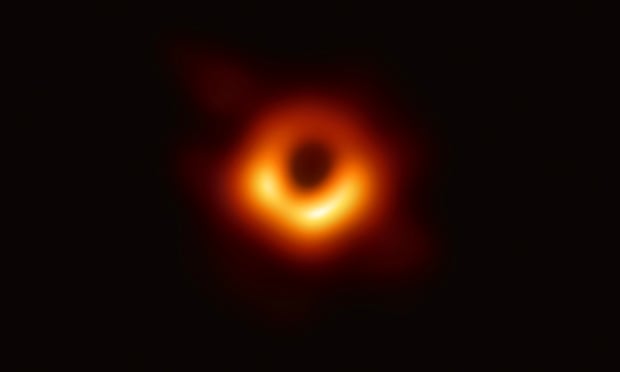
Obtaining the first-ever photograph of a black hole was an impressive feat. We tend to think of black holes as being tiny and they are. A black hole represents a singularity in space-time where gravitational field becomes so large that there is extreme curvature of space. But the ‘event horizon’ of a black hole, the region inside from which no light can escape, need not be tiny. It is the event horizon that gives rise to the dark region seen in the photograph and the size of the event horizon for any mass M is given by the Schwarzschild radius that is equal to 2GM/c2, where G is the gravitational constant and c is the speed of light.
The black hole at the center of the galaxy M87 that was photographed has a mass 6.5 billion times the mass of the Sun and thus its Schwarzschild radius is about 1.9×10¹⁰ km. This is quite large, about three times the distance of the planet Pluto from the Sun, which is 5.9×10⁹ km.