Spotted on Facebook. Hated it.
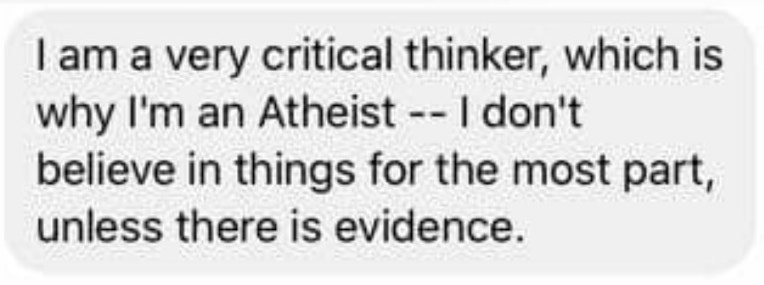
I am a very critical thinker, which is why I am an Atheist — I don’t believe in things for the most part, unless there is evidence.
That’ bullshit. I’m an atheist, too, and I’m trained in science, and shocker…most of the things I know I don’t have evidence for. I can’t possibly. There are too many things. I haven’t tested whether brushing my teeth every morning actually prevents tooth decay. I haven’t even read any papers on the subject! It makes sense, and I suspect it’s probably true, and it’s a reasonable practice, so I’ll keep doing it. If I have to, like if there were some surprising statement that countered my subjective belief, I might look it up, and I trust that there have been scientific experiments to verify it, but right now I believe it in the absence of known evidence.
Likewise for every other mundane experience. There is electrical current coming out of my wall sockets when I plug things in, and I accept that as evidence that the wiring in my house is actually functional, and that it’s hooked up somewhere to a power supply, but I haven’t actually traced that wiring back to the (probably) coal plant that is generating electricity for me. The fact that my computer is working right now is evidence for something, sure, but the majority of the “things” that make it work are mostly assumptions on my part.
What I actually have is a consistent worldview built on a model I’ve tested on a few key points, and that seems to hold up well under most circumstances. That’s all any of us have. You can be a devout Catholic who believes in transubstantiation and the trinity and dead saviors rolling back stones, and you can say exactly the same thing — your model of the universe simply includes some fundamental assumptions mine doesn’t, and vice versa. You can even carry out the same logical process that I do with my wiring. You can say you’ve done spot checks of the pieces of your theology that matter to you now, and they hold up, but just as I haven’t visited the coal plant, you haven’t yet visited Heaven. You get satisfaction out of your weekly Mass, just as I’m happy with my house wiring and tooth-brushing, and that’s enough for now.
One difference, though, is that I’m a fan of testing my assumptions, mostly. We have this scientific method we use that allows us — even encourages us! — to examine and verify the stuff we don’t know, even if, to be perfectly honest, we can’t possibly examine everything. A scientist or a philosopher is going to inspect key assumptions now and then, and try to build better models of the world as they go, sometimes throwing out perfectly serviceable models, like religion, for others that get some, but never all, of the details better. Never lose sight of the fact that we’re all dealing in approximations, however, and most of what we think is true is actually simply consonant with our current model.
That’s one of the dangers of the kind of atheism held by the guy I took that quote from. It was taken from a conversation in which he actually refuses to consider evidence against his deeply held belief that women who accuse men of harassment are not trustworthy, and he offered up that statement as a testimony that his beliefs are all true, because as an atheist, he doesn’t believe in false things lacking in evidence. It’s a dangerously cocky dogmatism that far too many naive atheists support, where the fact that he has examined a few key points in his worldview (although, more likely, he’s had them handed to him when he read a book by Dawkins), means he has therefore verified all of his opinions with evidence. If he believes it, it must be a fact, because otherwise he wouldn’t believe it.
You’re supposed to practice this idea called epistemic humility. An awful lot of atheists seem to lack it.