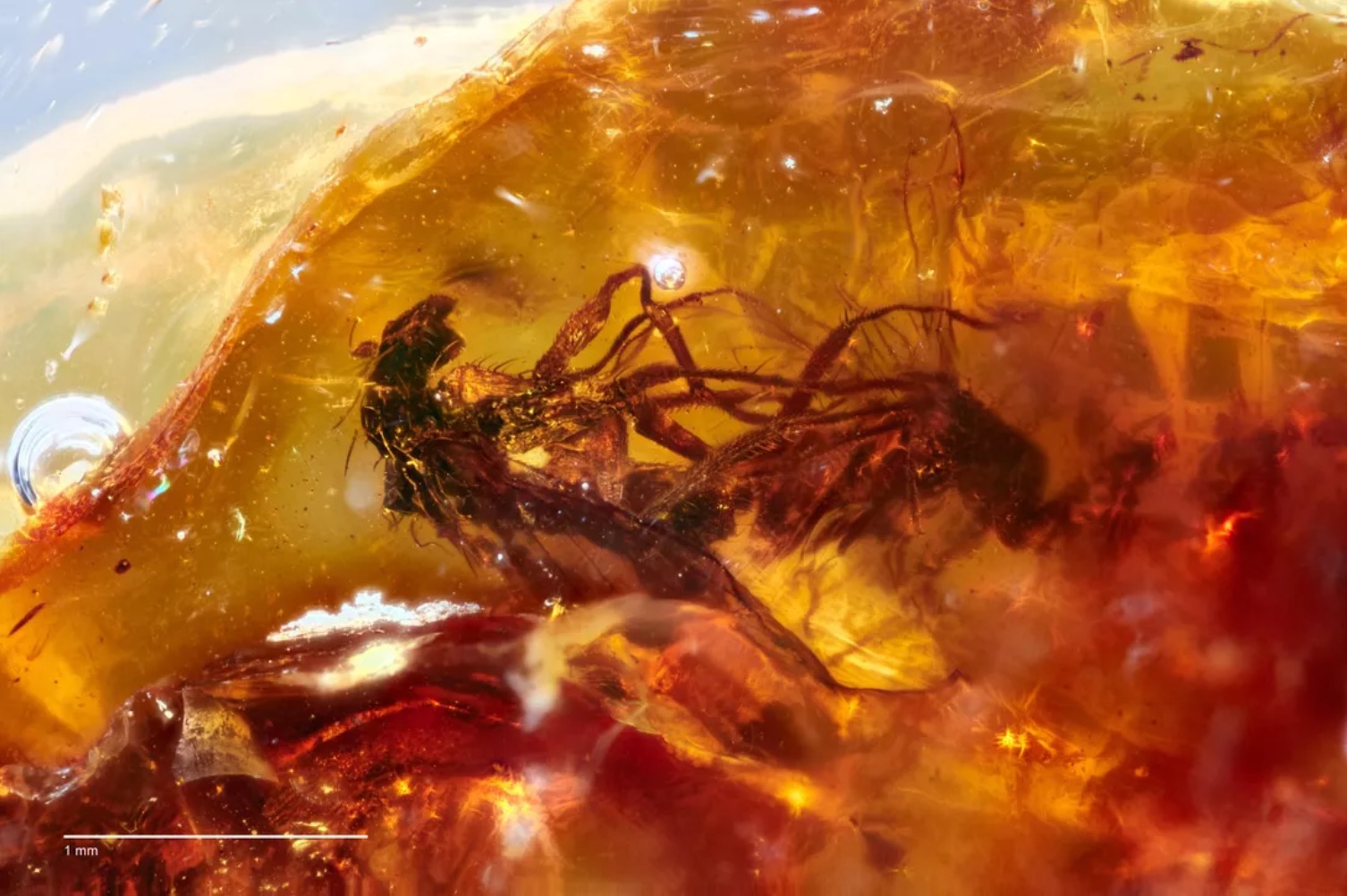
I’m sorry, but the spiders have put up big “Do Not Disturb” signs all over the place, so I have to leave them alone…until they’re hungry again.
It’s amazing. This is the universal comic, it applies to everything right now.
Except spiders and cephalopods, that is. They’re looking better and better.
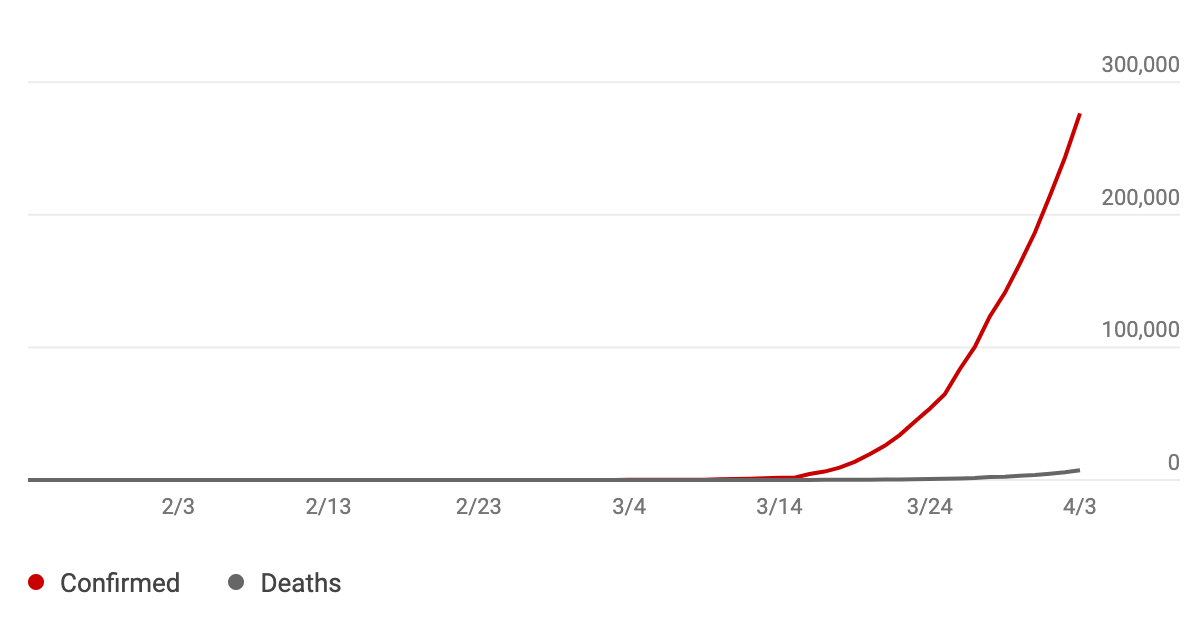
It’s cutting close to home now. South Dakota has reported FIVE putative cases of COVID-19 with one death scattered across the state, among people who had no contact with each other.
It’s entirely possible that this is a case of paranoia and misdiagnosis, since adequate testing kits have not been available, despite the fact that Trump officials keep saying it is contained. We can’t know. That’s a big part of the problem, that when science denialists are running the government they interfere with getting good information and allowing us to manage a disease effectively.
Here’s Richard Lenski’s take on the situation.
The news just came out that South Dakota — South Dakota! — has 5 presumptive cases of SARS-CoV-2 infections, including 1 death. South Dakota has lovely people and places, but it’s not exactly the center of the universe, or even of the midwest. It has ~885,000 people in total … roughly 0.3% of the US population. So a simple extrapolation to ~330 million people would imply something like 1,800 infections over the entire USA.
There’s good news and bad news. Good news: there weren’t 5 cases reported in North Dakota, which has an even lower proportion of the US population.
All the rest is bad news. We’re assuming all potential infections have been tested and discovered. We’re also looking in the rear-view mirror, time-wise. In most cases, it takes a few weeks for an infection to lead to death (when it does, which fortunately is not usually the case). Maybe a week or so to develop symptoms that would lead to someone being tested. So let’s call it a week. Well, this virus typically doubles in a week or so. So 1,800 infections a week ago (ones that have become symptomatic today) implies ~3,600 infections at present in the USA as a whole.
It’s personally worrisome, because Morris, where I live, is way out on the western edge of Minnesota, physically closer to South Dakota than we are to Minneapolis. Isolated rural communities aren’t supposed to be hotspots for pandemics, don’t you know — we leave that to the big city folks. Yet here we are, where we might have to deal with this at home.
We’ve received some concerned messages from the university administration, too. We’re supposed to develop a plan for how we’d complete lab courses if we go on lockdown, which isn’t exactly reassuring. I’ve been thinking about it, and have some less-than-satisfactory ideas about how I could wrap up the genetics course, and we’re supposed to have a meeting to discuss biology’s response tomorrow.
Our goal has to be to slow the spread of the disease to prevent medical services from being overwhelmed. Nobody is panicking — I’m already seeing conservatives mocking any response as panic — but taking necessary steps so that we don’t reach a situation that is unmanageable.
We already have examples we should be learning from, in China, in South Korea, in Italy. This rather cluttered infographic summarizes the lessons from Italy. It’s like a tsunami.
There’s a lot of medical jargon in that — I hope my local clinic is paying attention.
I pretty much agree with everything this guy says, except for the clumsy Batman analogy, but I fear it might be too late. I don’t have much hope that today’s primaries will change the trajectory of the electorate towards the moderate centrist. Ick.
But sure, vote for whoever wins the nomination. You know, the Democrats had a low bar to hurdle this time around, it’s rather depressing that they picked the guy that barely clears it.
I have to go teach in 15 minutes, and I’m barely conscious. I’m chugging coffee, but it isn’t doing the trick, and I’m afraid I might fall asleep in my own lecture. I have a seminar after that, a lab this afternoon, and another seminar at 5, and it’s going to be tough getting through this day.
I hate Tuesdays. They’re worse than Mondays.
OK, I made it through the first class of the day — the magical lightning bolts from hither and yon helped a lot. Sorry, trolls, I know you think you’re zapping me with hatred, but it’s all fuel for the machine. I managed to do a lightning-quick summary of both mitosis and meiosis for the first year students — next I’ve got to give them a bunch of homework to make sure it sticks.
I have a short break before the senior seminar on NKX-2.5, homeobox proteins involved in cardiac devalopment always keep me awake. Before that, though, it’s time to tend to my spiders for a bit.
I made it through the whole day! Fortunately, the student seminars were both very good, and the lab was painless. I still need a nap.
I think we all know the answer to that question, but I’ll tell you anyway: no. None of them are.
The threat of a pandemic creates so many ways for parasites to prosper. Take Stefanie Kelley Haines, of Eastern Oregon, who is, surprisingly, the director of clinical services for Harney District Hospital.
Stefanie Haines is director of clinical services for Harney District Hospital in Burns. Like many rural health care workers, she plays more than one role in the region’s isolated health care system. Haines owns the only fitness center in a town, which isn’t just a gym. It’s also an affiliate of The Wellness Way, a chiropractic company selling pricey lab tests to diagnose all kinds of ailments. The program also markets treatment plans like the “vaccine detox.”
On her personal Facebook page, Haines advances conspiracy theories about the debunked dangers of vaccinations, while promoting services available through the fitness center. Through memes, articles and her own words, Haines has vilified immunizations that protect millions of people from communicable diseases like measles, influenza and polio.
Before people in the U.S. started dying from the new COVID-19 disease, for which there is no vaccine, Haines told friends and followers, “the flu shot increases susceptibility to Coronavirus.”
Don’t worry about Ms Haines, though. The hospital is distancing itself from her views, but isn’t doing anything about their employee spreading misinformation.
Great. There is always a line of frauds ready to take advantage of people’s fears.
My genetics students are learning a bit about sex linkage and modes of inheritance, so I’ve got them thinking about an entirely hypothetic problem outside of class. I’ll be interested to hear their explanations, but this is the kind of problem that would drive me nuts to try and grade. Let’s see how you all do with it.
In Guardians of the Galaxy, the assassin Gamora is bright green. Her sister Nebula is blue.
a. Invent a genetics of skin color in her species, the Zehoberei, that explains their differences in color, using an autosomal gene and modeling it after human patterns of inheritance, and use it to predict the skin color of their parents. (Note: Thanos is purple, but he’s a different species and is their adoptive father.)
b. Now assume the trait is X-linked. Does it change your prediction for their parents? What color(s) would a hypothetical brother be?
c. A new twist: in Zehobereians, females are the heterogametic sex. What does this do to your model?
The fun part is (a), which could have all kinds of possible explanations (that’s why I couldn’t put it on an exam, the range of possibilities is huge), with the one constraint being that it has to be autosomal. I want to see some dueling discussions about how it would work, brought down to earth by the need to make a prediction about the parents.
Then (b) changes the assumptions, and forces their model to change, and (c) flips it around some more. I don’t want to grade this kind of question, I just want to see how their brains logic their way around it. It should be fun. I hope.
I also had some ideas about the inheritance of color in Minecraft sheep, but decided that was just too weird. Blending inheritance + acquired characters? Heretical. Not very instructive about Earthly rules of genetics.
Of course, it may all be moot because attendance in all of my classes is declining this semester — only half the students showed up today! I don’t know if it’s pandemic fears (no diagnosed cases in Morris), the imminence of Spring Break, or that I’m just horribly boring.
He’s gone. He had some impressive roles, he had some cheesy roles, but one thing he always had was presence.
One thing that always struck me about him is that he reminded me of my great grandfather: that slight accent, the pitch of his voice, and that he was tall and physically similar (I think my great grandfather was tall, but I was also very small when I knew him). I kind of hoped I’d grow old to be like Great-Grandpa Westad, or like Max von Sydow, but I think I got too many Myers genes.
I don’t follow the stock market at all. Nope, not interested — I have no direct personal investment, although I am sure a lot of my retirement funds may be attached to stocks of some sort. What do I know? Ask me about spiders, cephalopods, or zebrafish and I’ll respond enthusiastically, but money? I don’t have much, so it’s not on my radar.
But I do know enough to guess that “cratering” is not a word you want to see in the financial news. Probably “plunge”, “big losses”, “panic”, and “apoplectic” are not good things to hear from the grown-ups, either.
“The stock market is looking at the oil price plunge as a canary in the coal mine of a disinflationary one-two punch, driven partly by cratering demand for transportation fuels and a wanton price war among the major oil producers” that will result in big losses for U.S. and Canadian producers.
Global markets were apoplectic. Japan’s Nikkei closed down more than 5 percent, while Hong Kong’s Hang Seng Index shed more than 4.2 percent. European markets were tumbling more than 7 percent across the board in midday trading.
Panic pushed the yield on the U.S. 10-year Treasury below 0.4 percent for the first time in history Monday as investors fled for safe havens. The trajectory could be an ominous sign of a weakening economy, because a low yield can indicate a lack of confidence in economic growth. Yields decline as bond prices rise. Gold, another safe haven, was up 0.4 percent in early trading.
On top of that, Maxine Waters tells some Wells Fargo board members to resign, and…they do! Either Waters is even scarier than I thought, or Wells Fargo is more rotten than I expected and its executives know it, or both. The rats are scurrying to leave the ship.
I don’t like this subject. Can we talk about spiders instead?