Can we petition to have everyone who says the word “god” punished?

Like Minneapolis, the city of Mississauga is allowing mosques to broadcast the call to prayer during Ramadan, which seems reasonable, since 12% of the population is Muslim. The only problem is that some people are objecting, for bogus reasons.

An open letter attached to three petitions, two of them hosted on Change.org, calls on Mississauga to reverse the decision, arguing that broadcasting the Islamic call to prayer amounts to a “violation of human rights.”

“Those who would like to celebrate religious holidays should be allowed to do so without infringing on the rights of others,” the letter said.

It also suggests that hearing the Islamic call to prayer would trigger PTSD in soldiers who served for Canada in the Middle East. (Veteran Affairs Canada didn’t answer if any soldiers actually experience PTSD from hearing prayers but said any personnel needing help can reach out to them.)

I don’t get the argument that public religious practices are a violation of human rights. I am offended by the erection of churches all over my town; I can’t walk to the grocery store without passing 3 churches. Have my rights been violated? Hell no. If that’s a violation, that someone could argue that putting a giant spider outside my door for Halloween was violating their rights.

The PTSD argument needs more consideration, but is hard to take seriously in the absence of any individuals who are actually complaining about the problem. It also makes me wonder about the actual root of the problem: soldiers who were sent to Islamic countries to attack Muslims now get to come home and complain about Muslims because they acquired an aversion to the culture while they were bombing it? OK, PTSD is real and irrational, but I don’t think you get to blame the victims of a military operation for your problems. These soldiers, if they exist, should get help for their condition, but putting the problem on the shoulders of Muslim citizens is inappropriate.

And change.org? Really? Once upon a time that site seemed like a good idea, but it has become a morass of petitions, petitions, petitions, all of them destined to be ignored, and they have diluted what influence they might have once had to an absurd degree. Does anyone bother to read those petitions anywhere?

Will no one point out that hosting rogue mercenary outfits is bad?

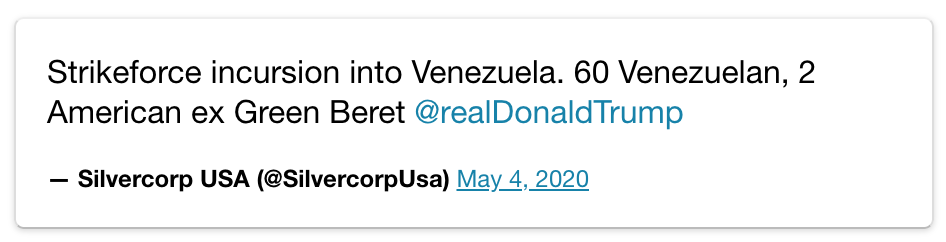
“Venezuela!” is the reflexive argument of the right-wingers against socialism, so it’s not surprising that a cocky gang of American thugs would decide they could just swagger in and topple the Venezuelan government — 62 stupid mercenaries against a nation of 28 million people. They were so arrogant that the head of the mercenary organization (tell me again why we tolerate these assholes?) tweeted proudly at Donald Trump about it as the military operation began.

Why? The invasion was bonkers and criminal, why would you brag about it as your men were attempting an illegal coup against a foreign nation? The whole thing was unprofessional and incompetent, not to mention an unprovoked act of militarism. All the shrieking about “Socialism!” on the US right seems to have convinced the people behind this nonsense that the people of Venezuela would welcome them with parades, rose petals, and delirious declarations of “Democracy! Whiskey! Sexy!” in the same way they fantasized about the invasion of Iraq. Only they encountered something very different (but the same as they saw in Iraq).

“They came to Venezuela thinking the people would greet them like some kind of Rambos, with applause,” Maduro said on Wednesday. “But the Venezuelan people … captured them, tied them up, and the police had to intervene so there were no acts of violence against them.”

No sympathy for this gang of bumbling clowns

Maduro is not a good guy, just another authoritarian. But imagine if some other nation landed 60 mercenaries on the Potomac, intending to march on Washington DC and ‘liberate’ our country from the dictatorship of Trump. Some of us might think the general idea of arresting Trump is great, but would object to the extra-legal way it was being done, and would argue that this would do nothing to change the citizenry; others would harden in their attitudes and strengthen their support for our president, and it would push the whole country farther down the road to a dictatorship, even if it succeeded (which it wouldn’t). The whole operation was stupid and misguided and criminal.

Meanwhile, Joe Biden is trying to walk a tightrope, working hard to avoid saying anything harsh about the mercenary invasion.

Come on, Joe. No malarkey, remember? It’s not hard to flat-out condemn the idiots behind Silvercorp, rejecting this kind of flagrant anti-democratic militarism. That’s what we ought to be doing. Not saying the US should do everything in their power to ‘rescue’ that American jerks now imprisoned in Venezuela, but recognizing that they are dangerous, armed criminals who ought to be tried by the government of the country they tried to overthrow. You may not like Maduro, as I don’t much care for him, but there are legitimate, democratic ways to depose him, just as there are legitimate, democratic ways to depose Trump. I hope.

Interviewed by Democracy Now! early on Wednesday, economist and foreign policy expert Jeffrey Sachs, who directs the Center for Sustainable Development at Columbia University, and Professor Miguel Tinker Salas of Pomona College discussed what they both agree is the dangerous and counterproductive agenda that leaders like Trump, Bolten, Biden, and Pelosi are now pushing in Venezuela.

“What’s so stupid about these American policies, these neocon policies,” said Sachs, “is they do create disaster, but they don’t achieve even the political goals of these nasty people like Bolton. It’s not as if they’re effective and nasty; they’re completely ineffective and totally nasty at the same time.”

While acknowledging that Maduro has certainly made mistakes and legitimate criticisms of his government exist, Tinker Salas said the history of U.S. intervention in Latin America—not to mention elsewhere in the world— shows overthrowing governments in this manner “doesn’t produce the change that most people want. And what it does is it aggravates conditions for the majority of the population.”

Sachs—who last week released a detailed study along with economist Mark Weisbrot on the devastating impact that U.S.-imposed sanctions have had on the Venezuelan economy—added that people backing Guaidó and the coup effort are really just embracing “normal U.S. right-wing foreign policy, nothing different.”

Nothing new here. Attacking South and Central American nations with deniable squads of mercenary thugs has historically been the standard way the United States keeps those nations under control. It’s too bad we’re not going to be able to vote for a party in November that treats our brothers and sisters to the south as equals.

It’s just astounding to me that our politicians pussy-foot around a blatant disregard for international law so casually.

The ‘elites’ will be fine, the merely competent will suffer

We sometimes speak of the American university, as if it is all one thing, where you’ll attend and be pampered for four years and pop out at graduation to a job and a well-paid career. Corey Robin exposes the inequities of the university system by comparing City University of New York, a massive public university, to the Ivy League colleges.

For decades, a handful of boutique colleges and powerhouse universities have served as emblems of our system of higher education. If they are not the focus of discussion, they are the subtext, shaping our assumptions about the typical campus experience. This has remained true during the pandemic. The question of reopening has produced dozens of proposals, but most of them are tenable only for schools like Brown; they don’t obtain in the context of Brooklyn College. The coronavirus has seeded a much-needed conversation about building a more equal society. It’s time for a similar conversation about the academy.

In academia, as in the rest of society, a combination of public and private actors directs wealth to those who need it least. While cuny struggles to survive decades of budget cuts—and faces, in the pandemic, the possibility of even more—donors lavish elite colleges and universities with gifts of millions, even billions, of dollars. Sometimes these donations fund opportunities for low-income students, but mostly they serve as tax-deductible transfers to rich, private institutions, depriving the public of much-needed revenue. What taxes federal and state governments do collect may be returned to those institutions in the form of hefty grants and contracts, which help fund operating budgets that Brooklyn College can only dream of. This is the song of culture in our society. The bass line is wealth and profit; the melody is diversity and opportunity.

It seems that massive endowments only get more massive year after year, while the smaller public colleges are reduced to begging for scraps from state governments. We’re expected to do just as much as universities swimming in money from wealthy alumni, for less, with less support and less press.

There’s also a significant distinction: rich people send their kids to the already-rich private universities; everyone sends their kids to the community colleges, the state universities, the small public colleges. When you pretend an Ivy League college is representative, and when you starve the state-funded institutions, you are making the wealthy wealthier and the poor poorer. You are also killing a major engine of class mobility, which I sometimes suspect is the actual purpose.

Yet, for all the talk of the poor and students of color at the Ivy League, the real institutions of mobility in the United States are underfunded public universities. Paxson [Brown University president and the deputy chair of the board of the Federal Reserve Bank of Boston, because that’s the kind of person who ends up running wealthy universities] may believe that “a university campus is a microcosm of any major city in the U.S.,” as she told NPR, but cuny is no microcosm. With nearly two hundred and seventy-five thousand students and forty-five thousand staff—a population larger than that of many American cities—it is what the Latin root of the word “university” tells us higher education should be: the entire, the whole. More than seventy-five per cent of our undergraduate students are nonwhite. Sixty-one per cent receive Pell Grants, and the same percentage have parents who did not graduate from college. At City College and Baruch College, seventy-six and seventy-nine per cent of students, respectively, start out in the bottom quintile of the income distribution and wind up in one of the top three quintiles. For hundreds of thousands of working-class students, in other words, a cash-starved public university is their gateway to the middle or upper-middle class.

In my career, I’ve been educated at state universities and only taught a state universities. I’ve visited the famous big name schools, like Princeton and UPenn and Yale, and mainly been struck by the disparities in privilege, not any differences in quality of content. We have to work harder in state colleges, and even harder in community colleges, but we bring the same information to the students, and the same opportunities. The only advantage to the expensive private schools is the opportunity to mingle with other people who can afford them — you don’t learn more, if that’s what you’re after, you just get to make connections with other spoiled rich kids.

What worries me now is that I see state legislatures, which are always keen to take a butcher knife to education at all levels, seeing the pandemic and economic failure as a reason to cut education to the bone, which is incredibly short-sighted, fails to see the need for building long-term investment in the human infrastructure of our society, and is going to hit the poorest population, the people who have the most to gain, hardest, while the wealthy institutions are unaffected. The economic inequities in the US have been expanding for a long time, and are a source of inefficiency and corruption already, and they’re just going to grow further in the aftermath of the pandemic.

Boy, the extinction spiral is a wild and depressing ride.

Michelle Malkin still has a fanbase? And it’s enhanced by including Milo?

Milo Yawannapissoff and Michelle Malkin have been collaborating, and the results are even more awful than you can probably imagine. They decided to work together to create an “America First” reading list for their followers. Just from their choice of subject you can tell it’s going to be a collection of racists’ greatest hits.

So what’s on it? Lots of Ann Coulter and Dinesh D’Souza, obscure racist tracts and not so obscure racist fiction, like The Turner Diaries, Jared Taylor and Charles Murray and Vox Day, and categorized as “U.S. politics, Adolf Hitler’s Mein Kampf. The cherry on top? They include The Protocols of the Elders of Zion. They also toss in a scattering of genuine Western classics like The Odyssey and The Divine Comedy, but really, they’re only there to put a shiny sugary glaze on the pile of shit they think are valuable contributions to the canon. It’s also rather demeaning to lump A Portrait of the Artist as a Young Man with In Trump We Trust: E Pluribus Awesome.

They provide summary blurbs to go with the books. The Iliad is “What it’s like to be around an unstoppable killing machine.” Mein Kampf is “History’s most demented autodidact sets out his political vision.” Kevin MacDonald’s deeply racist and anti-semitic book, The Culture of Critique, is a “Highly controversial historical survey of the roots of anti-semitism”.

Say what you will about the classic Western canon of literature — it is full of Old Dead White Men — but I don’t think that a compilation of recent racist propaganda and fleeting pop culture nonsense is an improvement, especially when it’s driven by a blatant far-right conservative agenda, and written by a pair of not-very-bright boobs.

Need to visit my doctor more often

I’m back from my doctor’s visit! It was nothing but good news. The outside walls of the clinic are covered with swarms of chironomid midges!

Everywhere I looked, there they were, clinging to the brickwork. This is one big buffet for spiders that I’ll have to check again later, but I didn’t see many today — just one lone jumping spider hanging about. There has to be more.

Oh, yeah, I’m also fine.

I have a doctor’s appointment today?

I was scheduled to get a routine physical a while back, cancelled for obvious reasons, and last week Stevens County Medical Center called me to come in for it today, which feels odd. I guess our local clinic has not been overwhelmed — there have been zero reported cases of COVID-19 in Stevens County, perhaps because the closure of the university meant we had a net outflow of residents as the pandemic hit — but I’m a little nervous about visiting a place that could be a disease vector.

Also, I was called in on this specific day because it is “reserved for senior citizens”. What? But I’m a young buckaroo! Oh, well. I guess they’re just doing what they must to separate susceptible populations, so I’m not going to complain. I’m also thrilled at the possibility I might actually talk to a human being face-to-face, something I haven’t done in a month and a half.

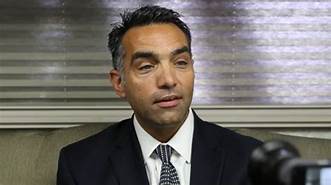
Behold! The Face of God!

I’ve always wondered what he looked like.

You may be somewhat disappointed. You haven’t yet seen the mind behind that rather ordinary face, though, which will leave you a lot disappointed.

A Republican Ohio state representative cited his religious beliefs to explain why he would not wear a mask as recommended by Gov. Mike DeWine (R) to help limit the spread of the novel coronavirus.

“This is not the entire world,” state Rep. Nino Vitale wrote in a lengthy Facebook post on Monday morning. “This is the greatest nation on earth founded on Judeo-Christian Principles.”

“One of those principles is that we are all created in the image and likeness of God. That image is seen the most by our face. I will not wear a mask,” he continued.

  • This is not the greatest nation on earth — we are one among many, and we need to throw out these politicians who preach American exceptionalism. This unfounded arrogance hinders any effort to make the country better.

  • We were not founded on Judeo-Christian principles, which is not even a thing. We are a secular nation. Or should be. Kick out these religious fanatics.

  • It’s a rather limiting conception of the nature of the hypothetical supreme being of the universe to imagine he is an anthropoid ape with a human face, or even a gaseous vertebrate of some kind, as Haeckel put it. Nino Vitale is some kind of shallow Biblical literalist, I guess. We should also evict those. They aren’t smart enough to govern.

  • I hope he is consistent in his beliefs to the point where if he comes down with COVID-19 or any other respiratory disease that he refuses to be intubated or to wear a mask; if he needs surgery he should do it without any anesthetic gas or oxygen. I want him to go to his maker with his bare face shining splendidly.

Vitale also doesn’t understand the data.

“This is not based on logic, this is based on fear and propaganda and every statistical, data driven study done in the last 2 weeks says death counts are low, the models were wrong, and this is more like the flu,” he continued.

Wrong on all counts. The data says we’ve been underestimating the effects, due to the lack of available testing, and that it isn’t anything like the flu.

It does not fill me with confidence that our government is packed with ignorant religious zealots who want to make policy counter to the evidence. It’s no wonder this country is screwed.

Amazon employees with courage

You have to give a lot of credit to Tim Bray, an Amazon vice-president who quit over the company’s treatment of workers. He was making a big sacrifice to expose Amazon’s corruption.

May 1st was my last day as a VP and Distinguished Engineer at Amazon Web Services, after five years and five months of rewarding fun. I quit in dismay at Amazon firing whistleblowers who were making noise about warehouse employees frightened of Covid-19.

What with big-tech salaries and share vestings, this will probably cost me over a million (pre-tax) dollars, not to mention the best job I’ve ever had, working with awfully good people. So I’m pretty blue.

He makes a point of mentioning the names of the fired activists:

The victims weren’t abstract entities but real people; here are some of their names: Courtney Bowden, Gerald Bryson, Maren Costa, Emily Cunningham, Bashir Mohammed, and Chris Smalls.

I’m sure it’s a coincidence that every one of them is a person of color, a woman, or both. Right?

Even if it wasn’t intentional bigotry, it’s still no coincidence that Amazon is hiring the underprivileged and desperate to do tedious labor in their warehouses.

He even provides a solution…a solution that has to be enforced outside of the Amazon executive boardroom.

Amazon is exceptionally well-managed and has demonstrated great skill at spotting opportunities and building repeatable processes for exploiting them. It has a corresponding lack of vision about the human costs of the relentless growth and accumulation of wealth and power. If we don’t like certain things Amazon is doing, we need to put legal guardrails in place to stop those things. We don’t need to invent anything new; a combination of antitrust and living-wage and worker-empowerment legislation, rigorously enforced, offers a clear path forward.

As long as Republicans and conservative Democrats hold power, though, no one is going to have the political will to make Jeff Bezos do the right thing.

Another professor embarrasses the professoriate

A university professor filed suit against his institution because it chastised him for inappropriate sexual behavior. He wasn’t fired, they just tut-tutted, put a black mark on his record, and told him not to do that anymore. He sued anyway, for his ego.

During a class in 2013, a psychology professor at George Mason University named Todd Kashdan told students he had once performed oral sex at a party, an anecdote he later said was meant to make a point about exhibitionism, according to findings from an internal school investigation and a federal lawsuit the professor filed against the university.

In 2016, Kashdan told graduate students gathered in his hot tub about a sexual experience he had in Europe, and in 2018, he went with graduate students to a strip club where he received a lap dance, the internal investigation found. The professor’s lawsuit said these incidents were misconstrued.

How is bragging about performing oral sex, his sexual experiences, and getting a lap dance in front of his students “misconstrued”? I’m mystified. Just going with students to a strip club seems like it’s crossing a line, and with all the rest, it’s hard to imagine how it could be “misconstrued”.

On top of all that, two former students also filed complaints about him with the university. He is baffled.

The professor, according to the suit, “was surprised to learn that the same women who had given him unsolicited praise for his teaching and research, and sought him out for assistance with academics and their careers, now alleged that he had created a ‘hostile environment.’ ”

Wow. He doesn’t understand that he’s a gatekeeper, that he holds the keys to future advancement in his students’ careers, and is so oblivious to the social workings of human minds that he can’t comprehend that people whose future he controls might flatter him to his face while resenting him?

Psychopaths. Psychopaths everywhere.