We’re safe right now

You should find this image of the location of rich people’s planes soothing and reassuring.

It’s part of an Apocalypse Early Warning Tracker. The idea is that if trouble is coming, you should look at what the rich people — you know, the ones who practice insider trading and have tentacles in the government — are doing.

The site isn’t your run-of-the-mill private plane tracker. The system pulls from publicly available aviation data, specifically ADS-B signals, which broadcast an aircraft’s position, speed, and altitude in real time. By tracking around 11,000 private and business jets and comparing the number airborne at any given moment against historical norms, the site assigns an alert level from 1 to 5. A normal day hovers at 1. A sudden spike, five standard deviations above the baseline, suggests some s—t is going down.

The alert level is at 1 right now. Good news: Elon Musk isn’t scrambling to get to his secret, skull-shaped lair right now.


Professors are disposable now

Once we’ve primed the AI pump with our brains, university doesn’t have to pay us anymore.

rizona State University soft launched a web app earlier this month that allows anyone, for $5 per month, to create an apparently unlimited number of customized “learning modules” using artificial intelligence. The AI chatbot, called Atom, uses online instructional materials from ASU professors to create a course that’s tailored to the goals, interests and skill level of the user. After asking a handful of questions and processing for about five minutes, Atom debuts a personalized course that includes readings, quizzes and videos from a half dozen experts at ASU.

You might be wondering, as I was, about the quality of the “learning modules” produced by running a course through a buzzsaw and splicing fragments together. Apparently and unsurprisingly, it’s not good.

ASU literature professor Chris Hanlon was one of the first to raise awareness of ASU Atomic. Hanlon told 404 Media that no professors he’d spoken with had given their permission for this generative content.

“None of the ASU faculty whose course materials were harvested for the module I generated were aware that their image, lectures, lessons, or other teaching materials are being used,” posted Hanlon on Bluesky.

Hanlon said the course materials were pulled from Canvas, a course management system. Hanlon criticized the AI-generated clips as error-laden, jumbled, lacking context, and confused.

“Concerning the course itself, there’s no throughline I can see; none of the videos really speak to one another — it’s a mishmash, though the individual lessons that comprise it probably make a lot more sense in their original context,” said Hanlon.

Oh, great. We use Canvas here. I respect my fellow biology professors, but I don’t see how it would improve our courses to have a machine fuse us into a nightmarish agglomeration. But that’s what happens when you see education as a fungible collection of “modules”.

The initiative by ASU is called “Project Atomizer”. An atomizer is “a device for converting a substance, especially a perfume or medicine, to a fine spray.” That sounds like an apt description of the project.

You may be wondering who is responsible for this abomination. I think it’s safe to blame the president of the university, Michael Crow.

Not much exists publicly on Project Atomizer. The initiative was mentioned briefly in a February presentation by ASU President Michael Crow, part of a larger proposal to make AI the focus of the future: “current realities require current solutions,” according to the presentation.

Crow said in an interview last week with the Greater Phoenix Chamber that ASU has 50 AI tools, three of which are augmentative AI tools for students. Crow said he uses AI for “everything” in his daily life.

“[W]hen I’m driving to work, I use the Gemini tool. Basically, I’ll pick a subject that I don’t know enough about and I’ll get myself educated in like 22 minutes or 25 minutes,” said Crow. “I use it for basically quick analysis of really complicated things that I don’t have enough facts [for].”

Crow also revealed that he has used AI to write 20 white papers since November. He’s also used AI to create multiple architectural proposals: one for a site in Hawaii near the village of Javi, another for an addition to the West Valley campus in Phoenix.

Oh god. An administrator who thinks a subject is a collection of facts, who uses it to churn out papers, who uses it to design buildings…fuck me sideways.

Oooh, a provocative philosophical conundrum

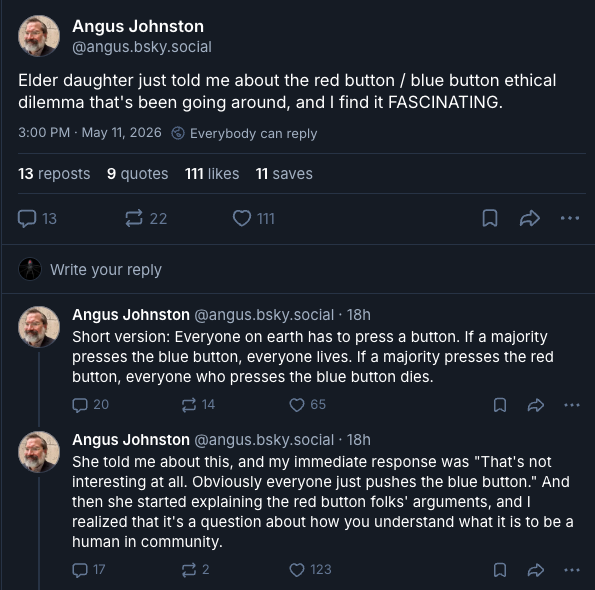
Found on Bluesky:

@angus.bsky.social
Elder daughter just told me about the red button / blue button ethical dilemma that’s been going around, and | find it FASCINATING.
Short version: Everyone on earth has to press a button. If a majority presses the blue button, everyone lives. If a majority presses the red button, everyone who presses the biue button dies.
She told me about this, and my immediate response was “That’s not interesting at all. Obviously everyone just pushes the biue button.” And then she started explaining the red button folks’ arguments, and |realized that it’s a question about how you understand what it is to be a human in community.

Likewise, my first thought was to press the blue button. But then I thought that that would just give all the red button people what they wanted, and I’d end up dead while they could take all my stuff. But then I thought again, would I want to live in a world full of murderous bastards? And I was back to pushing the blue button.

You could cycle around and around this dilemma all day long. Entertaining, but I have better things to do.

This does have evolutionary implications. We don’t have buttons with global effects, but throughout our history we’ve had people meeting and having to choose between cooperating and expediently executing those who oppose us. I think in the long run, cooperation wins, but the problem with this thought experiment is that it compresses a billion incremental decisions into one final, immediate commitment, and that isn’t at all realistic.

Looking for moral authority in all the wrong places

AI companies have a poor ethical reputation — they’re wrecking the environment to build data centers, they disregard privacy, they steal our words to populate their databases, they’re run by billionaires. They’re beginning to realize that they should do something to improve their image, so what do they do? They decide to steal from religion.

As concerns mount over artificial intelligence and its rapid integration into society, tech companies are increasingly turning to faith leaders for guidance on how to shape the technology — a surprising about-face on Silicon Valley’s longstanding skepticism of organized religion.

Leaders from various religious groups met last week with representatives from companies including Anthropic and OpenAI for the inaugural “Faith-AI Covenant” roundtable in New York to discuss how best to infuse morality and ethics into the fast-developing technology. It was organized by the Geneva-based Interfaith Alliance for Safer Communities, which seeks to take on issues such as extremism, radicalization and human trafficking. The roundtable is expected to be the first of several around the globe, including in Beijing, Nairobi and Abu Dhabi.

I don’t think Anthropic and OpenAI have anything to bring to the roundtable, but they they ignorantly assume that religions have the key to moral behavior, all evidence to the contrary.

“Regulation can’t keep up with this,” she said. But the leaders of the world’s religions, with billions of followers globally, have the “expertise of shepherding people’s moral safety,” she reasoned. Faith leaders ought to have a voice, Shields said.

She “reasoned.” I don’t think so. Those are the words of someone who has swallowed the propaganda that religions have always generated. Yeah, right, let’s turn to these guys for lessons in morality.

GIGO

I have a presupposition of my own, that essentially all people have equal capability and equal intelligence and equal intellectual processing power. We are all evolved to have these excellent, versatile computing engines in our skulls that are awesome in their ability to process inputs and draw conclusions and drive our behaviors as a function of those inputs. However, if these calculating engines are fed garbage, more garbage is what comes out.

One of the prime sources of garbage is religion. Take a young, naive brain and stuff it with lies and nonsense, and it produces even more nonsense, which we then feed to the next generation, and it gets worse and worse until you’ve got a population of gibbering slugs who can’t get anything right. We’ve got people who’ve been primed with a steady diet of bad Bible interpretations who struggle to analyze even the simplest phenomena.

Case in point: Perry Stone, a Pentecostal evangelist with a surprising number of followers for someone who is so thick. He has juggled together fantasies about the Rapture and UFOs to build an elaborate edifice of weird conclusions, none supported by any evidence.

I’m not going to go into great detail, but there were a large number of pastors that had been invited to go to a certain state to hear some men in the United States government and others share with them a concern that they had, said Stone, who did not identify his source in his April 27 YouTube video, but claimed the person has a great church.

Stone, whose YouTube channel has approximately 925,000 subscribers, said his friend told him that some of those in the meeting were telling us as pastors, ‘You need to prepare your people, and you need to get ready to answer them for what you’re about to hear being released.’

And some of it has to do with crafts that have been discovered that are not allegedly a part of our planet, and the materials they’re made of are not a part of our planet. Very strange, reptilian-looking creatures and other things that almost sound like something out of a sci-fi movie or an [H.G. Wells] book, he added.

Groovy. It’s a real mish-mash of bad sci-fi movies and bad religion fermenting in that man’s brain. The problem here is that the foundations of his reasoning are all garbage.

Stone went on to place the extraterrestrial phenomenon within the framework of his dispensational premillennial eschatology that features belief in a pre-tribulational rapture, an Islamic Antichrist and a third Jewish temple purified by red heifers.

Stop right there, I would like to get off this train to crazytown. He goes much much further, though, and starts ladling the right-wing politics and racism on top of his already rancid trash salad.

Stone claimed the officials in the supposed meeting warned the pastors that disclosure of UFOs and extraterrestrial existence will cause some Christians to question their faith and some non-believers to seek out pastors for an explanation.

Stone speculated that government fabrications regarding an alien invasion will eventually be used to explain away the rapture, attributing the theory to his son, Jonathan, who last year tweeted about former President Barack Obama being an advanced humanoid AI who used questions over his birthplace to hide that there was never any birth certificate at all.

This all supports my contention that these people have normal, healthy brains, but that their inputs are all garbled bullshit. It’s a real shame.

Is AI a bigger clownshow than creationism?

I spent many years debating stupid creationists, and I never ever got paid a nickel.* Nothing. For all that effort. I was in the wrong business, because apparently you can get paid $10,000 for debating AI-Doomer nonsense, and you can even show up for the online debate looking like this:

He was called to debate by this anonymous fellow, 47fucb4r8curb4fc8f8r4bfic8r, who coughed up the $10K for the privilege of telling Eliezer Yudkowski to stop making extravagant claims and stop threatening AI researchers with doom.

It is an utterly ridiculous debate between two clowns. Yudkowski wants to claim that research on AI is an existential threat to humanity (I think that’s silly, except in the sense that it is a waste of resources), while 47fucb4r8curb4fc8f8r4bfic8r is an LLM researcher who wants to grandstand and claim that Yudkowski is an existential threat to him, personally. I can’t take either of them seriously.

What I have learned is that if I want to profit from future debates, I need to invest in goofy hats.

*OK, Ray Comfort once sent me a fruit basket, but that was it. It was memorable because it was such an exception.