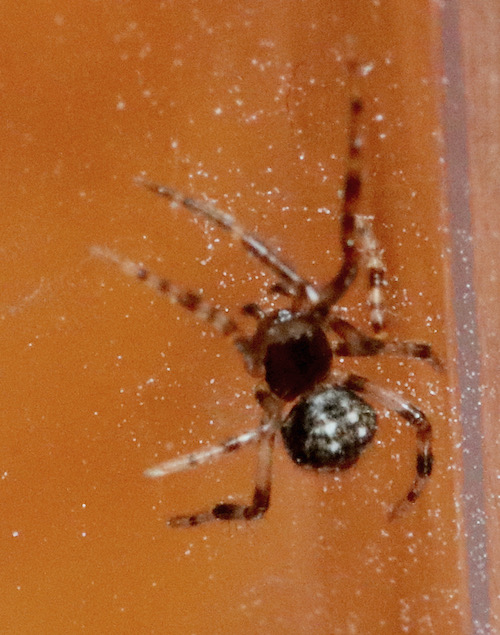
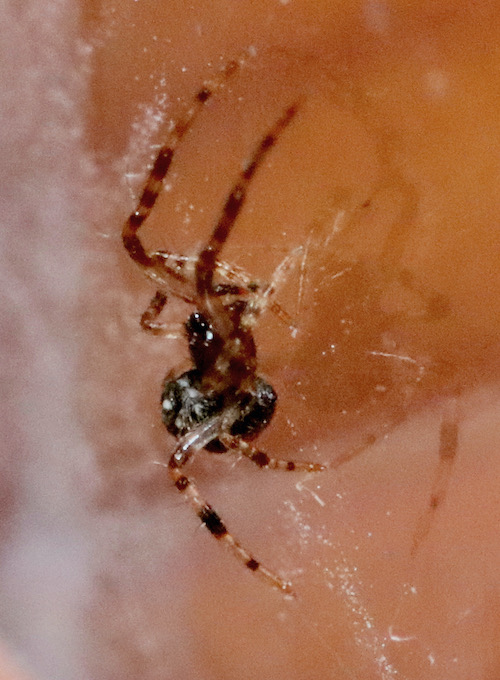
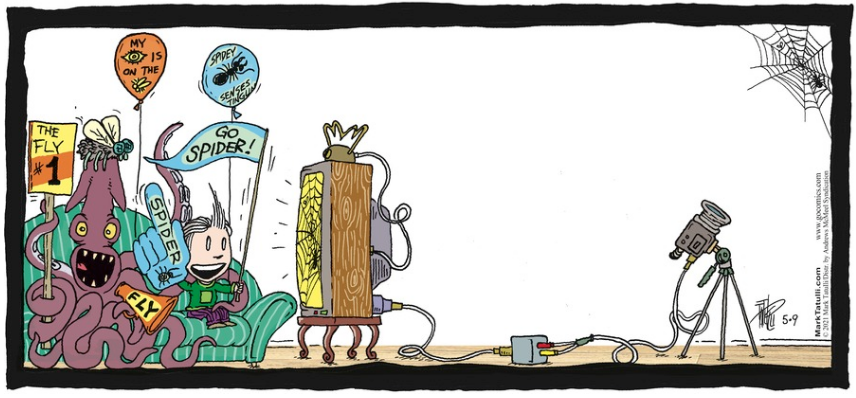
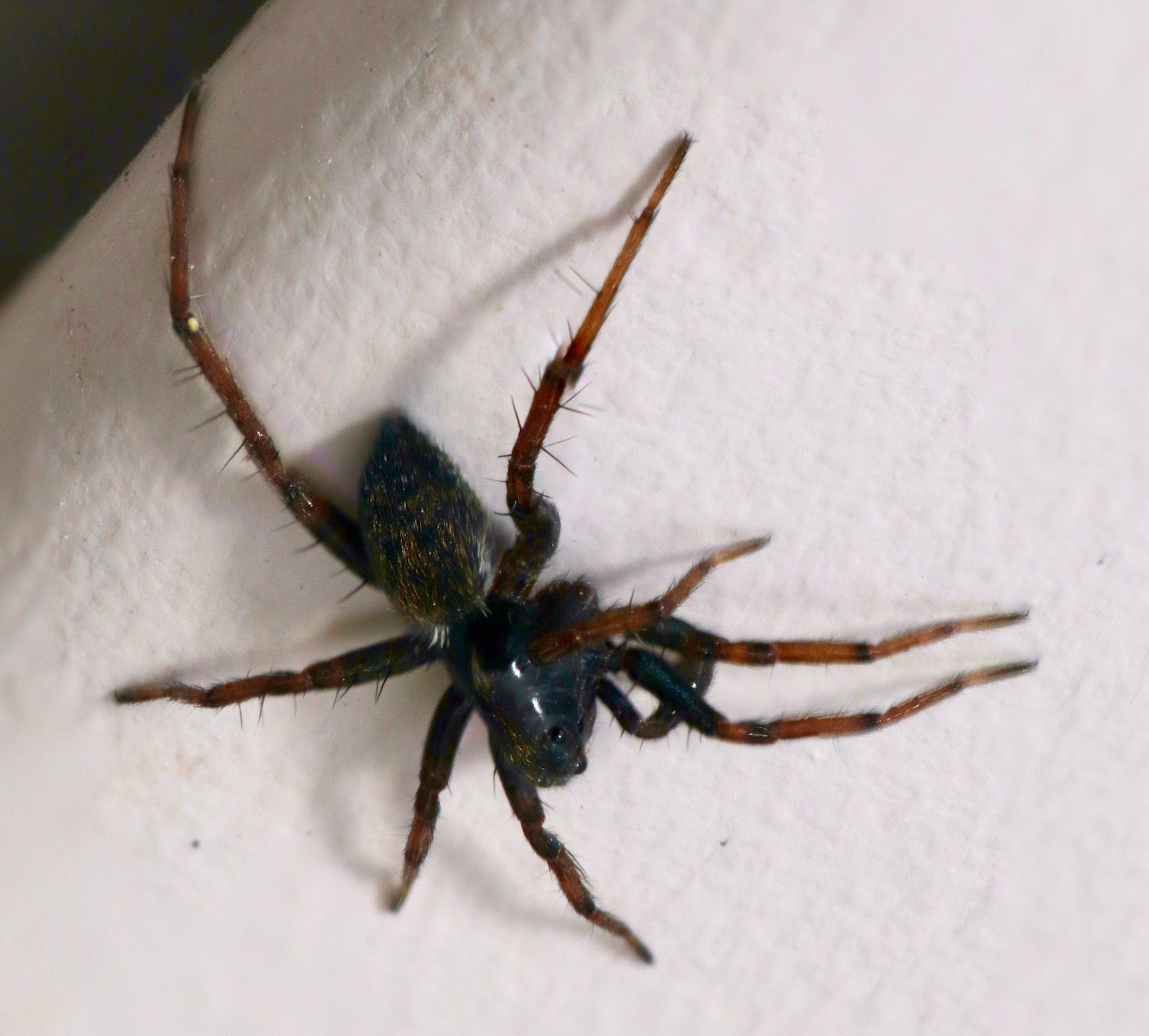
Spiders everywhere!

There’s a lot of flooding in New South Wales, Australia (can I come visit, please?), and as the floodwaters rise, so are the spiders. You’d think the citizenry would be pleased to meet their usually-hidden fellow denizens, but noooo.

At the same time, rising floodwaters surrounded Melanie Williams’s home, thousands of spiders scaled the fence in her front yard.

“That was enough to really freak me out, I had never seen anything like it before,” she said.

“I am an arachnophobe from way back so I hope they’ve gone back to wherever they came from.”

Wait. How can you be an arachnophobe in Australia? They’ve got such big, gorgeous spiders all over the place! You’re just seeing more than usual right now, and the floods are bring out the cute little cuddly ones.

Here’s a good explanation of the phenomenon.

A plague of spiders might seem apocalyptic, but experts say the episode is easily explained.

Professor Dieter Hochuli leads Sydney University’s integrative ecology group and has made a career out of examining what drives the ecology of animals and plants.

He described the phenomenon as “fascinating” and said the spiders were always there — we just don’t usually notice them.

“All this is happening under our noses, but we just don’t know what’s going on,” he said.

“There’s this vibrant ecosystem happening all the time.

“What happens with the floods is all these animals that spend their lives cryptically on the ground can’t live there anymore.

“The spiders are the really obvious ones as they throw out their webs.

“Just like people, they’re trying to get to higher ground during a flood.”

Exactly. Just like I know there are plenty of spiders around during our long Minnesota winters. They’re just hunkered down in the leaf litter, or deep down in the soil, or under rocks, or in compost heaps, or in my basement. Spring is just when they creep out and start flourishing and bringing beauty and joy back to the world.

Which reminds me…it’s time for my morning spider therapy session. I’ve got to work fast because I teach a class on Tuesday mornings.

Eking out a little spider time

This has been a stressful year, and I haven’t been giving the spiders the time they deserve. So I’ve recently resolved to spend an hour a day in the lab, even if all my other work is screaming at me, just tending to the basics. It’s soothing, I think, and it’ll make the spiders happy, which is what counts.

I have to go in to the university every morning anyway, to open up the fly lab and check on the status of student experiments, and now instead of rushing back to prepare for a lecture or do some grading, I have a zen-like period of contemplation in which I, for instance, feed the spiders, or wash dirty spider cages, or throw out old accumulated debris. I still have some plumbing and aquarium supplies that I’m moving out to our departmental dumpster a bit at a time. Anyone want a bucket of sand? An aquarium pump and filter? I’m putting those all behind me.

This morning I fed the babies; I’m trying out a daily feeding regimen, rather than twice a week, to see if can get them to grow a little faster. I’ve also moved some of the up-and-coming generation from the 130ml plastic cubes to 5.7l adult cages, to see if the expanded space promotes expanded growth. They look so tiny and lost in there! But they are cobwebbing them up well enough. I just hope that the flies aren’t getting lost in all that volume.

I’m also working at spiffing up the lab a bit, picking a stretch of bench every morning, cleaning it up and scrubbing it down, and just generally making it all shiny and tidy. I’ve been neglecting my patrons at my patreon account, and on my list of things to do is, in addition to more spiders as they emerge this spring, a video tour of my spider lab, maybe in the next two weeks (next weekend is hellish with grading, but maybe the weekend after that). This will initially be a patron-only video, but maybe I’ll make it public the month after. Sign up if you want to see the premiere! All the money donated every month goes to pay off our legal debt! I look forward to clearing that debt in the next few years so I can sink the money into the lab instead.

Spiders not having sex

I tried. I put the young male spiders with the young female spiders, and the females cringed and refused to move while the males wandered around pretending to be busy. You don’t even have to watch the movie, the full story is in the title.

I’ll plump them up and try again in a few weeks.

The spider routine

In case you were curious, here’s the boring routine for maintaining a colony of cute little Parasteatoda juveniles. Teenagers! Always demanding your time.

Right now I’ve got a sink full of dirty spider containers. I’ll have to get those cleaned up this week.

Spider jump scares

Always good for a laugh.

Which reminds me…yesterday, my wife tried to cheer me up by telling me she saw some small insects in the house, which means the return of the spiders can’t be far off. This seems to be an unusual response by most hu-mans.

I’m kind of laid up from a fall yesterday, having trouble getting any sleep because any turn of my head sends alarm signals up and down my spine. This is cramping my plans. I have a spider agenda! I need to move all the spiders, especially the lady spiders, to shiny clean new containers, so they can spend the next week getting comfortable and filling it with new silk. They won’t know it, but they’ll be making their nuptial bed. Yeah, time to try breeding! They’re still on the small side, so they’re comparable to human teenagers, but we’ll see if they’re as horny as people get in their youth.

I still have concerns about species matching, though. There are two spider species, Parasteatoda tepidariorum and Parasteatoda tabulata, that I can’t tell apart, short of dissecting their genitalia, which absolutely ruins them for mating, and I don’t want to put P. tep together with P. tab, since that could just end with cannibalism (wait, different species, so not cannibalism? Just violent murder?). My solution for this go-round is simple: I’m going to put male spiders on their sister’s nuptial bed. I want an inbred line anyway.

I’ll try to record their activities next week, so maybe I’ll have a movie for you then. With any luck, it won’t be a gory murder/horror flick, but instead a little incest porn. I hear that’s popular, but have no idea why.

We need bigger spiders in Minnesota

Poking around in the weeds as we do every summer, looking for spiders, one thing we turn up a lot are frogs. Big frogs. They like to nestle in some nice shady leaves during the day, and we occasionally part some leafy foliage to find a frog looking back at us, as if wondering how dare we intrude on his home. I’ve often thought they need a good predator to teach them a lesson.

Like a clever huntsman spider.

Retreat and predation event near retreat of Damastes sp. (a) Spider specimen of Damastes sp. (THC140, adult female), the prosoma and opisthosoma are approximately 1.5 cm in length (smallest square = 0.1 cm)—Observation 1; (b) Damastes sp. feeding on Heterixalus andrakata (frog) inside of the retreat, built of leaves of Tambourissa sp.—Observation 1, (c) Predation event where Damastes sp. captured Heterixalus andrakata near the retreat—Observation 1; (d) Damastes sp. hiding in the retreat, built of leaves of Cedrela odorata—Observation 4

These cunning ambushers from Madagascar use silk to stitch together a few leaves, making a nice shady refuge that might appeal to a frog looking for respite from the daytime heat. The frog snuggles in, not noticing the large-fanged venomous arthropod lurking in the back, and then snicker-snack, he’s a juicy piece of meat being sucked dry by Damastes.

I don’t know about you, but if I poked my face into a local bush and saw a big glorious spider instead of a fat frog, I’d be delighted. It’s not likely, though, since our harsh winters tend to kill off most of the spiders, giving them only a short growing and breeding season.

Maybe this would be a bright prospect from global warming? Do you think Republicans would be even more resistant to the idea of good legislation if they thought climate change would create a better environment for big hairy blood-suckers? They do have some things in common.