Twinkle, twinkle little spacelink

I’m happy to see the new, revitalized Skepchick, and I’ve been checking in every day. I’m recommending you all read Nicole’s recent post on the Spacelink intrusion. I guess Elon Musk just decided for all of us that we needed a few thousand satellites cluttering the sky, so he spewed a bunch of them upwards to get in the way of astronomers. Nicole gives a, I guess you could say, balanced perspective, but even at that she doesn’t have much good to say about this commercial venture.

Get your hands dirty for mental health?

I was getting worried. My wife is on a gardening kick, fencing off a part of the backyard and tilling and planting and weeding — she’s been coming into the house with disgustingly filthy hands, and has been suggesting that I should get out there and dig in the muck, too. For a moment, I was afraid this article on “Healthy fat hidden in dirt may fend off anxiety disorders” might give her more ammunition in her battle to get me to help out with the weeds. Fortunately, after reading it, I think I can argue it’s irrelevant.

You’ve all heard of the hygiene hypothesis, which suggests that exposure to diverse neutral and pathogenic organisms from an early age might play a vital role in shaping our immune systems. Further, there’s the idea that we might also pick up beneficial organisms from soil that evolution has shaped us to use in regulating our immune systems, so that being away from dirt is throwing our physiology out of balance in subtle ways.

“The idea is that as humans have moved away from farms and an agricultural or hunter-gatherer existence into cities, we have lost contact with organisms that served to regulate our immune system and suppress inappropriate inflammation,” said Lowry, who prefers the phrases ‘old friends hypothesis’ or ‘farm effect.’ “That has put us at higher risk for inflammatory disease and stress-related psychiatric disorders.”

Lowry has published numerous studies demonstrating a link between exposure to healthy bacteria and mental health.

One showed that children raised in a rural environment, surrounded by animals and bacteria-laden dust, grow up to have more stress-resilient immune systems and may be at lower risk of mental illness than pet-free city dwellers.

OK, that sounds plausible, although I’d say that there are so many differences between growing up on a farm vs. in a city that it’s going to be hard to persuade me that exposure to Bacterium X is the crucial variable. The only way to find out is to read the original paper. So I did.

This particular paper does no evolutionary testing. It doesn’t compare farm kids to city kids. It doesn’t look at human stress disorders at all. It tests the effects of a molecule found in cell bacteria on cells from mice isolated in culture. Basically, they synthesized and purified 1,2,3-tri [Z-10-hexadecenoyl] glycerol, 10(Z)-hexadecenoic acid and tested it on cells loaded with receptor and recorder constructs so they could determine its mechanism of action — the bottom line is that this molecule under these conditions seems to have a potent effect in reducing activation of an inflammatory pathway. Here’s their summary of the results:

The free fatty acid form of 1,2,3-tri [Z-10-hexadecenoyl] glycerol, 10(Z)-hexadecenoic acid, decreased lipopolysaccharide-stimulated secretion of the proinflammatory cytokine IL-6 ex vivo. Meanwhile, next generation RNA sequencing revealed that pretreatment with 10(Z)-hexadecenoic acid upregulated genes associated with peroxisome proliferatoractivated receptor alpha (PPARα) signaling in lipopolysaccharide-stimulated macrophages, in association with a broad transcriptional repression of inflammatory markers. We confirmed using luciferase-based transfection assays that 10(Z)-hexadecenoic acid activated PPARα signaling, but not PPARγ, PPARδ, or retinoic acid receptor (RAR) α signaling. The effects of 10(Z)-hexadecenoic acid on lipopolysaccharide-stimulated secretion of IL-6 were prevented by PPARα antagonists and absent in PPARα-deficient mice.

That represents a lot of work, and I think that result sounds reasonable and potentially useful — who wouldn’t want another anti-inflammatory compound? But all that stuff about evolution and mental health and the hygiene effect were extraordinarily hand-wavey, and none of that was tested here at all. Which is a relief if my wife comes to me to say I should do some gardening so I could stock up on 1,2,3-tri [Z-10-hexadecenoyl] glycerol, 10(Z)-hexadecenoic acid and be less stressed and grumpy, because I’ll just tell here that the effective dose in a handful of dirt hasn’t been found, the connection to mental health is speculative, and I am not a mouse.


Smith, D.G., Martinelli, R., Besra, G.S. et al. Psychopharmacology (2019). https://doi-org.ezproxy.morris.umn.edu/10.1007/s00213-019-05253-9

Spider party at my place

Today my spider squad is stopping by my place for a spider identification party — they’ve been out sampling spider diversity, and are bringing their captives to a central location so we can figure out who they are (don’t worry, we’ll be setting the majority of them free afterwards). Then we’re going to run through our survey protocol, practicing on my garage, and set up our schedule for site visits starting next week. This is going to be challenging because I’m not a spider expert by any means — but the only way to get better at it is to dive in and start actually working with the adorable little beasties.

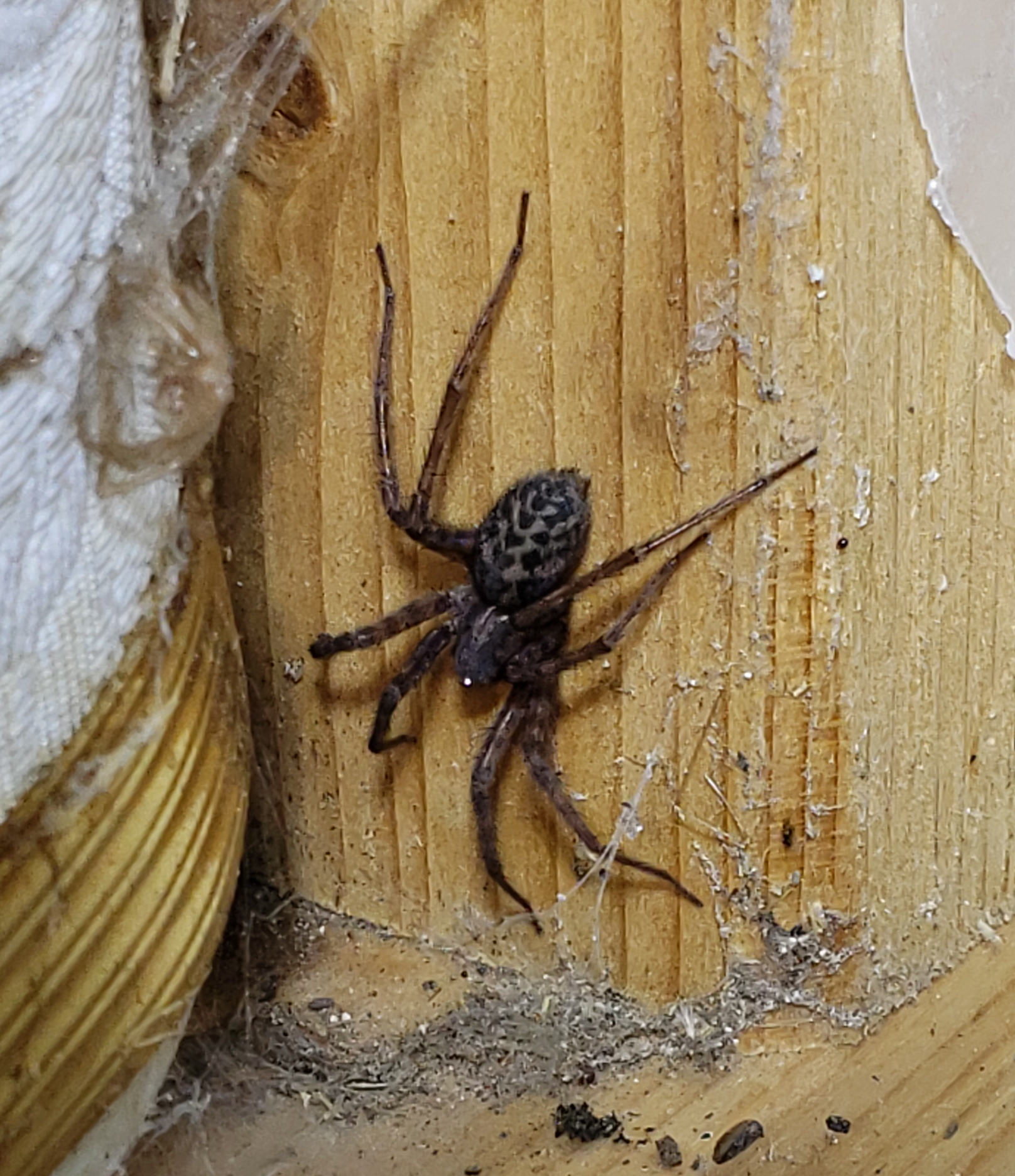
I can now spot Parasteatoda tepidariorum fairly easily, but other species I have to stare out for a while and flip through notes. P. tepidariorum is the species I’ve got thriving in the lab colony. Well, “thriving” is a little optimistic: the individuals are well-fed and looking good, but I still suffer from a shortage of males. I need more egg cases so I can separate the spiderlings early and alleviate some of the male mortality, but obviously I need more males to get more egg cases.

It’s going to be great fun!

Godzilla!

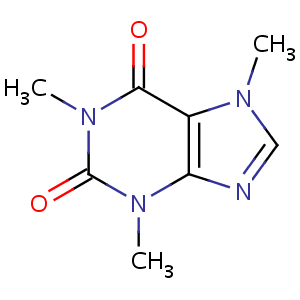
The new movie is playing in town, so I’m hoping to see it tonight…except that I’ve been prescribed cetirizine to suppress the allergies that might be causing my tinnitus, and I’ve been known to slip into unconsciousness at odd times of the day. It’s annoying, and worst of all, it doesn’t seem to be doing anything. So, if I can keep my eyes open tonight, I’ll be going to see Godzilla, King of the Monsters.

It’s about science, don’t you know. It just got a write-up in Science magazine!

The “evolutionary biology” of Godzilla is a topic of enduring interest among devotees, with numerous fan pages and forums dedicated to the subject. If we accept Godzilla as a ceratosaurid dinosaur and Lazarus taxon—a species thought to have gone extinct, only to be rediscovered later—then it represents a sensational example of evolutionary stasis, second only to coelacanths among vertebrates. Yet, the creature’s recent morphological change has been dramatic.

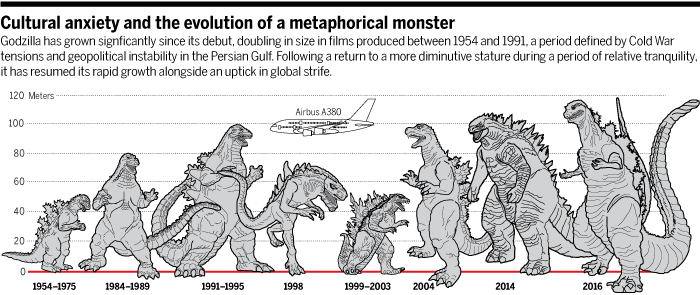
Godzilla has doubled in size since 1954. This rate of increase far exceeds that of ceratosaurids during the Jurassic, which was exceptional. The rate of change rules out genetic drift as the primary cause. It is more consistent with strong natural selection.

The strength of this selective pressure can be estimated by using the breeder’s equation, where the response to selection “R” is the product of the heritability (h2) of a given trait and the strength of selection. If we assume that h2 = 0.55 for body size—a reasonable estimate according to quantitative genetic studies of lizards—then the observed increase in Godzilla’s body size would require a total strength of selection of 4.89 SD. To put this number in context, the median value of natural selection documented in a review of more than 2500 estimates in the wild was 0.16. Godzilla, it seems, has been subject to a selective pressure 30 times greater than that of typical natural systems.

One problem with this analysis: isn’t it the same Godzilla in every movie? I could be wrong, but I think this is a specific individual returning over and over again, not a member of a population of Godzillas over many generations. It would have to be a very large and prolific population to hold up under that kind of selection pressure, too. It seems more likely to me that this is an example of a long-lived individual that is undergoing continuous growth over its lifetime, and therefore this is more of a matter for the developmental biologists, and is an example of a physiological adaptation.

Even if Godzilla is multiple different members of a changing population, we have no idea of the extent of the variation present within the population. The 1954 Godzilla could have been the Peter Dinklage of Godzillas, while the 2019 Godzilla could be the Yao Ming of the group. We don’t know, but I think that trying to argue for rates of selection is premature.

I must disagree with this diagram as well.

The 1998 monster does not look anything like the others, and must be from a completely different species, so don’t try to tell me it’s a Godzilla.

Project for the day

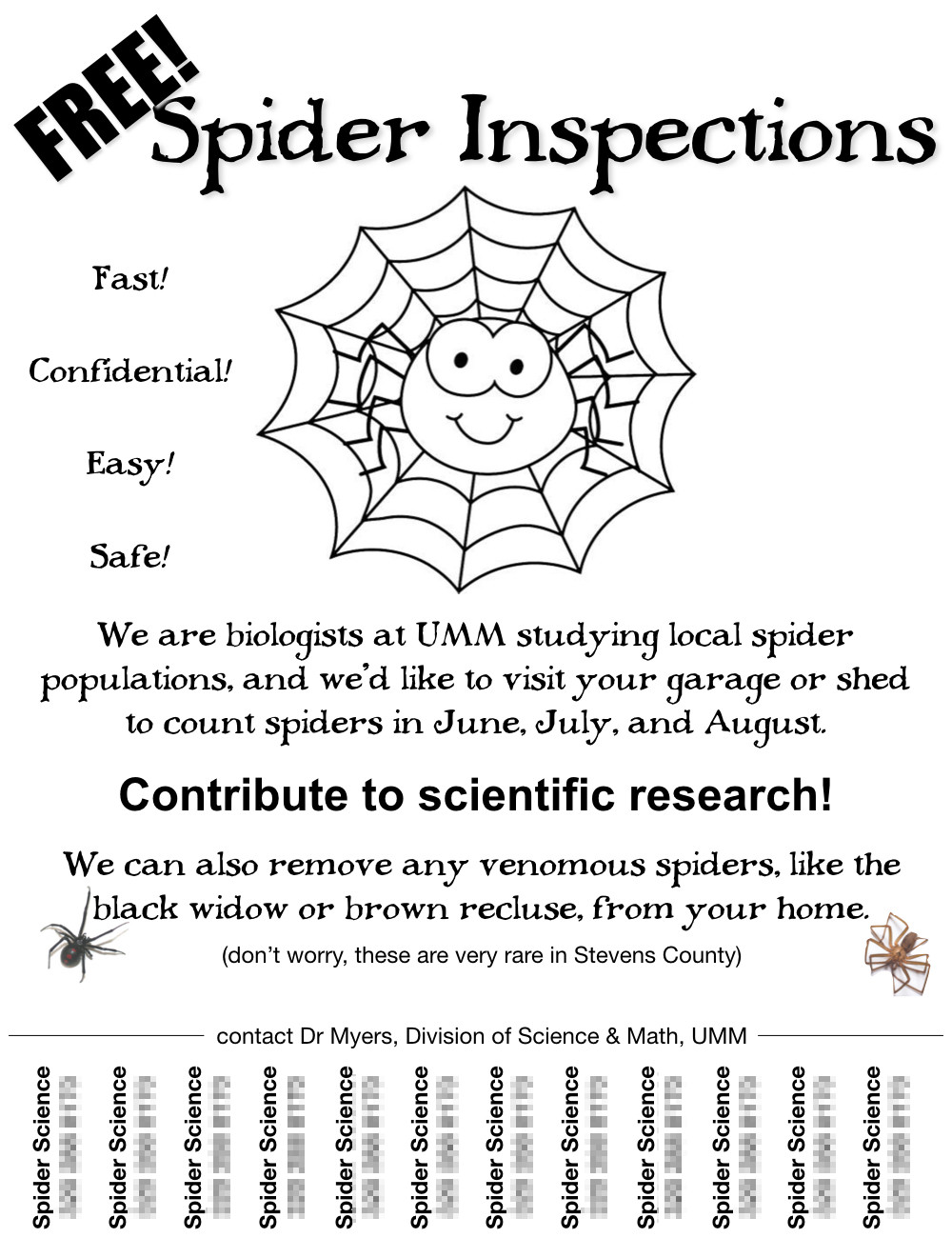
We’re getting close. This week I’m training some students (and myself) in spider classification, and then the week after we’re going to start charging into local residences to sample spider populations, with the goal of getting an estimate of the distribution of synanthropic species and making a baseline measurement of how their numbers change over the summer. So today I’m making signs that we’ll hang up around town to get volunteers.

I’ll be curious to see if my phone starts ringing madly or if I get nothing but silence — I don’t expect a lot of enthusiasm in the community for someone finding spiders in their homes, but maybe they’ll be curious. If I get no response, my backup plan is to show up in some neighborhoods and do some good old-fashioned door knocking.

This isn’t the only project I’ll have going this summer — we’re also going to do some laboratory work with developing P. tepidariorum. Anyway, I’m about to get busy.

We should colonize Mars, because it is inimical to human life, and therefore we’ll evolve super-fast!

Now this is high-quality click-bait: Near-Sighted Kids of Martian Colonists Could Find Sex With Earth-Humans Deadly. If only HG Wells had thought of that, his story would have had a more dramatic end as squinty-eyed Martian invaders dropped dead while trying to rape humans. The source for this peculiar claim isn’t that bad, but it’s still bad science. It’s about a guy who makes predictions about the future of human space colonists.

Solomon’s 2016 book, Future Humans: Inside the Science of Our Continuing Evolution, argues that evolution is still a force at play in modern humans. In an awe-inspiring TEDx talk in January 2018 — which inexplicably still has fewer than 1,000 views — Solomon outlined how humans would change — literally — after spending a generation or two living on Mars.

There’s the problem. These ideas are coming out of a TED talk, which is a good source for misinformation. I listened to it, and it was not awe-inspiring at all, but bad: it starts with the Elon-Muskian notion that the human race is doomed if we stay on Earth and we need to colonize other worlds. He lists a few ways we might go extinct, like a meteor strike, or erupting super-volcanoes, or using up all the resources on Earth. But he has a solution! One way to avoid such a fate would be to spread out beyond Earth, venturing out into the galaxy the way our ancestors spread from our birthplace in Africa.

I felt like raising my hand and mentioning that one and a quarter billion people still live in Africa, and that there are a lot of people who might wonder who you’re talking to with that “our ancestors” comment.

I’d also want to mention that changes occurring within two generations are going to be physiological adaptations, not evolutionary changes.

And galaxy? Seriously? He’s talking about a pie-in-the-sky effort to colonize Mars, practically our neighbor yet still almost impossible to reach. If we’ve got our pick of the entire galaxy, surely there are better choices than a cold, arid rock that is uninhabitable by humans.

It gets worse from there.

It’s a weird talk. The first half is all about how awful life on Mars would be for our species: the greatly reduced gravity is going to lead to calcium depletion and brittle bones, and much greater complications in pregnancy. The radiation is going to be a severe, even lethal problem — he points out that a native of Mars would receive 5,000 times the radiation dose of an inhabitant of Earth. Babies born on Mars will bear thousands of times more mutations than Earth babies, so miscarriages will be far more common.

You may be thinking that this sounds like a hell-hole, that the tiny population of humans who make it to Mars will be rapidly eliminated by fierce attrition, and that any colony will be far more doomed than anyone remaining on Earth. Not to this guy! He makes some very positive predictions about what will happen to this remote colony.

Far from waiting thousands of years to witness minuscule changes, Solomon instead believes that humans going to Mars could be on the verge of an evolutionary rollercoaster. He expects, among other things, that their bones will be stronger, their sight shorter, and that they’ll, at some point, have to stop having sex with Earth-humans.

But how? Solomon has an almost religious faith in the power of natural selection. Sure, there’ll be lots more mutations, but that just means evolutionary changes that might require thousands of years on Earth will occur in a few generations on Mars. He sort of sails over the fact that his hypothesis bypasses any opportunity for natural selection to work. He’s relying entirely on wishful thinking, that because brittle bones are a problem, a spontaneous mutation that counters it will arise, and rapidly spread through the colony…in a couple of generations. He doesn’t seem to be aware of the cost of selection. You’ve already got a tiny population, and you’re proposing that rare mutations will displace the majority of the individuals in a few generations? What kind of genetic load is he predicting? What is the effective population size of your colony?

“Evolution is faster or slower depending on how much of an advantage there is to having a certain mutation,” Solomon says. “If a mutation pops up for people living on Mars, and it gives them a 50-percent survival advantage, that’s a huge advantage, right? And that means that those individuals are going to be passing those genes on at a much higher rate than they otherwise would have.”

So we’re expecting an extremely rare advantageous mutation with extremely high adaptive value to “pop up” in a colony, while ignoring the greater likelihood of lethal or sterilizing mutations. We’ve got predictable increases in short-term adapations, like rising near-sightedness rates from living in close spaces, but we’ll pretend the predictable increases in cancer rates are negligible. Further, this population undergoing constant, rapid die-off with a few very rare benign mutations will, among other things, lose immune responses due to living in a sterile environment, which is how they’ll lose the ability to have sex with, or even contact with filthy Earth-humans, preventing the possibility of replacement of losses with new immigrants.

But cool, they might evolve new skin tones to cope with the radiation, because turning orange with more carotenes in your skin will be sufficiently protective to compensate for all the other damages.

He’s at least vaguely aware that they’re going to need a large, rich source of human genetic diversity to get all this “evolution” going.

It also means Musk and others will need to consider genetic diversity, to ensure a good mix throughout the population. Solomon argues for around 100,000 people migrating to Mars over the course of a few years, with the majority from Africa, as that is where humans see the greatest genetic diversity.

“If I were designing a human colony on Mars, I would want a population that would be hundreds of thousands of people, with representatives of every human population here on Earth,” Solomon says.

OK, how? At least this is a good example of a biologist telling physicists to do the impossible, rather than vice versa, but I’m just thinking this is silly. The resources required to ship hundreds of thousands of people to a place where the majority are going to die and fail might be better spent improving the sustainability of life on Earth. At least he did early on acknowledge that resource depletion might be a factor that would limit survivability, it just wasn’t clear that he wanted to engineer a situation to make his prophecy come true.

Finally, the fact that his solution relies entirely on unpredictable, chance mutations occurring so rapidly that natural selection has no time to work means that his fundamental premise, that he can make predictions about the fate of human colonies on other worlds, is absolute rubbish.

I don’t mind a little optimism, but it’s the internal contradictions and neglect of basic facts that gets to me.

Female salamander gang invades local turf to steal chromosomes!

Local scientist featured on Science Friday! Our newest addition to the biology discipline, Rob Denton, appeared on SciFri for his work on unisexual salamanders. This species only has females — they don’t need male chromosomes to reproduce. However, they do need sperm to initiate development, so they wander about the ponds picking up sperm from alien species to trigger their own egg cells.

Their other cool trick is that, although they don’t need that sperm’s chromosome content to make babies, they will sometimes incorporate a few chromosomes from alien species on top of their own, so that maybe they can acquire a few locally adapted genes. It’s cool stuff, but watch the video to get the full story.

If you want to learn more, check out the Denton lab website, or pester @RD_Denton. He’s got nothing better to do other than run his summer research and work hard to earn tenure, so ask him questions!

Dungeoneering

My wife and I are getting serious about this spider hunting business. We lit some torches and delved deep into our basement. I went as a dwarven fighter, she was an elven enchantress. It was terrifying.

You must understand that several years ago, when we still had teenagers at home, our basement was a hotspot for carousing. Many were the XBox battles waged in that space, the nights were full of shouts and gunfire and raucusness, and many Cheetos were consumed there. Then our offspring departed, and it fell silent and abandoned. We stripped out much of the furniture, removed carpeting, cleaned it all out, and it did fall into darkness and neglect. We braved the first level today.

The cobwebs are impressive and dense, and they were decorated with the shriveled corpses of many pholcids, and also the long-drained bodies of pill bugs, centipedes, and millipedes. We sought out any theridiidae, but they were absent. It was like a tomb.

Everything was covered thickly with webbing though, like the electrical system. Look closely, and you might see a pholcid embracing the grey box — it’s dead. I nudged it, it didn’t move (live pholcids will start gyrating in their webs if disturbed). One has to wonder what it is guarding.

I looked into the crawlspace. That was too awful to contemplate, too infested with webbing everywhere. No one has entered that cavern in decades, so we retreated. I think we’ll have to go up a few levels before we dare plunge into that nightmare.

We retreated further and turned the corner to escape when we saw…

[Read more…]

Meandering about spiders

I went for my morning stroll this morning, checking out spider haunts. My garage is still destitute, with nothing but dead husks and cobwebs. I walked over to the science building, and checked a few places that I knew were crannies where cobwebs and insect parts and spider poop could usually be found — nothing! They were shiny clean! I guess our magnificent custodial staff had been scrubbing unusually thoroughly for commencement. I’ve still got my lab spiders looking sleek and plump, but they’re all female, and I’m desperate for male spider juice right now.

I consoled myself by making my final travel details to the American Arachnological Society meeting next month. I’ll get my spider fix one way or another.

I like the label “charismatic minifauna”

Then I was reading a This American Life episode about spinelessness. It’s about the vertebrate bias in research publications and funding. Malcolm Rosenthal is deploring the fact that invertebrates are relatively neglected.

Our findings can be summarized in two major points:

First: The warm-blooded vertebrate skew was intense. Almost 85 percent of described species are arthropods, but more than 70 percent of publications were on vertebrates. Birds and mammals alone accounted for well over 50 percent of publications, despite representing less than 2 percent of all animal species.

Second: In a world where citations are used to measure impact, publishing on understudied systems comes at a cost to the researcher. Publications on vertebrates received more citations on average than arthropod papers. They were also far more likely to be “blockbuster” publications with more than 100 citations.

He’s right. You can’t deny that there is a strong bias at work. Back in the early days of zebrafish work, we often made the argument that these are honorary invertebrates when we were talking to other developmental biologists, because they do have a lot of the advantages of model systems in that group, but in our grant proposals we turned around and emphasized that these were true vertebrates, and that they had the virtues of relevance to research in human health and disease. We did our best to straddle that line.

And while Rosenthal’s evidence is true, I think he’s missing the real distinction. This bias is a consequence of a fundamental difference between basic and applied research. Basic research is all the stuff he and I love, where we just care about how the world in all of its richness works. Applied research has a focus on science that helps us, the human species, and because we’re such selfish assholes, that’s where the lion’s share of the moolah goes. Look at the names of the big funding agencies: the National Institutes of Health, the National Cancer Institute. That’s where you apply if you want to make a case for research that contributes to our understanding of human health and disease. You can apply for research grants to study, for instance, zebrafish, or even insects, but you’re going to have to link it with some relevance to Homo sapiens.

You want to study some other organism, because it is interesting in and of itself, and might tell you something fundamental about biology? You apply to the National Science Foundation.

The budget for NIH is $37 billion. The budget for NSF is $7.8 billion. Enough said. Even if you convince the agency to fund your research on some fascinating, little known organism, some jerk in the legislature is going to proxmire you and whine about wasting money on bugs. If you avoid the spotlight, you’re still going to that family reunion this summer where Uncle Dork is going to sneer at you and wonder what the hell you do for a living.

I agree that there should be more support for more diversity in topics in science, and I really want to see more support for basic science, but that’s going to require a huge shift in science priorities. I’m all for a National Spider Institute that is well-funded by congress, though.