My house: ground zero in the Northern Empire of Spiders

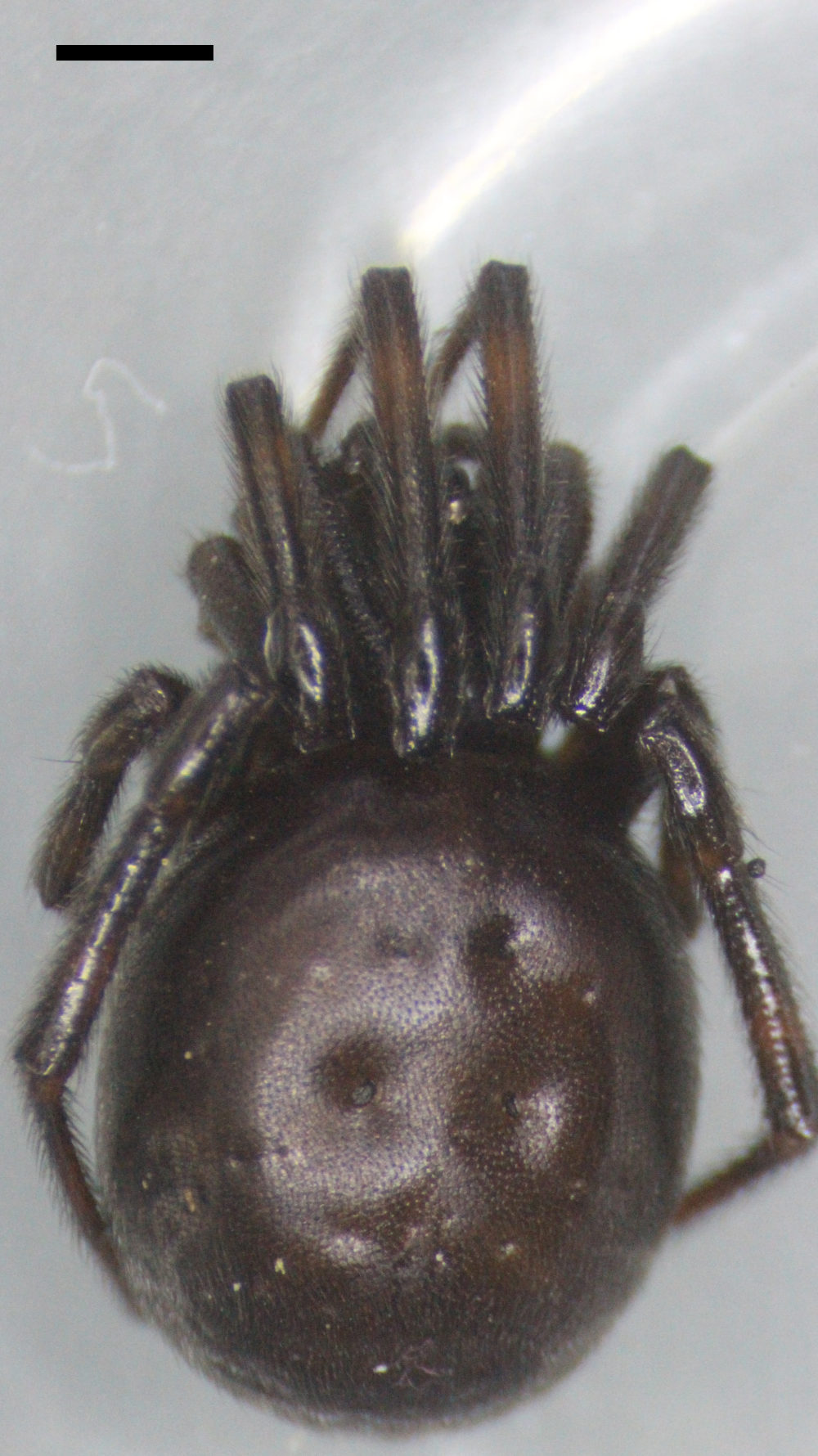
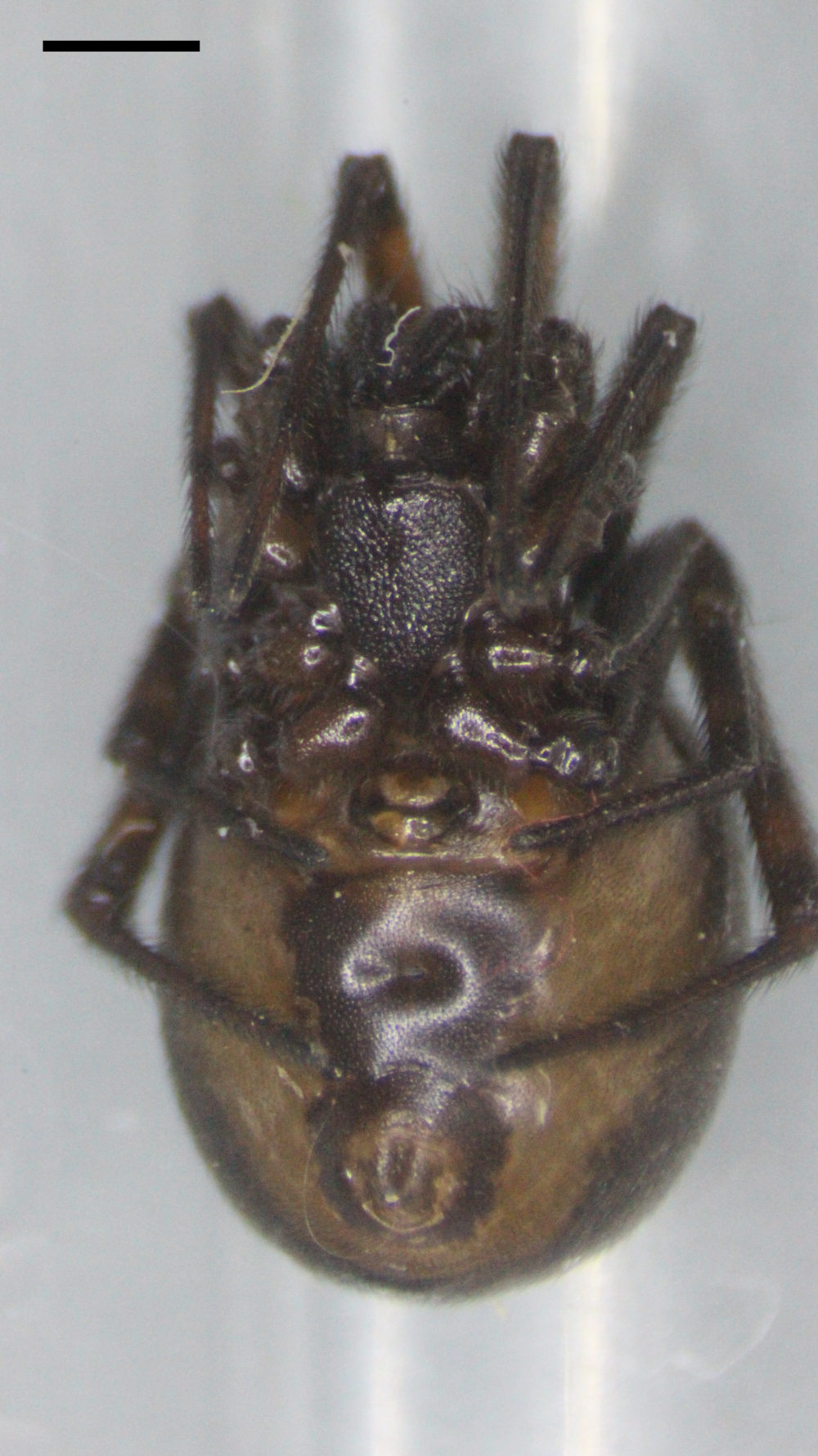
We were out spider-huntin’ again today, adding more data to the collection, and finding this Steatoda, which is about as big as they get. We’ve captured a couple of representatives of this species now, but they’re all female.

We limit the number we capture to one or two a day, because we don’t want to perturb the local populations too much. I’m only planning to breed Parasteatoda tepidariorum, though, so I’m going to have to do something with the other species we find…I’m probably going to release them all at my house, since I did so much collecting here that the population is hopelessly messed up already, which may turn my house into a weird little hotbed of exotic spider diversity.

I wonder if that will increase the property value? It should.

What paleo diet?

I keep hearing about this imaginary paleolithic diet, and I wonder how they know, and also find it strange that there was apparently one people a 100,000 years ago, and they all ate the same things. Everything about it seems wrong.

Now there is some evidence that humans were roasting starchy tubers in their caves.

Based on plants that would have been locally available, Stone Age people likely cooked tubers and roots in the cave, the scientists say. Compared with raw starchy plants, their cooked counterparts would have provided an especially efficient source of glucose, and thus energy, to people. Human fossils previously found in the coastal cave, located at Africa’s southern tip, also date to around 120,000 years ago.

Ancient starch eating at Klasies River Cave supports the possibility that Homo sapiens evolved genetic upgrades to help with digesting hard-to-break-down starch long before people started farming starchy crops in Africa around 10,000 years ago. Scientists have determined that people today carry more copies of starch-digestion genes than did Stone Age populations, such as Neandertals and Denisovans.

Ancient humans in southern Africa likely ate a mix of cooked roots and tubers, shellfish, fish and game animals, Larbey’s team says. Roots and tubers would have been available year-round. And while little is known about the origins of cooking, campfires were being built at least 300,000 years ago in Africa.

Well, maybe there is something to this paleo diet stuff, because I started salivating. I don’t have any shellfish or game, but I’m thinking now that dinner tonight might be some roasted tubers seasoned with some of the herbs my wife is growing in her garden. Our many-times-great grandparents weren’t stupid people. We might as well give those starch-digestion enzymes they bestowed on us a happy workout!

Class Photo

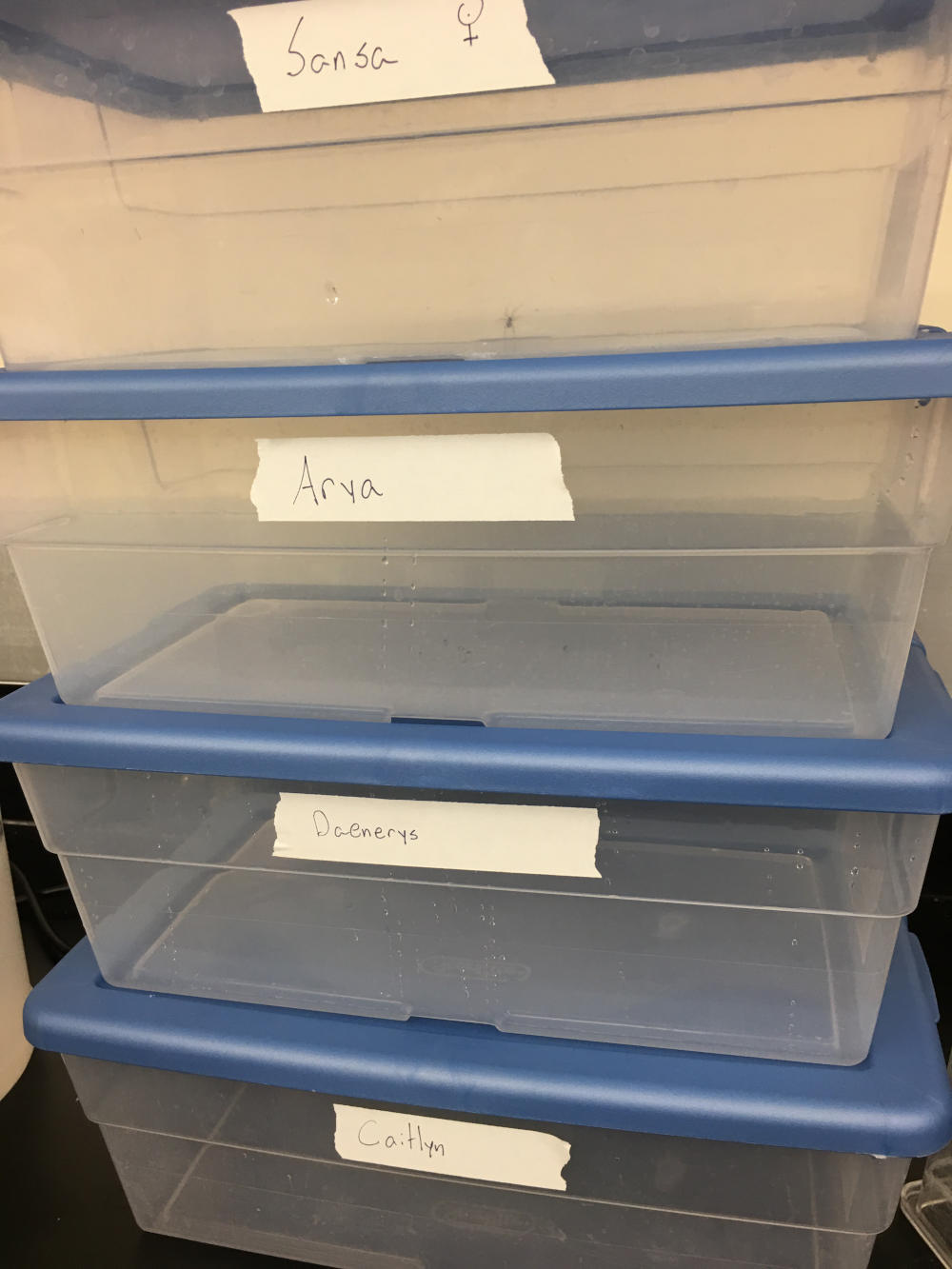
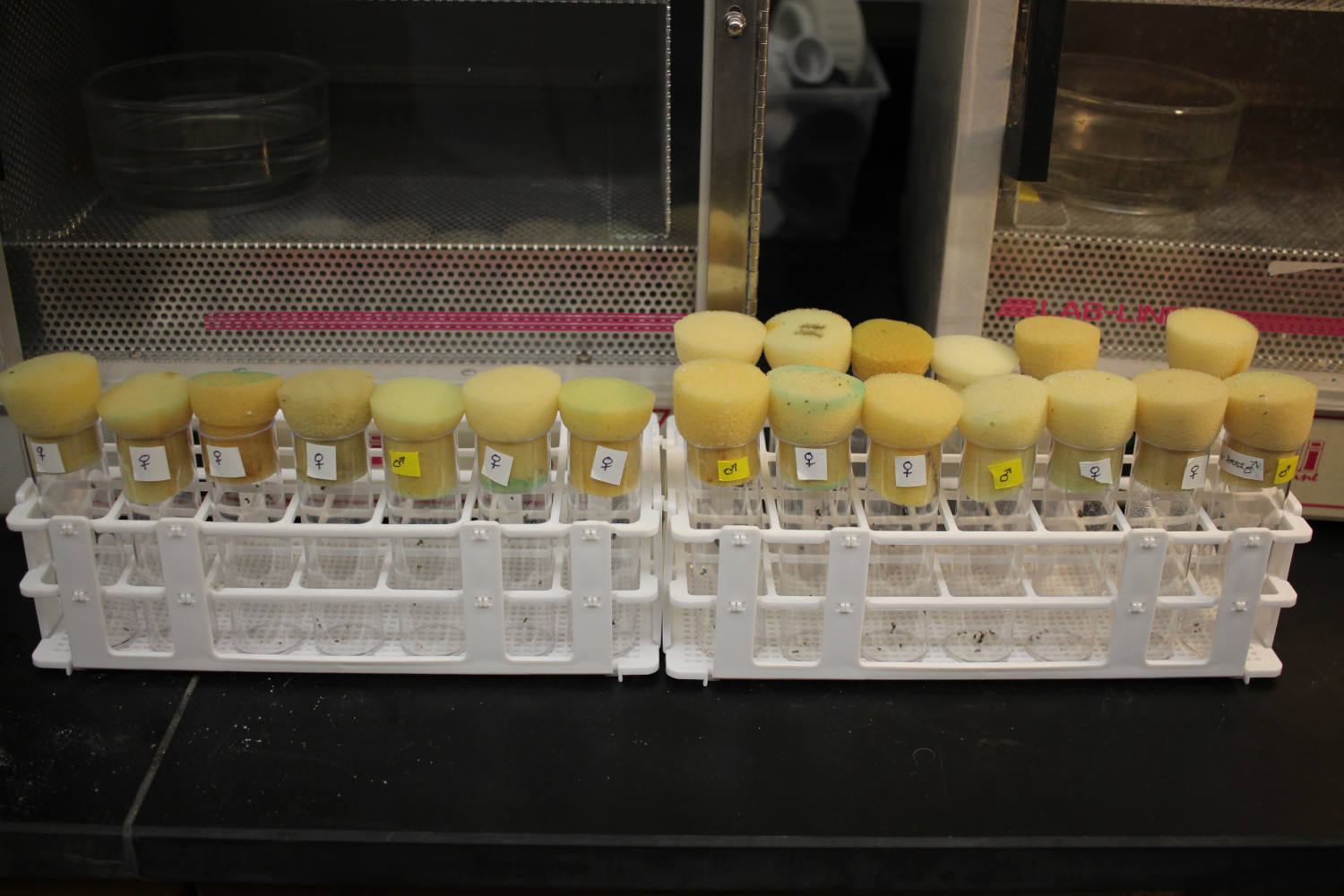
Today was lab cleanup and organization day. I had the spider colony line up for their class photo.

You can see it’s still a small group — we’re just beginning to rebound from a long, quiet, male-less winter. I’m hoping to expand the colony to four or five times that size in the next few weeks, which I think will be sustainably self-perpetuating at that point.

To that end, those few males in the group are getting a little nervous — tomorrow is their wedding day. The lucky ladies are licking their chops. I’m hoping to minimize the likelihood of patriarchal mortality by transferring pairs to large, roomy honeymoon containers where the guys have a chance of running away.

Another day, more spiders

This is my life right now: running around town, barging into people’s garages, peering into musty corners with my headgear, scooping up the occasional spider. Sorry. I’m going to be even more boring than usual for a while.

Today we surveyed a few more houses, including one that had no visible spiders at all — we found a few cobwebs, so we knew they were hiding somewhere in there, but no one was coming out to play. We were disappointed. The homeowners seemed pleased.

We also found one garage with multiple orb weavers, all very tiny and very young. This isn’t the usual place we expect to find orb webs.

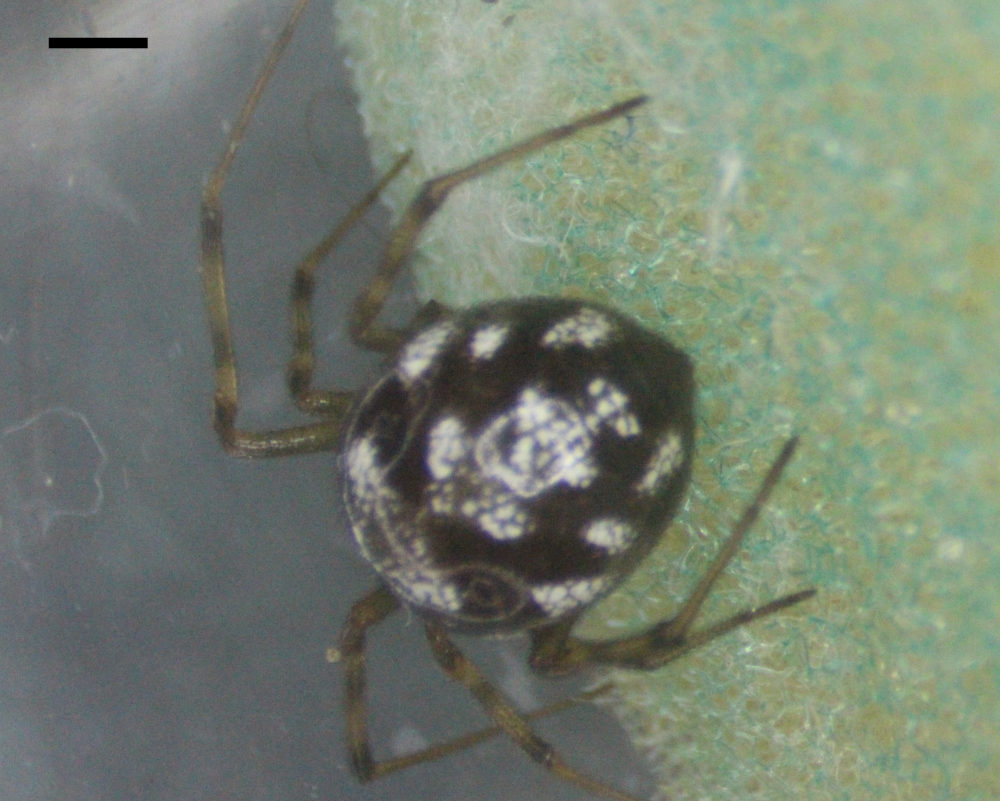
Also found: Steatoda triangularis, with their pretty black & white diamond pattern.

scale=1mm

Tomorrow I’m doing lab work, then a few more days of field work before we stop for the month, and then next weekend I’m off to the American Arachnological Society meeting to hang out with some real arachnologists. Am I immersed in spiderology nowadays? I think so.

Another day of spider-hunting!

We spent another day rummaging about in strangers’ garages, working up a dirty sweat and getting spider webs in our faces. It was great fun! We doubled the size of our data set, so that’s the big news.

The other fun thing is that while mostly the data is repetitive — most garages around here are full of Pholcidae or familiar ol’ Parasteatoda tepidariorum — it’s neat when find a different population. We’re seeing the same species of Theridiidae everywhere, but we walked into one shed today and it was different. Theridiidae, sure, this shed contained only Steatoda borealis. These guys, with many teeny tiny recent hatchlings:

We’re going back here in July to see if that population retains its grip.

Uh-oh. Ticks.

It’s going to be another day delving deep into more spidery domains, and then I see this news about another threat, a new species of tick invading the US.

Testing in New York identified the tick as an Asian longhorned tick nymph, with genetic sequencing adding more evidence affirming the finding. The National Veterinary Services Laboratory in Ames, Iowa, further confirmed the finding.

Tick sampling using corduroy drag cloths found Asian longhorned ticks on the patient’s manicured lawn, some of them in direct sun. More were found in the park across the street from the patient’s house, both in open, cut grass exposed to direct sun and in taller, shaded grass next to the woods. Testing also found ticks on a nearby public trail, in mowed short and midlength grass near the trail edge, both in full sun and partial shade. The discovery of the ticks near the man’s house were the first known collections in New York state.

The authors wrote that finding the ticks on manicured lawns and in open sun may be significant, because public education efforts often stress that Ixodes scapularis ticks—the most common biting tick in New York state—are found in wooded areas or shaded grass.

At least my area of interest right now is dark, shadowy, dusty, cobwebby, and hot, so I’m not going to panic. My long-term plans include expanding into lawns and gardens, though, so I’ll keep this in mind for next year.

Spider mission accomplished

I survived my first day of field work, although right now I’m feeling every square millimeter of my left trapezius muscle — all that stooping and stretching and poking exacerbated all my existing aches and pains. Also, it was hot, up around 30°C, which I think is the major limiting factor in how long we can keep it up. Did you know that most people don’t have air-conditioned garages? It’s true!

We surveyed half a dozen houses, which is what I hoped we could accomplish, so we’re right on track. I’m hoping to reach around 30 houses this week. There’s not much we can say from such a preliminary sample, but we have a couple of suggestive observations. The older the house, the more spiders. The most heavily populated garage had 37 active spiders on the walls, and 17 egg cases — we’re looking forward to seeing the population explosion there next month. The most sparsely populated had 1.

Almost all the spiders were either Pholcidae or Theridiidae, and curiously, their numbers were inversely correlated to one another. It could be a sign of a competitive interaction, or some subtle detail in the environment of these buildings that favors one over the other. Or it could just be our tiny sample size so far. We found only three spiders total that didn’t belong to those two families — I have to key them out this evening.

I also have to plug all the data into the computer, too. I’m practicing a little data security: there’s one key sheet with the addresses and a code, and then the data for each house is stored in paper files under that code, and also recorded in a database. I didn’t know if that would be necessary, but two people asked me if we’d keep the numbers confidential — I guess there’s some concern that one doesn’t want one’s home known as spider-infested. I would think that would increase the property value, but that’s just me.

Now I have to recover over night, and do it again tomorrow and the day after. Sunday shall be a day of rest, sort of. I’ve got about 30 spiders in the colony that will need some TLC that day.

Look at this beautiful beast! You’re missing out if you aren’t on our spider survey.

T-1 hour

Oh, boy, the data collection begins in about an hour: I’ve got about a week of grueling spider survey work ahead of me. I’m going to be poking around in dusty, cobwebby garages with headlamps on, tallying up spiders and spider egg cases, and I expect to be worn out at the end of the day. It’s going to be great! I’m looking forward to the first dollop of data today. I’m looking forward even more to the last dollop of data at the end of the summer.

The spiders may be the death of me tomorrow

My big spider survey project launches tomorrow. I’ve got a long list of people who have volunteered their residences, and starting at noon, we start cruising the mean streets of Morris, Minnesota, seeking spider-haunted garages, and plunging into them to count and classify arachnids. This will be painless if they’re sparsely occupied, but judging by the surge in the spider population at my house this week, it may be a grueling task with hundreds of eight-legged freaks clamoring for our attention. Thousands? Oh god, may die. The price we pay for Science.

I’m estimating a week spent on this first phase. Then another week a month from now. Then another week a month after that. Then some spot checking as fall and cool weather descends. In between, we’ll be culturing spider embryos in the lab — my colony is currently about 20, 25 strong, and I plan to triple that in short order, and then at last, the spiderlings will be pumped out assembly line fashion, and there will be no limit to my aspirations!

Laboratory nightmare!

I remember my wild man days, when I might have as much as 5 or 6 cups of coffee during the day — to be honest, I was never particularly wild, but I would get the caffeine shakes and feel a bit edgy. I’m now down to one cup in the morning, and if I’m feeling crazy, two. But never have I consumed the equivalent of 300 cups of coffee in one sitting, like these unfortunate students.

The students had volunteered to take part in a test in March 2015 aimed at measuring the effect of caffeine on exercise.

They were given 30g of caffeine instead of 0.3g, Mr Farrer said.

Death had previously been reported after consumption of just 18g, he told the court.

The university had switched from using caffeine tablets to powder, he said.

“The staff were not experienced or competent enough and they had never done it on their own before,” he said.

“The university took no steps to make sure the staff knew how to do it.”

The calculation had been done on a mobile phone, with the decimal point in the wrong place, and there was no risk assessment.

Caffeine is a potentially dangerous drug, and anyone working with it needs to be aware of that fact. I’ve had students experiment with it in our cell biology lab, and I always preface providing the purified drug to students with the warning that it is almost certainly the most dangerous chemical in the lab at that time, that they shouldn’t let familiarity with it as an ingredient in coffee and soft drinks let them be casual with playing with it.

I probably looked like a gaffed fish while I was reading that. It was appallingly sloppy practice.

  • They were dosing students with this drug, not mice or some other animal model.
  • They didn’t have competently trained staff monitoring every step.
  • They changed the reagent from over-the-counter pills to purified powder, which ought to have had everyone triple-checking the concentration.
  • They didn’t have their protocol vetted by an experienced pharmacologist.
  • They relied on a calculator.GIGO. I’ve been nagging my students to do more estimation, because I’ve noticed that calculator-dependent students easily make errors that are many orders of magnitude off, and they are completely unaware.

In our introductory labs, when we have students calculate concentrations, we have a little check box in the write-up — they have to get a TA or instructor to sign off on the calculations, and that’s for safe procedures, like adding an indicator dye to a tube of yeast. Every year when I’m grading lab reports, I keep an eye open for egregious errors in concentrations. One year the record was set by someone being off by 31 orders of magnitude.

I know students are easily capable of bone-headed errors in arithmetic that they aren’t experienced enough to notice, and to do it in an experiment in which students are the subjects…no. Just no. Now I’m going to have nightmares.

At least in this case the two poisoned students survived, and the university was fined £400,000. They all got off easy.