Chemistry and triangulosa

Work is heating up as it always does in the first few weeks of classes. Today and Friday I’m blitzing through a basic chemistry review in cell biology, because…biology is all chemistry. A very narrow and specific domain of chemistry, sure, but if you don’t understand how electrons flow you’re getting nowhere in cell biology. Yesterday was spent re-reading a lot of introductory chemistry stuff to remind me of how this all works, today I lay it all out for the students, who might be bored, but still a bunch of them will mess up on the easy chemistry questions in the first exam.

It always shocks incoming students who think biology is all frog dissections and memorizing organs. Nope, all chemistry, and in order to get the chemistry, you need to know the math. So all you high school kids thinking it would be neat to major in biology and play with spiders, buckle down and learn your basic algebra and pre-calc, at the least, and work through chemistry and physics.

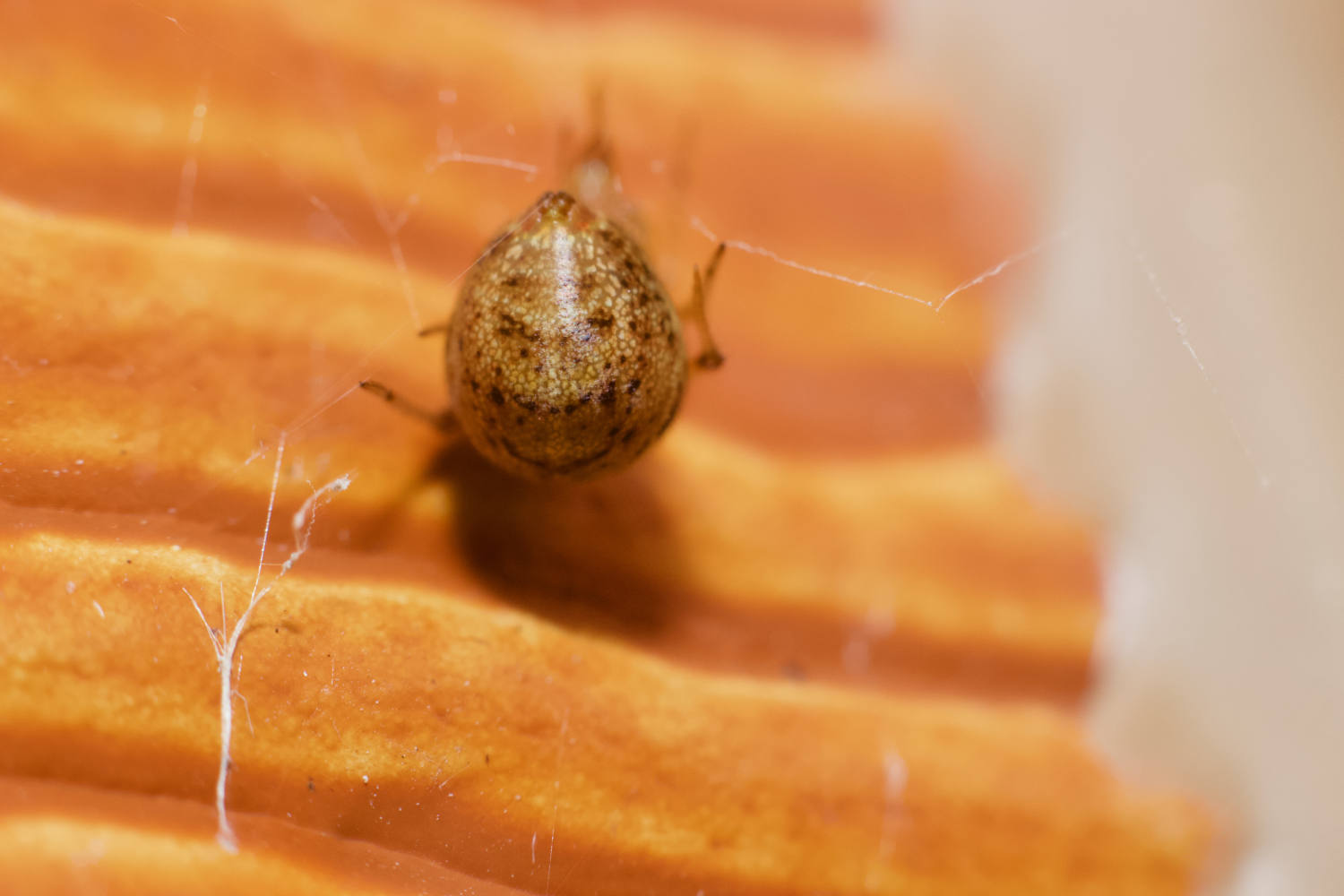
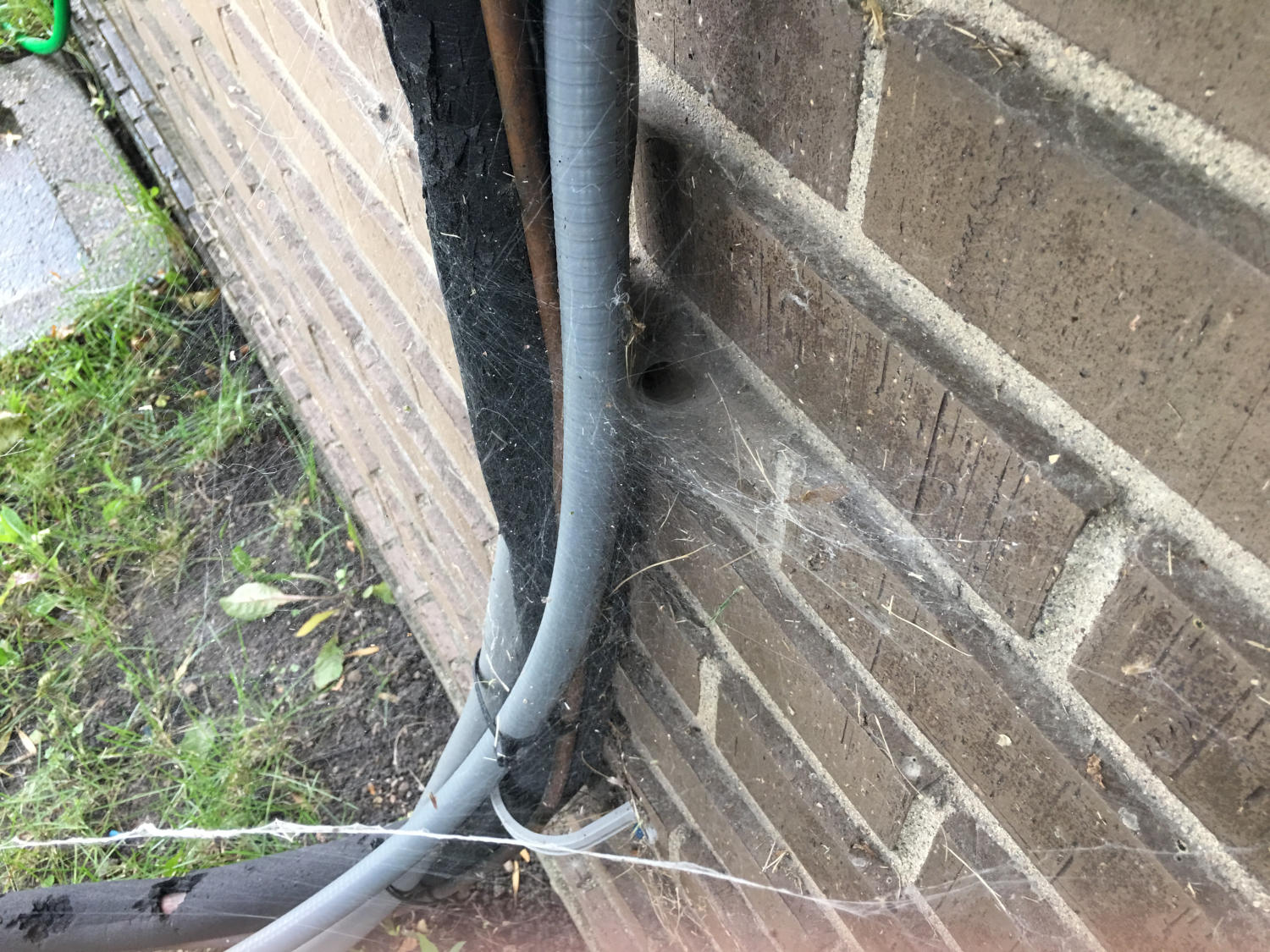
Then I have some lab stuff to do. Today I’m going to focus on our Steatoda triangulosa. We’ve got a few young second generation juveniles coming up that I need to sort into larger quarters, and another egg sac that is full of baby spiders. The cool thing about S. triangulosa, besides the pretty pigment patterns, is that their egg sacs are fluffy, loosely woven silk and are semi-transparent, so you can see the eggs right through them, and right now I peek in and it’s a mass of writhing spider legs, so they’re about to emerge, I’m sure. The less cool thing about them is that they seem to be slower to develop, and for at least the one mama I’ve got in the lab, lay a smaller number of eggs. I might have to go hunt down some more adults so I have a larger sample before the frost hits.

Anyway, I’ll take pictures! I think I’ll post a purely S. triangulosa article later today.

But first, chemistry! That’s my day sorted.

Bee-killer

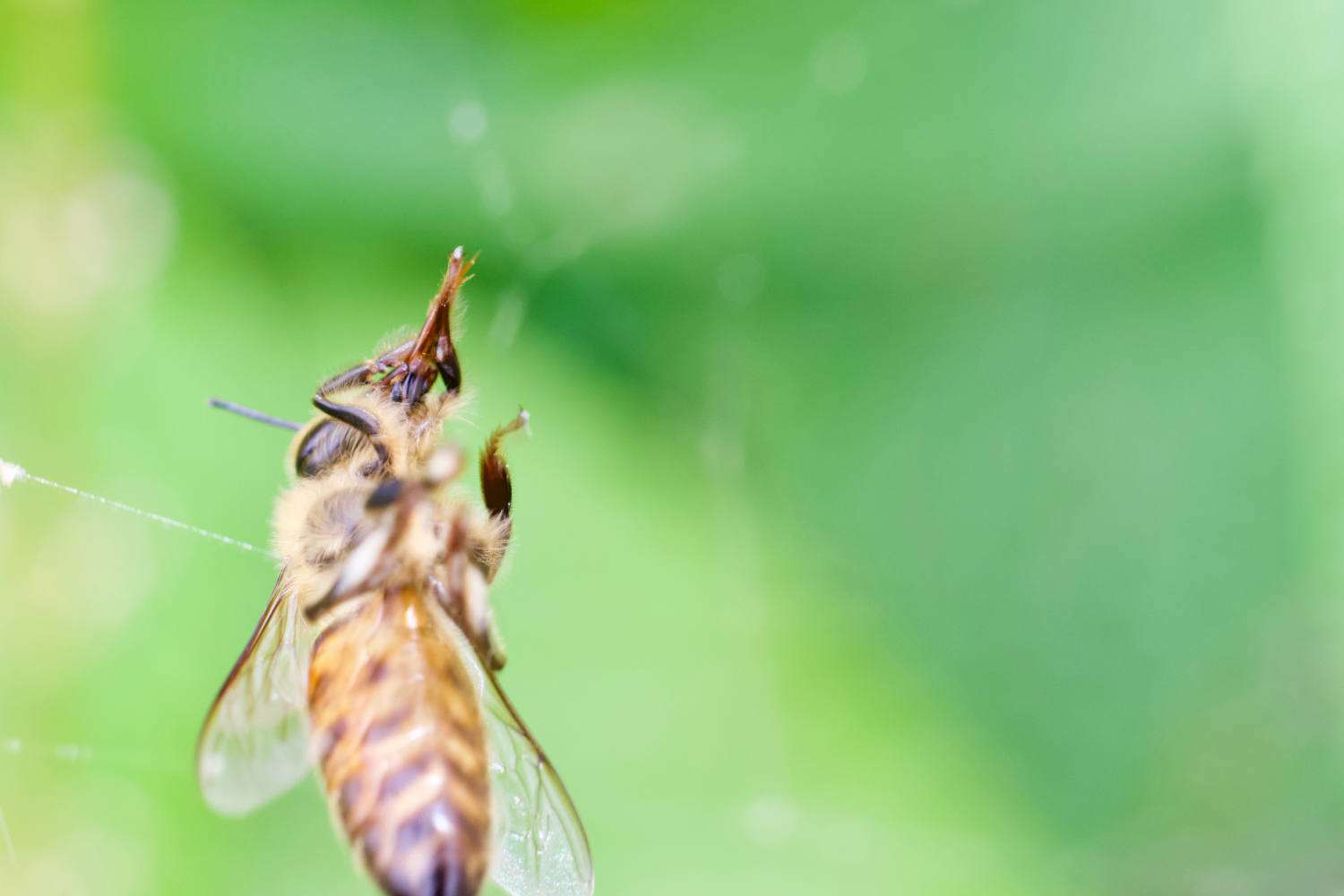
It begins with the screaming of the bee. We looked down into a flower patch, and there was an innocent honeybee, snared in a spiderweb, twirling maniacally and buzzing frantically as it struggled to get free. Mary told me to free it…I said “No,” callously.

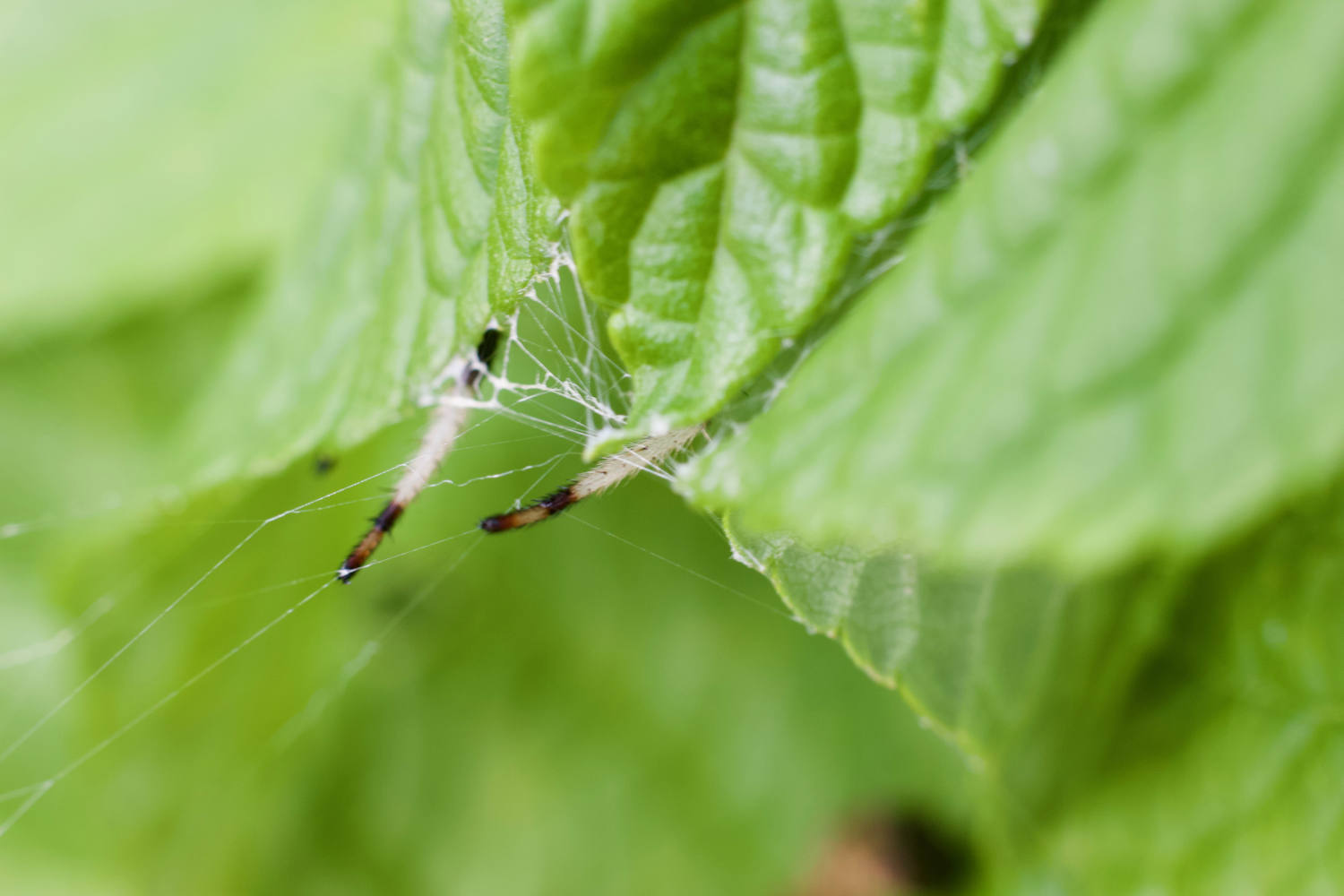
I followed the lines of the web, a rather tattered orb at this point, and found what I was looking for — the claws of the predator, peeking out from under a leaf.

[Read more…]

Walking with spiders

I went for a walk in lovely downtown Morris today, and was rather disappointed. Tegenaria has taken over! Where earlier this summer I would have found the delicate, airy cobwebs of my favorite false black widows, there was nothing but these thick, dense sheets of webbing leading to tunnels of silk with these massive spiders lurking within.

OK, fine, they’re still spiders…but they’re far more shy than Parasteatoda. I’d gently and slowly ease my camera lens towards them, but long before the spiders were in focus they’d dart deeper into the tunnel. It was frustrating. I started seeing the utility of this probe lens.

[Read more…]

Spider Friday

One of the benefits of my job is that I get to work with young men and women all day, except when I’m not, when I’m puttering about with spiders (we will pretend committee meetings do not happen). So this morning I had my coffee and then toddled off to the lab to tend to my little friends.

Here’s my breeding colony.

They’re the ones with special privileges. They get the big roomy 5.7L sterilite containers, with one female per cage and connubial visitations. There are also racks in a pair of incubators with about 50 more spiders living in 3cm diameter tubes; they seem content, as long as food keeps getting delivered. So some of the spiders get to live in a suite at the Hilton, others are in the capsule hotel.

[Read more…]

First day back, and I survived!

I got through the first lecture, and even had an easy time prompting students to speak up and ask questions, so I’m doing OK so far. Also, I gave them my background and told them I work on spiders, and nobody passed out…in fact, after class they asked to see the colony, and about half the class was crammed into my lab. That’s a good sign, that they’re not all arachnophobes (it’s OK if they are). I also plugged all the other research going on here, in case they weren’t aware of the opportunities.

So now I get to go home and celebrate with a nice dinner. Involving tomatoes. We have so many tomatoes, and I have to cook down another batch tonight. We’ve got marinara sauce dribbling out of our ears, we had fried tomatoes yesterday, I’m going to have to come up with a lot of different ways to make tomatoes delicious. I think Mary needs to plant slightly fewer tomatoes next year. That has nothing to do with my class, it’s just that I’m drowning in tomatoes.

She also planted zucchini. I’m doomed.

Growing up is tough for a spider

I mentioned a while back that we had this surplus of spiderlings and that we were going to do some measurements of survival under different population densities. Well, we’ve got two weeks of data now, so we can think a bit.

It was a simple experiment: we put different numbers of recently emerged spiderlings in two different sized containers. We had 5, 10, 15, or 20 spiders in containers that were either about 100ml in volume, or 5.7 liters, so spider density ranged from 0.0009 spiders/ml for the big, nearly empty containers to 0.17 spiders/ml in the small overcrowded ones. We’re basically asking how crowded to they need to be to start affecting each other’s survival, and what’s the greatest density we can get away with, anticipating that no matter what, some will die. And the answer is…

Density doesn’t matter. It didn’t matter how many spiders we started with, or whether it was a small or large container, we ended up with 1-3 spiders in a container at the end of two weeks. You start with 10 in a giant container, you end up with about 3; you start with 20 in a tiny box, you end up with about 3. They’re all spaced out, too; we found that individuals tended to occupy different corners, no matter how much room they had. There were no containers which had 100% mortality.

What does that look like? They seem to be murdering their siblings to set up exclusive territories. Ah, the life of an adolescent spider. What it means is that only about 20% of the spiderlings have survived this battle royale so far. Maybe eventually they’ll be reduced to one spider per container.

Dang. Next experiment is to set up containers for individual spiderlings to see if that increases the overall survival rate. If it does, then I’ve got to do some more thinking. I can’t possibly accommodate every spiderling produced by a parent, since that would mean I’d have 150n spiders in n generations, with a generation time of about a month, so in a year I’d have 1026 spiders, which would mean I’d have to pack about 1012 spiders per square meter of Earth’s surface area, and I’d have to take over the earth to provide housing for my brood. Oh, man, and all the flies I’d have to raise! Sorry, everyone, I’m going to have to draft everyone on the planet to help maintain my spider colony.

Alternatively, I have two more modest strategies. A) I handpick the small number of spider babies I need to repopulate my colony and maintain the population size, which would require raising their offspring in individual containers. Or B) I put a small number, say 10, spiderlings in small containers, expecting that most will die in a vicious battle royale, and only one can survive in each container. There can be only one! But that one will be the most savage, ruthless spider of the group. It’s mollycoddling vs. natural selection.

Maybe I can do both for a while and see which strategy leads to the healthiest next generation.

One worry is that (B) might lead to the total extinction of all males, since the females are bigger. In nature they can disperse far apart, so we don’t have as much fratricide/sororocide, other factors will cull them. Get males from population A, and females from B? This sounds like another experiment.

Dude. You read the wrong books.

I keep hearing that this somewhat well-known computer scientist, David Gelernter, has given up on Darwin. Dude. We moved on past Darwin over a hundred years ago. Just the fact that you think Darwin is still part of the science is revealing how little you know. We know where Darwin was wrong, and where he was heading in the right direction, and how much he didn’t know, and we recognize that he was important in setting us off on an interesting trail, but we’ve learned so much more since then.

So where did Gelernter get this wrong impression that it’s all about “Darwinism”? It’s because he read the wrong books.

Stephen Meyer’s thoughtful and meticulous Darwin’s Doubt (2013) convinced me that Darwin has failed. He cannot answer the big question. Two other books are also essential: The Deniable Darwin and Other Essays (2009), by David Berlinski, and Debating Darwin’s Doubt (2015), an anthology edited by David Klinghoffer, which collects some of the arguments Meyer’s book stirred up. These three form a fateful battle group that most people would rather ignore. Bringing to bear the work of many dozen scientists over many decades, Meyer, who after a stint as a geophysicist in Dallas earned a Ph.D. in History and Philosophy of Science from Cambridge and now directs the Discovery Institute’s Center for Science and Culture, disassembles the theory of evolution piece by piece. Darwin’s Doubt is one of the most important books in a generation. Few open-minded people will finish it with their faith in Darwin intact.

Just once I’d like to read that one of these creationists started by taking a college-level course in evolutionary biology, and read core textbooks in the field, rather than that they jumped right in with clueless ideologues who don’t understand the science, but are sure it’s wrong, and have produced silly polemics that bamboozle the ignorant. The thing that Berlinski, Meyer, and Klinghoffer have in common isn’t that they understand the basics of evolutionary biology, it’s that they don’t…and they overcome their ignorance with remarkable pomposity and pretentiousness. I’ve read those books, and they’re terrible. The authors ooze self-regard and are remarkably oblivious of the subject they’re opining on.

I didn’t go into science with “faith in Darwin” in the first place, so there was nothing to dismantle. It’s telling that they think evolutionary biologists are engaged in a faith-based enterprise — it’s purest projection.

So what arguments impressed Gelernter? The usual creationist nonsense: the fossils are missing! (Yeah, we know — we never expected a flawless representation of every living creature in the fossil record, since we can see right now in the here and now that most dead things rot and leave no trace). And then he makes an argument from bad math. You would think a computer science guy would know about the Garbage In, Garbage Out principle, but his whole argument is based on trivial, simplistic notions of how molecular biology works, so of course it’s total trash. He makes the old creationist combinatorial argument.

It’s easy to see that the total number of possible sequences is immense. It’s easy to believe (although non-chemists must take their colleagues’ word for it) that the subset of useful sequences—sequences that create real, usable proteins—is, in comparison, tiny. But we must know how immense and how tiny.

The total count of possible 150-link chains, where each link is chosen separately from 20 amino acids, is 20150. In other words, many. 20150 roughly equals 10195, and there are only 1080 atoms in the universe.

Oh god. So tired. This is such a stupid argument. Yes, if you have a specific target string in mind, it’s remarkably unlikely that you’ll get it by pure chance. If you’re blindfolded and shoot a gun at the side of a barn, making a hole in it, it is unlikely that you’ll hit that same hole if you fire a second time. That is not an argument that it was impossible to put the first hole in that specific spot, however. It is not an argument that you can’t possibly shoot the side of a barn.

That attempt to argue that the number of possibilities is larger than the number of atoms in the universe is also silly. Here’s another string of 150 characters:

Call me Ishmael. Some years ago—never mind how long precisely—having little or no money in my purse, and nothing particular to interest me on shore, I…

Do you realize that there are more characters here than there are relevant amino acids — 26 letters, space, and some assorted punctuation? The total count of possibilities of putting that sentence together was more like 30150, or far more than the number of atoms in the universe, so I don’t understand how Melville could have put it together. Then there are those millions of other books, that each start with a different combination of 150 characters, as if there is a whole vast range of different possible combinations. I give up. Literature is clearly a lie. It never happened.

That’s so obviously a bullshit argument, yet Gelernter makes it, as if it is somehow trenchant. Hint: Only creationists think it’s meaningful. Evolutionary biologists see it as a non-problem, and that creationists who make it are notably ignorant, just as professors of literature will shoo away any crackpot who comes to their door with a bizarre claim about the numerology of Herman Melville’s paragraphs.

It’s also so much easier to see the variations extant in biological paragraphs, too. Pick a gene, any gene, and go into the molecular biology databases, and you can find different versions of the sequence in different species and even different individuals within the same species. We have a record of all kinds of random permutations of the equivalent of that introductory paragraph, and they’re all functional — it’s as if Melville published a typo-ridden edition of Moby Dick, and the typos varied in each subsequent edition, but they were all still readable, and no one complained at the sloppiness. As if the code was so slack that we could accept novel versions of the text and new readings could evolve from the differences.

This myth of fundamental errors in evolutionary theory persists in the creationist community, though, because creationists only read other creationists. Gelernter reads Meyer and Berlinski and Klinghoffer, and thinks he now understands evolutionary biology, despite never ever reading anything in the field. Now other people will read Gelernter and think, because he’s a big smart computer scientist, that they have learned something about real problems in the field, instead of the echoes of the same old bullshit plopping out of assholes for the last 60 years.

My recommendation to everyone is that if you think you have some insight to contribute, that you think you are well-informed enough to criticize the field, put Meyer’s awful book down and get down to the basics first. Read Futuyma’s Evolution textbook, or Herron and Freeman’s Evolutionary Analysis. They’re too expensive? (They are.) Get an old edition, that’s good enough, and the price plummets as you get further from the current edition, but the evidence is still solid. Still too expensive? Download Felsenstein’s Theoretical Evolutionary Genetics, it’s free.

None of them are a light read, but you must be a brilliant person if you think you’ve completely demolished evolutionary theory, so I’m sure you can cope with the real thing, rather than those misrepresentations pushed by the frauds at the Discovery Institute. You might be horrified to discover that they don’t anguish over missing fossils or build bogus arguments based on misunderstandings of probability theory, and your simple-minded critiques are totally irrelevant to the science.

In other words, fuck off, David Gelernter, you arrogant clown.