The Discovery Institute is getting better at shooting themselves in the foot

Abby Hafer has pissed off the Discovery Institute. Good.

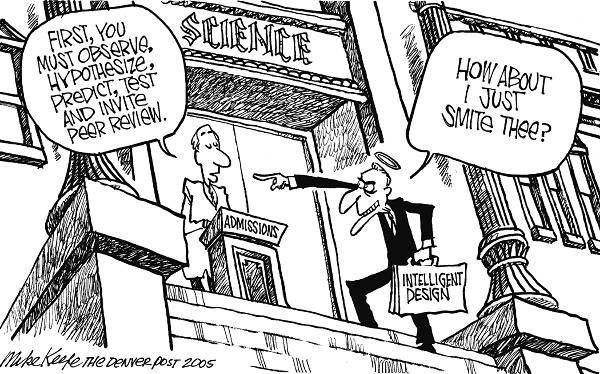
Hafer is a professor at Curry College who has done two horrible things: she helped draft a bill for the Massachusetts legislature that would require some rigor in what can be taught in public schools — specifically excluding the use of non-scientific materials for instruction in the classroom — and she has written about the lack of rigor in the Discovery Institute’s propaganda. Uh-oh. That’s a one-two punch that hits the DI right in the gut, so they’ve tried to counter it, ineffectively.

First, they tried to defend their strengths and weaknesses tactic, and claim that the Massachusetts bill weakened academic freedom.

As I’ve noted previously, academic freedom laws are very limited in their scope. They do not authorize bringing in material on intelligent design, nor make teachers teach anything differently. They simply provide freedom for teachers and students to analyze the strengths and weaknesses of controversial scientific issues in the curriculum in an objective fashion. They protect teachers and students who want to engage in scientific inquiry, which means examining evidence critically. If science is defined as investigating nature objectively, then they represent the opposite of “science denial.”

Note the bit I highlighted. There is nothing in the bill against the use of evidence, or critical thinking. To the contrary, it requires that ideas be supported by good fact-based, scientific evidence. The DI claims to support that. The problem is that no one considers the religion-based speculations of Intelligent Design creationism to be either fact-based or scientific.

So what does the Discovery Institute do? They decided to attack the author. They explicitly claimed that Hafer is not a biologist, nor a biology teacher in an article initially titled When non-biologists speak to biology teachers, which is easily discredited by simply looking up her credentials. How lazy are the hacks at the DI? They apparently just assumed that only a non-biologist would ever cooperate with their state legislators, and barreled in, guns blazing. It’s revealing that they’d do so little investigating, a quick googling would have revealed the facts, and further, they’re complaining about an article she published in — get ready for it — The American Biology Teacher, which right there on the front page lists her affiliations: “Dr. Abby Hafer is a Professor at Curry College”. Remarkable. That’s how bad the DI’s “research” is.

Furthermore, all the DI does is fund-raising, lobbying, and the production of propaganda, and they want to complain about an imaginary “non-biologist” trying to dictate to biology teachers? They keep killing irony.

When it was pointed out that their leading claims were trivially false, they hastily changed the title and edited the text to obliterate their stupidities. It is now titled When Biologists Speak to Biology Teachers, Cont.. It’s written by Sarah Chaffee, who is the Program Officer in Education and Public Policy at Discovery Institute, not a biologist. It’s revised to follow an article titled When Biologists Speak to Biology Teachers, no Cont., written by David Klinghoffer, who is also not a biologist. It’s kind of obvious that their preference is to have only non-biologists tell teachers what to do, except when the imaginary non-biologist disagrees with them.

What they’re doing in this edited article is complaining about an article Hafer wrote, titled “No Data Required: Why Intelligent Design Is Not Science”. It’s a straight-forward bit of analysis. She asks a simple question, do the papers promoted by the DI include data and reference evidence, or do they cobble together arguments without presenting supporting data? Here’s the abstract.

Intelligent Design (ID) proposes that biological species were created by an intelligent Designer, and not by evolution. ID’s proponents insist that it is as valid a theory of how biological organisms and species came into existence as evolution by natural selection. They insist, therefore, that ID be taught as science in public schools. These claims were defeated in the Kitzmiller case. However, ID’s proponents are still influential and cannot be considered a spent force. The question addressed here is whether ID’s claim of scientific legitimacy is reinforced by quantified results. That is, do they have any data, or do they just argue? The ID articles that I analyzed claimed to present real science, but they rarely referred to data and never tested a hypothesis. Argumentation, however, was frequent. By contrast, peer-reviewed articles by evolutionary biologists rarely argued but referred frequently to data. The results were statistically significant. These findings negate claims by ID proponents that their articles report rigorous scientific research. Teachers will find this article helpful in defending evolution, distinguishing science from non-science, and discussing the weaknesses of ID.

She contrasted the DI’s “work” with peer-reviewed papers published by real scientists. The DI fails on this simple criterion — they don’t talk about the evidence. They’d rather just say there is doubt and debate, instead of backing up their claims.

Now for the hilarious part: that awkwardly revised DI article simply asserts that Hafer’s claims are wrong, and then to show that she’s got it all wrong, it doesn’t show contrary data — it just says that some scientists question neo-Darwinism! We don’t need no data, all we have to say is that there is a debate.

We know that a significant number of scientists worldwide, such as those who attended the 2016 Royal Society meeting on evolution, question the sufficiency of neo-Darwinism in accounting for biology complexity. Yet don’t tell the biology teachers that! Because they might tell their students, and then, Katie, bar the door!

They also clumsily try to apply Hafer’s methods to a classic peer-reviewed paper in science.

Hafer’s method sounds scientific, maybe. But to see how absurd it is, perform the same analysis on the 1953 article by Watson and Crick describing the structure of DNA. Is the seriousness of this work somehow to be gauged by observing that they use the “argu” root once and “data” three times? No, what matters is what the article actually says.

Except the entirety of the Watson-Crick paper is about presenting their evidence for the structure of DNA, and the DI’s analysis actually supports Hafer’s point, that the words used focus attention on the data, not the arguments, and that their result is entirely congruent with Hafer’s analysis. Just to hammer it home, I had to look up the paper to see how they’re using the word “argument”.

The previously published X-ray data on deoxyribose nucleic acid are insufficient for a rigorous test of our structure. So far as we can tell, it is roughly compatible with the experimental data, but it must be regarded as unproved until it has been checked against more exact results. Some of these are given in the following communications. We were not aware of the details of the results presented there when we devised our structure, which rests mainly though not entirely on published experimental data and stereochemical arguments.

Data, results, results, data, stereochemical arguments. Does the Discovery Institute even realize that in this usage “arguments” is being used to refer to stereochemical structures as evidence for their model of DNA?

Everyone at the Discovery Institute is either a fool or a fraud or both.

Shinya Inoué has died

Another great scientist is gone. Inoué wrote my Bible that I relied on greatly in the 80s and 90s, Video Microscopy: The Fundamentals (which now costs $129? Wow), a very thorough overview of television and closed-circuit TV, as well as microscope optics. It’s now rather dated — it’s quaint to imagine there was a time we relied on RS-170 and NTSC to do video microscopy, and the extensive discussion of tape formats and antique gadgetry isn’t of much use any more, unless you’re planning to pick up an OMDR on eBay. Once upon a time, though, it was an indispensable guide to the thicket of rapidly emerging imaging technologies.

I never met Inoué, but I’d also heard he was a great teacher, and I can believe it. The book is dense but extremely well written and thorough. I’ve still got my copy in an honored position on my bookshelf, even if I probably haven’t cracked it open in 10 or 20 years. But in its time…I even taught a course a couple of times that was built around it as a reference text. It would still be useful if I were splicing together antique devices now and then for use in the lab.

#Arachtober: The #Spider Swarm!

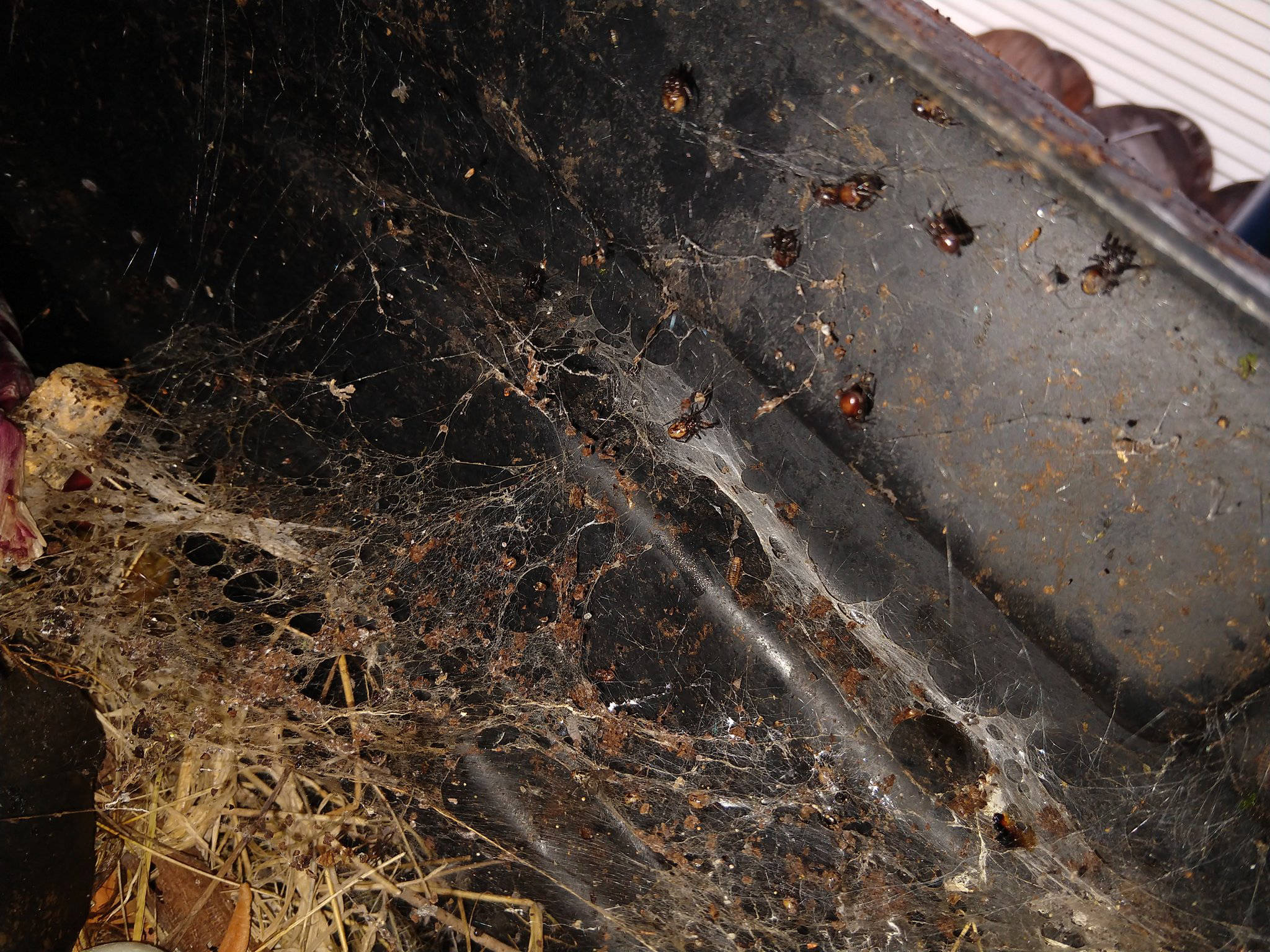
My colleague, Chris Atkinson, told me yesterday that he’d been seeing a lot of spiders in his compost heap. “Interesting,” I thought. Then he sent me this photo:

WHOA. Look at all those spiders.

So I stopped by this morning (how could I not?), and the photo doesn’t do it justice. It is spider paradise. It’s a spider commune. There are all kinds of bugs living in the compost, and all over above them is a dense communal spider web, packed with spiders. I’d suspected it from the first picture, but I stuck my face down there and confirmed it — Steatoda borealis, the Northern Combfoot, which I’ve occasionally found while prowling about town, but this was the Mother Lode. I got a few closeups of one of their number in their web.

[Read more…]

What “heritability” actually means

I often get brought up short when someone tells me that intelligence, for instance, is 80% determined by your genetics. I’m held up because that someone clearly doesn’t understand the magic word “heritability”, which every geneticist understands but every layman seems to consciously misunderstand, preferring to play games with folk etymology than actually understand the math, or the concept. So here’s a nice video that explains the background clearly, and as a bonus, show that Sam Harris doesn’t know diddly squat about the science behind the racism he endorses.

The pig pandemic is here

Don’t we have enough bad news? There’s always something slipping its way into our nightmares, and this one is the African Swine Fever sweeping across Asia.

It is being described as the biggest animal disease outbreak the world has ever seen. Its impacts are already profound in Asia and beyond, with increased export demand certain to support pork prices for the foreseeable future. There will be longer-term implications of Asia’s African swine fever (ASF) outbreak, too, concerning the production and consumption of pork, some of which are already becoming apparent.

Nice to know pork prices will be propped up by the ongoing devastation. But read the rest: a quarter of the world’s pig population faces imminent death. And it’s spreading!

Official figures from China show the national pig herd had declined by 32% year-on-year by July, with an estimated 100 million pigs lost already. While some of the losses will be directly or indirectly linked to the disease itself, the reduction is also being heavily driven by vast numbers of producers choosing to slaughter their herds and get out of pigs before the virus gets to them.

Rabobank is forecasting that, by the end of the year, China’s pig herd will have halved. Given that it numbered 700 million and accounted for half the world’s pigs before ASF struck in August 2018, the damage the virus is causing is plain for all to see.

And that is just China. ASF is continuing to spread across Asia at a worrying rate, confirmed in September for the first time in South Korea, where six cases were confirmed within two weeks, and the Philippines, where 12 cases were recorded in one area in a short time.

In Vietnam, infected soon after China, the virus has reached all 63 provinces and around 5 million pigs have been killed. Rabobank forecasts a 15-20% reduction in pork production in Vietnam this year.

An industry comprising millions of, often remote, ‘backyard’ farmers, with little concept of biosecurity was always going to be easy prey for a virus that can travel and survive in tiny quantities for a long time on animals, people, clothes, vehicles and equipment. It also became clear at an early stage that the virus had become embedded in the pig feed chain and was being spread via swill feeding. It is also in the human pork supply chain, helping its spread around the continent.

It hasn’t yet affected the American midwest (Hello, Iowa! I hear you’re a major pork producer?) or Europe, but oh boy, imagine the chaos if it did. I hope our understanding of biosecurity is more robust than that of Chinese farmers, but I have my suspicions that no, our local swine farms are not at all constrained by science. Capitalism, baby!

Worse than Lovecraft: What if the Old Ones were real, but they’re all extinct?

Fantasio

One of my commonly made arguments against the likelihood of finding extraterrestrial intelligence is that it seems to be remarkably rare on our planet — I’m not making a joke about Republicans (although I could), but am stating a fact, that in the half-billion year history of animal life on Earth, only one species has followed the evolutionary strategy of extreme reliance on technology, ours. It doesn’t seem to be a common way for complex multi-cellular organisms to succeed, so we should expect that even if that kind of life is common on other worlds, it’s not likely to produce organisms we can talk to.

But what if I’m wrong? What if intelligent life had arisen on Earth multiple times? Would we be able to recognize it in the geological record?

Forget about the SF tropes of finding the equivalent of the Statue of Liberty on a beach somewhere, or digging up a transistor radio. All the monuments and all the toys we’ve built would be crumbled away and ground into dust in a million years or so. But what about chemical traces? We’ve been pumping out all kinds of novel chemistry, maybe some bits of it would leave a signature behind for our successors to discover.

That’s the question asked in this article by Schmidt and Frank. What should we look for?

If an industrial civilization had existed on Earth many millions of years prior to our own era, what traces would it have left and would they be detectable today? We summarize the likely geological fingerprint of the Anthropocene, and demonstrate that while clear, it will not differ greatly in many respects from other known events in the geological record. We then propose tests that could plausibly distinguish an industrial cause from an otherwise naturally occurring climate event.

Like they say, there’s a fair amount of uncertainty — on a geological scale, we don’t know how long industrial byproducts will linger. Stuff like plastics and halogenated organics might persist for a long time, in the right environment, such as after being buried and sequestered. Maybe we should look in ancient sediments for compounds that are likely to have been produced by a technological society.

In a real twist, the authors also wrote a science fiction story about such a search. What if we found PCBs and transuranic elements in a deep stratum, and what if it was also associated with an abrupt change in climate or the biota of the time? How would scientists interpret that?

What I found most chilling, though, was the long list of unexplained, abrupt climate shifts they describe in the geological record. Worst case scenario: what if they were all caused by the appearance of species that achieved some kind of global dominance (not necessarily technological) that led to a brief period of self-defeating triumph that always led to their inevitable extinction?

I think I just gave myself nightmares. What if we launched a SATI (Search for Ancient Terrestrial Intelligence) program, found multiple instances, and learned that our peculiar niche is more common than we thought, and always leads to our decline and disappearance? Would that knowledge allow us to change, do better, and escape our doom, or would it tell us that any attempt would be futile?

Worse than finding Cthulhu would be finding it’s traces, and learning that it was long dead, it’s annihilation pre-ordained by its nature, as we will be.


Schmidt GA, Frank A (2019) The Silurian hypothesis: would it be possible to detect an industrial civilization in the geological record? International Journal of Astrobiology 18(2): 142-150.

Jenny appears!

Usually, Jenny By-The-Front-Door is huddled up inside her nest, and at best I see a waving leg or three. Tonight, though, she made a rare appearance. Isn’t she beautiful?

I really want to dig into the intricate pigment patterns on Parasteatoda abdomens.

Evolutionary Psychology, the favorite discipline of old white men everywhere

Matt Lubchansky

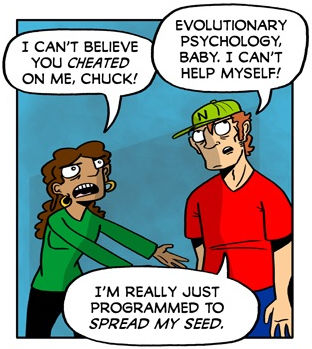
Well, some old white men, anyway. Jeffrey Epstein loved evolutionary psychology because it was used to justify rapey behavior and abuse of women — it’s good for the species, don’t you know, rich abusers wouldn’t exist if they didn’t have an adaptive advantage. So Epstein threw money at helpful apologists like Robert Trivers and Martin Nowak (boy, did he throw a lot of money at him), and they obliged by rationalizing the worst activities of men. Meanwhile, other hangers-on who did not even like, let alone get paid by him, were still well-pleased by the chauvinism of EP, and heaped praise upon it without even requiring any quid pro quo. I don’t know which is worse.

Pinker is a talented popularizer of science and authored several books on language which were generally well received. He has attracted controversy, however, for engaging with popular debates on evolutionary psychology’s more sweeping claims in the 1990s. His 2002 book The Blank Slate is a sustained attack on those academics, intellectuals, and feminists who weight nurture more heavily than nature in the development of human behavior. While defending the book A Natural History of Rape, whose authors Craig Palmer and Randy Thornhill (a Trivers coauthor on the Jamaican symmetry work) helpfully advise women to wear modest clothing to prevent assaults, Pinker describes typical rapists as “losers and nobodies,” “outcasts,” or perhaps “ethnic rioters.” The billionaire science enthusiast is not included in Pinker’s rapist typology.

Heh, yeah — The Blank Slate is the terrible piece of crap that totally soured me on Pinker. It’s a dishonest polemic contrived to advance a dead perspective by pretending it was obviously true while taking malicious swipes at everyone who had a more nuanced, sophisticated view of the interplay between genes and behavior. I am not surprised that he became a proponent of evolutionary psychology, which was just more of the same old ignorant adaptationist garbage. When I compare the careers of two Harvard professors, Gould and Pinker, one of whom wrote two great books, The Mismeasure of Man and Ontogeny and Phylogeny, and a multitude of essays revealing his fundamental humanism, and the other of whom is a darling of modern racists and rapists, I have to think that the wrong one died early.

There is one thing to do now.

Epstein is dead, and now beyond the reaches of human justice, but it is still possible to hold his enablers and scientific sycophants to account. It is necessary, but not enough, to demand that individuals like Trivers and Nowak and institutions like Harvard and MIT return the millions they received from Epstein. The ideas produced by these scientists also matter. Evolutionary psychologists have naturalized, and even at times excused, male sexual violence, but evolutionary biology is not the sole province of reactionary white men. Those of us working in this field must push back on both the corrupt funding system at elite institutions and flawed ideas these institutions have produced.

If your beliefs require propping up with large amounts of cash from self-serving rich people, then maybe they deserve to be starved for a while. It should cost you credibility to be a recipient of donations from evil men: give the money back, let’s see if your ideas can stand on their own without the support of corrupt processes.